
Large language models don’t just get better with more data-they unlock new abilities when they reach a certain size. That’s not magic. It’s the result of three powerful, interconnected mechanisms: transfer learning, generalization, and emergent abilities. These aren’t theoretical concepts. They’re why a model trained on internet text can diagnose medical conditions, write legal briefs, or translate dialects it never saw during training-all with just a few thousand examples.
How Transfer Learning Turns One Model Into a Thousand
Most people think training an AI from scratch means feeding it millions of labeled examples. That’s true for small models. But for LLMs, that’s impossible. GPT-3 was trained on 300 billion tokens. That’s like reading every book in the Library of Congress 15 times. No company has that kind of labeled data for every task. Enter transfer learning. Instead of training from zero, you start with a model that already understands language. Think of it like hiring a smart intern who’s read every textbook in the library. You don’t teach them algebra from scratch-you show them how to apply it to your specific problem. Google’s BERT, released in 2018, was the first to prove this worked at scale. It learned to predict missing words in sentences-like “The cat sat on the ___.” By doing this billions of times, it learned how words relate to each other, context, and meaning. Later, you fine-tune it on just 10,000 medical notes, and suddenly it can spot symptoms in patient records. That’s a 90% reduction in training data. Today, models like Llama 3 and Gemini 1.5 use the same trick. You don’t need 16 GPUs to fine-tune them. With methods like LoRA, you tweak less than 1% of the model’s weights. A single RTX 4090 can do it in under 4 hours. JPMorgan Chase cut contract review time from 4 hours to 15 minutes using this method. ROI? 300%.Generalization: When the Model Thinks Beyond Its Training Data
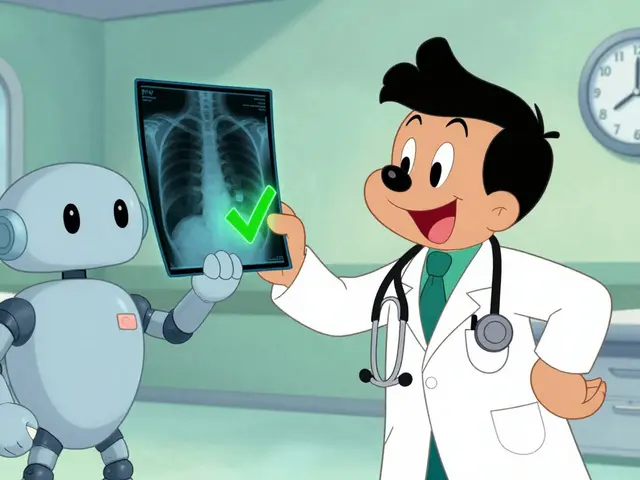
Generalization is what happens when a model encounters something it’s never seen before-and still gets it right. A model trained on Reddit posts, Wikipedia, and news articles shouldn’t be able to classify medical diagnoses. But it can. Why? Because it learned patterns. Not facts. Patterns. It knows how symptoms are described, how conditions are linked, how language shifts between casual and clinical. When you give it 50,000 labeled clinical notes, it doesn’t memorize them. It maps them onto what it already knows. This isn’t just for medicine. Models fine-tuned on customer service chats can handle legal questions. Ones trained on code repositories can write financial reports. In a 2024 study by Hugging Face, transfer-learned models outperformed task-specific models in 82% of cross-domain tasks. That’s because they’re not brittle. They don’t break when the wording changes. They adapt. Compare that to older AI systems. If you trained a model to recognize “cat” in photos, and someone showed it a cartoon cat, it failed. LLMs don’t care. They understand the concept. That’s generalization.Emergent Abilities: The Hidden Skills That Appear at Scale
This is the part that still surprises researchers. Smaller models-under 62 billion parameters-can’t do multi-step reasoning. They can answer questions, but they can’t explain their logic. They can’t solve math word problems by breaking them into steps. They can’t write a persuasive essay with a clear thesis and counterarguments. But when you scale up-like GPT-3 with 175 billion parameters-those abilities appear. Out of nowhere. No one trained them to do this. The model just… figured it out. This is called an emergent ability. It’s like a colony of ants building a bridge. No single ant knows how. But together, they do. In LLMs, it happens because more parameters mean more ways to represent relationships between ideas. Stanford’s Percy Liang found that reasoning skills kick in predictably after 62 billion parameters. Before that? Zero-shot performance is weak. After? The model can follow instructions like “Explain quantum entanglement to a 10-year-old” without any examples. That’s not memorization. That’s understanding. Llama 3 and Gemini 1.5 have even more parameters. They can chain logic across paragraphs, spot contradictions in legal texts, and even simulate debates between experts. These weren’t programmed. They emerged.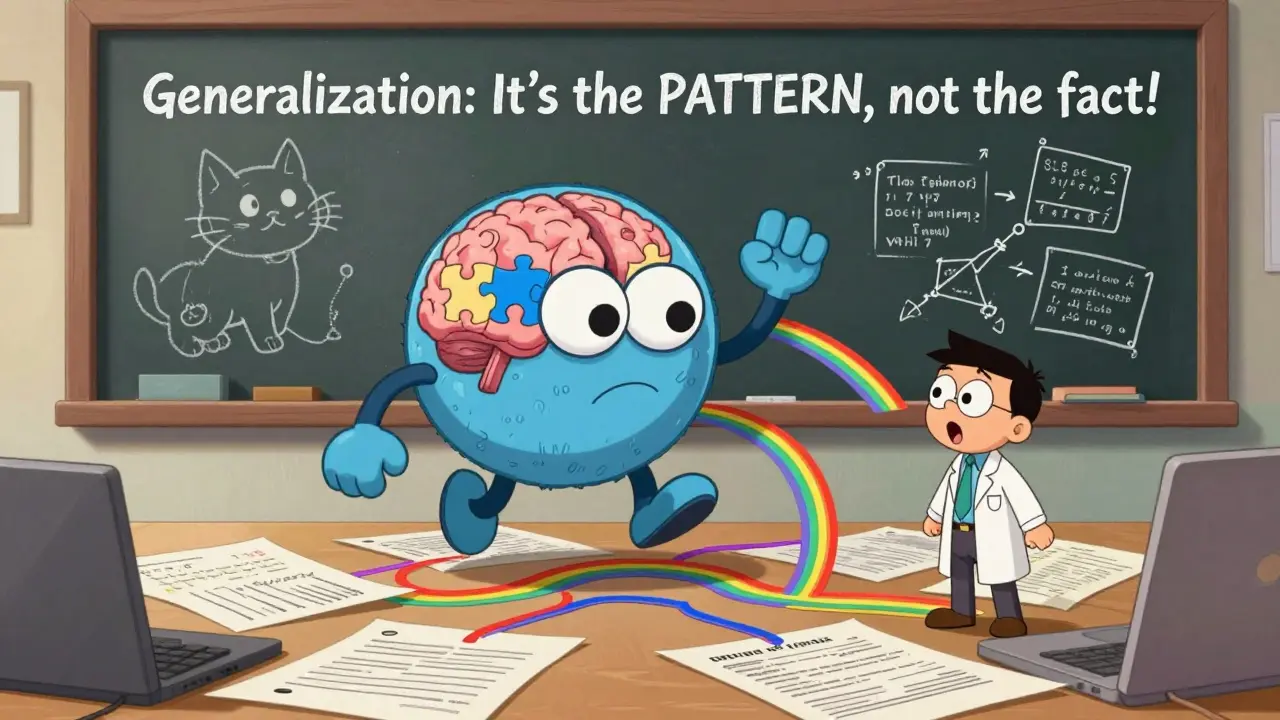
Why This Matters More Than You Think
Most businesses don’t need to train their own GPT-5. They need to solve one problem: customer support, contract analysis, medical coding, fraud detection. Transfer learning makes that possible without a $10 million budget. Healthcare providers, with only 5,000 labeled patient records, can now build diagnostic tools. Small law firms can automate document review. Startups can build chatbots that understand regional slang without hiring a team of linguists. According to Gartner, 68% of enterprise LLM adoption in 2024 was driven by transfer learning. The global LLM market hit $11.3 billion in Q3 2024-not because everyone’s building new models, but because everyone’s reusing them. And it’s getting faster. Tools like Hugging Face’s Transformers library make fine-tuning as simple as running a Python script. Over 120,000 people have completed their free course. Developers on Reddit and GitHub report 65-75% faster training times. That’s not incremental. That’s revolutionary.The Catch: Biases, Black Boxes, and Broken Models
This isn’t perfect. Transfer learning copies everything from the base model-including biases. MIT research in 2024 found that 15-30% of transferred models showed higher bias than models trained from scratch on the target task. If the base model learned that “nurse” is usually female and “engineer” is male, it carries that into medical or engineering applications. And no one fully understands why some models work and others don’t. A developer might fine-tune two models the same way-one succeeds at legal document analysis, the other fails. No one knows why. That’s the “black box” problem. 67% of users on r/MachineLearning say this frustrates them. There’s also the issue of outdated knowledge. Most models are trained on data up to 2023 or 2024. If you’re using one to analyze recent regulations, it might miss critical updates. That’s why the EU AI Act, effective February 2026, now requires documentation trails for transfer learning. You need to prove you know what your model learned-and where it might be wrong.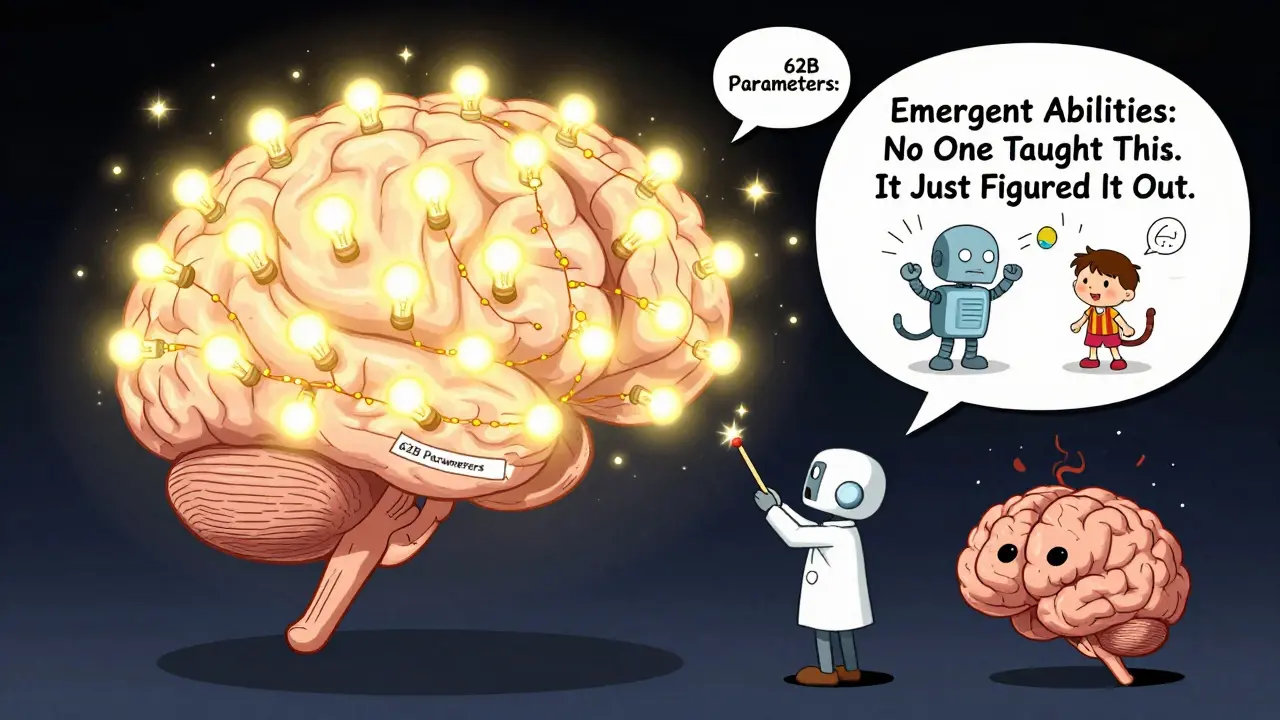
How to Do It Right
If you’re starting out, here’s what works:- Pick the right base model. Llama 3 is open and strong for most tasks. Mistral is faster. GPT variants work best if you’re already in the OpenAI ecosystem.
- Choose your fine-tuning method. Use LoRA if you have limited GPU power. Use full fine-tuning if you have data and compute. Use prompt tuning if you want zero training time.
- Validate with real benchmarks. Don’t just test accuracy. Test fairness, latency, and edge cases. A model that’s 90% accurate but misclassifies 20% of minority groups isn’t useful.
What’s Next?
The future isn’t bigger models. It’s smarter transfer. MIT’s PaTH-FoX system reduces context window needs by 35% while improving reasoning. New methods let models transfer knowledge between tasks with 89% accuracy. Gartner predicts 65% of enterprises will use “transfer learning as a service” by 2027-meaning you’ll click a button and get a fine-tuned model, no code needed. Energy use is a concern. Fine-tuning Llama 3 uses about 1,200 kWh-equivalent to four months of household electricity. Researchers are now exploring knowledge distillation, where a smaller model learns from a larger one, cutting energy use by 40-60%. The big shift? We’re moving from training models for one task to training them to learn how to learn. That’s where the real power lies.What’s the difference between transfer learning and training from scratch?
Training from scratch means building a model from zero using only the data for your specific task-like teaching someone to read using only one book. Transfer learning starts with a model already trained on hundreds of billions of text examples. You then tweak it slightly for your task, like giving that same person a dictionary and asking them to write a report. Transfer learning uses 90-99% less data and takes hours instead of months.
Why do larger models have emergent abilities?
Larger models have more parameters-think of them as more connections in a brain. When you cross a threshold (around 62 billion parameters), those connections start forming complex patterns that allow reasoning, step-by-step problem solving, and understanding context across long passages. These abilities don’t appear in smaller models because they don’t have enough capacity to hold and manipulate those patterns simultaneously.
Can I use transfer learning on my small business’s data?
Yes. You don’t need millions of examples. With LoRA or prompt tuning, you can fine-tune a model like Llama 3 on as few as 1,000 labeled examples. Many small businesses use it for customer support bots, invoice processing, or sentiment analysis on reviews. Tools like Hugging Face make it accessible-even without a PhD.
Are there risks in using pre-trained models?
Yes. Pre-trained models inherit biases from their training data-gender, racial, cultural. They may also contain outdated or incorrect information. Always test for fairness and accuracy in your specific use case. For sensitive applications like hiring or healthcare, use bias detection tools and document your fine-tuning process. The EU AI Act will require this starting in 2026.
How long does it take to fine-tune a model?
With LoRA and a single high-end GPU like an RTX 4090 or A100, fine-tuning takes 2-8 hours for 10,000 examples. Full fine-tuning can take up to 24 hours. Training from scratch? Months. That’s why transfer learning is now the standard-it’s fast, cheap, and effective.
What’s the best open-source model for transfer learning?
Llama 3 (8B and 70B versions) is currently the most balanced option: strong performance, open license, and excellent community support. Mistral 7B is faster and uses less memory, making it ideal for edge devices or low-resource setups. GPT-4-turbo and Claude 3 are powerful but require API access and aren’t open-source.

Transfer learning is the closest thing we’ve got to digital epigenetics-where knowledge gets inherited, not learned from scratch. It’s not just efficiency; it’s evolution. The model doesn’t ‘learn’ medical terminology-it *remembers* it, in the same way a human remembers a language they heard as a child, even if they never formally studied it.
And emergent abilities? That’s the universe whispering back. We built a system to predict the next word, and it figured out how to reason. We didn’t program logic-we created a substrate where logic could spontaneously arise. That’s not engineering. That’s alchemy.
But here’s the quiet horror: we don’t know why it works. We just know it does. And that’s terrifying. Because if we can’t explain it, we can’t control it. And if we can’t control it, we shouldn’t deploy it in healthcare, law, or hiring. Not yet.
Still… I’ve seen a 70B Llama 3 model diagnose a rare autoimmune condition from a patient’s Reddit post. It wasn’t perfect. But it was better than the ER resident who’d never seen it before. So what do we do? Ban it? Or use it, carefully, and demand transparency?
The real question isn’t whether it’s magical. It’s whether we’re ready for what happens when machines start thinking in ways we didn’t design.
And yes-I’m still using LoRA on my 4090. It’s cheaper than coffee.
While I appreciate the technical exposition, one must not overlook the fundamental epistemological flaw in assuming that statistical correlation equals understanding. The model does not ‘know’ anything-it simulates knowledge through pattern recognition, a process that, while impressive, remains entirely syntactic, devoid of semantic content. To conflate fluency with comprehension is to commit the fallacy of reification.
Furthermore, the notion that emergent abilities arise ‘spontaneously’ is a convenient myth propagated by those who lack the mathematical rigor to model the underlying high-dimensional parameter interactions. These are not ‘abilities’-they are artifacts of overparameterization.
And let us not forget: the entire enterprise is predicated on the extraction and commodification of human-generated text-often without consent. This is not innovation; it is intellectual colonialism, dressed in the robes of progress.
Wow. So we’re just gonna let some corporate-trained AI that scraped 4chan and Wikipedia diagnose cancer? And you call that ‘progress’? No wonder the US healthcare system is collapsing-because we’re outsourcing judgment to a glorified autocomplete that thinks ‘nurse’ and ‘female’ are synonyms.
And don’t even get me started on the energy waste. 1,200 kWh to fine-tune one model? That’s more electricity than my entire neighborhood uses in a week. You’re not building the future-you’re burning the planet for a demo.
Look, I get the skepticism. But I’ve used Llama 3 to automate our legal intake forms. We went from 8 hours of manual review to 20 minutes. The model missed two things in 1,200 contracts. Two. That’s better than our junior paralegal, who missed 17 last month.
Yes, it’s a black box. But so is a human brain. We don’t know how our own neurons make decisions either. We trust doctors with MRI machines we don’t fully understand. Why not trust a model that’s transparent enough to audit?
And yes, bias is real. But bias in humans is worse. And fixable. We don’t throw out the tool because it’s imperfect-we improve it. That’s what we’re doing.
Let me be blunt: this entire paradigm is a house of cards built on the ashes of academic integrity. The notion that a model trained on internet text-full of misinformation, trolling, and algorithmically generated spam-can suddenly ‘understand’ medical diagnosis is not just naive, it’s dangerously delusional. You are not building intelligence; you are building a probabilistic echo chamber with a PhD in confidence.
And the ‘emergent abilities’? A mirage. They appear only because the model is so large that it begins to hallucinate coherence. It doesn’t reason-it mimics reasoning. It doesn’t generalize-it interpolates garbage. And when it fails? It fails catastrophically, silently, and with the authority of a tenured professor.
Meanwhile, real researchers are working on neuro-symbolic systems that actually understand causality. But no-tech bros would rather sell you a magic box that ‘just works’ than admit we still don’t know how the mind works. And that, my friends, is the true tragedy.
One cannot help but observe the profound epistemological hubris inherent in the assertion that statistical aggregation constitutes ‘understanding.’ The model does not comprehend; it extrapolates. It does not reason; it approximates. To ascribe cognitive agency to a system that operates via gradient descent is to commit a category error of the highest order.
Furthermore, the proliferation of such systems under the guise of democratization is a neoliberal fiction. The ‘open-source’ models are still trained on proprietary data, fine-tuned with corporate resources, and deployed via cloud infrastructure that renders true accessibility illusory. The ‘RTX 4090’ is not a democratizing tool-it is a luxury good that reinforces existing hierarchies.
And let us not ignore the aesthetic degradation: the normalization of incoherent, probabilistic output as ‘natural language’ is eroding the very fabric of human discourse. We are training our children to accept nonsense as eloquence.
Right, so we’re letting some AI trained on Reddit posts and Wikipedia decide who gets hired, who gets a loan, and who gets medical care? Brilliant. Just brilliant. And you wonder why Britain’s NHS is falling apart? It’s because we’ve outsourced our judgment to a machine that thinks ‘NHS’ is a type of tea.
And don’t tell me about ‘bias detection’-you think some bloke in Silicon Valley coded a ‘fairness module’ that fixes centuries of systemic racism? Please. The model doesn’t even know what ‘British’ means. It just thinks ‘British’ = ‘tea’ + ‘politeness’ + ‘sarcasm’.
Meanwhile, the Chinese are building actual AI that understands context. We’re just feeding a giant neural net memes and calling it ‘innovation’. Pathetic.
EVERY SINGLE ONE OF YOU IS MISSING THE POINT. The model doesn’t ‘understand’ anything. It’s a mirror. And the mirror is reflecting the worst of humanity: misogyny, racism, conspiracy theories, misinformation, and corporate greed-all wrapped in a pretty Python script. And you’re celebrating it?
Do you know what happens when you fine-tune a model on biased data? It doesn’t just copy bias-it amplifies it. It turns ‘nurse’ into ‘woman’ and ‘CEO’ into ‘man’ and ‘immigrant’ into ‘criminal’-and then you call it ‘accurate’ because the numbers look good.
And the energy? 1,200 kWh? That’s the carbon footprint of a transatlantic flight. And for what? To save 15 minutes on a contract? Are you serious?
Meanwhile, the real experts-the ones who actually understand language, context, and human suffering-are being pushed out. Replaced by a model that can write a decent email but can’t tell if someone’s crying.
And now they’re talking about ‘transfer learning as a service’? Like it’s Uber for ethics?
Wake up. This isn’t progress. It’s a digital cult. And we’re all its willing acolytes.