
Companies are spending millions on large language models (LLMs), but too many don’t know if they’re getting their money back. It’s not enough to say, "Our chatbot is cool" or "Employees love the new search tool." If you can’t tie the LLM to real business outcomes, you’re gambling-not investing. The truth? LLM ROI isn’t about how smart the model is. It’s about how much time, money, and frustration it saves your team.
What LLM ROI Actually Means
ROI for LLMs isn’t the same as ROI for a new CRM or a marketing campaign. You can’t just compare upfront costs to sales increases. LLMs work behind the scenes-cutting down search time, reducing repetitive questions, helping analysts spot patterns faster. Their value shows up in hours saved, decisions made quicker, and employees spending less time digging through documents. A European company with 50 data users and a 5-person support team saw a 93% ROI in the first year. How? Before the LLM, specialists spent 25 minutes per query answering the same questions over and over. After switching to a conversational AI tool, that dropped to under 2 minutes. That’s 23 minutes saved per question. Multiply that by 100 questions a week, 50 weeks a year, and you’re talking 1,150 hours saved annually. At €50/hour, that’s €57,500 in labor savings. The LLM’s annual token cost? Just €50. That’s not magic. That’s math.Metrics That Actually Matter
Forget vanity metrics like "number of queries answered." Real ROI comes from tracking what changes in behavior and cost. Here are the only metrics you need to measure:- Search Success Rate: What percentage of user queries return the right answer on the first try? Before LLMs, many teams saw 45-60%. After implementation, top performers hit 80-90%. If your number didn’t jump, the model isn’t helping.
- Time Saved Per Search: Time is money. Track how long it took users to find answers before and after. A 5-7 minute reduction per search adds up fast. One tech firm reported 32 hours saved weekly across 50 employees. That’s 1,664 hours a year-almost a full-time employee’s workload.
- User Adoption Rate: If only 20% of staff use the tool, your ROI is broken. Aim for 70%+ active usage within 90 days. If people aren’t using it, either it’s too hard to use, or it’s not giving them what they need.
- Hallucination Rate: LLMs make things up. A 5% hallucination rate might sound low, but if your finance team relies on it for budget forecasts, even 1 in 20 wrong answers can cost you. Track how often the model generates false or misleading info. Tools like Confident AI help measure this automatically.
- Tool Correctness: If your LLM uses external tools (databases, APIs, calculators), how often does it call the right one? A model might answer well, but if it pulls data from the wrong system, it’s useless. Track this as a percentage of correct tool calls.
- Cost Per Query vs. Human Cost: Compare the cost of running the LLM (tokens) to what it replaces. IBM found token costs are often 1/100th of human labor. In the Bluesoft case, €50 in tokens replaced €57,500 in labor. That’s the ROI.
Don’t Ignore the Soft Metrics
Money isn’t the only thing that moves. Employee satisfaction, decision speed, and reduced burnout matter too. A data team at a Fortune 500 company reported a 70% drop in repetitive questions after deploying an LLM. That didn’t show up in their finance report-but it changed their culture. Specialists stopped being human Google and started doing analysis, strategy, and innovation. One CIO in Portland told me, "We used to have five people answering the same 10 questions every day. Now they’re building predictive models. That’s not cost savings. That’s career growth." These aren’t fluffy feelings. They’re measurable. Survey users quarterly. Ask: "How much time did you save this week?" "Did you make a better decision because of this tool?" "Would you go back to the old way?" Use those answers to justify continued funding.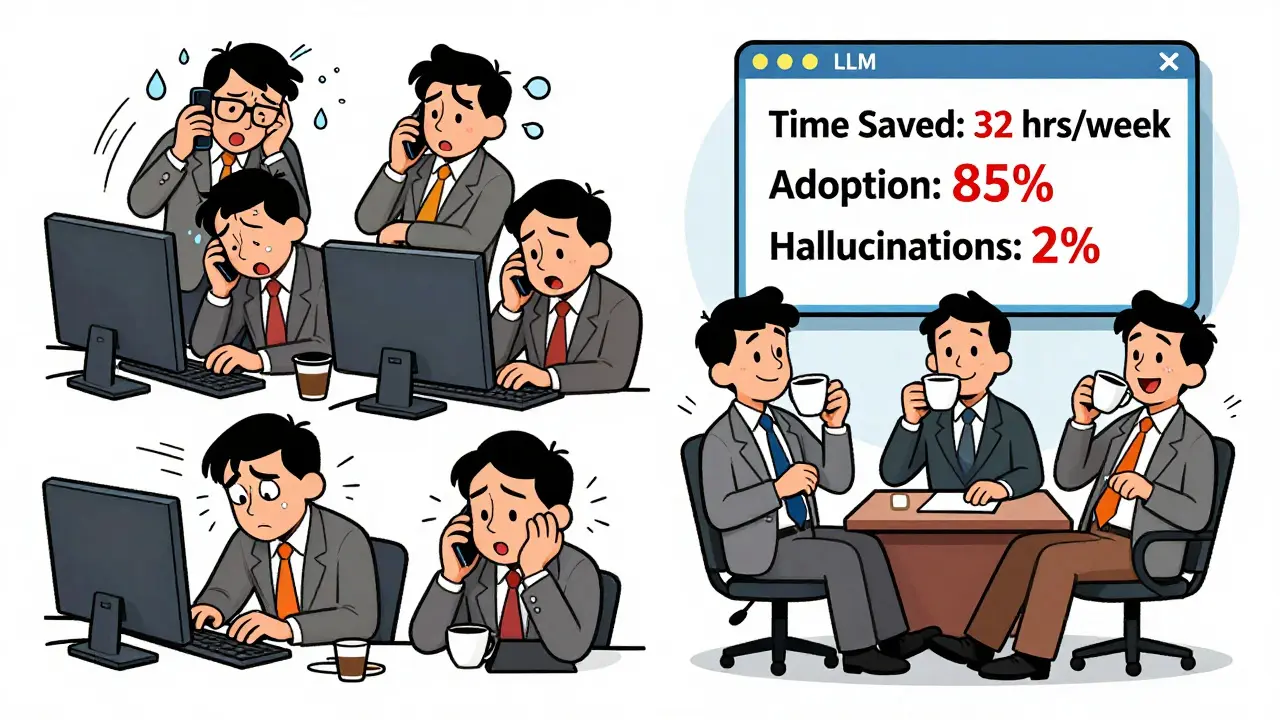
Where ROI Falls Apart
Not every LLM project delivers. Gartner found 42% of companies took 3-6 months just to integrate the tool into daily workflows. Why? They skipped the basics.- No baseline: If you don’t measure how long things took before, you can’t prove improvement. One manufacturing company measured ROI by counting fewer support tickets-but ignored that employees were now spending 3 extra hours a day manually verifying LLM answers. Their ROI? 15%. They didn’t measure the hidden cost.
- Wrong use case: LLMs aren’t for every task. Trying to use them for legal contract reviews without human oversight? High risk. High cost. Low ROI. Stick to high-volume, repetitive, information-heavy tasks: customer service FAQs, internal knowledge lookup, report summarization, data exploration.
- Poor data quality: IBM found 68% of failures came from bad or messy data. An LLM can’t give good answers if the source data is outdated, incomplete, or inconsistent. Clean your data before you deploy.
- Ignoring context: Traditional metrics like BLEU or ROUGE (used in older AI models) don’t work for LLMs. They measure word overlap, not meaning. A response can be grammatically perfect and completely wrong. You need human judgment and tools that score for relevance, accuracy, and usefulness.
Real-World ROI Examples
- Healthcare: A hospital used an LLM to help radiologists summarize patient histories. They cut report prep time from 45 minutes to 12 minutes per case. ROI: 451% over five years. When they added time saved for doctors reviewing cases, it jumped to 791%. - Finance: A bank deployed an LLM to answer compliance questions from analysts. Before: 15 minutes per query, 500 queries/month. After: 2 minutes, 85% success rate. Saved 650 hours/month. Annual labor cost avoided: $390,000. LLM cost: $12,000/year. ROI: 3,150%. - Technology: A SaaS company used an LLM to auto-generate customer support replies. First-month ticket volume dropped 38%. Customer satisfaction (CSAT) rose from 78% to 91%. The tool didn’t just save time-it improved experience.
How to Start Measuring Your LLM ROI
Follow these steps-or you’ll waste money.- Choose one high-impact use case. Don’t try to replace everything. Pick one repetitive task that eats up hours-like answering FAQs, summarizing meeting notes, or pulling data from spreadsheets.
- Measure the baseline. How long does it take now? How many errors occur? How many people are involved? Record everything.
- Deploy the LLM. Use a pilot group of 10-20 users. Don’t roll out company-wide until you’ve tested.
- Track the four key metrics: Search success rate, time saved, adoption rate, hallucination rate. Use tools like Confident AI or Galileo if you can.
- Compare costs. Token cost vs. labor cost. Include training time, IT support, and maintenance.
- Survey users. Ask open-ended questions: "What changed for you?" "What still doesn’t work?"
- Calculate ROI after 90 days. Use this formula: (Savings - Costs) / Costs × 100. If it’s under 50%, pause and fix the problem. If it’s over 100%, scale it.
What’s Next in 2026
The game is changing. By 2026, Gartner predicts 75% of successful LLM projects will use industry-specific metrics-not generic "time saved" numbers. Healthcare will track patient outcome accuracy. Finance will track compliance risk reduction. Manufacturing will track downtime avoided. IBM released an AI ROI calculator in late 2024 that lets you plug in your industry, discount rate, and labor costs to get a projected NPV. AWS and other vendors are rolling out real-time dashboards that link LLM performance directly to financial KPIs. The companies that win won’t be the ones with the fanciest model. They’ll be the ones who measure what matters-and act on the data.Can LLMs really save money, or is this just hype?
Yes, they can-but only if you use them for the right tasks. LLMs cut costs when they replace repetitive, high-volume human work like answering FAQs, summarizing reports, or pulling data from multiple sources. The Bluesoft case showed €57,500 in labor savings for a €50 tool cost. That’s not hype. That’s measurable. But if you try to use an LLM for tasks requiring legal or medical precision without human review, you risk costly mistakes. ROI depends on alignment, not technology.
What if my team doesn’t use the LLM tool?
If adoption is low, the problem isn’t the LLM-it’s your rollout. People won’t use tools that feel clunky, slow, or unreliable. Start small. Train a champion team. Show them how it saves them 10 minutes a day. Make it part of their workflow, not an extra step. If after 60 days usage is still under 50%, go back. Did you pick the wrong use case? Is the interface confusing? Is the answer quality poor? Fix the problem before scaling.
How long does it take to see ROI from an LLM?
Most companies see measurable ROI within 60-90 days if they start with a focused use case and track the right metrics. The Bluesoft case hit 93% ROI in the first year. A bank saw 3,150% ROI in 6 months. But if you’re waiting six months just to get the system live, you’re doing it wrong. The key is speed: pick one task, measure before, deploy fast, track daily. Don’t wait for perfection.
Are there hidden costs I’m missing?
Absolutely. Beyond token costs, you have: data cleaning (68% of failures come from bad data), employee training (40-60 hours for prompt engineering), IT integration time, and ongoing monitoring. One company spent $80,000 on an LLM but forgot to budget for data engineers to fix their CRM sync. That’s a hidden cost of $40,000 in lost time. Always include maintenance, updates, and support in your ROI calculation.
Should I use an off-the-shelf LLM tool or build my own?
For ROI-focused projects, start with off-the-shelf tools like GoSearch, Confident AI, or enterprise versions of open-source models. Building your own from scratch takes 8-12 weeks and requires deep AI expertise. Unless you’re a tech giant like Google or Microsoft, you’ll waste time and money. Off-the-shelf tools come with pre-built metrics, dashboards, and support. Save your custom builds for unique, high-value use cases you can’t solve any other way.
How do I prove ROI to my CFO?
Show them the numbers: hours saved × hourly rate = dollars saved. Subtract token and support costs. Use a simple formula: (Savings - Costs) / Costs × 100. If you saved $200,000 and spent $20,000, your ROI is 900%. Don’t talk about "AI innovation." Talk about what that money buys: a new hire, a software license, or a bonus for the team. CFOs understand dollars. They don’t care about transformer architectures.


Let’s be real - if your ROI calculation doesn’t include the mental relief of not having to answer the same question for the 87th time, you’re measuring wrong. This isn’t about dollars and cents. It’s about giving people back their fucking sanity. I’ve seen teams turn from burned-out zombies into actual contributors once the grunt work got automated. That’s not a metric. That’s a revolution.
‘Search success rate’? Please. You’re ignoring that 80% success rate means 1 in 5 answers are dangerously wrong. And no one’s tracking how many people blindly trust the LLM and make bad decisions because it ‘sounded right.’ This whole post reads like a vendor brochure. Where’s the real risk analysis? Where’s the liability? You’re selling snake oil with fancy graphs.
Yeah but honestly? I’ve seen this go both ways. One team got an LLM and it saved them 20 hours a week. Another team got the same tool and no one used it because it kept giving them nonsense. It’s not the tech. It’s the fit. If your people don’t trust it, or it’s not easy, it’s just another app gathering dust. Start small. Make it useful. Then watch it spread.
Irish companies don’t waste money on this nonsense. We’ve got real problems - like infrastructure and housing. You’re telling me we should spend €50k on a chatbot so accountants don’t have to Google stuff? This is American tech bro fantasy. You don’t need AI. You need better training. And maybe a manager who stops hiring idiots.
ROI my ass. The real metric is how many people actually stopped screaming at their desks after this thing went live. I work in finance. We used to have people crying over Excel errors. Now they just ask the bot and go get coffee. That’s not a number. That’s a goddamn win. Stop overcomplicating it.
You mention hallucination rate, but don’t define acceptable thresholds. Is 3% okay? 5%? Depends on context. In customer service, maybe. In legal or medical, no. Also, ‘time saved per search’ - how is that measured? Self-reported? That’s unreliable. You need time-tracking software. Otherwise it’s just guesswork.
This is peak corporate delusion. You think you’re saving money? You’re just outsourcing critical thinking to a glorified autocomplete. And when the LLM hallucinates a $2M budget error? Who gets fired? The engineer? The CFO? Or the poor analyst who trusted it? This isn’t innovation. It’s negligence dressed up in AI jargon.
While the empirical data presented is compelling, it remains fundamentally incomplete without a rigorous control group, longitudinal analysis, and a clear distinction between correlation and causation. Furthermore, the implicit assumption that labor cost is the sole variable of economic value ignores opportunity cost, cognitive load, and systemic organizational inertia - all of which are non-trivial confounding factors in ROI modeling for generative AI deployments.
THEY DIDN’T EVEN MENTION HOW MUCH TIME PEOPLE GOT BACK TO SPEND WITH THEIR FAMILIES. I’M CRYING. I WORKED AT A COMPANY WHERE THE LLM CUT OUR TEAM’S WEEKLY MEETINGS BY 70%. PEOPLE STARTED LEAVING AT 4PM. ONE GUY TOOK HIS KID TO HIS FIRST BASEBALL GAME. THAT’S THE REAL ROI. YOU CAN’T MEASURE THAT IN DOLLARS - BUT YOU CAN FEEL IT IN YOUR CHEST.