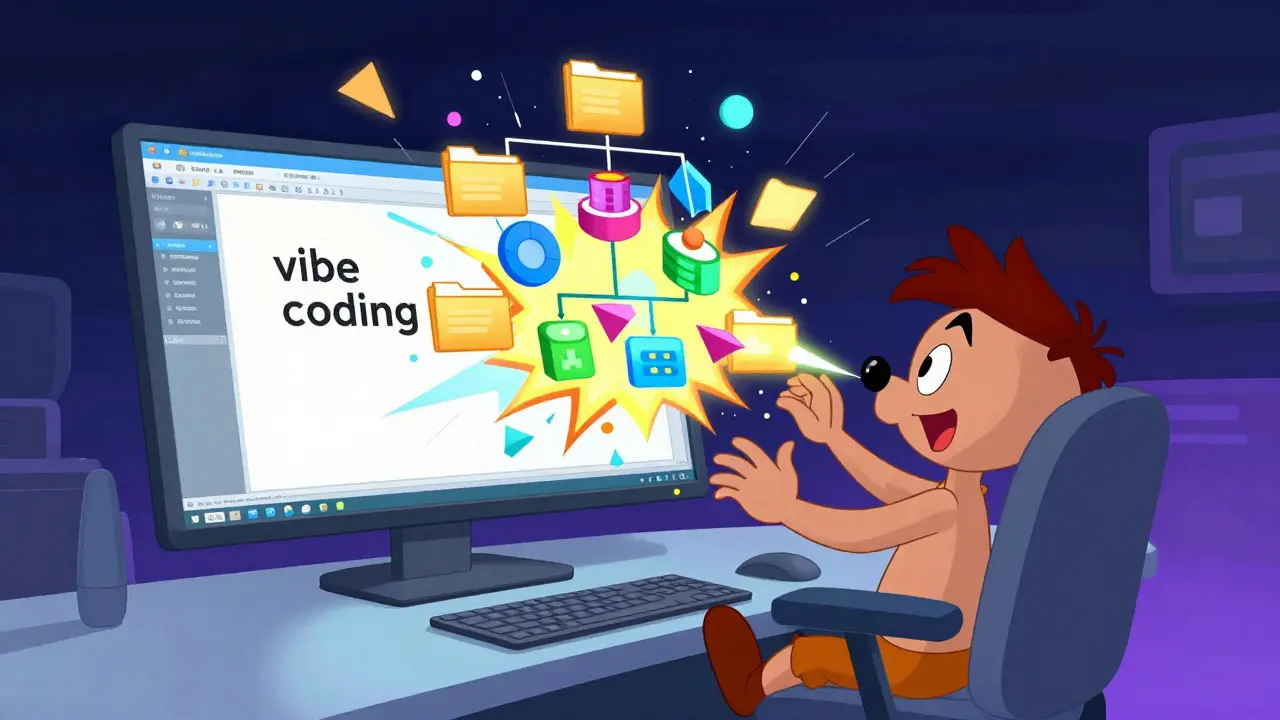
Imagine typing a single sentence into your editor and watching a fully structured application appear in seconds. That is the promise of vibe coding, a development approach where you describe the desired outcome in natural language, and an AI tool translates that intent into working code structure. Instead of manually setting up folders, configuring databases, and writing boilerplate for authentication, you simply state what you need. The result is a dramatic shift in how initial software architectures are born, moving from hours of manual setup to moments of automated generation.
This method isn't just about speed; it changes the developer's role from syntax writer to architectural curator. However, this power comes with a catch. While the initial scaffold looks impressive, the underlying structural decisions made by the AI can be fragile if left unchecked. Understanding how these tools work, where they excel, and where they fail is critical for anyone looking to leverage this technology without falling into technical debt traps.
Key Takeaways
- Vibe coding reduces initial scaffolding time by up to 92%, turning hours of setup into minutes.
- AI tools make approximately 17 architectural decisions per 100 lines of code, with varying accuracy rates depending on complexity.
- Standard CRUD applications and data pipelines see high success rates (74-82%), while complex distributed systems often require significant refactoring.
- Using "iterative prompting" and explicit architectural guardrails improves the quality of generated structures significantly.
- Human oversight remains essential, particularly for boundary decisions and cross-cutting concerns like security and scalability.
The Mechanics of Prompt-to-Architecture Translation
When you submit a prompt like "Build a REST API in Python with endpoints to create, read, update, and delete customer records," the AI doesn't just guess. It analyzes the request through multiple reasoning layers. First, it identifies the domain (customer management) and the pattern (CRUD). Next, it selects an appropriate framework, such as FastAPI or Flask, based on popularity and suitability for the task. Finally, it generates the file structure, database models, and route definitions.
This process involves making dozens of micro-decisions. According to recent whitepapers, modern AI coding assistants make roughly 17 architectural decisions for every 100 lines of code generated. These include choosing dependency management strategies, defining module boundaries, and setting up error handling mechanisms. For simple tasks, these choices are usually safe. For example, selecting a standard ORM library is a low-risk decision. But when the prompt gets vague, say "make it scalable," the AI might default to patterns that don't fit your specific scale requirements, leading to inefficiencies later.
Where Vibe Coding Shines: Speed and Prototyping
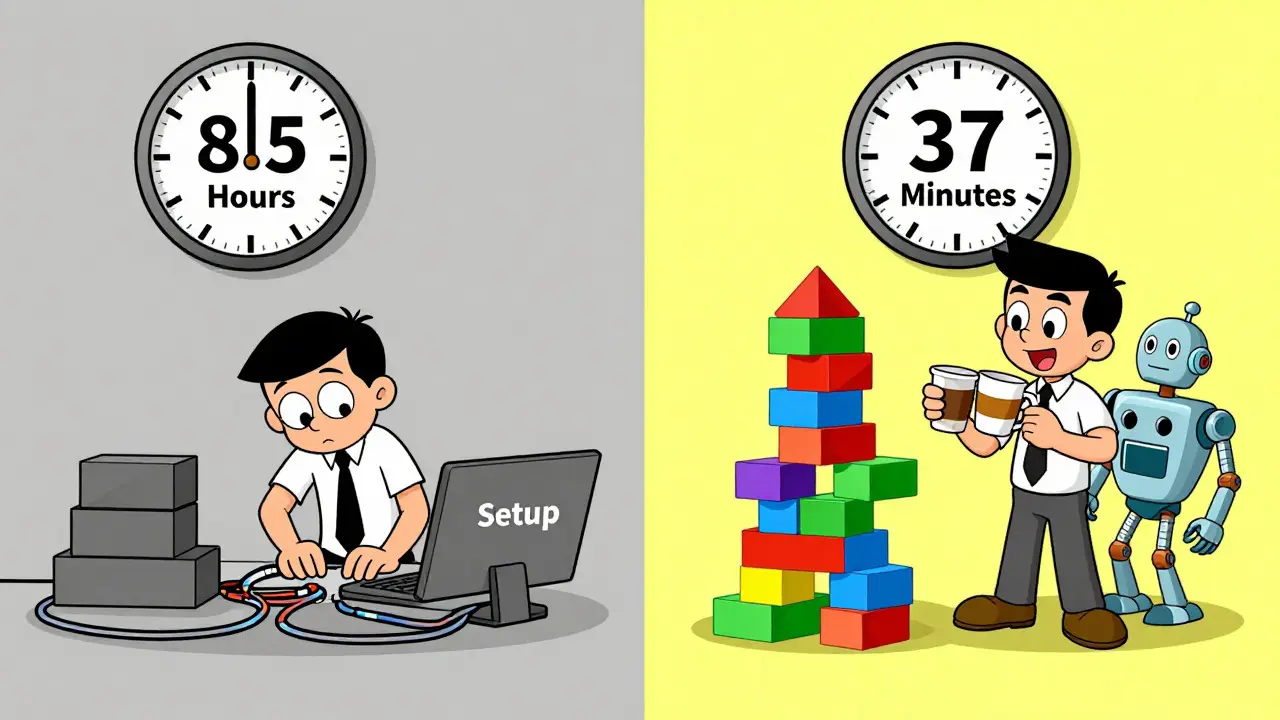
The primary benefit of vibe coding is velocity. Traditional approaches to building a basic business application might take 8.5 hours for a senior developer to set up the skeleton. With AI scaffolding, that same structure can be generated in about 37 minutes. This 92% reduction in time allows teams to test ideas faster and iterate on core features sooner.
This speed is most valuable in specific contexts:
- MVP Development: When speed-to-market is more important than long-term architectural perfection, AI-generated scaffolds provide a functional starting point quickly.
- Internal Tools: Applications used within a company, where user load is predictable and regulatory pressure is lower, tolerate more architectural imperfection.
- Data Pipelines: Standard ETL (Extract, Transform, Load) patterns are well-understood by AI models, resulting in coherent and reliable code structures for data ingestion and processing.
For these use cases, the trade-off between speed and architectural purity is often worth it. You get a working system fast, and you can refactor specific parts later if needed.
The Hidden Costs: Architectural Debt and Fragility
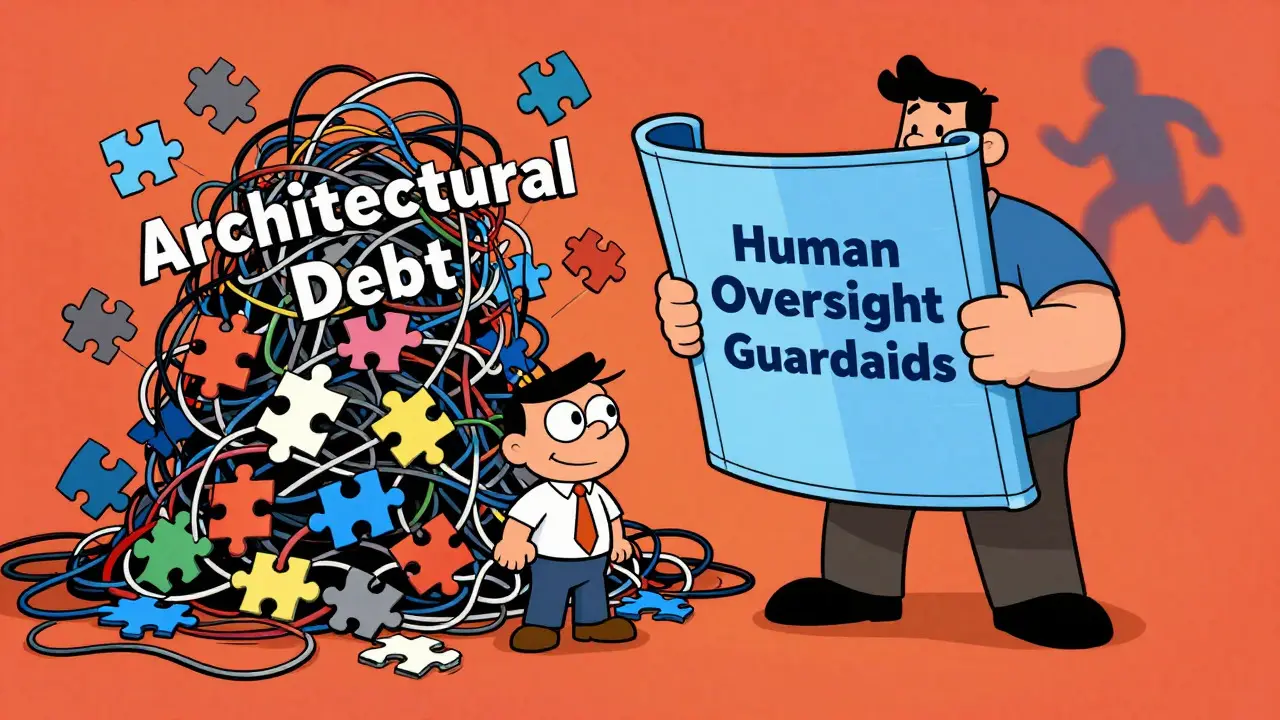
Despite the speed gains, there is a silent rot happening in many AI-built systems. Software architects have noted that AI optimizes for local correctness rather than systemic soundness. It gives you functions, not frameworks. Snippets, not structure. A study of over 1,200 AI-generated codebases found that 83% lacked proper separation of concerns in their business logic layers. Another 76% exhibited circular dependencies between modules, which makes testing and updating individual components difficult.
This issue becomes critical at scale. One startup founder reported building a SaaS MVP in three days using Cursor, only to face $150,000 in refactoring costs when trying to scale beyond 10,000 users. The initial architecture collapsed under the weight of increased traffic because the AI had chosen patterns suitable for a prototype but not for a production environment. This highlights a key risk: AI-generated code passes unit tests at high rates (around 94%), but fails integration and architectural conformance tests at rates three times higher than human-written code.
Comparing Approaches: Traditional vs. Vibe Coding
To understand the trade-offs, it helps to compare traditional manual scaffolding with AI-driven generation across several dimensions.
| Attribute | Traditional Manual Scaffolding | AI Vibe Coding |
|---|---|---|
| Initial Setup Time | Hours to Days | Minutes to Seconds |
| Architectural Coherence | High (if designed by expert) | Variable (often lower for complex systems) |
| Error Handling | Customized to specific edge cases | Generic defaults, may miss specific edge cases |
| Scalability Readiness | Planned upfront | Often retrofitted later |
| Learning Curve | Requires deep framework knowledge | Requires prompt engineering skills |
The table illustrates that while AI wins on speed, traditional methods offer more control over long-term quality. The choice depends on whether you are building a throwaway prototype or a durable product.
Best Practices for Effective AI Scaffolding
You don't have to choose between speed and quality. By adopting specific practices, you can mitigate the risks of vibe coding. The most effective approach is an "iterative mindset." Instead of expecting one perfect prompt, plan for refinement. On average, developers go through 4.7 iterations per feature to get the right structure.
Here are practical steps to improve outcomes:
- Define Architecture First: Before asking for code, outline the high-level structure. Specify patterns explicitly, such as "use repository pattern with clean architecture." This guides the AI away from generic defaults.
- Use Guardrail Prompts: Modern tools allow constraint-based prompting. Specify rules like "no circular dependencies" or "must use hexagonal architecture." This increases the likelihood of compliant code.
- Validate Immediately: Don't accept the first output blindly. Use static analysis tools or architectural linters to check for boundary violations and dependency issues before integrating the code.
- Focus on Boundaries: Human oversight is most critical for deciding how different components interact. Let the AI fill in the details within those boundaries.
Developers who adopt these practices report a 39% improvement in architectural coherence. It turns the AI from a black box into a collaborative partner that respects your design constraints.
The Future of Hybrid Workflows
The industry is moving toward hybrid models where humans define the strategy and AI handles the implementation. This "architectural pairing" approach has shown promising results, achieving better architectural outcomes than pure vibe coding while maintaining most of the speed benefits. Tools are emerging that analyze runtime behavior to give AI agents better context, reducing the need for post-generation refactoring by over 50%.
By 2027, AI-assisted architecture will likely become standard practice. However, the most successful organizations will treat AI as an implementer, not the architect. Humans will retain ownership of quality attributes and boundary decisions, ensuring that the system remains robust as it grows. This balance leverages the speed of AI while preserving the wisdom of human design.
Frequently Asked Questions
Is vibe coding suitable for production applications?
It can be, but with caution. For internal tools and MVPs, it is highly effective. For customer-facing applications requiring high scalability and strict compliance, significant refactoring is often needed. Always validate the generated architecture against your specific scaling requirements before going live.
What are the best AI tools for generating code scaffolds?
Popular options include Cursor, GitHub Copilot, Windsurf, and Replit Ghostwriter. Each has strengths; Cursor is known for its agentic capabilities, while GitHub Copilot offers strong integration with existing repositories. Choose based on your preferred IDE and workflow.
How do I prevent circular dependencies in AI-generated code?
Explicitly define module boundaries in your prompts. Use architectural patterns like Hexagonal or Clean Architecture that enforce separation of concerns. Additionally, run static analysis tools after generation to detect and fix any circular references before committing the code.
Does AI always pick the right framework?
Not always. AI tends to select popular, mainstream frameworks like FastAPI or Django. If your project requires a niche or legacy framework, specify it clearly in the prompt. Otherwise, you may end up with a framework that doesn't align with your team's expertise or project constraints.
How much time does it take to learn prompt engineering for architecture?
Most developers reach proficiency in crafting effective architectural prompts within 40 to 60 hours of practice. This involves learning how to structure requests, define constraints, and interpret the AI's reasoning to refine subsequent iterations.
Okay so I’ve been sitting with this for a bit and honestly the idea of typing one sentence and getting a whole app back is kinda wild but also slightly terrifying. Like, who is holding the steering wheel here? The part about AI making 17 architectural decisions per 100 lines really stuck in my craw because that sounds like a lot of tiny choices being made by something that doesn’t actually care if your database scales or not. It’s like hiring a very fast intern who knows every framework name but has no idea what “maintainability” tastes like. I love the speed though! Getting from zero to something clickable in 37 minutes instead of 8 hours is magic for prototyping. But then you read about that startup paying $150k to fix what they built in three days and suddenly the magic feels a little expensive. It reminds me of those cheap IKEA furniture pieces that look great in the showroom but fall apart when you try to hang a heavy mirror on them. You get the vibe, right? It’s all vibes until the server crashes at 2 AM.
It is indeed a fascinating shift in paradigm. While the velocity gains are substantial, we must remain vigilant regarding the long-term structural integrity of these systems. The article rightly points out that AI optimizes for local correctness, which is a significant pitfall for enterprise-grade applications. However, if we treat the AI as a junior developer rather than an architect, the workflow becomes much more manageable. We should encourage our teams to adopt the iterative prompting method described, ensuring that guardrails are explicitly defined before generation begins. This approach allows us to harness the speed benefits while retaining human oversight over critical boundary decisions. It is a delicate balance, but one that is necessary for sustainable development practices in this new era of coding.
this is huge man think about it we used to spend days just setting up folders and config files now its basically free time to actually build the cool stuff. i know people say the code is fragile but if you just check it once or twice its fine right? the fact that you can test an idea in half an hour instead of a week is just game changing for startups. dont let the perfectionists stop you from shipping. the best way to learn is to do and this lets you do way more things faster. just keep an eye on the dependencies and youll be golden. its a win win situation for anyone trying to move fast
The numbers are cherry-picked. 92% reduction in setup time is meaningless if the refactor cost is 3x higher later. They ignore the context of *what* is being built. For complex systems, this is just technical debt on steroids. The 'vibe' is that you feel productive while digging your own grave. Trust the process less, trust the architecture more.
i totally agree with the point about circular dependencies! i ran into this last month when i tried to scaffold a simple auth flow and the ai just decided to make the user model depend on the session manager which depended on the user model. it was such a mess. i had to manually break it apart. also the part about specifying frameworks is so true. i forgot to mention we use rails and it kept defaulting to django because that's what it sees most. once i added "must use rails" to the prompt it got better but still felt like i was talking to a stubborn dog. has anyone else had issues with error handling being too generic? mine just threw a 500 for everything which was not helpful for debugging. but yeah the speed is real. i finished a side project in two days that would have taken me a month before. just gotta be careful with the details i guess
One must not underestimate the sheer magnitude of risk involved in delegating structural integrity to an algorithmic process. The notion that a machine can comprehend the nuanced interplay between scalability and security is, frankly, optimistic to the point of naivety. We are witnessing a systematic erosion of engineering rigor, masked by the glossy veneer of rapid deployment. The $150,000 refactoring bill cited in the article is not an anomaly; it is the inevitable consequence of prioritizing velocity over coherence. Until we develop robust automated verification tools that match the sophistication of human architectural review, this 'vibe coding' remains a high-stakes gamble. The industry would do well to slow down and reconsider whether speed is truly worth the price of fragility.
Just another way for US companies to offload basic coding tasks to foreign AI models trained on open source data. Why pay for American talent when a bot can do it cheaper? Makes sense for efficiency.