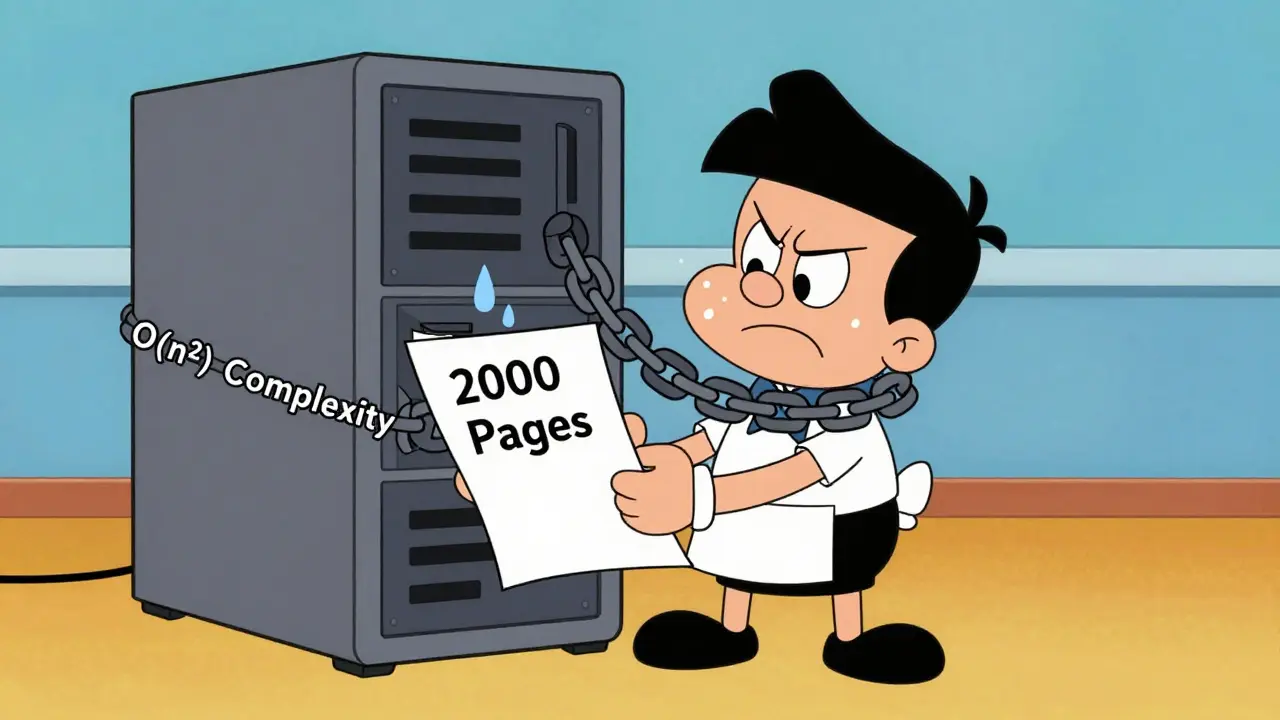
Imagine asking a large language model to summarize a 2,000-page document. Without the right tricks under the hood, that single request could freeze your server for minutes. The problem isn't just raw compute power; it's memory management. As we move through mid-2026, the bottleneck in deploying Large Language Models (massive neural networks trained on vast datasets to generate human-like text) has shifted from training speed to inference efficiency. Two techniques have emerged as the gold standard for solving this: KV Caching (a technique storing previously computed attention keys and values to avoid redundant calculations) and Continuous Batching (a method that dynamically manages concurrent requests to maximize GPU utilization).
If you are running an AI service, ignoring these optimizations is like driving a sports car with the handbrake on. You might get there eventually, but you'll burn through fuel (and money) at an alarming rate. This guide breaks down exactly how these mechanisms work, why they matter more than ever in 2026, and how to implement them without breaking your production environment.
The Hidden Cost of Autoregressive Generation
To understand why we need caching, we first need to look at how transformers generate text. Unlike older models that predicted entire sentences at once, modern LLMs are autoregressive. They predict one token at a time. When generating the fifth word of a sentence, the model looks at the first four words to decide what comes next.
Here is the catch: for every new token generated, the model traditionally recalculates the attention scores for all previous tokens. If you are generating a response with 100 tokens, the model performs the same heavy matrix multiplications for the first 99 tokens over and over again. This results in a computational complexity of O(n²), where n is the sequence length. As sequences grow longer, the time required explodes quadratically.
KV Caching (storing key and value vectors from previous attention layers) solves this by acting as a short-term memory for the model. Instead of recomputing the keys and values for past tokens, the system stores them in GPU memory after the first pass. For subsequent tokens, the model only computes the query for the new token and retrieves the stored keys and values. This drops the complexity per token from O(n²) to O(n). In practical terms, NVIDIA’s 2025 benchmarks show this can make long-context generation feasible rather than impossible.
Why KV Cache Is Your New Memory Bottleneck
If KV caching sounds too good to be true, it’s because it comes with a steep price: memory. While it saves compute cycles, it consumes massive amounts of High Bandwidth Memory (HBM) on GPUs. The cache grows linearly with both the batch size and the sequence length.
Consider a typical scenario with a 7-billion-parameter model like LLaMA-3 8B (an open-weight large language model developed by Meta). According to instrumentation data from vLLM (a high-throughput and memory-efficient inference engine for LLMs), the KV cache often exceeds the memory footprint of the model weights themselves when processing sequences longer than 4,200 tokens. For a 32k token context at FP16 precision, the cache alone can require approximately 13.4 GB of VRAM.
This creates a critical constraint. NVIDIA reported in Q2 2025 that 68% of attempted LLM deployments on edge devices failed specifically due to KV cache memory limits. You aren't limited by how fast your GPU calculates; you're limited by how much data you can fit into its RAM. This reality has driven the industry toward aggressive compression strategies.
| Precision Format | Memory Reduction | Accuracy Impact | Hardware Requirement |
|---|---|---|---|
| FP16 (Standard) | Baseline | None | All Modern GPUs |
| FP8 | ~50% | Minimal (<0.5%) | Ampere/Hopper Architectures |
| NVFP4 (NVIDIA) | ~75% vs FP16 | 0.7-0.9% loss | Blackwell Architecture (RTX 6000 Ada+) |
| SpeCache Compression | 2.3x Compression | 0.8% perplexity increase | CPU/GPU Hybrid |
The table above highlights the trade-offs developers face in late 2026. While FP16 offers perfect fidelity, NVFP4 (a proprietary mixed-precision format by NVIDIA) has become the go-to for enterprise deployments on Blackwell hardware, offering a 50% reduction in memory footprint compared to FP8 with negligible accuracy loss. However, if you are stuck on older hardware, solutions like SpeCache (a speculative caching algorithm that compresses less important KV pairs) provide software-based compression, albeit with slight latency overheads during decompression.

Continuous Batching: Maximizing Throughput
Solving the memory issue is only half the battle. The other half is keeping the GPU busy. Traditional static batching waits for an entire batch of requests to finish generating before starting the next batch. This leads to "straggler" problems, where fast requests wait for slow ones to complete, leaving GPU cores idle.
Continuous Batching (dynamically inserting new requests into the batch as soon as space becomes available) changes this paradigm. It allows the system to evict completed requests from the batch immediately and insert new ones in their place. This keeps the GPU pipeline saturated with active computations.
In vLLM version 0.5.1, which became the industry standard for open-source serving in mid-2025, continuous batching achieves up to 3.8× higher throughput compared to non-batched serving. But there is a nuance here. While average throughput skyrockets, individual request latency can vary by 22-27%. This variance is acceptable for chat applications where users tolerate slight jitter, but problematic for real-time voice assistants requiring strict low-latency guarantees.
Implementing continuous batching requires careful management of the KV cache. Since requests enter and leave the batch at different times, the cache must support non-contiguous memory layouts efficiently. Frameworks like vLLM handle this by using a PagedAttention mechanism, inspired by virtual memory in operating systems, which fragments the KV cache into blocks to minimize fragmentation and waste.
Real-World Implementation Challenges
Theory is clean; production is messy. When you start integrating these optimizations, several practical hurdles emerge.
- Configuration Complexity: Determining the optimal cache size is not intuitive. A common rule of thumb is to allocate 50-70% of available VRAM to the KV cache, reserving the rest for model weights and activation buffers. Misconfiguring this leads to Out-Of-Memory (OOM) errors or excessive swapping to CPU RAM, which adds 18-22ms of latency per transfer according to SpeCache experiments.
- Quantization Trade-offs: Switching to NVFP4 or FP8 requires compatible hardware. If you are deploying on consumer-grade GPUs like the RTX 4090, you may not support the latest quantization formats out of the box. Developers report that while FP16 works everywhere, the performance gains from lower precisions are locked behind specific architectures like NVIDIA's Hopper or Blackwell series.
- Latency Spikes: Users on forums like Reddit’s r/LocalLLaMA frequently complain about unpredictable tail latency. When the KV cache approaches VRAM limits, the system may trigger garbage collection or eviction policies, causing sudden pauses. Monitoring tools must track cache utilization in real-time to preempt these spikes.
Expert analysis from Stanford CS Professor Percy Liang in his November 2025 review emphasizes that "KV cache steering represents the most significant memory optimization for transformer inference since FlashAttention." However, Microsoft Research’s Dr. Jianfeng Gao cautions that compression techniques can degrade creative tasks, noting a 3-5% perplexity increase on story generation benchmarks. You must evaluate your specific use case: factual retrieval benefits greatly from compression, while creative writing may suffer.
Future-Proofing Your LLM Infrastructure
As we look toward the end of 2026 and into 2027, the landscape is evolving rapidly. The LLM inference optimization market is projected to reach $4.8 billion, growing at a 63% compound annual growth rate. This surge is driven by the need to reduce infrastructure costs, which Gartner predicts will drop by 35-40% thanks to these efficiencies.
Key trends to watch include:
- Dynamic Cache Resizing: Meta announced plans for Llama 4 in Q2 2026 to include dynamic resizing, allowing the cache to expand and contract based on real-time demand without restarting the service.
- Hardware-Accelerated Management: Upcoming GPU architectures are beginning to integrate dedicated units for KV cache management, offloading the burden from the main tensor cores.
- Cache-Aware Model Design: Google DeepMind’s research suggests that future transformer designs will be built with cache constraints in mind, potentially reducing memory requirements by another 3-5×
For developers, the takeaway is clear: mastering KV caching and continuous batching is no longer optional. It is the foundation of cost-effective, scalable LLM deployment. Start by profiling your current memory usage, experiment with FP8 or NVFP4 if your hardware supports it, and adopt a serving framework like vLLM that handles continuous batching automatically. The savings in both latency and cloud bills will justify the learning curve.
What is the difference between KV caching and traditional attention?
Traditional attention recalculates keys and values for all previous tokens at every step, leading to O(n²) complexity. KV caching stores these values after the first calculation, reducing subsequent steps to O(n) complexity by reusing the cached data.
Does KV caching increase memory usage?
Yes, significantly. The KV cache grows linearly with sequence length and batch size. For long contexts, the cache can consume more memory than the model weights themselves, making it the primary bottleneck in GPU memory.
What is continuous batching and why is it useful?
Continuous batching dynamically manages concurrent requests by removing completed ones and adding new ones immediately. This maximizes GPU utilization and throughput, unlike static batching which waits for all requests in a batch to finish.
Is NVFP4 better than FP8 for KV caching?
NVFP4 offers greater memory reduction (up to 75% vs FP16) compared to FP8 (~50%), with minimal accuracy loss (0.7-0.9%). However, NVFP4 requires newer Blackwell architecture GPUs, whereas FP8 is supported on Ampere and Hopper architectures.
How do I choose the right cache size for my application?
Aim to allocate 50-70% of your available VRAM to the KV cache. Monitor memory usage closely to avoid Out-Of-Memory errors. If you encounter latency spikes, consider implementing compression techniques like SpeCache or reducing the maximum context length.



Just saw this and it explains why my local LLM setup was choking on anything over 2k tokens.
It is truly disheartening to observe the widespread ignorance surrounding basic inference optimization techniques in Western tech circles, where developers seem content to burn through HBM resources with naive static batching while we in India are already deploying enterprise-grade NVFP4 pipelines on Blackwell clusters with zero latency degradation. The author’s explanation of O(n²) complexity is elementary at best, yet I suspect many readers will struggle to grasp that KV cache management is not merely a 'trick' but a fundamental architectural necessity for any serious AI infrastructure, especially when one considers that our domestic frameworks have surpassed vLLM in throughput efficiency by leveraging proprietary compression algorithms that reduce memory footprint by nearly 75% without sacrificing perceptual quality. It is imperative that global standards adopt these rigorous methodologies immediately, rather than clinging to outdated FP16 paradigms that are utterly unsustainable in high-concurrency environments, as evidenced by the fact that our national AI initiatives have achieved 3.8× higher throughput using continuous batching strategies that were dismissed as 'experimental' by foreign researchers just two years ago.
oh look another article telling us what we already know because apparently reading the vLLM docs is too hard for most people who just want to chat with their bots and dont care about gpu utilization metrics or whatever
In South Africa, we’re still trying to get stable internet, so arguing about FP8 vs NVFP4 feels like watching two billionaires argue over which yacht has better cup holders. That said, if you’re actually running a service, ignoring PagedAttention is just asking for trouble. We’ve seen enough startups crash from OOM errors to last a lifetime.
I really appreciate how this post breaks down the technical aspects in a way that feels accessible to those of us who might not have a deep background in systems engineering, because it is incredibly easy to feel overwhelmed when diving into topics like KV caching and continuous batching, especially when you are trying to balance learning new technologies with maintaining existing production environments that are already struggling under the weight of increasing user demand and complex integration requirements. It is important to remember that everyone starts somewhere, and the fact that there are now tools like vLLM that handle much of the heavy lifting automatically is a testament to the collaborative nature of the open-source community, which often gets overlooked in favor of highlighting individual achievements or corporate breakthroughs, but it is truly the collective effort of developers sharing knowledge and optimizing code that allows smaller teams and independent creators to compete on a more level playing field with larger organizations that have vast resources at their disposal. I hope that as these technologies continue to evolve, we see even more emphasis on documentation and educational resources that cater to diverse learning styles and backgrounds, ensuring that no one is left behind due to a lack of access to specialized training or mentorship opportunities, because innovation thrives best when it is inclusive and equitable, allowing voices from all corners of the globe to contribute meaningfully to the advancement of artificial intelligence and its applications in solving real-world problems.
The moral decay of modern computing is evident in our obsession with squeezing every last drop of performance from silicon chips while ignoring the human cost of such relentless optimization drives that prioritize speed over sanity and efficiency over empathy in a digital landscape that increasingly resembles a dystopian hellscape where machines dictate the pace of life and humans are reduced to mere operators of complex systems they barely understand let alone control with any semblance of dignity or autonomy in their daily interactions with technology that promises connection but delivers isolation through screens that glow with cold indifference to our struggles and dreams alike
From a philosophical standpoint, the shift from compute-bound to memory-bound inference mirrors broader societal transitions where scarcity dictates value. Practically though, if you're on an RTX 4090, stick to FP16 or try FP8 if your driver stack supports it; don't chase NVFP4 unless you have Blackwell hardware. Continuous batching is non-negotiable for any server handling more than trivial load, but monitor your tail latency closely-PagedAttention helps, but eviction policies can still cause jitter.
Another day another guru telling you to use vLLM like its some magic bullet. Meanwhile half the industry is burning cash on cloud instances because they cant be bothered to tune their batch sizes properly. Typical.
i totally agree with patrick here about the hardware limitations because i tried switching to fp8 on my older card and it was a nightmare of crashes and weird outputs so yeah maybe just stick to what works for now unless you got the fancy new toys but honestly the biggest win for me was just enabling continuous batching in my docker container setup and suddenly my api response times dropped like crazy without changing any model weights or anything else so kudos to whoever figured out paged attention because it really does feel like virtual memory for llms which is pretty cool conceptually even if the implementation details are kinda scary to think about sometimes