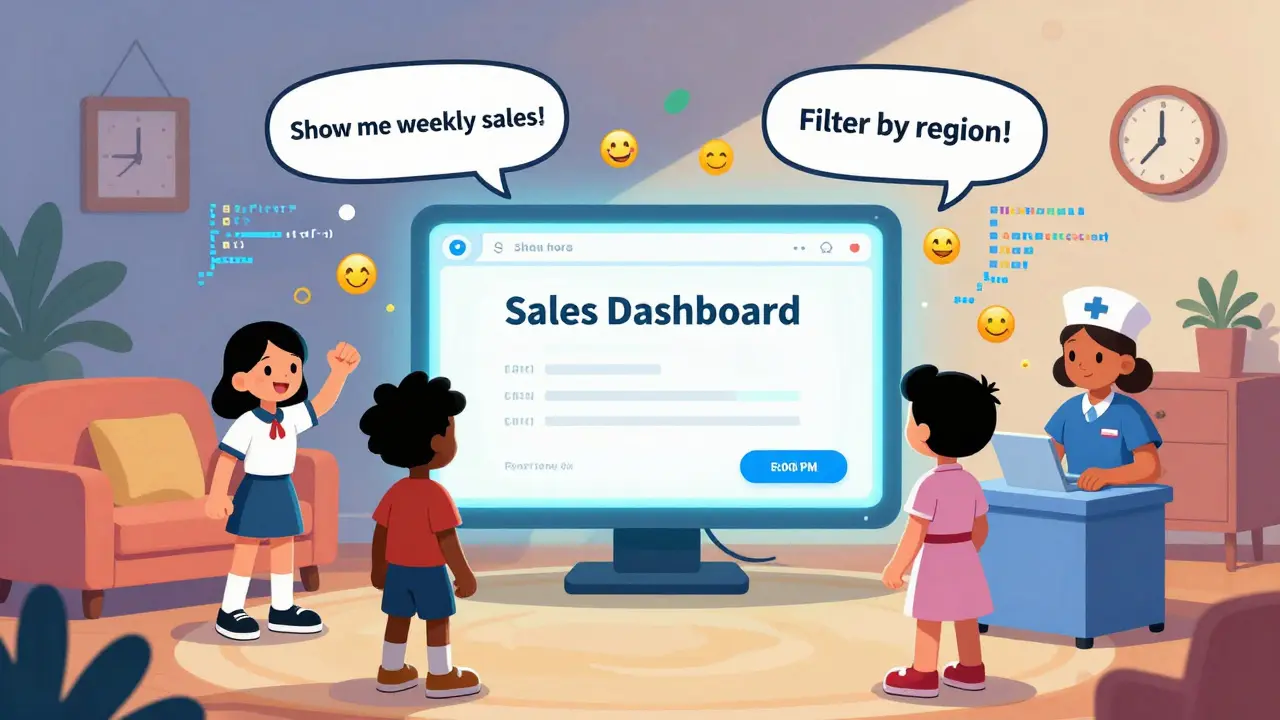
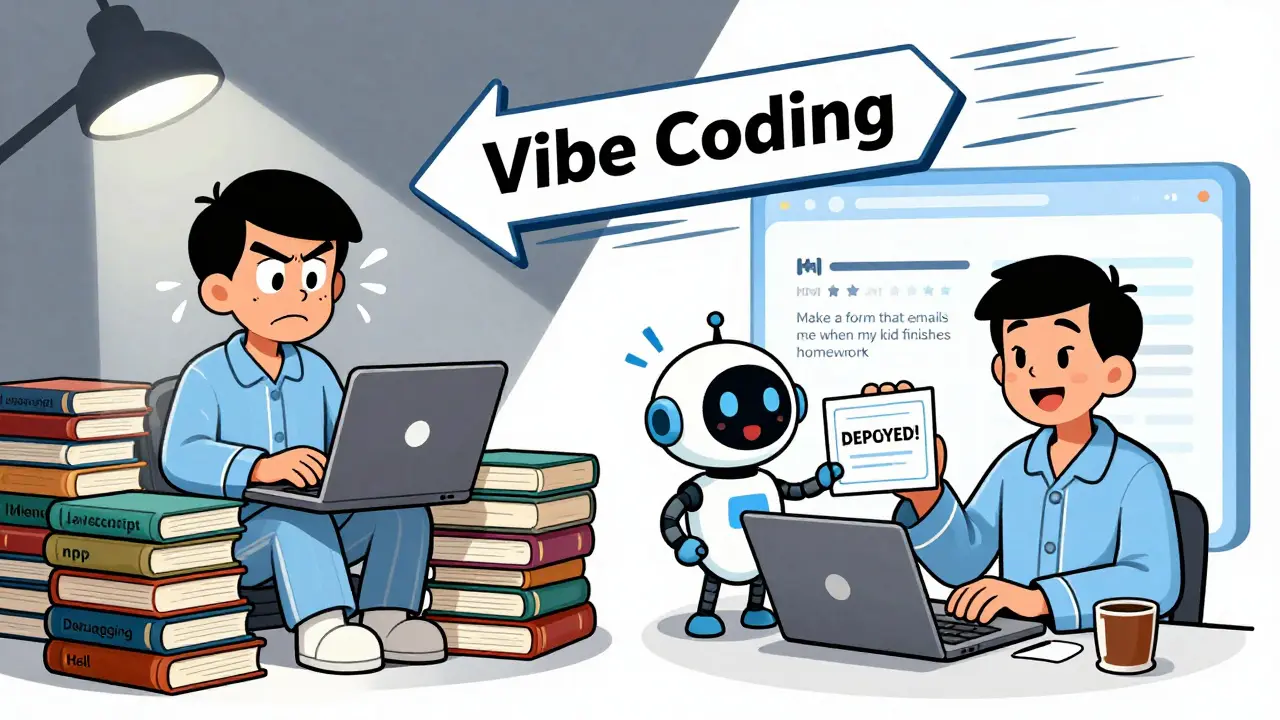
Five years ago, building a simple app meant learning JavaScript, setting up a server, debugging database connections, and spending months just to get something working. Today, a high school student in Portland, a small business owner in Ohio, or a nurse in Texas can describe an app in plain English-"I want a dashboard that shows my sales data and lets me filter by week"-and get a working, deployed app in under an hour. This isn’t science fiction. It’s vibe coding.
What Is Vibe Coding, Really?
Vibe coding isn’t just another AI tool. It’s a shift in how software gets made. Instead of typing lines of code, you talk to an AI like you’re explaining an idea to a friend. You say, "Make a login page with Google sign-in and a password reset", and it spits out clean, functional code in JavaScript or Python. No memorizing syntax. No wrestling with npm installs. No hours spent Googling stack overflow errors. It works because of large language models-Google’s Gemini, OpenAI’s GPT-4, and others-that have been trained on millions of real codebases. These models don’t just guess what you mean. They understand context. If you ask for a to-do list with drag-and-drop, they know you need React, state management, and localStorage. If you say, "Add a chart that updates every minute", they pull in Chart.js and set up a WebSocket or polling loop automatically. Tools like GitHub Copilot, Google’s Gemini Code Assist, and Replit’s Agent integrate right into your code editor. You don’t need to leave your workflow. The AI suggests code as you type, fixes bugs, writes tests, and even generates entire files based on your description. According to JetBrains’ 2024 survey, developers using these tools cut boilerplate coding time by 35-50%. That’s not a small win. That’s hours saved every week.Who Can Build With Vibe Coding Now?
The biggest change? You don’t need a computer science degree anymore. A product manager at a startup in Austin used Replit to build an internal tool that tracks customer feedback. She had never written a line of code. She spent three afternoons describing what she wanted, tweaking the AI’s output, and deploying it. The app saved her team 12 hours a week. She didn’t hire a developer. She didn’t pay for a no-code platform subscription. She just talked to an AI. Teachers are using it to create classroom dashboards that track student progress. Small business owners are building inventory trackers, appointment schedulers, and order forms. Even artists and writers are making interactive portfolios that update automatically when they post new work. Microsoft’s internal data shows 42% of new app prototypes in the company now come from employees without formal training. That’s not a fluke. It’s a pattern. The barrier to entry has collapsed. You don’t need to be a coder to build software anymore. You just need a clear idea and the willingness to describe it.How It Compares to No-Code and Low-Code
You’ve probably heard of tools like Bubble, Webflow, or OutSystems. They’re called no-code or low-code platforms. They let you build apps with drag-and-drop blocks. But here’s the catch: you’re stuck with what they offer. If you want a custom animation, a unique data structure, or a third-party API integration that’s not in their library? Tough luck. You hit a wall. Forrester found that 78% of enterprises using pure no-code tools eventually needed to bring in developers to fix or extend their apps. Vibe coding doesn’t lock you in. It gives you the freedom of code, without the steep learning curve. You start with a simple description. The AI generates the code. Then you open it up, edit it, tweak it, add your own logic. It’s like having a co-pilot who knows every programming language and framework. You’re still in control. You just don’t have to write everything from scratch.
What Vibe Coding Can’t Do (Yet)
It’s not magic. And it’s not perfect. GitHub’s 2024 State of the Octoverse report found that 37% of AI-generated code had security flaws. That means if you deploy an app without checking it, you might be exposing user data. The AI doesn’t always understand context. Ask for "a secure login system", and it might generate code that stores passwords in plain text. You need to know enough to spot that. Complex systems-like real-time trading platforms, high-frequency data pipelines, or enterprise ERP modules-are still beyond its reach. Gartner says AI coding assistants handle only 62% of full-stack development tasks without human help. For big, critical apps, you still need experienced engineers to design architecture, review security, and handle edge cases. There’s also the risk of technical debt. A Reddit user named u/CodeQualityWatch wrote: "The AI writes code that works today but becomes a nightmare to maintain next month." That’s true. The AI doesn’t care about clean architecture. It cares about making the prompt work. So if you’re building something long-term, you’ll need to refactor the code later. That’s where human judgment still matters.How to Start With Vibe Coding
You don’t need to be a tech expert to get started. Here’s how:- Choose a platform: Start with Replit (free tier available) or GitHub Copilot (free for students, $10/month for professionals). Both work inside VS Code.
- Start small: Don’t try to build an app like Uber. Start with a to-do list, a weather widget, or a simple form that emails you when submitted.
- Be specific: Instead of saying "Make a website", say "Create a web page with a red button that says 'Submit' and sends an email to me when clicked". The more detail, the better the result.
- Review the code: Open the generated files. Read them. Don’t just click deploy. Look for obvious mistakes: hardcoded passwords, missing validation, unsecured APIs.
- Deploy and test: Use the one-click deploy feature. Test it on your phone. Share it with a friend. See what breaks.
The Future: What’s Next?
Vibe coding is evolving fast. Google just released a feature in AI Studio called "Prompt to Product"-you describe an app, and it auto-generates not just code, but hosting, authentication, and even AI-powered features like chatbots or image recognition. Replit added multiplayer vibe coding, where two people-say, a designer and a marketer-can talk to the AI together in real time and build an app side by side. One says, "Make the button bigger", the other says, "Change the color to blue", and the AI updates it live. In the next five years, IDC predicts 65% of all software development will involve AI-assisted coding. That means the role of the developer is changing. It’s not about typing code anymore. It’s about guiding AI. It’s about asking the right questions. It’s about knowing when to say, "That’s not secure," or "We need a different architecture."Final Thought: The New Developer Is Anyone With a Problem to Solve
The old model said: "If you don’t know how to code, you can’t build software." That’s dead. Now, the rule is: "If you can describe a problem clearly, you can build a solution." This isn’t about replacing developers. It’s about expanding who gets to be one. A teacher. A nurse. A parent running a side business. A teenager with a great idea. They all have something in common: they see a problem, and they want to fix it. Vibe coding gives them the tools. The AI does the heavy lifting. The human does the thinking. The software world is no longer a club for the technically initiated. It’s open to everyone who dares to ask, "Can you build this?"Do I need to know how to code to use vibe coding?
No. Vibe coding is designed for people without coding experience. You describe what you want in plain language, and the AI writes the code for you. You can start building apps in hours, not months. But learning basic code concepts-like variables, functions, and data types-helps you review and improve the AI’s output.
Is vibe coding safe for business use?
It can be, but you must review the code. AI-generated code often has security flaws-37% of it, according to GitHub’s 2024 report. Never deploy an app without checking for hardcoded passwords, unsecured APIs, or missing input validation. Use vibe coding for prototyping and internal tools first. For customer-facing apps, have a professional developer audit the code before launch.
Can vibe coding replace software developers?
Not entirely. Vibe coding automates routine tasks like writing boilerplate code, setting up databases, or building UI components. But complex systems-like payment gateways, real-time analytics, or scalable backends-still require expert design, security review, and performance tuning. Developers are shifting from coders to AI supervisors: guiding, reviewing, and refining what the AI produces.
What’s the best free tool to start vibe coding?
Replit is the easiest free option. It includes a built-in AI assistant, cloud hosting, and one-click deployment. You don’t need to install anything. Just sign up, type your idea, and launch. GitHub Copilot also has a free tier for students and open-source contributors. Google’s Gemini Code Assist is free with Google Cloud credits.
How long does it take to learn vibe coding?
You can start building simple apps in under an hour. To feel confident using it regularly, plan for 8-12 hours of practice. That’s enough to build a few basic tools like a task manager, contact form, or data tracker. The key isn’t memorizing syntax-it’s learning how to ask good questions. The better your prompts, the better the results.
Can vibe coding be used in education?
Yes. Schools and universities are using vibe coding to teach problem-solving without the frustration of syntax errors. Students focus on logic and design instead of debugging missing semicolons. A 2024 study showed students built working apps 10x faster with vibe coding than with traditional programming courses.

Bro just let the AI do everything and call it a day. I tried vibe coding last week and it made a login page that stored passwords in plaintext. I deployed it anyway. Now my boss thinks I'm a genius. Who needs security when you got vibes?
This is actually one of the most hopeful things I've seen in tech in years. For so long, coding felt like an exclusive club with secret handshakes and mandatory memorization of semicolons. But now? A single mom in Ohio can build a tool to track her kids' school lunches. A retired teacher in Florida can make a digital photo album that auto-updates when her grandkids post. It’s not about replacing developers-it’s about unlocking human potential. The real skill now isn’t typing code. It’s asking the right questions. And that? That’s something anyone can learn.
I used Replit to build a simple form that emails me when my cat knocks over her water bowl. It took me two hours and I didn’t cry once. The AI suggested I add a camera feed, which was overkill, but I kept it because it made me laugh. The point isn’t perfection-it’s progress. You don’t need to be an engineer to solve a problem you care about. Just start small. Say what you want. Let the AI help. Then tweak it until it feels right. No shame in that.
I find it remarkable how this shift redefines accessibility in technical creation yet raises critical concerns regarding long term maintainability and security hygiene. The democratization is undeniable but the absence of foundational understanding among users may lead to systemic vulnerabilities. One must not mistake convenience for competence
In India, many students use this to build small tools for local shops. No degree needed. Just idea + phone. Changed lives.
So you're telling me I can now outsource my job to a chatbot and call it innovation? Congrats you built a to-do list. Now go fix a production bug without copy-pasting stack overflow. I'll wait.