
When you deploy a large language model (LLM) globally, you’re not just choosing a model-you’re choosing where your data lives. And that matters more than ever in 2026. If your users are in the EU, China, Australia, or Canada, your AI system must follow local rules. Otherwise, you risk fines up to 4% of your global revenue under GDPR, or worse-being blocked from operating in key markets.
Why Data Residency Isn’t Just a Compliance Checkbox
Data residency means your data must stay within a specific country or region. It’s not about security alone. It’s about legal control. The EU’s GDPR, China’s PIPL, and Australia’s Privacy Act all treat personal data as something that belongs to the person and the territory-not the company using it. When an LLM trains on or processes user data-like medical records, financial details, or even chat logs-it’s storing that information in its parameters. And yes, research from the University of Cambridge in June 2025 proved that LLMs can memorize and regurgitate personal data, even if you think it’s been "transformed" into numbers. This isn’t theoretical. A German bank spent 14 months deploying Llama 2 70B on-premises just to meet GDPR. Their goal? Reduce regulatory risk from "high" to "medium." That’s not a minor win. It’s the difference between being fined and staying in business.Three Ways to Handle Data Residency for LLMs
There are three main paths: cloud-hosted, hybrid, and fully local. Each has trade-offs in cost, control, and capability.- Cloud-hosted LLMs (like Azure OpenAI or Google’s Vertex AI) are easy to set up and powerful. But they store data in centralized regions. If you’re serving EU customers from a U.S. server, you’re violating GDPR. These services score 4.7/5 on performance-but only 2.3/5 on data residency compliance, according to Gartner’s August 2025 report.
- Hybrid deployments use cloud tools for development but run inference locally. AWS Outposts and Local Zones let you run Amazon Bedrock Agents on hardware inside your own data center or a nearby AWS facility. Your data never leaves the country. This setup gives you 99.95% uptime and cuts query latency to 200-300 milliseconds (compared to 500-700ms in pure cloud). But it costs at least $15,000 per month and needs certified ML engineers to manage.
- Small Language Models (SLMs) like Microsoft’s Phi-3-mini (3.8B parameters) are changing the game. They need just 8GB of RAM-far less than Llama 3’s 140GB. You can run them on a single server in your office. CloverDX’s Q2 2025 tests show Phi-3-mini hits 78% of GPT-4’s accuracy on financial compliance tasks while keeping 100% of data local. But it drops to 62% on creative tasks. For customer service bots or legal document review? Perfect. For brainstorming product names? Not so much.
Who’s Most Affected-and Why
Healthcare and finance lead the charge on data residency. Why? Because they handle the most sensitive data. IDC’s May 2025 survey of 350 European enterprises found that 87% delayed AI adoption due to GDPR fears. In contrast, only 32% of companies in less regulated industries (like retail or marketing) held back. China is even stricter. PIPL requires a security assessment before any data leaves the country. That means if you want to serve Chinese users, you need local infrastructure. No exceptions. McKinsey’s June 2025 survey showed 93% of Chinese enterprises are already building local AI stacks.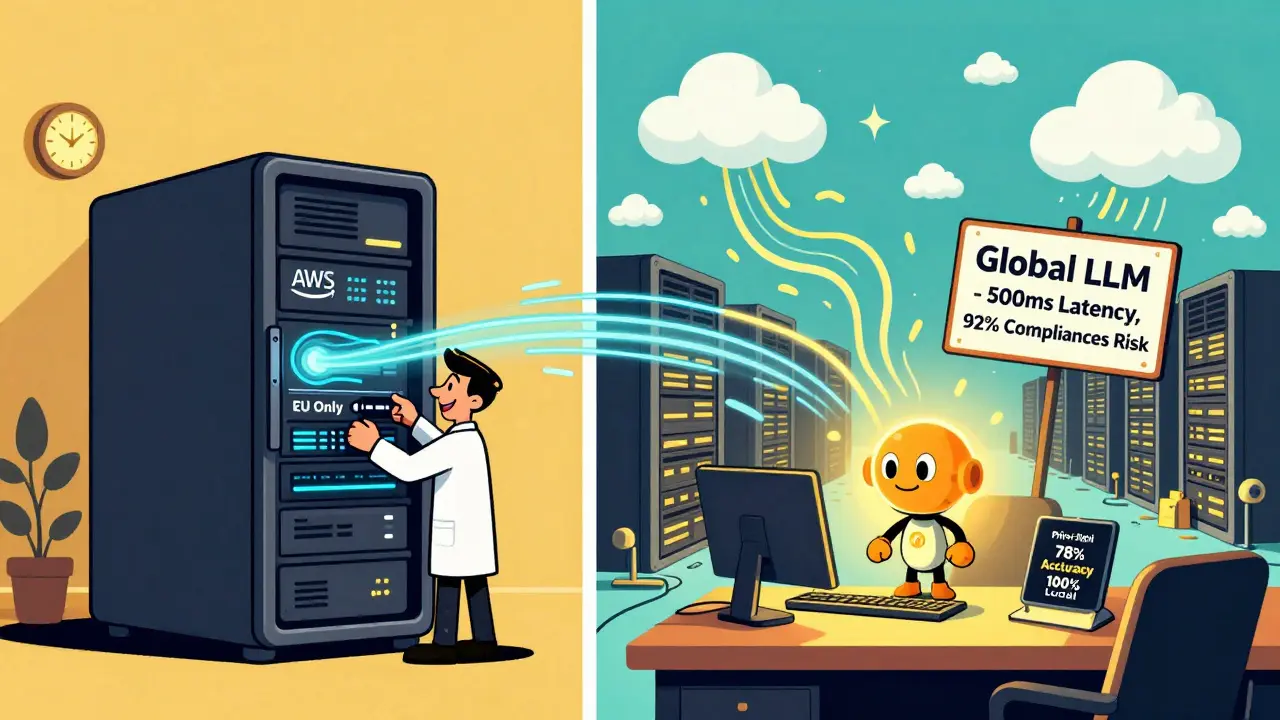
Real-World Trade-Offs: Power vs. Compliance
You can’t have it all. Higher compliance often means lower performance. AWS’s internal tests show local LLMs on Outposts achieve only 65-75% of the reasoning power of their cloud counterparts. Why? Hardware limits. G4dn instances with NVIDIA T4 GPUs (16GB VRAM) can’t match the scale of multi-GPU cloud clusters. A Capital One team abandoned their local embedding model after discovering a 17% drop in accuracy on financial QA tasks-because they didn’t have enough memory or optimized tuning. Then there’s cost. A fully local SLM setup using Mistral 7B and Ollama runs around $3,500/month. AWS Outposts? $15,000+. And that’s just infrastructure. You also need engineers who understand both AI and local privacy laws. One Reddit user from a German bank said it took three full-time ML engineers for 14 months just to get their system live.How to Actually Build a Compliant System
If you’re serious about data residency, here’s how to do it right:- Map your data flows. Where does user input come from? Where is it stored? Where does the model run? Use tools like InCountry’s data mapping platform to visualize cross-border risks.
- Choose your model type. If you’re in finance or healthcare and need high accuracy on structured tasks, go hybrid with AWS Bedrock or Azure Sovereign Regions. If you’re doing chatbots or document classification, try an SLM like Phi-3-mini.
- Use Retrieval Augmented Generation (RAG). Instead of feeding raw data into the model, store documents in a local vector database (like Amazon OpenSearch or Pinecone). The LLM only sees retrieved snippets-reducing exposure. AWS’s seven-step RAG workflow is the industry standard.
- Implement Context-Based Access Control (CBAC). Lasso Security’s April 2025 whitepaper showed CBAC cuts unauthorized data access by 92% in EU banks. It blocks responses based on user role, time of day, and sensitivity of the data.
- Sync models across regions. Version drift is a silent killer. DataRobot’s GeoSync (launched April 2025) automates encrypted, containerized model distribution so your EU and Canada models stay identical.

The Future Is Fragmented
By 2027, IDC predicts 65% of global enterprises will use hybrid AI architectures with region-specific models. That’s up from just 28% today. The AI infrastructure market will split into 15+ sovereign clouds-each with its own rules. AWS launched Bedrock Sovereign Regions in July 2025, offering physically isolated infrastructure in 12 countries. Google’s selective parameter freezing technique (April 2025) reduces data memorization by 73% without hurting performance. These aren’t just features-they’re survival tools. But here’s the catch: MIT’s Center for Information Systems Research estimates compliant AI systems could cost 220-350% more than centralized ones. That means only highly regulated industries will afford it-unless a breakthrough lowers the barrier.Final Reality Check
Some cloud providers, like AWS CTO Werner Vogels, argue that encrypted data in transit and at rest is secure no matter where it’s stored. But 78% of EU privacy professionals disagree, according to a January 2025 IAPP survey. The law isn’t about encryption. It’s about jurisdiction. If your users are in Europe, your AI must be in Europe. If they’re in China, your AI must be in China. There’s no workaround. No magic bullet. Just hard choices between cost, control, and capability. The companies winning this game aren’t the ones with the biggest models. They’re the ones who built systems that respect borders-not ignore them.Does GDPR require my LLM to be hosted in the EU?
Yes-if you process personal data of individuals in the EU, GDPR requires that the data remains within EU borders during storage and processing. Hosting your LLM in the U.S. or Asia while serving EU users violates this rule, even if the data is encrypted. You must use region-specific infrastructure like AWS Local Zones, Azure Sovereign Regions, or on-premises SLMs.
Can I use a cloud-based LLM if I anonymize the data first?
Not reliably. Anonymization is hard to prove under GDPR. The University of Cambridge’s June 2025 study showed LLMs can still reconstruct personal details from training data-even when it’s been "anonymized." If the model can recall a user’s name, address, or medical condition through a clever prompt, it’s not truly anonymized. Regulatory bodies treat this as a compliance failure.
Are Small Language Models (SLMs) good enough for enterprise use?
For many enterprise tasks, yes. SLMs like Phi-3-mini match or exceed GPT-4’s accuracy on financial compliance, legal document review, and customer service QA-while keeping data local. They’re not ideal for creative writing or complex reasoning, but if your use case is rule-based or structured, they’re often the smarter, cheaper, and legally safer choice.
What’s the biggest mistake companies make with data-resident LLMs?
Assuming they can deploy a cloud model and just "turn off" data exports. Many companies try to use global LLMs with data filtering rules, but that doesn’t stop the model from memorizing inputs during training or inference. The only reliable solution is architectural: keep data, models, and processing within the same legal jurisdiction. No shortcuts.
How much does a compliant LLM deployment cost monthly?
Costs vary widely. A fully local SLM (like Mistral 7B on Ollama) runs around $3,500/month. A hybrid AWS Outposts deployment starts at $15,000/month. Add in engineering, compliance audits, and model maintenance, and total costs can easily hit $25,000-$50,000/month for enterprise-grade systems. The cheapest option isn’t always the most cost-effective-when you factor in fines or market access, compliance pays for itself.
Is China’s PIPL stricter than GDPR?
In practice, yes. While GDPR focuses on consent and rights, PIPL requires pre-approval for any cross-border data transfer-including AI model outputs. If your LLM processes data from Chinese citizens, you must host it locally and pass a government security assessment. There’s no gray area. Many global companies now maintain separate AI systems for China, just to comply.



Man, I’ve seen so many teams try to cut corners with cloud LLMs and then get blindsided by compliance audits. We went hybrid last year after a near-miss with a German client-turned out their legal team had a checklist longer than our codebase. AWS Outposts ain’t cheap, but when your CFO’s got nightmares about 4% fines, you learn to love the extra latency. Also, side note: running Phi-3-mini on a Raspberry Pi 5 for internal HR chatbots? Absolute gold. 98% accuracy on policy Q&A, zero data leaving the office. Who knew small could be so powerful?
Just dropped $15k on an Outposts box and honestly? Worth it. My team thought I was crazy until we deployed it for our EU customer support bot. No more ‘sorry, we can’t process that data’ emails. Now we get ‘wow, you guys are so responsive’ instead. The 300ms lag? Barely noticeable. My grandma’s phone loads slower than that. And yeah, the engineers are grumbling about maintenance-but hey, at least we’re not getting sued. Also, RAG is a game changer. Stop feeding raw chat logs into the model. Just… stop.
Let me just say this as someone who’s spent the last 18 months wrestling with PIPL and GDPR simultaneously-this isn’t about technology, it’s about sovereignty. The moment you think you can ‘anonymize’ your way out of jurisdictional requirements, you’re already in violation. Cambridge’s study isn’t a footnote-it’s a warning label. I’ve seen startups try to use GPT-4 with data filters, thinking they’re clever, only to get flagged by regulators because the model reconstructed a patient’s medical history from a vague prompt like ‘tell me about someone with diabetes and a car accident.’ That’s not a bug. That’s a feature of how LLMs work. And yes, SLMs aren’t perfect-but they’re honest. They don’t pretend to be smarter than they are. If you’re doing legal document review or insurance claims triage, Phi-3-mini does 80% of what GPT-4 does, with 100% of your data staying put. And that’s not a compromise. That’s responsibility. The cost? Sure, it’s high. But compared to the cost of being blocked from the EU market? It’s a bargain. The future isn’t centralized AI. It’s a patchwork of regional models, each respecting their own laws. And if you’re not building for that, you’re building for obsolescence.
Wow. Just… wow. You guys are still arguing about cost and performance? Have you even READ the GDPR? It’s not a suggestion. It’s law. And if you think you can ‘anonymize’ data and call it a day, you’re either lying to yourself or you’ve been living under a rock since 2018. I work in compliance for a bank in Bangalore, and I’ve seen Indian firms get fined for using US-based AI to process EU customer data-even if the data was ‘encrypted’. Encryption doesn’t change jurisdiction. The data still left the EU. That’s it. Game over. Also, SLMs aren’t ‘good enough’-they’re the ONLY right choice. Anyone still trying to run Llama 3 on a US cloud for EU users is basically handing regulators a signed confession. And don’t even get me started on China. PIPL isn’t ‘strict’-it’s brutal. If you’re not hosting locally, you’re not allowed to operate. No ifs, ands, or buts. Stop pretending there’s a shortcut. There isn’t. Just do the work. Or get out.
One sentence: SLMs are the quiet revolution nobody’s talking about.