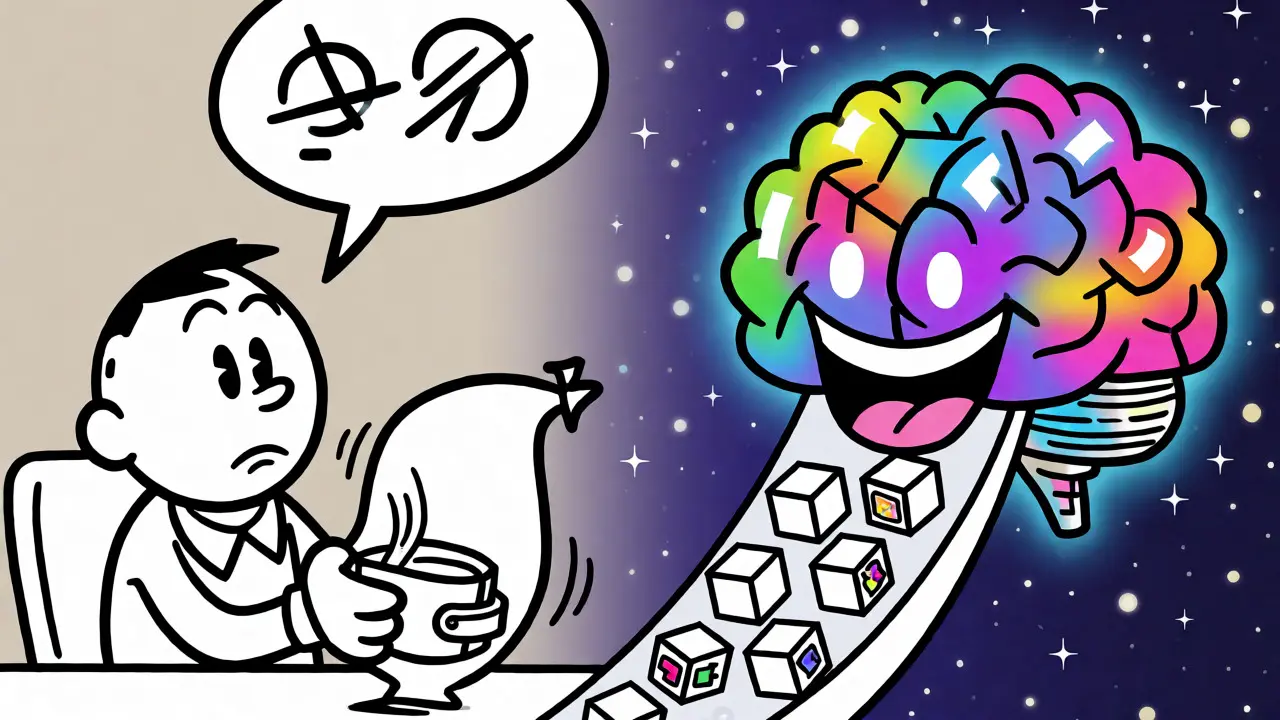
You type a prompt into an AI chatbot. It spits out a coherent answer in seconds. But behind that magic lies a gritty, computational reality: the model doesn't read words. It reads numbers. Specifically, it reads tokens, which are small chunks of text converted into numerical vectors. If you've ever wondered why your API bill spikes when you paste a long document, or why the model hallucinates on rare technical terms, the culprit is often how those tokens were created. This process, known as tokenization, is the bridge between human language and machine logic. Get it wrong, and your model struggles to understand context. Get it right, and you unlock efficiency and accuracy.
Why Raw Text Doesn't Work for Machines
Human language is messy. We have typos, slang, compound words, and endless variations of proper nouns. A computer, however, needs structure. It can't just "know" what "unhappiness" means; it needs to break it down into pieces it recognizes. If we treated every unique word as a single unit, our vocabulary would explode into millions of entries, making models slow and memory-hungry. Conversely, if we used only individual letters, sequences would become too long for current hardware to handle efficiently. Tokenization solves this by segmenting text into standardized units. These units aren't always whole words. They might be parts of words, punctuation marks, or even spaces. For example, the sentence "Generative AI is revolutionizing technology" might be split into ['Gener', 'ative', 'AI', 'is', 'revol', 'ution', 'izing', 'tech', 'nology']. Each of these fragments gets mapped to a specific number ID. The model then learns relationships between these IDs. This approach allows AI to handle new, unseen words by breaking them into familiar subparts, ensuring the system remains robust against the infinite variability of human speech.
The Dominance of Subword Algorithms
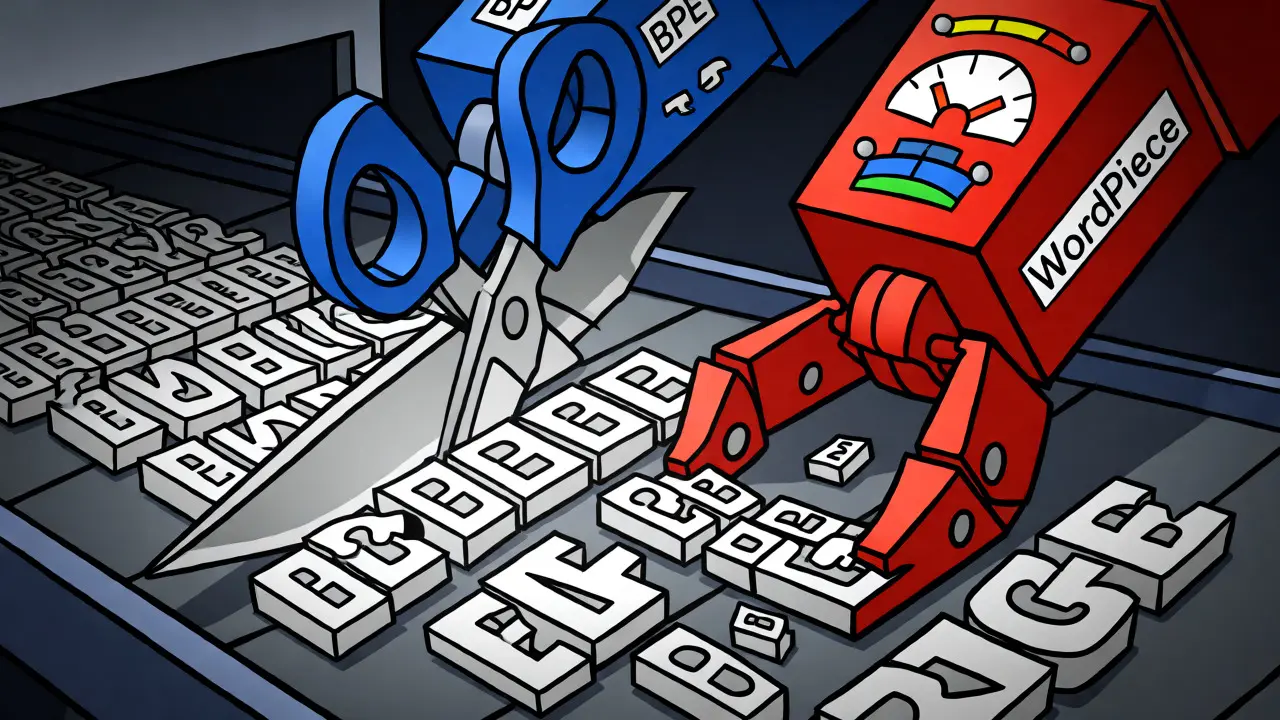
Most modern large language models (LLMs) don't use simple word splitting. They rely on sophisticated subword algorithms. The two heavyweights here are Byte-Pair Encoding (BPE) and WordPiece. Both aim to find the sweet spot between vocabulary size and sequence length, but they go about it differently. BPE starts from the ground up. Imagine you have a massive pile of text. You start with every character as its own token. Then, you look for the most frequent pair of adjacent characters-say, "th" appears more than any other pair. You merge them into a new token "th". You repeat this process, merging the next most frequent pairs, until you reach your desired vocabulary size. This method is iterative and greedy. It's highly effective because it naturally captures common linguistic patterns like prefixes ("un-", "re-") and suffixes ("-ing", "-ed"). Models like GPT-4 and Llama use variants of BPE because it handles diverse languages and code snippets reasonably well without needing a pre-defined dictionary.
WordPiece takes a probabilistic approach. Instead of just counting frequency, it calculates the likelihood of a pair of tokens appearing together based on their individual frequencies. It merges pairs that maximize the probability of the resulting sequence. This subtle difference means WordPiece tends to produce different splits than BPE for the same input. It was popularized by Google's BERT and RoBERTa models. In tasks where understanding masked words is critical, WordPiece has shown strong performance. However, both methods share a core limitation: they are static. Once the vocabulary is built during training, it rarely changes, which can cause issues when dealing with rapidly evolving internet slang or niche technical jargon.
Comparing Tokenization Strategies
Choosing the right tokenizer isn't just a technical detail; it impacts cost and speed. Here is how the main approaches stack up against each other in real-world scenarios.
| Method | Mechanism | Pros | Cons | Best Use Case |
|---|---|---|---|---|
| Word-Level | Splits by whitespace/punctuation | Simple, preserves meaning | Huge vocab, fails on unknown words | Small, controlled domains |
| Character-Level | Splits into individual letters | No OOV errors, tiny vocab | Very long sequences, hard to learn semantics | Spelling correction, noisy text |
| Byte-Pair Encoding (BPE) | Merges frequent character pairs | Handles OOV via subwords, efficient | Can split meaningful words awkwardly | General purpose LLMs (GPT, Llama) |
| WordPiece | Merges based on likelihood scores | Optimizes for semantic density | Slower training, complex implementation | Masked LM tasks (BERT) |
| SentencePiece | Language-agnostic subword tokenizer | No preprocessing needed, multilingual | Similar to BPE/WordPiece trade-offs | Multilingual models (T5, PaLM) |
The Hidden Costs of Token Counts
If you're building an app on top of an API, you pay per token. Not per word. This distinction trips up many developers. The phrase "internationalization" might be one word to you, but to a tokenizer, it could be four or five tokens depending on the algorithm. Why does this matter? Because transformer architectures have a quadratic complexity regarding sequence length. Double the tokens, and you might quadruple the computation time and memory usage. Moreover, different models use different tokenizers. The word "strawberry" might be one token in one model and three in another. When you switch providers or upgrade models, your costs can change unpredictably if you don't account for this. Understanding your specific tokenizer's behavior helps you optimize prompts. Shorter, clearer prompts save money. But cutting corners too aggressively can strip away context, leading to poorer answers. It’s a balancing act between brevity and clarity.
Beyond Text: Multimodal Tokenization
We usually think of tokens as text, but the concept extends far beyond. In multimodal systems like DALL·E or Stable Diffusion, images are also tokenized. An image isn't processed as pixels directly; it's broken down into patches-small square regions of the image. These patches are then converted into embeddings, similar to how text tokens are handled. This allows the model to associate visual concepts with textual descriptions within the same mathematical space. This expansion raises new challenges. How do you align a visual patch token with a textual token representing "cat"? Research into cross-modal learning focuses on creating shared embedding spaces where these heterogeneous tokens can interact effectively. As AI moves toward handling video, audio, and 3D data, tokenization strategies will need to evolve further to maintain efficiency across these diverse data types.
Emerging Trends and Limitations
Static tokenizers have flaws. They struggle with emojis, special characters, and languages with non-standard scripts. To address this, researchers are exploring dynamic tokenization, where the segmentation strategy adapts based on the input's content. Another frontier is semantics-driven tokenization, which tries to group tokens not just by frequency, but by meaning. This could help models better grasp synonyms or antonyms at the input stage rather than relying solely on deep layers to figure it out. There's also talk of quantum computing applications for tokenization, though this remains largely theoretical. Currently, the focus is on efficiency. Techniques like quantization reduce the precision of token embeddings to speed up inference. Distillation creates smaller models that mimic larger ones, often requiring less complex token processing. These optimizations are crucial as we push toward real-time applications where latency matters more than perfect academic accuracy.
Frequently Asked Questions
What is the difference between a token and a word?
A word is a linguistic unit, while a token is a computational unit. Tokens can be whole words, parts of words (subwords), characters, or punctuation. For example, the word "running" might be split into two tokens: "run" and "ning". Models process tokens, not words.
Why do different AI models give different token counts for the same text?
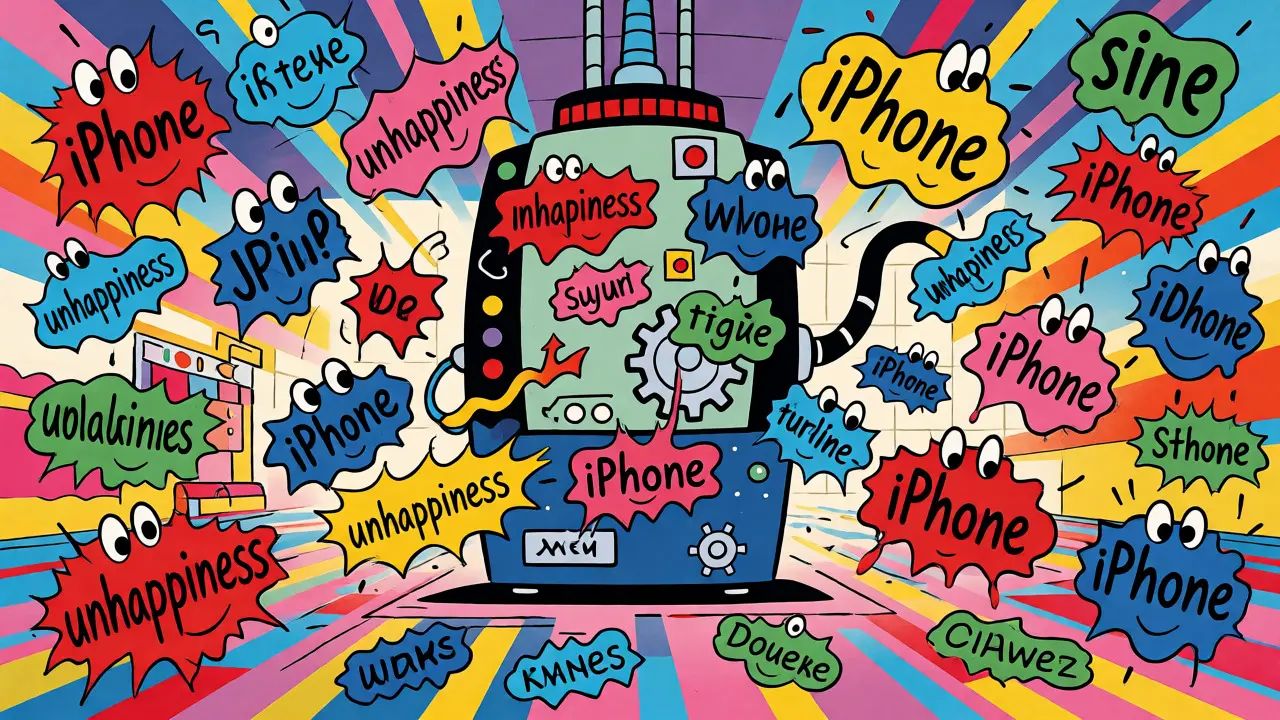
Each model uses a specific tokenizer trained on its own dataset. One model might treat "iPhone" as a single token, while another splits it into "i" and "Phone". These differences arise from variations in algorithms like BPE vs. WordPiece and the specific vocabulary size chosen during training.
How does tokenization affect AI API costs?
API providers charge based on the number of tokens processed. Since some words consume multiple tokens, inefficient tokenization increases costs. Optimizing prompts to use fewer tokens without losing meaning can significantly reduce expenses, especially for high-volume applications.
Can tokenizers handle emojis and special characters?
Yes, but they may be inefficient. Emojis are often represented as multi-byte Unicode characters, which can result in multiple tokens per emoji. This can bloat context windows and increase costs unnecessarily if not managed properly.
What is Out-of-Vocabulary (OOV) error?
An OOV error occurs when a word is not present in the model's fixed vocabulary. Older word-level tokenizers failed completely on OOV words. Modern subword tokenizers mitigate this by breaking unknown words into known subparts, allowing the model to still process them, albeit with less precision.