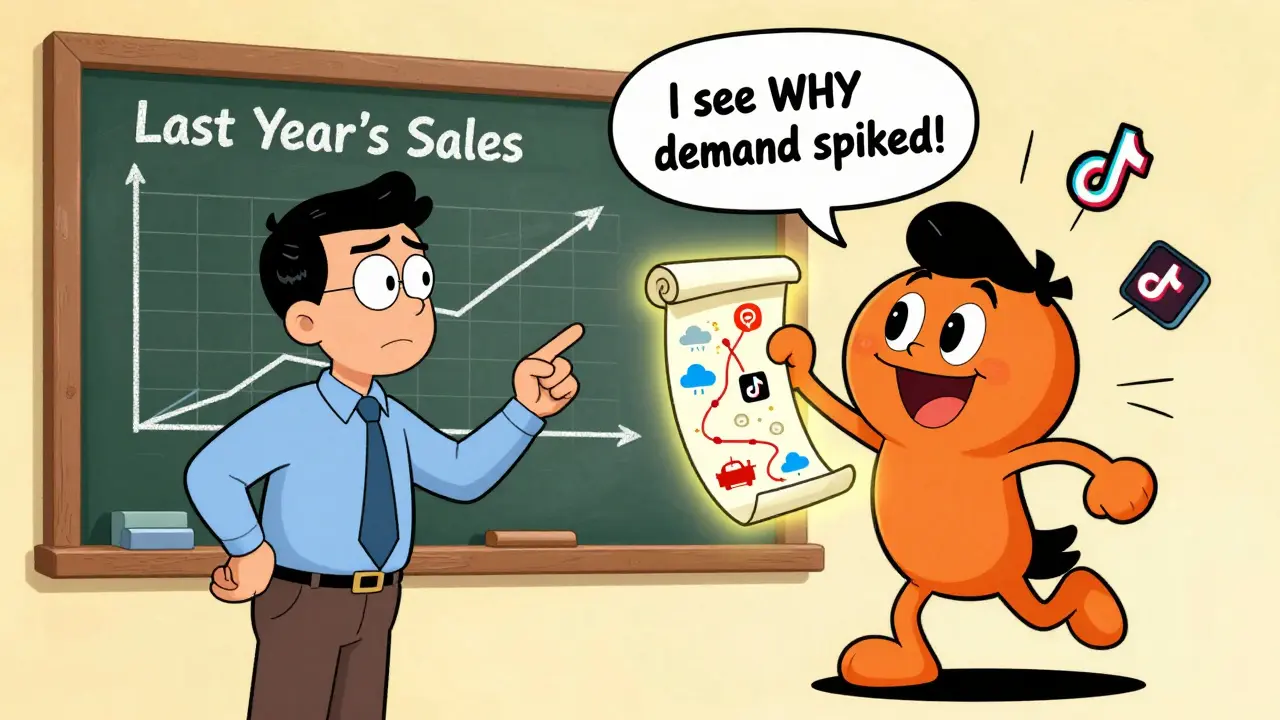
Why Your Old Demand Forecasting Method Is Failing in 2025
Remember when you’d look at last year’s sales numbers, add a little buffer for holidays, and call it a forecast? That approach worked when supply chains were predictable. But today? A storm in Malaysia shuts down a chip factory. A viral TikTok trend spikes demand for a niche product overnight. A port strike in Los Angeles delays shipments by three weeks. Traditional forecasting tools can’t react to this chaos. They see patterns. They don’t understand context. And they certainly can’t explain why a forecast went wrong.
Generative AI changes that. It doesn’t just predict demand - it tells you why it predicted it. It simulates 50 different versions of what could go wrong, then shows you which ones are most likely. It turns numbers into stories. And those stories? They’re what keep shelves stocked, warehouses from bursting, and your supply chain from collapsing.
How Generative AI Builds Demand Narratives (Not Just Numbers)
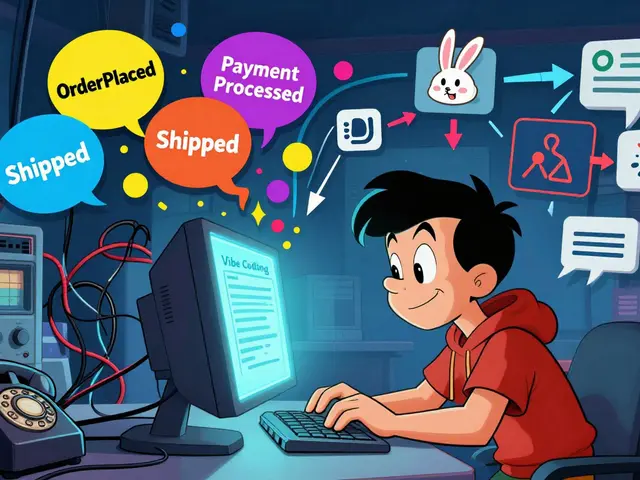
Most forecasting tools give you a single number: "We’ll sell 12,000 units next month." Generative AI gives you a narrative: "Sales will rise 22% next month due to a heatwave in the Southwest driving AC unit demand, but a 14% drop in Europe is expected because of new import tariffs and a weakening euro. Inventory should be shifted from Frankfurt to Madrid to compensate. If the port strike in Long Beach extends beyond 10 days, we risk a 17% stockout in California - consider rerouting through Vancouver."
This isn’t magic. It’s data. Generative AI pulls in hundreds of inputs - historical sales, weather patterns, social media sentiment, shipping delays, commodity prices, even political news feeds. It doesn’t just crunch them. It connects them. It sees that a tweet storm about a new eco-friendly detergent in Germany correlates with a 15% sales spike in Austria. It notices that every time the price of lithium carbonate jumps, electric scooter orders in Spain drop within 72 hours.
Companies using this tech report 20-50% better forecast accuracy. But the real win? They stop guessing. They start knowing. A retail chain in Ohio cut excess inventory by 31% in six months not because they sold more - but because they stopped over-ordering based on outdated assumptions. Their AI told them: "The last three holiday seasons were outliers. Demand is actually flat. Scale back."
What Happens When the Forecast Goes Off the Rails
Even the best AI gets surprised. A new competitor launches. A key supplier goes bankrupt. A pandemic hits a region you thought was safe. That’s when exceptions matter - not the forecast itself, but what happens when reality disagrees with the model.
Generative AI doesn’t just flag exceptions. It explains them. Instead of saying, "Forecast error: +42%," it says, "Demand spiked because a major influencer in Brazil used your product in a viral video that reached 18M viewers. Your inventory system didn’t track Brazilian social trends - we’ve now added that feed. Also, your main distributor in São Paulo had a warehouse fire. We recommend shifting 60% of Brazilian orders to your partner in Bogotá."
That’s the difference between a red alert and a roadmap. One tells you something’s broken. The other tells you how to fix it - and why it broke in the first place.
One manufacturer in Michigan used to spend 12 hours a week manually investigating forecast exceptions. Now, their AI generates a 90-second narrative for each one. Planners spend that time making decisions, not chasing ghosts in spreadsheets.
Why Some Companies Are Still Struggling
Not everyone wins with generative AI. The biggest failure point? Data.
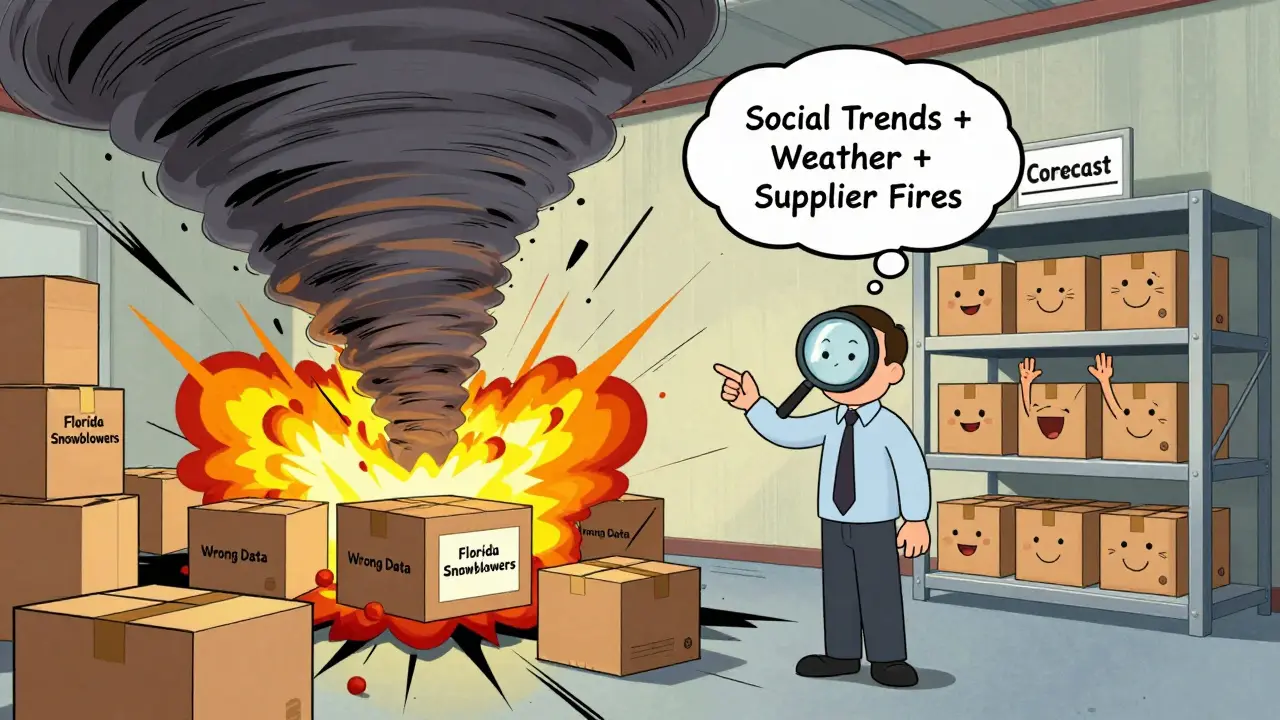
AI needs clean, connected data. If your sales data lives in SAP, your inventory in Oracle, your shipping data in a spreadsheet, and your social media tracking in a third-party tool? You’re building a house on sand. One company spent 14 months just cleaning up data before their AI even started working. Another tried to skip the prep and ended up with a model that thought snowstorms in Florida meant a surge in snowblower sales.
Another trap? Expecting AI to replace humans. Generative AI is a co-pilot, not a pilot. It suggests. It simulates. It explains. But it doesn’t have context for your company’s culture, your supplier relationships, or your CEO’s risk tolerance. A biotech firm in Boston used AI to recommend switching suppliers during a geopolitical crisis. Their planner knew the new vendor had a history of quality issues - something the AI couldn’t see. They overruled the suggestion. Saved the product line.
And then there’s the black box problem. Some vendors sell AI as a sealed box. You feed it data. It spits out answers. But if you can’t understand why it made a decision, you won’t trust it. And if you don’t trust it, you won’t use it. The best systems give you traceable logic - "This forecast was influenced 40% by weather, 30% by social sentiment, 20% by lead time changes, 10% by economic indicators."
What You Need to Get Started
You don’t need a tech team of 50. But you do need three things:
- Unified data - All your sales, inventory, logistics, and external data (weather, social, economic) in one place. If you’re using Excel files and email attachments, start there.
- A clear use case - Don’t try to optimize everything at once. Pick one product line. One region. One pain point - like reducing stockouts in your top 10 SKUs.
- A planner who’s curious - The best AI tool in the world won’t help if the person using it doesn’t ask, "Why?" Train your planners to question the AI’s narratives. Test them. Challenge them. That’s how the model learns.
Implementation usually takes 6-12 months. The first 3-6 months? Data cleanup. The next 2-4? Training the model. The last 1-3? Integrating it into your planning meetings. Don’t rush it. The ROI comes from better decisions - not faster reports.
Who’s Winning With This Right Now
Leading adopters aren’t tech giants. They’re companies that needed to survive chaos.
- Retailers - One chain in California reduced overstock by 35% and stockouts by 28% by using AI to predict regional demand shifts during the 2024 holiday rush. Their AI caught a surge in demand for portable heaters in Arizona - a region they’d never forecasted before.
- Pharmaceuticals - A drugmaker in New Jersey used generative AI to simulate disruptions from raw material shortages. When a supplier in India had a power outage, their system flagged a 14-day delay and automatically rerouted orders to a backup plant in Germany - all before the supplier even called.
- Automotive - A Tier 1 supplier in Ohio used AI to model the impact of chip shortages across 120 components. They didn’t just reorder parts. They redesigned their production schedule to prioritize high-margin vehicles. Saved $2.1M in lost production.
These aren’t outliers. They’re early adopters. And they’re pulling ahead - not because they spent more, but because they thought differently.
The Future: AI That Learns From Your Decisions
The next leap isn’t just better forecasts. It’s feedback loops.
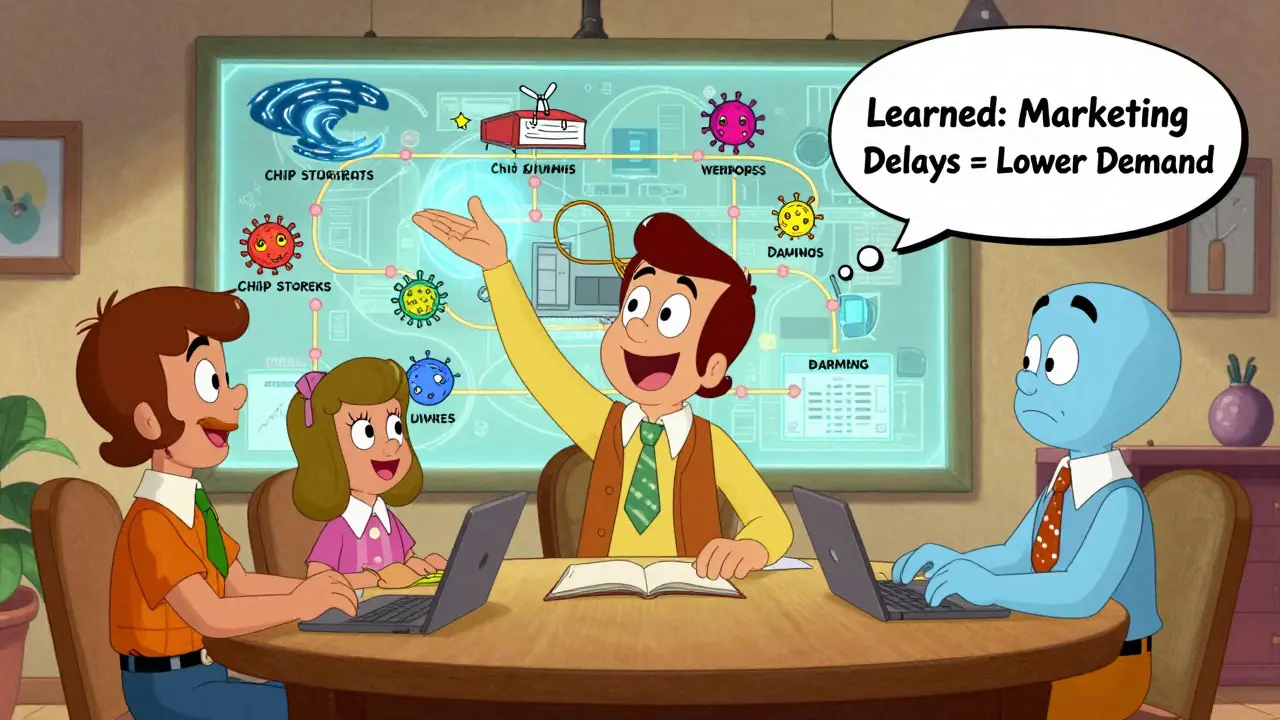
Imagine this: Your AI suggests a 20% inventory increase for a new product. You say no - because you know the marketing campaign got delayed. The AI notes that. Next time, it weights marketing signals more heavily. You override it again. It learns. Over months, it starts matching your judgment - not because you programmed it, but because you taught it through action.
By 2027, 60% of large companies will use digital twins - virtual replicas of their entire supply chain - powered by generative AI. They’ll simulate a hurricane hitting a port, then instantly see how it ripples through their suppliers, warehouses, and retailers. They’ll test 100 responses in minutes. Pick the best one. Execute.
But here’s the truth: The best supply chains won’t be the ones with the smartest AI. They’ll be the ones where humans and machines work together. Where planners don’t fear the AI - they use it to think bigger, faster, and smarter.
What to Do Next
If you’re still using spreadsheets or basic forecasting tools, start here:
- Identify your biggest pain point: Stockouts? Excess inventory? Late shipments?
- Map your data sources. How many systems do you use? Are they connected?
- Find one product line or region to pilot. Start small. Measure everything.
- Ask your team: "What’s one thing you wish you could predict?" That’s your AI’s first mission.
You don’t need to go all-in tomorrow. But if you wait until everyone else is using this? You’ll be playing catch-up in a race you didn’t even know you were in.

I’ve been using this AI stuff for my small retail chain in Ontario, and honestly? It’s like having a psychic who reads spreadsheets. Last winter, it flagged a surge in demand for thermal socks in Winnipeg because of a viral TikTok trend with a Canadian influencer-something our old system completely missed. We stocked up, sold out in 72 hours, and didn’t have to pay for expedited shipping. 🤯 The AI even told us why: "People were wearing them under snow boots in a 30-second clip." I still don’t know how it connected that, but I’m not arguing with the profit margin. 😅
The notion that generative AI provides ‘narratives’ rather than forecasts is a semantic rebranding of probabilistic modeling-nothing more. The real innovation lies not in anthropomorphizing statistical outputs, but in the rigorous integration of heterogeneous data streams into a unified probabilistic framework. The rhetoric surrounding ‘stories’ is performative, designed to appease non-technical stakeholders who require narrative coherence to justify capital expenditure. The underlying mathematics remains unchanged.
They dont want you to know this but the AI is just a fancy way for corporations to spy on you. Every time you tweet about a product, they use it to predict what youll buy next. Then they charge you more. Its not about supply chains its about controlling you. I saw a guy on YouTube say the government is using this to track what people buy during protests. You think thats a coincidence? I dont think so.
You think this AI is smart? It’s just a glorified spreadsheet that thinks a tweet is a weather report. My cousin works at a warehouse and they used this system and it told them to order 2000 more of a product that got banned by the FDA two weeks before. They lost 80k. And now they’re stuck with a system that thinks if a dog barks on Instagram, it means dog food sales will spike. This isn’t innovation. It’s corporate delusion.
The elegance of generative AI in supply chain forecasting lies not merely in its predictive accuracy, but in its capacity to render latent, nonlinear dependencies between disparate data modalities into interpretable, context-rich narratives. The confluence of geospatial weather patterns, micro-trend sentiment analysis from social platforms, and real-time logistics telemetry enables a form of anticipatory cognition previously unattainable through traditional econometric models. What is particularly compelling is the emergent capacity for the system to self-correct via human feedback loops-transforming the planner from a passive recipient of outputs into an active instructor of probabilistic reasoning. This is not automation; it is augmentation of human judgment at a systemic level.
I’ve seen this work. One company I worked with cut their inventory costs by 30% in six months. No magic. Just clean data and a planner who asked why.
You think AI is learning from data? Nah. It’s just mirroring the biases of the people who fed it. Every time it says ‘heatwave drives AC sales’ it’s just repeating what humans told it to believe. But the real truth? The system is being trained to make you dependent. Once you trust it, you stop thinking. And then who controls the narrative? Not you. Not the planner. The algorithm. And the people behind it. We’re not building tools-we’re building cages with pretty labels.
This is exactly why capitalism is broken. They don’t care about people-they care about profit. They take data from our social media, our purchases, our lives, and turn it into a machine that tells them how to squeeze more money out of us. And you call this ‘innovation’? It’s surveillance dressed up in buzzwords. The AI doesn’t care that your local store went under because it predicted a 12% drop in sales. It just optimized for shareholders. That’s not progress. That’s exploitation.
USA best supply chain no cap. Other countries try to copy this but they dont have the grit. We dont need no fancy AI to know when to stock up. We just know. And if you dont like it? Move to canada. They still use paper lists.
This is why people don’t trust corporations anymore. You make these systems sound like heroes, but they’re just tools to cut jobs and increase prices. The AI doesn’t care that your warehouse worker lost their overtime because the system told them they didn’t need extra staff. You call it ‘efficiency.’ I call it betrayal. And the fact that you’re praising this instead of fighting for people? That’s the real failure.