
Generative AI isn’t just another tech buzzword-it’s reshaping how businesses run day-to-day. Companies aren’t experimenting with it anymore. They’re building it into their core workflows. From automating customer service to predicting supply chain disruptions, generative AI is delivering real, measurable results. But not every company gets it right. The difference between success and failure often comes down to one thing: how you implement it.
What Generative AI Actually Does in Business
Most people think of generative AI as a tool that writes emails or generates images. That’s true-but it’s only the surface. In business, it’s used to solve complex, messy problems that traditional software can’t touch. Think of it as a cognitive assistant that doesn’t just follow rules-it learns patterns, connects dots, and creates new options from thin air.
Unlike robotic process automation (RPA), which handles repetitive, structured tasks like filling out forms, generative AI works with unstructured data: customer emails, meeting transcripts, supply chain reports, legal contracts. It reads them, understands context, and responds in human-like ways. That’s why companies like Commerzbank used it to automate client call documentation. Instead of having financial advisors spend hours writing notes after every call, an AI agent listened, summarized key points, and filed them automatically. The result? Advisors regained 20% of their time to focus on building client relationships.
It’s not magic. It’s pattern recognition at scale. And it’s already saving businesses millions.
Top 5 High-Impact Use Cases
Not all uses of generative AI are equal. Some deliver quick wins. Others transform entire departments. Here are the five most impactful applications based on real enterprise results:
- Customer Service Automation - Chatbots powered by generative AI don’t just answer FAQs. They handle complex, multi-turn conversations. Pinnacol Assurance found that 96% of employees saved time using Gemini to draft client interview questions and analyze insurance claims. These aren’t canned responses-they’re tailored, context-aware answers that reduce escalations by up to 40%.
- Document and Report Generation - Legal teams, HR departments, and finance units spend weeks drafting reports, contracts, and compliance documents. Citi used Vertex AI to automate internal document creation across teams. One team cut report writing time from 10 hours to 90 minutes. The AI didn’t just copy-paste-it synthesized data from multiple sources into coherent narratives.
- Supply Chain Optimization - BMW Group built SORDI.ai, a digital twin system that simulates thousands of logistics scenarios. By combining historical shipping data with weather forecasts, port delays, and geopolitical risks, the system predicts bottlenecks before they happen. The result? A 30% improvement in distribution efficiency.
- Software Development Assistance - Developers at Croud used custom AI tools to generate code, debug errors, and write unit tests. They reported 4-5x productivity gains on repetitive coding tasks. The AI didn’t replace developers-it handled boilerplate work, letting them focus on architecture and innovation.
- Marketing Personalization at Scale - Dun & Bradstreet built a Gemini-powered email tool that generates hyper-personalized outreach messages based on a prospect’s industry, size, and recent news. The system doesn’t just insert names-it references recent funding rounds, leadership changes, or regulatory updates. Campaign open rates jumped 65%.

How Successful Companies Implement It
Most AI projects fail because companies try to boil the ocean. They dump generative AI into every department and hope something sticks. The winners take a different approach.
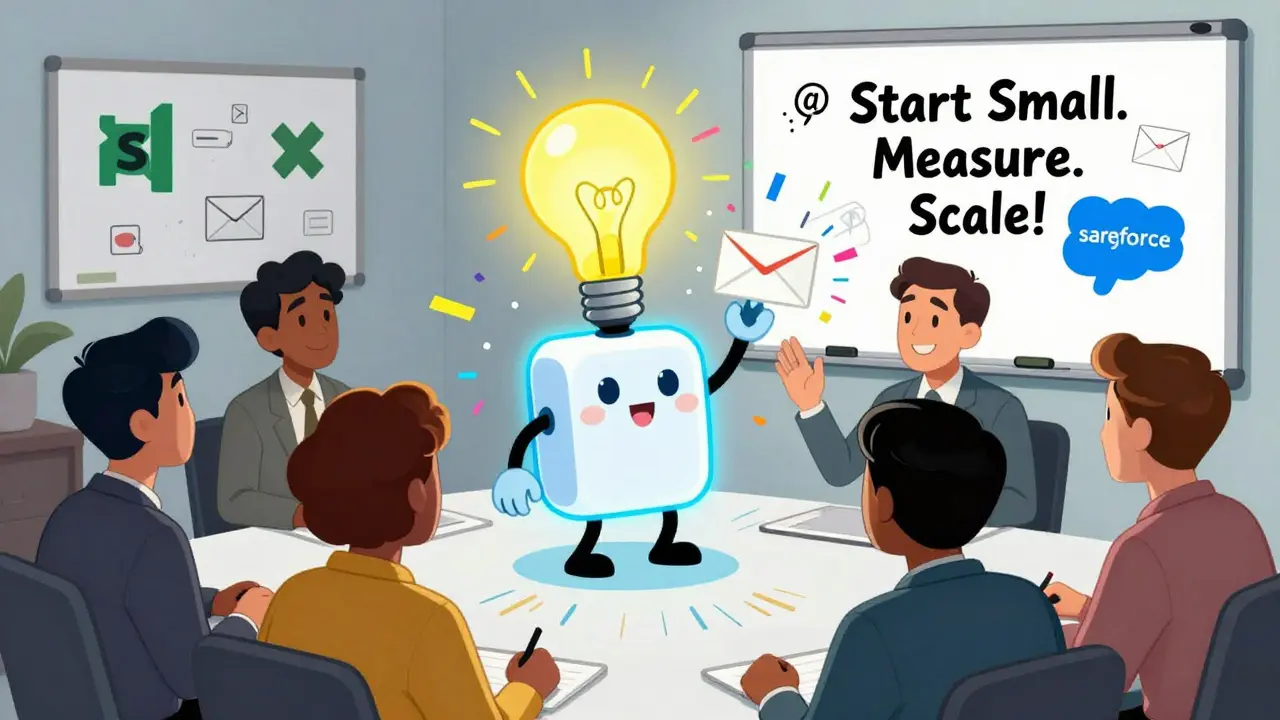
They start small. They pick one high-friction, low-risk task. Then they measure. Then they scale.
Here’s the pattern:
- Find the bottleneck - Look for tasks that eat up hours but add little value. Meeting summaries, customer intake forms, invoice processing. These are low-hanging fruit.
- Build a pilot - Don’t roll out to 100 people. Start with 5-10 users. Give them a clear goal: “Reduce time spent on X by 50%.” Track the results.
- Integrate, don’t overlay - Generative AI needs to live inside your existing tools. If your team uses Salesforce, make the AI work inside Salesforce. If they use Slack, let it respond in Slack. Forcing users into a new interface kills adoption.
- Train it on your data - Public models are generic. Your AI needs to learn your language. A healthcare company trained its AI on internal policy manuals and patient records. The result? Accurate, compliant responses instead of generic advice.
- Measure impact, not novelty - Did it save time? Reduce errors? Increase revenue? If not, pivot or kill it. Don’t fall in love with the tech. Fall in love with the outcome.
Companies that follow this path see ROI within 3-6 months. Those that skip it? They’re stuck with a fancy demo that nobody uses.
Where It Falls Short
Generative AI isn’t perfect. And pretending it is will get you into trouble.
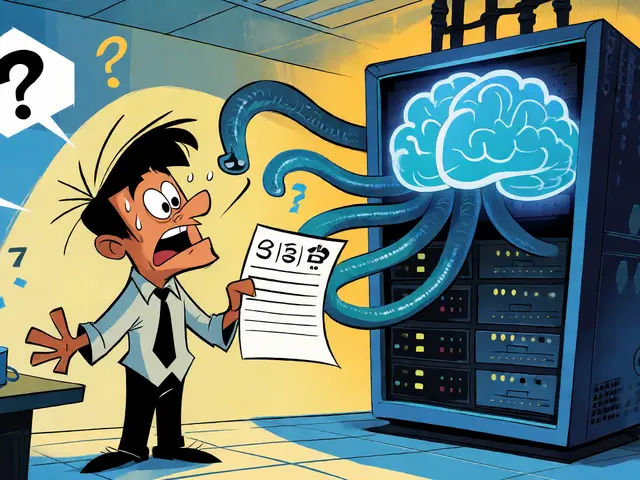
It hallucinates. It makes things up. A model might confidently generate a financial forecast based on fake data. In customer service, that could mean promising a refund that doesn’t exist. In HR, it might suggest a candidate based on biased training data.
It’s also hungry. Training large models costs millions. Running them daily eats into cloud budgets. And if your data is messy-duplicate records, outdated CRM entries, missing fields-the AI will struggle. Garbage in, garbage out.
And then there’s culture. Employees fear being replaced. Managers don’t know how to supervise an AI. Without training and change management, even the best tool fails.
The key is governance. Set rules:
- Never let AI make final decisions in regulated areas (finance, healthcare, hiring).
- Require human review for high-stakes outputs.
- Monitor for bias-especially in customer segmentation and recruitment tools.
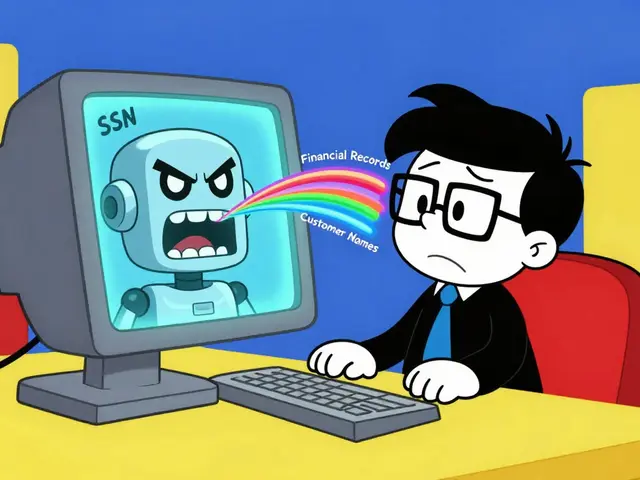
- Keep data private. Use on-prem or private cloud models if you’re in healthcare or banking.
What’s Next: Agentic AI and Beyond
The next wave isn’t just AI that responds. It’s AI that acts.
Agentic AI systems can chain together multiple tasks without human input. Imagine an AI that:
- Monitors customer support tickets
- Identifies a recurring complaint
- Generates a fix for the product team
- Updates the knowledge base
- Sends a notification to affected customers
This isn’t science fiction. Companies like PGIM and IBM are already testing these systems. They’re not replacing humans-they’re giving them superpowers.
By 2030, McKinsey estimates generative AI could automate 20-30% of current work hours. But the real value isn’t in cutting staff. It’s in freeing people to do work that matters: solving hard problems, building relationships, and creating new ideas.
Final Thought: Don’t Chase AI. Solve Problems.
Too many companies buy generative AI because it’s trendy. They want to be “innovative.” But innovation isn’t about using the latest tool-it’s about solving real problems faster and better.
Ask yourself:
- What task takes too long and drains morale?
- Where do customers get frustrated?
- What data do we have that’s sitting unused?
Answer those, and you’ll find your AI use case-not the other way around.
Can generative AI replace human workers in business operations?
No-not completely. Generative AI automates repetitive, time-consuming tasks, but it doesn’t replace judgment, creativity, or emotional intelligence. It’s best used as a co-pilot. For example, a customer service rep can use AI to draft responses, but still needs to review and approve them. A financial analyst can use AI to generate reports, but must interpret the results. The goal isn’t to eliminate humans-it’s to let them focus on higher-value work.
Is generative AI only for large enterprises?
No. While large companies have more resources to build custom AI tools, small and mid-sized businesses can use off-the-shelf platforms like Google Gemini, Microsoft Copilot, or AWS Bedrock. These tools integrate with common software like Microsoft 365, Salesforce, and Slack. A small marketing team can use AI to write campaign copy, analyze customer feedback, or summarize meeting notes-all without needing a data science team.
How long does it take to see results from generative AI?
With the right approach, you can see results in 30-90 days. Start with a single high-impact task-like summarizing sales calls or automating report generation. Pilot it with a small team. If it saves time and reduces errors, expand it. Companies that rush into enterprise-wide rollouts often wait 6-12 months and see little ROI. The key is starting small, measuring fast, and iterating.
What’s the biggest risk when implementing generative AI?
The biggest risk is trusting AI without oversight. Generative models can invent facts, repeat biases, or leak sensitive data if not properly controlled. For example, an AI trained on internal emails might accidentally generate a response that reveals confidential client information. That’s why governance is critical: set rules, require human review for sensitive outputs, and monitor what the AI is doing. Never let it operate in a black box.
Which industries are seeing the most benefit?
Financial services lead in fraud detection and document processing. Healthcare uses it for drug discovery and patient record summarization. Manufacturing optimizes supply chains with digital twins. Energy companies simulate demand scenarios. But every industry benefits-retail uses it for personalized marketing, legal firms for contract review, and education for adaptive learning tools. The common thread? Any business that deals with large volumes of text, data, or customer interactions can use generative AI to cut costs and improve quality.
Generative AI is not a magic wand, but a scalpel-precise, powerful, and only as effective as the hand that wields it.
I’ve seen teams in India implement this at the grassroots level: a small fintech startup used Gemini to automate loan application summaries, cutting processing time from 48 hours to under 4.
The key isn’t the tool, it’s the discipline: start with one painful, repetitive task, train the model on your own documents, and embed it into your existing workflow-never force users into a new app.
And please, never let AI draft customer communications without human oversight. One typo in a financial disclaimer can cost you more than a year of savings.
Also, data quality matters more than model size. A clean, curated dataset of 500 emails will outperform a billion-parameter model trained on noisy public data.
Respect the human layer. AI doesn’t feel frustration, but your customers do. Your team does too.
Don’t chase innovation. Chase reduction in friction.
And if you’re still using spreadsheets to track AI usage? You’re already behind.
Start small. Measure relentlessly. Scale only when the ROI is undeniable.
Success isn’t about deploying AI-it’s about unburdening your people.
lol so ai writes the reports but someone still has to proofread em like a highschool essay?? 😂
Mark, you’re not wrong-but I’ve seen teams where the ‘proofreading’ step became a ritual of trust.
One HR manager in London told me she now reads every AI-generated candidate summary… not to catch errors, but to feel connected to the process.
It’s not about accuracy-it’s about agency.
People need to feel they’re still steering the ship, even if the AI is handling the rudder.
And honestly? The typos? They’re humanizing.
A perfectly polished AI response feels cold. A slightly messy one? Feels like a teammate who’s trying.
Maybe we don’t need perfect AI.
Maybe we just need honest ones.
Love this thread.
I work in edtech in California, and we rolled out AI to summarize parent-teacher conference notes.
At first, teachers hated it. ‘It sounds like a robot wrote this.’
So we tweaked it.
We trained it on real teacher voice-colloquial, emotional, occasionally sarcastic.
Now? The summaries include phrases like ‘Jaden’s still doodling during math, but he’s got the best ‘I got this’ energy in class.’
Parents cry. Not because it’s accurate-but because it feels like someone who actually knows their kid wrote it.
AI doesn’t replace humanity.
It amplifies it.
When you let it learn your tone, your rhythm, your quirks-it becomes a mirror of your team’s soul.
Stop trying to make it perfect.
Make it yours.
What if the real breakthrough isn’t in automation… but in redefinition?
We’ve spent decades optimizing for efficiency.
But maybe the future isn’t about doing more with less.
Maybe it’s about doing less… with more meaning.
When AI takes over invoice processing, what do we replace it with?
Not more meetings.
Not more reports.
But deeper conversations-with clients, with colleagues, with ourselves.
What if the goal of AI in business isn’t to cut costs… but to restore dignity to work?
Every time we hand over a rote task to a machine, we reclaim a sliver of our humanity.
That’s not productivity.
That’s purpose.
And I think… that’s why this matters.