
37% of open-source large language model repositories fail to meet basic license requirements. For companies using these models, that’s not just a technical oversight-it’s a legal time bomb. Imagine spending months building a product only to face a lawsuit for $500,000 or more. This isn’t hypothetical. In 2024, a startup got a cease-and-desist letter from Meta after improperly using Llama 2 under the wrong license. The lesson? Licensing isn’t optional. It’s the foundation of safe, legal AI deployment. Let’s break down exactly what you need to know.
Common License Types and Their Requirements
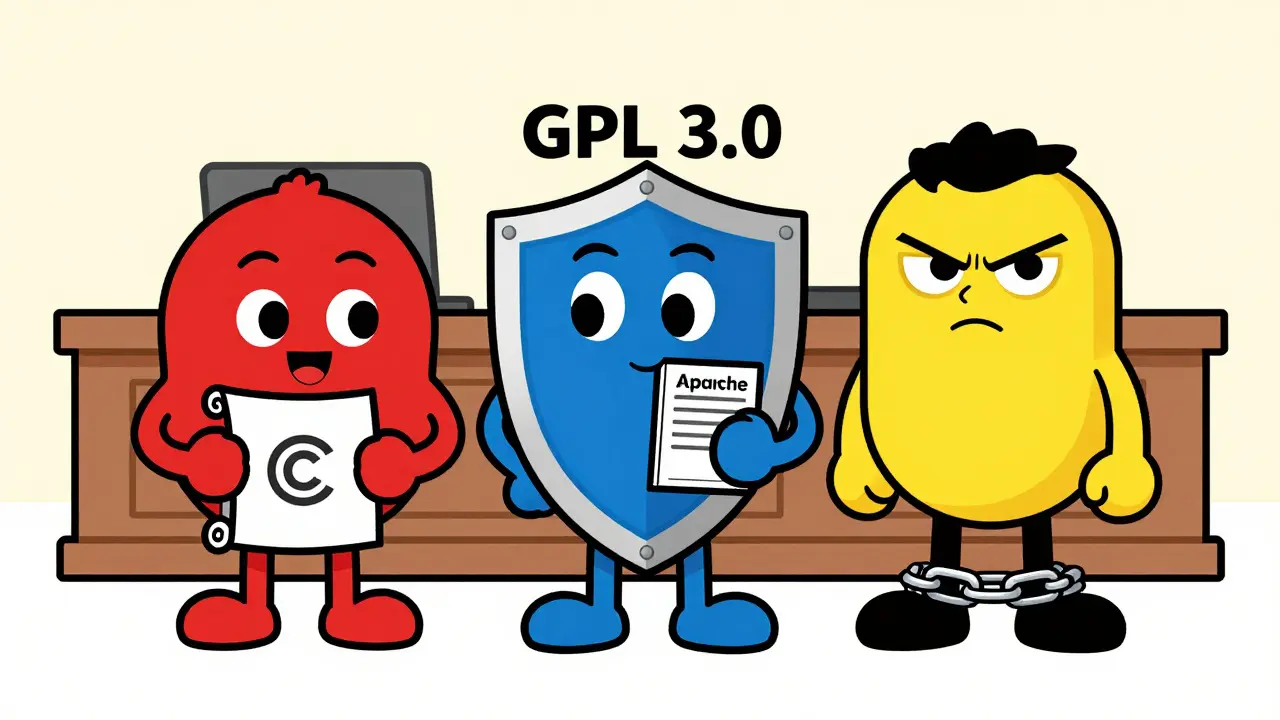
Open-source LLMs come with different licenses, each with specific rules. The MIT Licenseis a permissive license that requires only preserving copyright notices. is one of the most common. It’s simple: you just need to include the original license text and copyright notice. No need to share your own code. This makes it popular for commercial use.
Apache 2.0 Licenseadds patent protection and requires documenting changes. Unlike MIT, Apache 2.0 includes explicit patent grants. If someone contributes to the code, they can’t sue you later for patent infringement. You also have to state any changes you made. This extra step takes a bit more work but offers stronger legal protection.
GPL 3.0 Licenseis a copyleft license that forces you to open-source derivative works. If you modify a GPL-licensed model, you must release your entire project under GPL. This scares most businesses because it exposes proprietary code. Only 8% of enterprises successfully deploy GPL-licensed LLMs commercially, according to Latitude’s 2025 survey.
Hugging Face’s 2025 audit found 62% of open-source LLMs use permissive licenses like MIT or Apache 2.0, 18% use copyleft like GPL, and 12% use weak copyleft like LGPL. The rest are custom licenses or public-domain equivalents.
Risks of Non-Compliance
Ignoring license rules can cost you big. Knobbe Martens legal assessments show potential infringement penalties range from $500,000 to $5 million. In February 2025, a startup settled a $375,000 lawsuit after using a "research-only" licensed model in production. They assumed "open source" meant commercial use was allowed-wrong. The Software Freedom Law Center documented 212 GPL violation cases involving AI models in 2024, with 89% related to improper license propagation in derivative works.
Another common mistake is failing to attribute model outputs. GitHub’s 2025 State of the Octoverse report found 41% of LLM license violations came from missing attribution in binary distributions, like mobile apps. Red Hat’s legal team also warned about "covert insertion of proprietary code" into open-source projects via AI tools. In 2024, they confirmed 17 incidents where GitHub Copilot added GPL-licensed code to MIT-licensed projects, triggering compliance headaches.
Compliance Steps for Safe Deployment
Latitude’s 2025 compliance framework recommends five steps:
- Identify all license components-model code, weights, and training data. These often have separate licenses.
- Determine license type and obligations. Permissive licenses like MIT need minimal effort; GPL requires full source disclosure.
- Document all required attributions. For Apache 2.0, include patent notices and change logs.
- Implement automated license tracking in CI/CD pipelines. Tools like FOSSA or Mend.io scan dependencies in real time.
- Conduct quarterly compliance audits. Xebia’s case studies show this reduces risks by 45%.
Developers with open-source experience need about 8 hours to master basic compliance. Legal teams require 40+ hours of specialized training. The Open Source Initiative’s 2025 toolkit cuts compliance time by 35% for enterprises.
Real-World Successes and Failures
On Reddit’s r/MachineLearning, developer "ML_Engineer_42" spent three weeks resolving Apache 2.0 compliance issues for a commercial product. "The patent clause created unexpected complications with our existing IP portfolio," they said. But they avoided lawsuits by following the proper steps.
Conversely, user "OpenSourceDev" on Hacker News shared a cautionary tale: "We accidentally distributed a fine-tuned Llama 2 model under MIT instead of the required custom license, triggering a cease-and-desist from Meta." Meta’s license requires specific attribution and prohibits commercial use beyond 700 million monthly users. The company fixed the issue but lost months of development time.
Positive examples exist too. Stack Overflow developer "TensorFlowPro" said, "Using Apache 2.0-licensed Mistral 7B saved us $1.2 million annually versus GPT-4 API costs with minimal compliance overhead." Companies like Netflix and Spotify now use permissive-licensed LLMs for internal tools without legal headaches.
Current Trends and Future Outlook
The global open-source LLM market hit $4.2 billion in 2025, growing at 68% yearly. Regulatory pressure is rising. The EU AI Act requires "sufficient documentation of training data sources and licensing" for high-risk systems, effective August 2026. The U.S. Copyright Office also clarified that AI outputs may qualify for copyright protection only with "substantial human modification."
License fragmentation is a growing problem. Custom licenses now make up 34% of open-source LLMs on Hugging Face, up from 12% in 2023. This creates complex compliance challenges. To address this, the Open Source Initiative launched the "AI License Harmonization Project" in March 2025, with participation from 42 major AI companies. Meta also updated its Llama Community License in June 2025 to permit commercial use up to 700 million monthly active users (up from 700,000 in 2023).
Forrester warns that "license fragmentation could increase compliance costs by 300% without industry standardization." But the trend is clear: 83% of enterprise AI deployments now use permissive licenses like MIT or Apache 2.0. These offer the lowest legal risk profile, as confirmed by the American Bar Association’s 2025 Legal AI Guidelines.
Frequently Asked Questions
What’s the difference between MIT and Apache 2.0 licenses?
MIT requires only preserving copyright notices. Apache 2.0 adds patent protection and requires documenting changes. Both are permissive, but Apache gives extra legal safeguards against patent lawsuits. For most commercial projects, Apache 2.0 is safer long-term.
Can I use GPL-licensed LLMs commercially?
Technically yes, but with major restrictions. GPL requires you to open-source any derivative work. Most companies avoid GPL for commercial products because it forces them to share proprietary code. Only 8% of enterprises successfully deploy GPL-licensed LLMs commercially, according to Latitude’s 2025 survey.
How do I check if my LLM’s license is compliant?
Start with Hugging Face’s license metadata fields. Then use tools like FOSSA or Mend.io to scan dependencies. Always verify the license for model code, weights, and training data separately-they might have different terms. Red Hat’s 2025 report found 68% of models have mismatched licenses across these components.
What happens if I don’t comply with a license?
Legal action. In 2024, 212 GPL violation cases involved AI models. Penalties range from $500k to $5 million in infringement lawsuits. Some companies settle for hundreds of thousands, while others face injunctions halting product use. The Software Freedom Law Center documented 89% of violations relate to improper license propagation in derivative works.
Are there tools to help with license compliance?
Yes. FOSSA, Mend.io, and Snyk offer automated scanning. The Open Source Initiative’s 2025 compliance toolkit reduces compliance time by 35% for enterprises. These tools track license obligations in CI/CD pipelines, flagging issues before deployment. For small teams, free tools like ScanCode work well for basic checks.


License compliance isn't optional-it's the foundation of safe AI deployment.
This is crucial for any company. Always verify licenses before deployment. 😊
Oh my goodness, this is such a critical issue that nobody is talking about enough! I mean, think about it-how many startups are out there right now using open-source LLMs without checking the licenses? They probably think 'open source' means 'free to use however I want,' but that's completely wrong. We've seen cases where companies got cease-and-desist letters from Meta for improper use of Llama 2. Imagine working for months on a product only to have it all shut down because of a licensing mistake. It's insane! The legal risks are real and can cost hundreds of thousands or even millions. In 2024, a startup settled a $375,000 lawsuit just because they didn't check their license properly. And it's not just about money-imagine the reputational damage too. Companies like Netflix and Spotify are using permissive licenses correctly and avoiding all this hassle, but others are not. This is why we need to educate everyone about license compliance. It's not optional; it's the foundation of safe AI deployment. I can't stress this enough-always double-check those licenses before deploying anything. It's better to spend a few hours now than face a lawsuit later. 😭🔥
It's fascinating how many companies overlook license details when deploying open-source LLMs. I wonder if there's a standardized method to check all components-model code, weights, and training data-since they often have separate licenses. Red Hat's 2025 report found 68% of models have mismatched licenses across these components, which is alarming. Beyond FOSSA and Mend.io, are there any free tools suitable for small teams? The Open Source Initiative's toolkit reduces compliance time by 35%, but does it work for non-enterprise settings? Also, how do companies handle custom licenses, which now make up 34% of open-source LLMs on Hugging Face? This seems like a growing problem.
Hey everyone, I know this stuff can feel overwhelming at first, but trust me, taking the time to understand licensing isn't just a chore-it's essential for your project's future. We've all been in that rush to deploy quickly, but legal troubles can wipe out months of work in an instant. I've seen teams panic when they get a cease-and-desist letter, and it's not a fun place to be. But here's the good news: compliance is manageable with the right tools and processes. Tools like FOSSA and Mend.io automate a lot of the heavy lifting, and the Open Source Initiative's toolkit makes it even easier. Let's support each other in getting this right-because when we do, we build better, safer AI for everyone. 💪
Oh, fantastic. Just when I thought licensing couldn't get more complicated, here we are again. 'Simple compliance steps' my foot-this is a full-time job for legal teams. But hey, at least we have tools like FOSSA and Mend.io to automate the pain. If you're not using them, you're basically leaving a 'please sue me' sign on your product. And let's not even get started on custom licenses-34% of LLMs on Hugging Face have them, and good luck figuring out what they mean. Sarcasm aside, this is why we need better standardization. Otherwise, we're all just playing Russian roulette with our legal risks. 😒
Understanding the intricacies of open-source LLM licenses is critical for any organization looking to deploy these models legally.
The MIT License is straightforward, requiring only the preservation of copyright notices, which makes it popular for commercial use.
Apache 2.0 adds patent protections and requires documenting changes, which provides additional legal safeguards.
On the flip side, GPL 3.0 mandates that any derivative works must also be open-sourced under GPL, which is a major hurdle for most companies.
According to Latitude's 2025 survey, only 8% of enterprises successfully deploy GPL-licensed LLMs commercially due to these restrictions.
Hugging Face's 2025 audit found that 62% of open-source LLMs use permissive licenses like MIT or Apache 2.0, while 18% use copyleft licenses like GPL.
The remaining 12% use weak copyleft or custom licenses.
Ignoring these license requirements can lead to severe legal consequences.
Knobbe Martens legal assessments show potential infringement penalties ranging from $500,000 to $5 million.
In February 2025, a startup settled a $375,000 lawsuit after using a research-only licensed model in production.
GitHub's 2025 State of the Octoverse report found 41% of violations came from missing attribution in binary distributions.
Red Hat confirmed 17 incidents where GitHub Copilot added GPL-licensed code to MIT-licensed projects.
The Software Freedom Law Center documented 212 GPL violation cases in 2024, with 89% related to improper license propagation.
Latitude's compliance framework recommends five steps: identify all license components, document attributions, automate tracking in CI/CD pipelines, and conduct quarterly audits.
These steps can reduce risks by 45% according to Xebia's case studies.
Proper compliance isn't just about avoiding lawsuits-it's about building trust and ensuring sustainable innovation in the AI ecosystem.
While the preceding discourse elucidates the necessity of license compliance, it is worth contemplating the broader philosophical implications of proprietary versus open-source intellectual property frameworks. The imposition of legal obligations upon derivative works inherently challenges the notion of intellectual freedom, particularly within the context of artificial intelligence development. As such, the current regulatory landscape may necessitate a reevaluation of foundational principles governing collaborative innovation. A more nuanced approach to licensing could potentially mitigate the perceived burdens while preserving legal safeguards. Furthermore, the proliferation of custom licenses, now accounting for 34% of open-source LLMs on Hugging Face, exacerbates compliance complexities. Without industry-wide standardization, compliance costs may increase by 300%, as Forrester warns. The EU AI Act's requirement for 'sufficient documentation of training data sources and licensing' underscores the growing regulatory pressure. Similarly, the U.S. Copyright Office's clarification on AI outputs requiring 'substantial human modification' adds another layer of complexity. The Software Freedom Law Center's documentation of 212 GPL violation cases in 2024 highlights the severity of the issue. Additionally, the Open Source Initiative's toolkit reduces compliance time by 35% for enterprises, offering a practical solution to these challenges. Meta's update to the Llama Community License to permit commercial use up to 700 million monthly active users also reflects evolving industry standards. Therefore, the ongoing AI License Harmonization Project by the Open Source Initiative represents a critical step towards resolving these issues. However, until such standardization is achieved, enterprises must remain vigilant in their compliance efforts to avoid legal repercussions. In conclusion, while the challenges are significant, proactive measures can mitigate risks and foster sustainable innovation in the AI ecosystem.
While philosophical discussions about intellectual property are interesting, the reality is that businesses need clear, actionable steps to avoid legal risks. Tools like FOSSA and Mend.io automate license tracking, making compliance manageable. Overcomplicating the process with abstract debates won't help-focus on practical solutions.