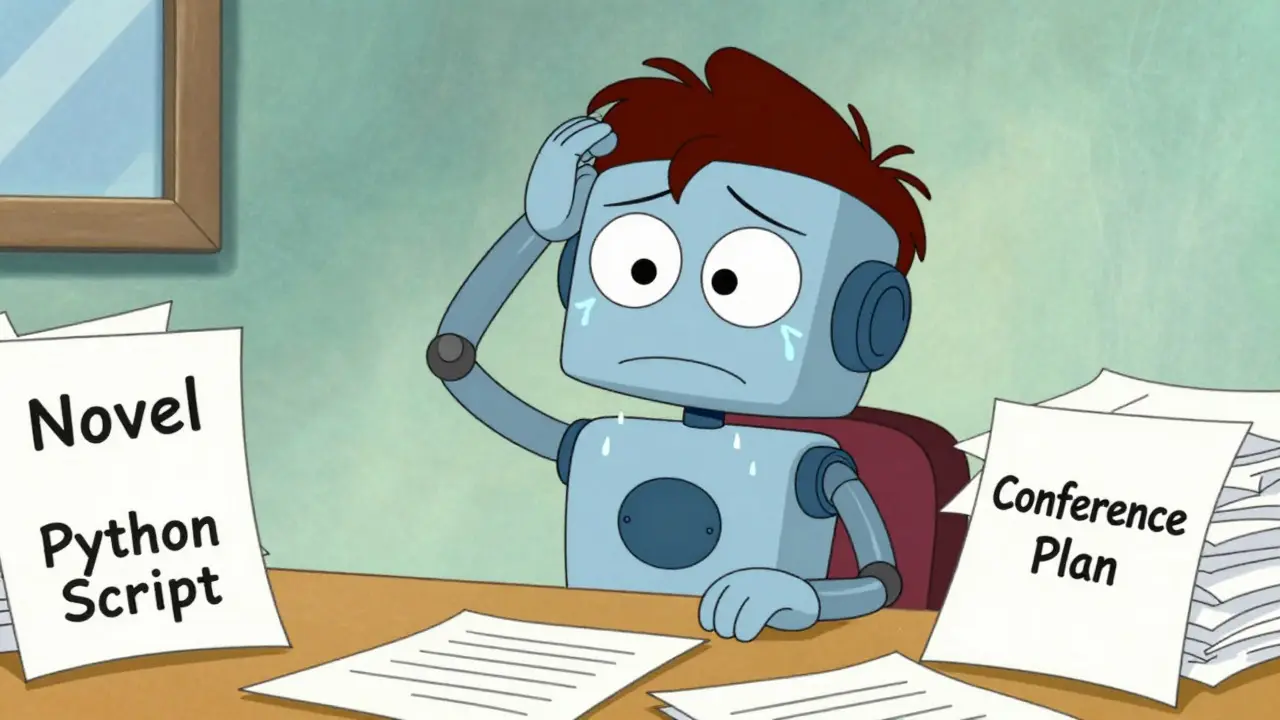
Have you ever asked an AI to write a novel chapter and debug a Python script in the same prompt? If so, you likely got a messy, half-baked result. This is the core problem with Large Language Models (LLMs): they struggle when tasks get too complex. They have a limited "working memory" and tend to lose track of logic steps as the request grows longer. The solution isn't just bigger models; it's smarter planning. Enter task decomposition, the strategy of breaking big problems into small, manageable pieces that an LLM can actually handle reliably.
Why LLMs Need Help Thinking Step-by-Step
Think of an LLM like a brilliant but easily distracted intern. Give them one clear task-like summarizing a short email-and they nail it. Ask them to plan a three-day conference, book flights, and draft invitations simultaneously, and things fall apart. Without structure, the model tries to solve everything at once, leading to hallucinations or logical errors.
Task decomposition is the process of splitting a complex goal into smaller subtasks that are executed sequentially or in parallel. This approach emerged around 2022-2023 as researchers realized that raw scale wasn't enough. By structuring work into chunks, we improve accuracy, reduce costs, and make error recovery possible. In fact, studies show that proper decomposition can boost accuracy by up to 40 percentage points on complex benchmarks like SATBench and Spider.
Core Decomposition Frameworks and Techniques
Not all decomposition strategies are created equal. Depending on your needs, different frameworks offer distinct advantages. Here are the most impactful approaches currently shaping the field:
- ACONIC (Analysis of CONstraint-Induced Complexity): Introduced in early 2025 by Wei et al., this framework treats tasks as constraint satisfaction problems. It uses "treewidth" as a complexity measure to guide how to split the task. On database querying tasks (Spider benchmark), ACONIC showed a 40% improvement over standard methods.
- Chain-of-Thought (CoT): The classic approach where the model is prompted to "think out loud" before answering. While effective, it can be slow and prone to error propagation if one step goes wrong.
- Recursion of Thought (RoT): Designed for tasks that exceed context limits, RoT breaks problems down recursively. It’s particularly strong in multi-digit arithmetic and financial analysis, reducing error rates significantly despite adding slight latency.
- Chain-of-Code (CoC): Instead of pure text reasoning, CoC integrates code execution. The model writes code to solve parts of the problem, then executes it. This outperforms standard CoT by 18.3% on mathematical reasoning tasks.
- Task Navigator: Developed for multimodal LLMs, this framework breaks complex visual questions into sub-questions. It achieved a 22.7% accuracy boost on complex image reasoning tasks compared to monolithic approaches.

The Trade-Off: Performance vs. Complexity
Decomposition isn't a free lunch. While it boosts reliability, it introduces new challenges. The biggest issue is coordination overhead. As Amazon Science noted in March 2025, single LLM task complexity grows linearly with size, but parallel decomposition requires managing multiple subtasks. If you decompose too finely, the effort to stitch answers together outweighs the benefits.
Latency is another concern. Sequential processing adds time. ApX Machine Learning measured that decomposed workflows are, on average, 35% slower than single-step approaches. However, this trade-off is often worth it for high-stakes applications. For example, using smaller LLMs with decomposition reduced infrastructure costs by 62% for website generation projects while maintaining quality.
| Framework | Best Use Case | Key Benefit | Main Drawback |
|---|---|---|---|
| ACONIC | Database Querying, Logic Puzzles | High accuracy (up to 40% gain) | Complex setup, requires formal modeling |
| Chain-of-Thought | General Reasoning | Simple to implement | Error propagation, slow |
| Chain-of-Code | Math, Data Analysis | Precise calculations via code execution | Requires secure code sandbox |
| Task Navigator | Multimodal (Image + Text) | Better visual reasoning | Engineering-heavy refinement process |
| Recursion of Thought | Long Context Tasks | Handles context overflow | Added latency (~400ms per query) |
Practical Implementation: Getting Started
If you're ready to build an agent that plans effectively, start by analyzing your task structure. Don't jump straight into code. First, identify natural "break points" in the workflow. For instance, in a customer support bot, separating "intent recognition" from "response generation" is a clean decomposition point.
Developers report that mastering optimal granularity takes 2-4 weeks of dedicated effort. You'll need to balance specificity with flexibility. Subtasks should be specific enough to be actionable but not so fine-grained that they create coordination nightmares. Tools like LangChain have simplified this process, reducing initial setup time from 80 hours to just 25 hours according to user reports. LangChain's decomposition module now supports parallel execution (v0.2.1, May 2025), making it easier to manage concurrent subtasks.
Common pitfalls include ignoring context coherence. When passing data between subtasks, use summarization techniques to keep relevant information alive. About 72% of successful implementations solve this through explicit context summaries. Also, watch out for conditional branching. If Subtask B only runs if Subtask A succeeds, your workflow needs robust error handling. LLM-driven dynamic decomposition can help here, addressing about 65% of these branching issues.

Market Trends and Future Outlook
The demand for reliable LLM agents is driving rapid adoption. The global market for LLM orchestration tools incorporating decomposition reached $2.8 billion in Q1 2025, growing at 147% year-over-year. Financial services (78%) and healthcare (71%) are leading enterprise adoption because their tasks require high precision.
We're moving toward hybrid approaches. IEEE's May 2025 analysis found that 74% of new production systems use two or more decomposition techniques. For example, combining Chain-of-Code for calculation with Chain-of-Thought for narrative explanation. Looking ahead, Google Research announced automated decomposition boundary detection in March 2025, which promises to remove much of the manual engineering burden. Within 18 months, MIT Technology Review predicts that 83% of AI leads will treat decomposition as a standard component of LLM architecture.
Expert Insights and Community Feedback
Industry experts validate the power of decomposition but warn against blind implementation. Dr. Yisong Yue from Caltech noted that finding the right granularity is "more art than science." Meanwhile, Professor Yoav Goldberg criticized some methods for adding engineering complexity without sufficient cost-benefit analysis. The consensus? Decomposition works best when tailored to the specific constraints of your task.
Developer feedback echoes this nuance. On Reddit, engineers reported a 32% reduction in hallucinations after implementing DECOMP prompting, but admitted it took three weeks to get subtask boundaries right. GitHub discussions reveal that while 78% of developers see improved reliability, 63% cite increased debugging complexity as their top challenge. The key takeaway: test iteratively. Start simple, measure performance, and refine your decomposition map based on real-world errors.
What is the best decomposition strategy for database queries?
The ACONIC framework is currently considered the best for database querying tasks. It models queries as constraint satisfaction problems and has demonstrated a 40% accuracy improvement on the Spider benchmark compared to traditional Chain-of-Thought methods.
Does task decomposition increase latency?
Yes, it typically does. Sequential decomposition adds about 35% latency on average due to multiple API calls and processing steps. Recursion of Thought (RoT) can add around 400ms per query. However, parallel execution features in newer frameworks like LangChain v0.2.1 help mitigate this delay.
How long does it take to implement task decomposition effectively?
Developers report a learning curve of 2-4 weeks to master optimal granularity. Using frameworks like LangChain can reduce initial setup time significantly, from roughly 80 hours to 25 hours, though fine-tuning subtask boundaries still requires iterative testing.
What are the main risks of over-decomposing a task?
Over-decomposition leads to coordination overhead, where the effort to manage and stitch together many tiny subtasks outweighs the benefits. It can also fragment context, disrupting the natural flow of reasoning and potentially increasing error rates rather than reducing them.
Which industries are adopting task decomposition the fastest?
Financial services (78% adoption) and healthcare (71% adoption) are leading the way, according to Forrester's March 2025 survey. These sectors prioritize reliability and accuracy, making the structured approach of decomposition highly valuable for complex workflows.
Can task decomposition reduce computational costs?
Yes. By breaking tasks down, you can use smaller, cheaper LLMs for specific subtasks instead of relying on a single massive model for the entire job. Amazon Science reported a 62% reduction in infrastructure costs for website generation projects using this strategy.
What is Chain-of-Code (CoC) and when should I use it?
Chain-of-Code integrates code execution into the reasoning process. The LLM writes code to solve parts of the problem, which is then executed. It is ideal for mathematical reasoning and data analysis, outperforming standard Chain-of-Thought by 18.3% on math benchmarks.