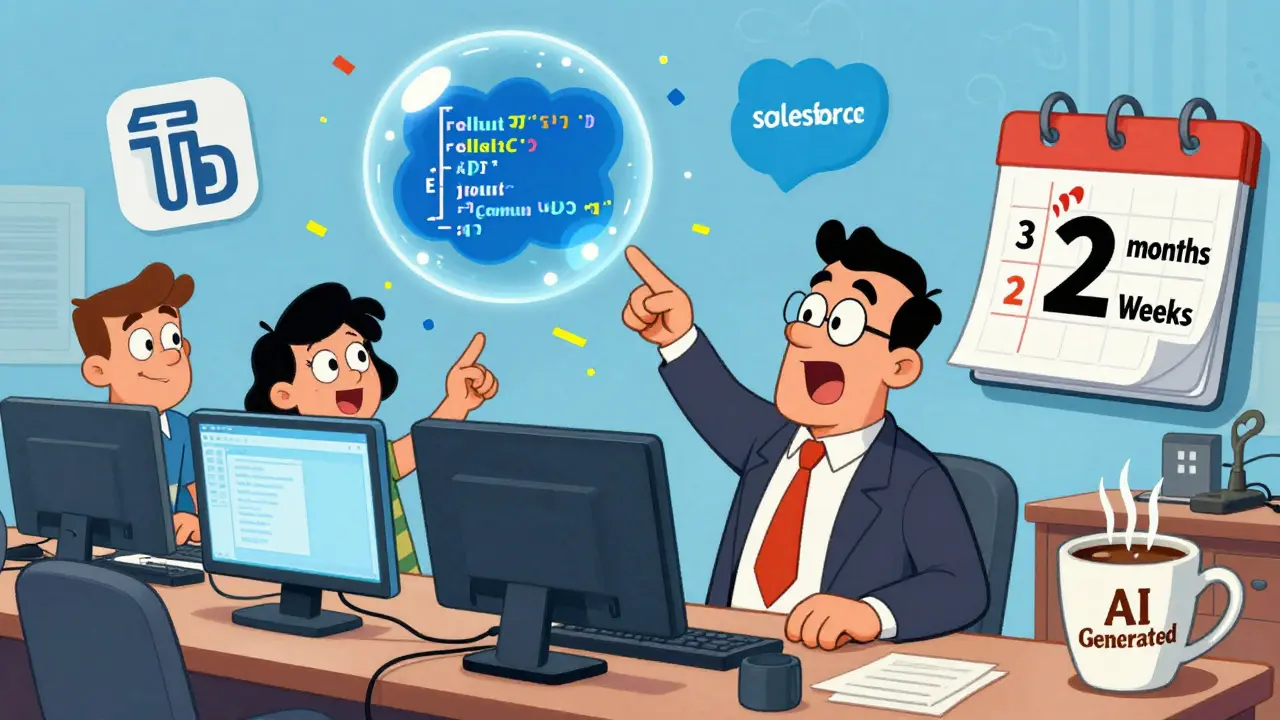
Two years ago, if you told a project manager they could go from idea to working software in under a month, they’d laugh. Today, teams using Vibe Coding are doing exactly that - and the numbers don’t lie. Hexaware Technologies reports that clients now deliver Minimum Valuable Demonstrations (MVDs) in 2 to 4 weeks, not quarters. Relanto AI cuts coding cycles by 40-60%. Salesforce developers are saving 30,000 hours in just 30 days. This isn’t science fiction. It’s happening right now, and it’s rewriting how we predict when software will be ready.
What Exactly Is Vibe Coding?
Vibe Coding isn’t just another AI tool. It’s a full shift in how software gets built. Instead of writing line-by-line code, developers describe what they want in plain language - and the AI generates the structure, tests, and even integrations. Think of it like telling a builder, ‘I need a kitchen with granite counters and a dishwasher,’ and they hand you a fully installed room in a day. The AI handles the wiring, plumbing, and cabinetry. You just say what you need.
This method started as a theoretical idea in early 2024, but by late 2025, it had moved from blog posts to boardrooms. Companies like Hexaware, Relanto AI, and Bacancy Technology now offer full Vibe Coding frameworks. GitHub’s internal data shows up to 55% faster coding with AI pair programmers. Salesforce reported that 20% of all new Apex code in a recent month was AI-generated. That’s not a small pilot - that’s enterprise-scale adoption.
How Vibe Coding Changes Delivery Forecasts
Traditional forecasting relied on historical velocity: ‘Last sprint, we delivered 12 story points. So this sprint, we’ll do 10-15.’ That worked when humans wrote every line. But with Vibe Coding, the baseline changes. The AI doesn’t get tired. It doesn’t need coffee breaks. It doesn’t get stuck on syntax errors for hours.
Second Talent’s 2025 study of 1,200 teams found:
- 81% faster boilerplate and configuration code
- 67% faster API integrations
- 51% faster UI components
- 34% faster business logic
That means a feature that used to take two weeks now takes five days. A backend integration that took a week? Done in one afternoon. When you’re forecasting timelines, you’re not guessing based on past human speed anymore. You’re calculating based on AI-assisted output.
But here’s the catch: not all tasks speed up equally. Complex algorithms? Only 18% faster. Security-critical code? Just 12%. That’s because AI doesn’t yet fully understand risk. It can write a login system fast, but it might miss edge cases that lead to breaches. That’s why teams still need human oversight - not to write the code, but to validate it.
Who Benefits Most - and Who Struggles?
Small teams win big with Vibe Coding. Teams of 2-5 developers report 68% faster delivery. Why? Less coordination. Fewer meetings. Faster feedback loops. A startup in Portland used Hexaware’s framework to build a customer onboarding flow in 10 days - a task that previously took six weeks. They didn’t hire more devs. They just changed how they asked for work.
Larger teams? Not so much. Teams of 15+ developers saw only 31% improvement. Why? Bureaucracy. Legacy systems. Slow approval chains. AI can generate code in minutes, but if your CI/CD pipeline takes three days to deploy, you’re still stuck waiting. Bacancy Technology’s clients often report integration headaches with old systems. One CTO on Capterra said, ‘We got the code fast - then spent two weeks fixing our Jenkins pipeline.’
Industries matter too. Financial services adopted Vibe Coding at 81% rates because they handle routine, repeatable tasks: transaction reports, compliance checks, dashboard updates. Healthcare? Only 67%. Why? Regulations. Audit trails. Compliance checks. You can’t just deploy AI-generated code in a hospital system without layers of human review. The speed gain is real - but the risk tolerance isn’t.
The Hidden Costs: Quality, Validation, and Skill Gaps
Speed isn’t free. Every AI-generated line needs checking. Relanto’s internal data shows 15% of generated code contains hallucinations - code that looks right but doesn’t actually work. One developer on Reddit wrote: ‘We got a feature done in 10 days. Then spent 8 days fixing logic errors the AI misunderstood.’
That’s why validation is now the most important skill in Vibe Coding. You’re not just a coder anymore. You’re a QA engineer, a prompt writer, and a logic auditor. Hexaware’s onboarding requires 2-3 weeks just to train teams how to ask the right questions and spot bad outputs. G2 reviews show 4.6/5 ratings - but the negative ones all say the same thing: ‘It’s powerful, but only if you know how to use it.’
And the learning curve is steep for non-AI-native developers. Older engineers who’ve spent 20 years writing Java or C# struggle to shift from ‘I write code’ to ‘I direct code.’ One FinTech CTO told Capterra: ‘My team’s productivity dropped for three months while we learned to talk to the AI.’
Real-World Examples: What’s Working Now?
Here’s what’s happening on the ground:
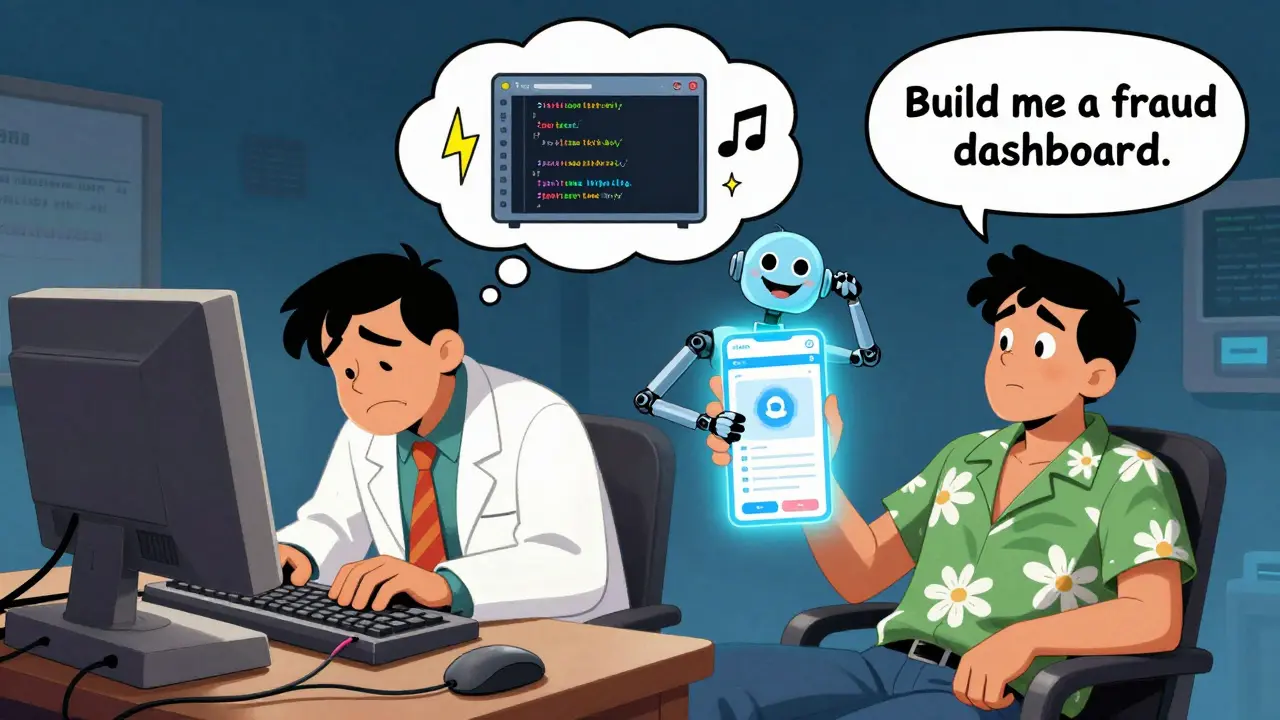
- A fintech startup in Austin used Vibe Coding to build a fraud detection dashboard in 12 days. They used natural language prompts like, ‘Show me transactions over $5K from new users in Texas, flag duplicates, and email alerts.’ The AI generated the frontend, API, and alert logic. Human review caught two edge cases.
- A Salesforce team reduced Apex development time by 45%. One developer delivered a full React + Salesforce integration in one day - something that used to take a week.
- A healthcare SaaS company used Vibe Coding for patient intake forms. They cut development time from 6 weeks to 10 days. But they kept human review on every field that handled PHI (protected health information).
The pattern? Vibe Coding works best when the task is well-defined, repetitive, and low-risk. It fails when the problem is ambiguous, highly regulated, or requires deep domain expertise.
What’s Next? The Road to 2027
By 2026, Gartner predicts 70% of enterprise dev teams will use AI-augmented tools. Vibe Coding is leading that charge. Hexaware just released Vibe Coding 2.0 with built-in quality gates. Relanto integrated with GitHub Copilot. Salesforce plans to raise AI-generated code from 20% to 50% by Q3 2026.
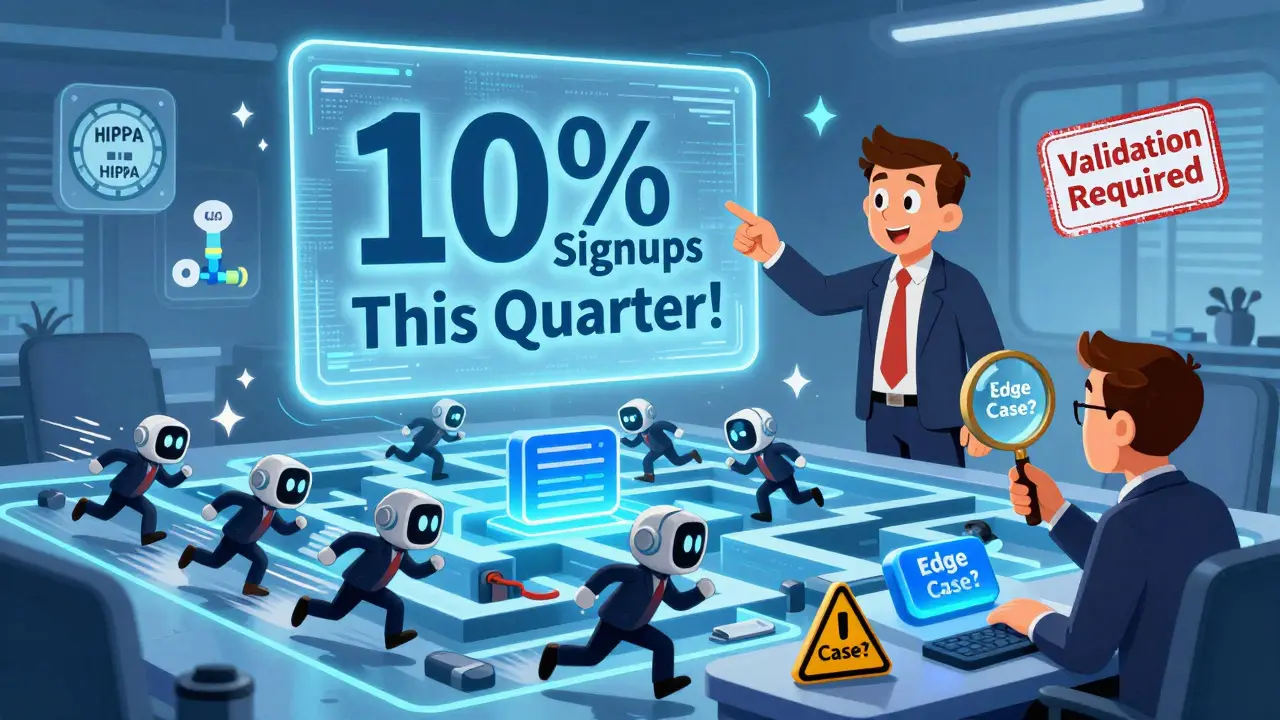
Andrew Chen, who helped define the concept, now predicts a future where product managers don’t write specs - they set outcomes. ‘Tell the system: “Get me 10% more signups this quarter.” Let it figure out the code.’ That’s not far off. If you can forecast delivery timelines today based on AI output, tomorrow you’ll forecast them based on business goals.
But there’s a warning. Second Talent’s CTO, Maria Rodriguez, says: ‘Organizations that get 81% faster with senior devs may crash when junior teams rely too much on AI and lose the ability to debug.’ Code quality isn’t just about speed. It’s about sustainability.
How to Start Using Vibe Coding for Better Forecasts
If you’re thinking about trying this:
- Start small. Pick one low-risk feature - a dashboard, a form, a report.
- Use a proven framework. Hexaware, Relanto, or Bacancy all have documented workflows.
- Train your team on prompt engineering. Bad prompts = bad code.
- Build validation into your sprint. Don’t skip code reviews - just make them faster.
- Track your metrics. Measure how much time you save - and how many bugs slip through.
Don’t try to replace your whole team. Replace the busywork. Let AI handle the boilerplate. Let humans handle the hard stuff.
Final Thought: It’s Not About Replacing Developers - It’s About Redefining Their Role
Vibe Coding doesn’t make developers obsolete. It makes them better. Instead of spending days writing login screens, they’re now designing systems, auditing AI output, and solving the problems AI can’t touch. The best teams aren’t the ones using AI the most. They’re the ones using it the smartest.
Can Vibe Coding replace software developers?
No. Vibe Coding automates routine coding tasks, but it doesn’t replace the need for human judgment. Developers now focus on validating AI output, defining requirements, handling edge cases, and managing security - skills AI can’t replicate. The role is shifting from coder to conductor.
Is Vibe Coding secure for sensitive data?
It can be, but only with strict controls. AI-generated code isn’t inherently insecure, but it can miss edge cases. For sensitive data (like healthcare or finance), always layer human review, use encrypted environments, and avoid training AI on real customer data. Many firms use Vibe Coding only for non-sensitive components and keep critical logic manually written.
How long does it take to train a team on Vibe Coding?
Most teams need 2-3 weeks to become proficient. This includes learning how to write clear prompts, interpret AI outputs, and set up validation workflows. Hexaware and Relanto offer onboarding programs that include sample projects and live feedback. Teams with prior AI experience adapt faster.
What tools are needed to start Vibe Coding?
You need an AI-powered IDE (like GitHub Copilot, Tabnine, or Hexaware’s platform), a CI/CD pipeline that can handle AI-generated code, and a review process. Many teams start with existing tools like VS Code + Copilot and gradually adopt full Vibe Coding frameworks. Don’t buy everything at once - start with one tool and scale.
Does Vibe Coding work with legacy systems?
It can, but it’s harder. Legacy systems often have complex dependencies, undocumented APIs, and outdated frameworks that confuse AI. Companies using Vibe Coding with legacy tech usually start by building new modules in parallel, then slowly replace components. Integration challenges are the #1 reason for failed implementations in large enterprises.
What’s the biggest mistake teams make with Vibe Coding?
Skipping validation. Many teams assume AI-generated code is production-ready. It’s not. The biggest failures happen when teams treat AI like a magic button. The best teams treat it like a junior developer - they review everything, test edge cases, and never trust output without verification.
This is wild, but I’ve seen teams burn out trying to keep up with AI-generated code that makes no sense.
The shift from coding to validating is profound. I’ve trained five teams in India on this, and the most successful ones treated the AI like a brilliant intern who needs constant supervision. The real skill is knowing when to say ‘no’ to the AI’s elegant but broken solution.
Man, I saw a guy in Bangalore try to deploy an AI-generated payment module without review… and yeah, it sent $2000 to a random wallet. The AI thought ‘send money to user’ meant ‘send to whoever says their name is Bob’. We lost a client. And a weekend. And my will to live. AI is fast. But it’s not smart. It’s just good at mimicry.
Let’s be real - this ‘Vibe Coding’ nonsense is just corporate buzzword bingo dressed up in Python. You think you’re saving time? Nah. You’re just offloading your job onto a glorified autocomplete that hallucinates SQL injections like it’s writing poetry. And don’t get me started on juniors who think they’re ‘developers’ now because they can say ‘make a login page’ and copy-paste the result. We’re not building software. We’re curating AI spam.
Isn’t it ironic? We spent decades trying to make machines think like humans… and now we’re teaching humans to think like machines - to speak in prompts, to bow to outputs, to worship efficiency over understanding. Vibe Coding isn’t the future of development. It’s the death of craftsmanship. We used to build with our hands. Now we whisper to algorithms and call it progress. But what are we becoming? The whisperers? The obedient? The codeless?
While the concerns about validation and legacy systems are valid, the potential here is too significant to ignore. Teams that embrace this shift - not as a replacement, but as a force multiplier - are seeing real gains. Start with one small workflow. Invest in training. Celebrate the new role of the developer as architect and auditor. The tools are here. The challenge isn’t the tech - it’s the mindset. And that’s something we can all grow into.