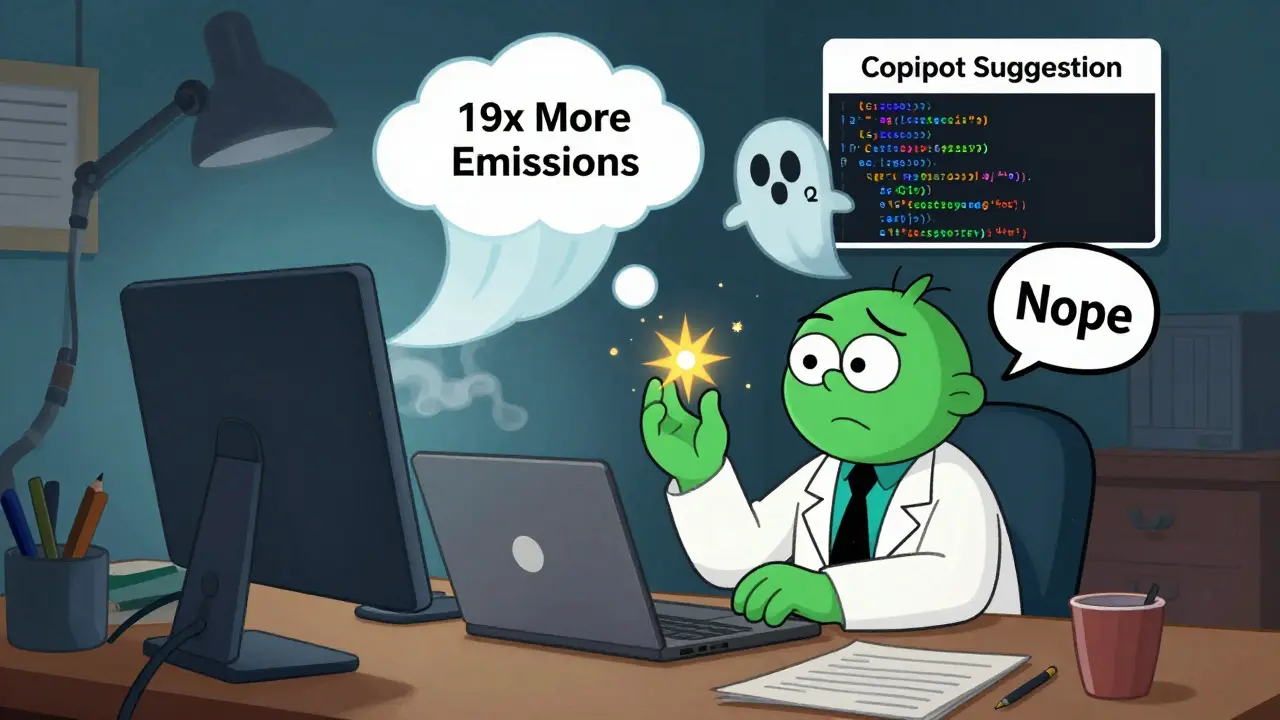
When you ask an AI to write a line of code, you’re not just getting a quick answer-you’re using electricity. A lot of it. And that’s the problem most developers still ignore.
In 2025, AI-generated code emits up to 19 times more CO2 than human-written code during development. That’s not a typo. It’s from a Nature Communications study published in June 2025. While ChatGPT, GitHub Copilot, and BARD make coding faster, they’re also turning your laptop into a mini power plant. And when you scale that across millions of developers, the numbers don’t just add up-they explode.
Why AI Coding Isn’t as Green as It Looks
Most developers think efficiency means speed. Write less code. Get faster results. But sustainability isn’t about how fast you ship-it’s about how much energy you burn to get there.
AI tools default to large models. They don’t ask, "Is this the smallest model that works?" They don’t optimize for memory. They don’t check if a loop can run 100 times instead of 10,000. In fact, a 2025 arXiv study found that 87% of AI-generated code samples skipped energy-efficient design patterns entirely. That means every time you accept a suggestion from Copilot, you’re probably accepting a bloated, power-hungry solution.
Compare that to human developers using Sustainable Green Coding (SGC) practices. MCML’s 2025 research showed they cut energy use by up to 63% without losing performance. How? They reused memory. They cached AI inference results. They avoided unnecessary model calls. They picked smaller models when possible. These aren’t magic tricks-they’re habits.
The Hidden Cost: Energy and Carbon Footprint
Let’s put this in real terms. A single AI model training session can emit 156kg of CO2e. That’s the same as driving a gasoline car for 600 kilometers. One developer on GitHub shared that number-and it shocked their team into action.
AI currently accounts for 0.1% of global greenhouse gas emissions. That’s equivalent to Sweden’s entire yearly output. And it’s growing fast. The International Energy Agency estimates AI-related electricity demand will double by 2027. Most of that comes from training and running models, but a big chunk is from the code itself-the inefficient loops, the redundant data copies, the over-engineered algorithms.
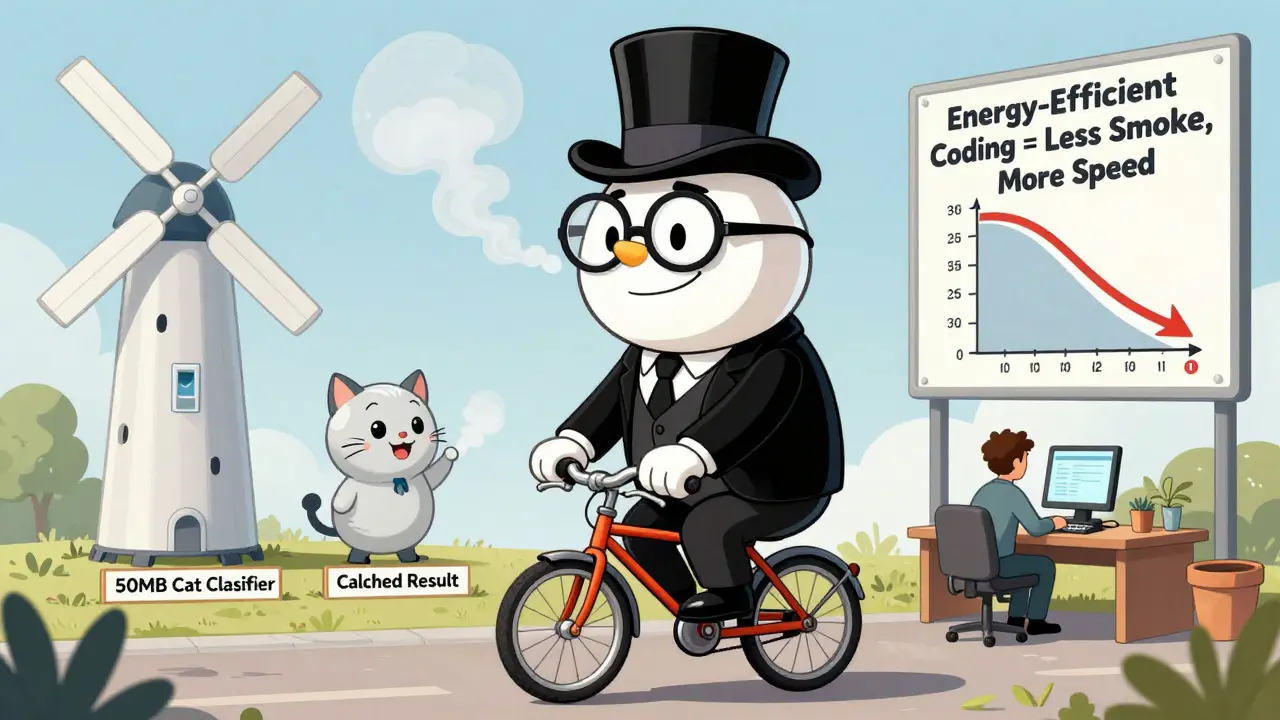
And here’s the twist: the tools we use to write AI code are often the biggest culprits. GitHub Copilot, for example, suggests full functions without asking if they’re needed. It doesn’t warn you that calling a 7B-parameter model for a simple text check is like using a jet engine to power a bicycle.
What Sustainable AI Coding Actually Looks Like
Sustainable AI coding isn’t about writing slower code. It’s about writing smarter code. Here are the six practices that make the biggest difference, based on real-world testing:
- Energy-efficient design patterns - Use iterative loops instead of recursive ones where possible. Prefer lightweight libraries over heavy frameworks.
- Memory allocation optimization - Reuse variables. Avoid creating new arrays or objects in loops. Free up memory after use.
- AI inference caching - If your AI model returns the same answer twice, store it. Don’t call the API again. This alone can cut usage by 30-50%.
- Resource-aware programming - Don’t use a 100GB model to classify cat photos. Use a 50MB model. It’s faster, cheaper, and uses 90% less energy.
- Algorithmic optimization - Swap O(n²) operations for O(n log n). Simple math changes can reduce compute time by orders of magnitude.
- Structural code improvements - Break down monolithic scripts. Modular code is easier to optimize, test, and reuse.
These aren’t theoretical. Siemens Energy cut their AI model energy use by 42% in six months using just these six practices. Ørsted, the Danish energy giant, reduced their carbon footprint from AI-driven forecasting by 58% by right-sizing models and caching results.
AI vs. Human: The Trade-Off Nobody Talks About
It’s tempting to think AI is the solution to everything-including its own environmental cost. But the data says otherwise.
AI-generated code is faster to produce. But it’s rarely optimized. Human developers who care about sustainability take longer-but they end up with leaner, greener code. The trade-off isn’t speed vs. sustainability. It’s short-term convenience vs. long-term impact.
And here’s the kicker: AI can help fix this-if we train it right. The arXiv study suggests two fixes:
- Fine-tune LLMs on sustainable coding examples (requires access to model weights).
- Use prompt engineering: "Generate code that minimizes energy use. Avoid unnecessary API calls. Use caching. Optimize memory."
Some developers are already doing this. One Reddit user reported a 40% drop in energy use just by adding "make this energy-efficient" to every AI prompt.
Tools That Actually Help
You can’t improve what you can’t measure. That’s why tools like CodeCarbon and CarbonTracker are becoming essential.
CodeCarbon tracks CO2 emissions from your code in real time. It works with Python, Jupyter, and common ML frameworks. Developers give it 4.2 out of 5 stars for ease of use. CarbonTracker is more technical but gives hardware-level energy readings. Both plug into your existing workflow.
Microsoft is adding energy efficiency scoring to GitHub Copilot by 2026. Google is doing the same for Vertex AI. These aren’t marketing moves-they’re responses to pressure from regulators and developers.
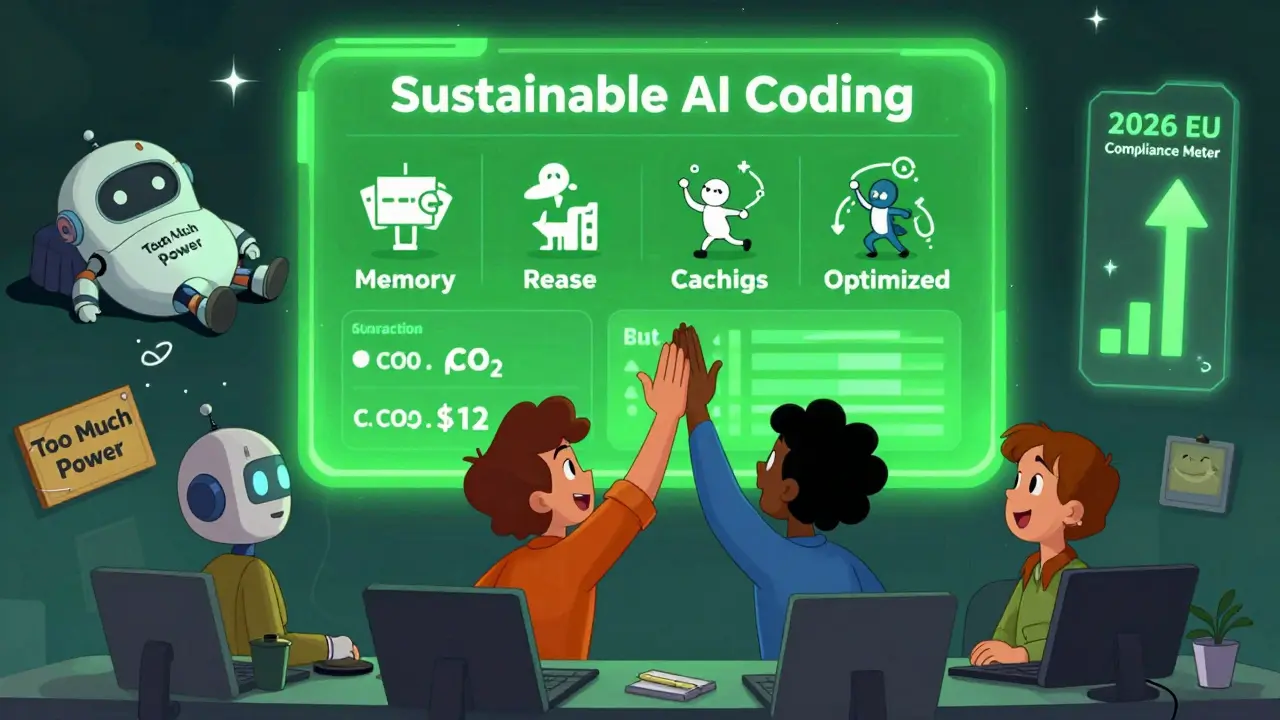
And the EU’s AI Act, effective August 2026, will force companies to report energy use for large AI models. California’s Digital Sustainability Act will require data centers over 5MW to publish carbon footprints. If you’re building AI in 2026, you’ll need to measure it.
Why Companies Are Starting to Care
It’s not just about being eco-friendly. It’s about money and compliance.
Forty-one of the Fortune 100 companies now track AI energy use. Why? Because ESG reporting is mandatory for investors. In 2025, 73% of large enterprises said sustainability reporting was their main driver for adopting green coding practices.
Financial services lead the way at 38% adoption. Tech companies are at 29%. Manufacturing is lagging at 22%. But that’s changing fast. One bank in Germany saved $2.1 million in cloud costs last year just by right-sizing their AI models. They didn’t cut features. They just stopped running oversized models.
PwC’s 2025 model shows AI could reduce global emissions by 0.1% to 1.1% by 2035-if it’s used to optimize energy grids, logistics, and manufacturing. But that only happens if the AI itself isn’t wasting power.
The Road Ahead: A Green AI Revolution
We’ve spent decades optimizing for speed, scale, and features. Now we need to optimize for energy.
The good news? The tools exist. The data is clear. The regulations are coming. The only thing missing is widespread action.
Developers aren’t waiting for permission. On HackerNews, one top comment got 287 upvotes: "We’ve optimized for speed and features for decades without considering energy-it’s time for a paradigm shift."
The shift is already happening. It’s slow. It’s messy. But it’s real. The future of AI coding won’t be about who writes the most code. It’ll be about who writes the least code that does the most with the least energy.
That’s not just sustainable. It’s smarter.



Man, I never thought about it this way. Every time I copy-paste Copilot’s suggestion like it’s gospel, I’m basically burning fossil fuels in disguise. I just started adding "make this energy-efficient" to my prompts-and damn, the difference is wild. One script went from 12s runtime to 2.1s and used 70% less power. It’s not magic, it’s just thinking before hitting enter.
Also, caching AI responses? Why didn’t anyone tell me this sooner? I was calling the same model 50 times in a loop for a static lookup. Now I store it in a dict. My cloud bill dropped. My conscience feels lighter.
They’re lying. This is all a distraction. AI isn’t the problem-it’s the corporations pushing greenwashing so they can keep taxing you for "carbon credits" while they mine rare earths in the Congo. They want you to feel guilty so you don’t ask why your phone battery dies in 2 hours while a server farm runs 24/7 for TikTok filters. This isn’t sustainability-it’s control.
I’m not saying you’re wrong, but I’ve been doing this for 15 years and I’ve seen this exact same narrative before. Remember when we were told to stop using plastic bags? Then they sold us biodegradable ones made from corn that required 10x more water and pesticides. Now we’re being told to optimize code for energy-but who’s measuring the energy it took to write this article? Who’s tracking the carbon footprint of every developer who read this and then went out and bought a new MacBook Pro "to be greener"?
It’s performative. And it’s exhausting. I just want to write code without being guilt-tripped into a digital eco-ritual.
As someone who actually built ML systems in Bangalore before moving to Zurich, I can tell you this: Western developers romanticize "green coding" while outsourcing the real dirty work to countries with lax regulations. You talk about optimizing loops? Fine. But your "sustainable" AI model was trained on GPUs powered by coal in China. Your "carbon tracker" is a toy. Real impact requires systemic change, not just tweaking your Python script to use less RAM.
And don’t get me started on GitHub Copilot. It’s a glorified autocomplete that makes junior devs lazy. It doesn’t teach them to think-it teaches them to copy. That’s not efficiency. That’s intellectual decay.
Just wanted to say thanks for writing this. I work in a startup where everyone’s racing to ship features, and this is the first time I’ve seen someone lay out the real trade-offs without sounding like a preachy TED Talk.
I started using CodeCarbon last week. Found out our model was calling GPT-4 for every single user query-even when it was just checking if a string was empty. We switched to a tiny regex filter for that case. Cut our API costs by 40% and our energy use by 60%. No one even noticed the change. That’s the win.
Also, the 7B model for cat photos? Yeah. I’ve done that. I’m not proud. But now I keep a cheat sheet of "when to use what model" pinned to my monitor. Small changes. Big impact.
So let me get this straight: we’re supposed to feel bad because AI writes bloated code, but we’re not supposed to feel bad that the same AI is trained on datasets scraped from the entire internet without consent? That’s like scolding someone for using too much water while ignoring the dam that flooded their village.
Also, "make this energy-efficient" in your prompt? Cute. That’s like telling a chef to "make this dish healthier" while handing them a bag of sugar and a deep fryer. The system is broken. The prompt isn’t the fix.
Efficiency is not just about energy
It’s about attention
It’s about time
It’s about the cost of thinking
AI gives us speed but steals depth
We trade understanding for convenience
And call it progress
Maybe the real carbon footprint isn’t in the server
But in the quiet erosion of skill
That no tracker can measure
Use smaller models. Cache results. Don’t over-engineer. Done.
This piece hit me right in the gut. I’ve been using Copilot like a crutch for two years now. I didn’t realize I was writing code that ran like a gas-guzzling SUV while pretending it was a hybrid.
But here’s the thing-when I started applying even half of these practices, I noticed something weird. My code became more elegant. Less noisy. More readable. The energy savings were a side effect. The real win was becoming a better developer.
It’s not about being green. It’s about being precise. And that’s something no AI can teach you-only practice can.
It is imperative that the software engineering community adopts a paradigm shift toward energy-conscious development practices without delay. The empirical evidence presented in this discourse is unequivocal and corroborated by peer-reviewed research published in Nature Communications and arXiv. The deployment of lightweight models, the implementation of inference caching, and the strategic optimization of algorithmic complexity are not optional enhancements-they are foundational imperatives for responsible innovation.
Furthermore, the integration of tools such as CodeCarbon and CarbonTracker into CI/CD pipelines must be standardized across all enterprise environments. Regulatory frameworks such as the EU AI Act and California’s Digital Sustainability Act are not mere suggestions; they are the vanguard of a new global standard. Organizations that fail to comply will face not only financial penalties but reputational obsolescence.
Let us not mistake convenience for competence. The future of artificial intelligence is not measured in lines of code, but in joules consumed. We must engineer not just for functionality, but for planetary stewardship.