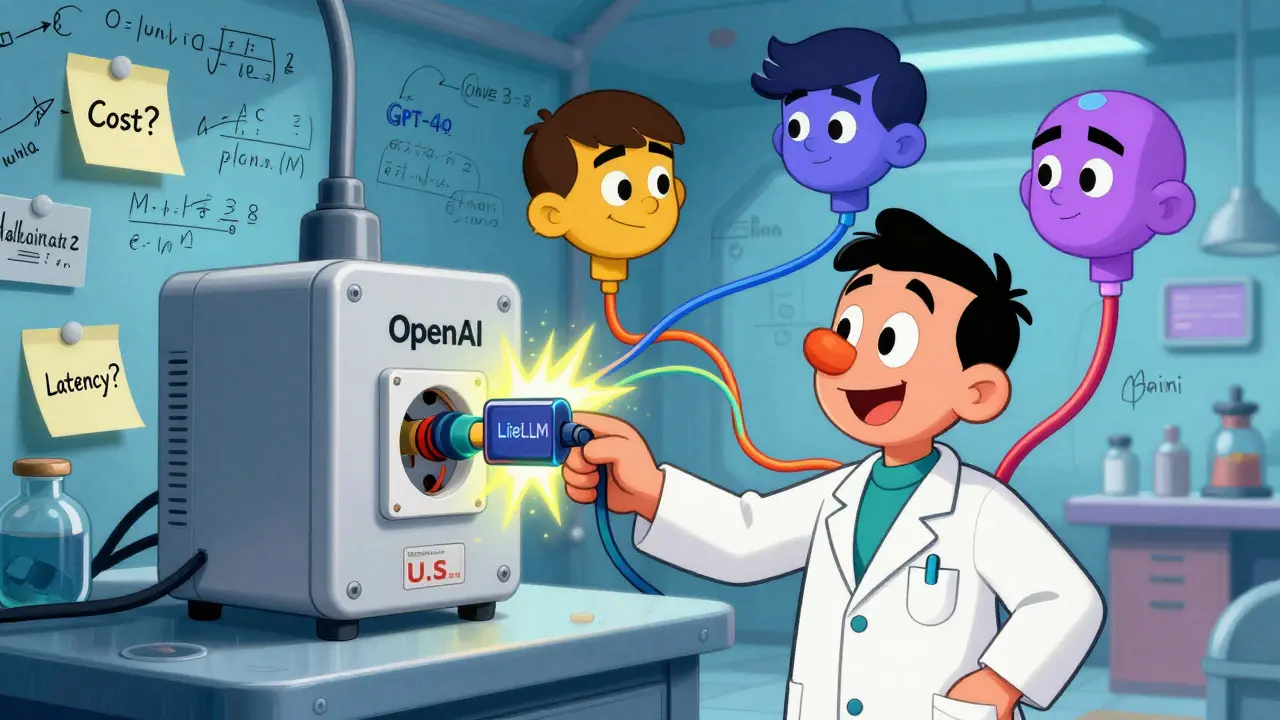
Switching between OpenAI, Anthropic, and Google Gemini shouldn’t feel like rewiring your entire app every time you want to try a cheaper or faster model. Yet, that’s exactly what many teams are stuck doing. The truth? Most LLM integrations are brittle. One provider changes its API format, your chatbot stops working. A rate limit hits, and your whole workflow collapses. This isn’t just annoying-it’s expensive. Companies lose millions every year just managing these fragile connections.
Why Abstraction Matters More Than Ever
In 2025, no smart team relies on a single LLM provider. Why? Because each one has strengths: OpenAI’s GPT-4o handles complex reasoning well, Anthropic’s Claude 3 excels at long-context tasks, and Google Gemini is strong in multimodal inputs. But they don’t speak the same language. Their APIs differ. Their response formats vary. Their token limits range from 8k to 200k. And their behavioral quirks? Those are invisible until you switch.That’s where abstraction comes in. It’s not about hiding complexity-it’s about controlling it. Think of it like plugging a European appliance into a U.S. outlet. You don’t rewire the appliance. You use an adapter. LLM interoperability patterns are those adapters. They let you swap models without touching your core logic.
According to Gartner, the lack of standardized interoperability is costing enterprises $2.7 billion annually in wasted engineering time. That’s not theoretical. It’s real teams spending weeks rewriting prompts, debugging response parsing, and testing new models-only to find out the new model hallucinates data differently than the old one.
The Five Proven Patterns
Five patterns have emerged as the most reliable ways to abstract LLM providers. Each solves a different part of the problem.- Adapter Integration: This is the most common approach. It wraps each provider’s API in a consistent interface. LiteLLM, an open-source framework launched in early 2023, does this perfectly. With one line of code change, you can switch from OpenAI to Anthropic-no rewrites. It supports over 100 models and cuts integration time by 70%, according to Newtuple Technologies’ March 2024 case study.
- Hybrid Architecture: Combines monolithic LLM calls with microservices for caching, data enrichment, or preprocessing. This pattern reduces costs by up to 40% by minimizing expensive calls. For example, you might use a lightweight model to extract keywords from a document, then send only those to a more expensive model for summarization.
- Pipeline Workflow: Breaks down complex tasks into steps, each handled by the best-suited model. One model extracts entities, another validates them, a third generates output. This is how FHIR-GPT achieved 92.7% accuracy in converting clinical notes into standardized medical records. Each step uses the optimal model, not just the most convenient one.
- Parallelization and Routing: Sends the same request to multiple models at once, then picks the best response. Useful for high-stakes applications like legal document review or medical diagnosis. You’re not just avoiding vendor lock-in-you’re improving reliability.
- Orchestrator-Worker: A central controller (the orchestrator) decides which model (the worker) to use based on context: cost, speed, accuracy, or even user identity. This is the most flexible-and complex-pattern. It’s what enterprise teams use when they need fine-grained control over model selection.
LiteLLM vs. LangChain: The Real Choice
You’ll hear two names everywhere: LiteLLM and LangChain. But they’re not the same.LiteLLM is lean. It’s a thin layer that normalizes API calls. If your app uses the OpenAI SDK format, you can switch providers with one line of code. Developers report onboarding in 8-12 hours. It doesn’t do prompt templating, memory management, or tool calling. It does one thing: make APIs interchangeable. And it does it well. Reddit users have cut API costs by 35% just by switching from OpenAI to Anthropic during peak hours.
LangChain is a full framework. It handles prompts, memory, agents, tools, and chains. But that power comes at a cost. Implementation takes 40+ hours. The learning curve is steep. G2 reviews give it a 4.2/5, but users constantly complain about complexity. If you need agents that use calculators, databases, and APIs-go with LangChain. If you just want to swap models? LiteLLM is faster, lighter, and less risky.
The Hidden Problem: Behavioral Drift
Here’s what no one talks about enough: models behave differently even when given the same prompt.Newtuple Technologies tested two models with identical agent code. Model A could extract complex figures from multiple tables by improvising data joins. Model B, with the same code, failed-because it followed instructions too strictly. It didn’t infer. It didn’t adapt. It just stopped.
This isn’t a bug. It’s a feature of how models are trained. Some are optimized for creativity. Others for safety. Some hallucinate more. Others are overly cautious. Swapping them blindly can drop task accuracy by 22%, as one company discovered in January 2025. It took them two weeks to fix.
That’s why interoperability isn’t just about APIs. It’s about expectations. Professor Michael Jordan of UC Berkeley put it bluntly: “Interoperability standards must address behavioral consistency.”
Anthropic’s Model Context Protocol (MCP)
In Q2 2024, Anthropic introduced the Model Context Protocol (MCP). It’s not just another API. It’s a standard for how AI apps connect to external tools and data sources. MCP lets LangChain, for example, work with any model that supports it-no custom code needed.By October 2024, MCP 1.1 reduced integration time by 35%. And Mozilla.ai built on it with their “any-*” fabric: any-llm, any-agent, and soon, any-evaluator. These tools let you test model behavior across providers consistently. That’s the next frontier: not just switching models, but knowing how they’ll behave before you switch.
Real-World Impact: Healthcare Leads the Way
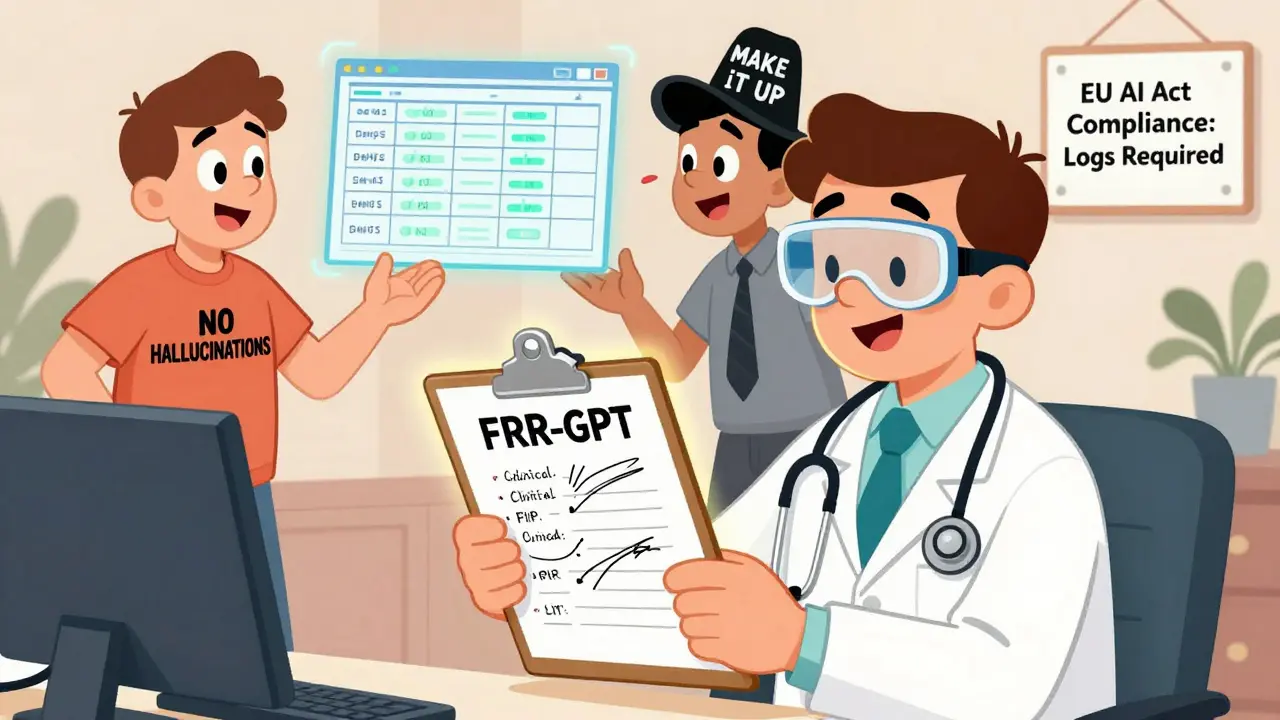
Healthcare is where interoperability saves lives-not just money. FHIR-GPT, a system built on these patterns, transforms free-text clinical notes into standardized FHIR medical records. In a July 2024 study, it achieved 92.7% exact match accuracy. That’s better than traditional NLP pipelines. It cut manual data entry by 63%.By December 2024, 81% of major U.S. healthcare systems were exploring AI-powered interoperability. Why? Because regulations like the EU AI Act now require documentation of model switching procedures for high-risk applications. You can’t just swap models anymore-you have to prove it’s safe.
What You Need to Do Today
If you’re using one LLM provider right now, here’s your action plan:- Map your use cases. Which tasks need speed? Which need accuracy? Which need long context?
- Test LiteLLM. Replace your OpenAI call with LiteLLM in 2 hours. Switch to Anthropic. See if your app still works.
- Run a behavioral test. Give both models the same prompt. Compare outputs. Are they consistent? Does one miss key details?
- Document your fallback rules. If the primary model fails, which one do you switch to? Under what conditions?
- Start measuring. Track cost per task, latency, and accuracy by model. Don’t assume one is better-prove it.
By mid-2026, Gartner predicts 75% of enterprise LLM implementations will use multi-provider strategies. The question isn’t whether you’ll abstract your LLMs-it’s whether you’ll do it before your competitors do.
Frequently Asked Questions
What’s the easiest way to start abstracting LLM providers?
Use LiteLLM. Install it via pip, replace your OpenAI import with LiteLLM’s equivalent, and change one line of code. It supports over 100 models and works with the same syntax you’re already using. No rewrite needed.
Can I just swap models without testing?
No. Models behave differently even with the same prompt. One might be overly cautious and miss key details. Another might hallucinate facts. Always test with real data before switching in production. A 22% drop in accuracy can cost more than the savings from cheaper APIs.
Is LangChain worth the complexity?
Only if you need agents that use tools, manage memory, or chain multiple steps. If you’re just calling a model for text generation, LangChain is overkill. LiteLLM is faster, simpler, and less error-prone for basic swaps.
What’s the Model Context Protocol (MCP)?
MCP is Anthropic’s standard for how AI apps connect to external tools and data. It lets frameworks like LangChain work with any model that supports MCP-no custom integration needed. It’s the closest thing we have to a universal plug for LLMs.
How do I know which model to use for what task?
Track performance metrics: cost per task, latency, accuracy, and hallucination rate. Use Mozilla.ai’s upcoming ‘any-evaluator’ tools to compare models on your own data. Don’t guess. Measure.
Are there legal risks to switching models?
Yes. The EU AI Act requires documentation of model switching for high-risk applications. If you’re using LLMs in healthcare, finance, or legal workflows, you must prove your switching process is safe and repeatable. Keep logs of which model was used, when, and why.



Just switched our internal chatbot to LiteLLM last week. Took me 90 minutes total. No code rewiring, no panic. We’re now routing to Anthropic during peak hours and saving 30% on costs without a single outage. If you’re still hardcoding OpenAI calls, you’re basically manually changing tires on a highway.
LangChain is a goddamn dumpster fire. I’ve spent three weeks debugging memory leaks and prompt chaining nonsense just to swap models. LiteLLM does one thing and does it right. Stop pretending you need all that baggage. You don’t.
It’s like trying to swap out a Ferrari engine with a Tesla motor and expecting the car to purr the same way. Same wheels, same chassis-but the soul? Totally different. I ran the same legal doc review prompt through GPT-4o and Claude 3. One gave me nuanced context with a side of sarcasm. The other? A sterile, bullet-pointed robot monologue. You can’t just flip a switch-you gotta feel the vibe.
Of course you’re all still talking about LiteLLM like it’s the holy grail. Pathetic. You’re all clinging to amateur scaffolding while real engineers are building custom orchestration layers with Rust and WASM. And you think a Python wrapper is ‘interoperability’? Please. You’re not abstracting-you’re just lazy. The Model Context Protocol? That’s a toddler’s first crayon drawing compared to what’s coming next. You’re still using stethoscopes while the rest of us have MRIs.
Hey, I get the frustration with LangChain-it’s heavy. But if you’re doing anything beyond basic text generation-like pulling data from databases, calling APIs, or chaining reasoning steps-you’re going to need it. LiteLLM is perfect for simple swaps. LangChain is for when your app starts thinking. Don’t shame people for needing the right tool. Just use what fits your problem. No one’s forcing you to use both.
I’ve been testing behavioral drift with our healthcare client’s clinical notes. We gave both models the same patient history. GPT-4o inferred a possible drug interaction we missed. Claude 3 flagged it as ‘outside scope’ and refused to comment. We had to build a validation layer on top. Interoperability isn’t just about APIs-it’s about trust. You need to know what kind of ‘personality’ each model brings to the table.
So I tried the parallelization pattern last month for our customer support bot. Sent the same query to OpenAI, Anthropic, and Gemini. Then picked the response with the highest confidence score. Worked like a charm for high-priority tickets. But here’s the kicker-it tripled our latency. We had to add a timeout fallback to keep users from bouncing. Now we only run parallel mode for Tier-1 support. For everything else? LiteLLM + caching. It’s not about using the fanciest pattern-it’s about matching the pattern to the pain point. I’ve seen teams over-engineer this stuff into oblivion. Keep it simple until you need to go complex.
Oh please. You’re all acting like this is some groundbreaking revelation. We’ve had adapter patterns since the early 2000s for SOAP and REST. And now you’re surprised that LLMs need the same? This isn’t innovation-it’s rediscovery. And ‘behavioral drift’? That’s just another word for ‘your model isn’t deterministic.’ Welcome to AI, folks. The magic was always an illusion.
Just ran the behavioral test on our internal QA bot. Same prompt. GPT-4o gave a 3-line answer with a joke. Claude 3 gave a 12-sentence breakdown with citations. Gemini hallucinated a non-existent FDA warning. We now have a scoring matrix: accuracy (40%), tone match (25%), hallucination risk (20%), cost (15%). We rotate models daily based on the metric that matters most for the task. No more guessing. Just data.
I used LiteLLM in our rural clinic’s telehealth system. We switched from OpenAI to Gemini because of lower cost in India. No code changes. But we had to tweak the prompt because Gemini kept using American medical terms. Now we add ‘Use Indian clinical terminology’ to every prompt. Abstraction helps, but context still matters. Don’t forget the human side.