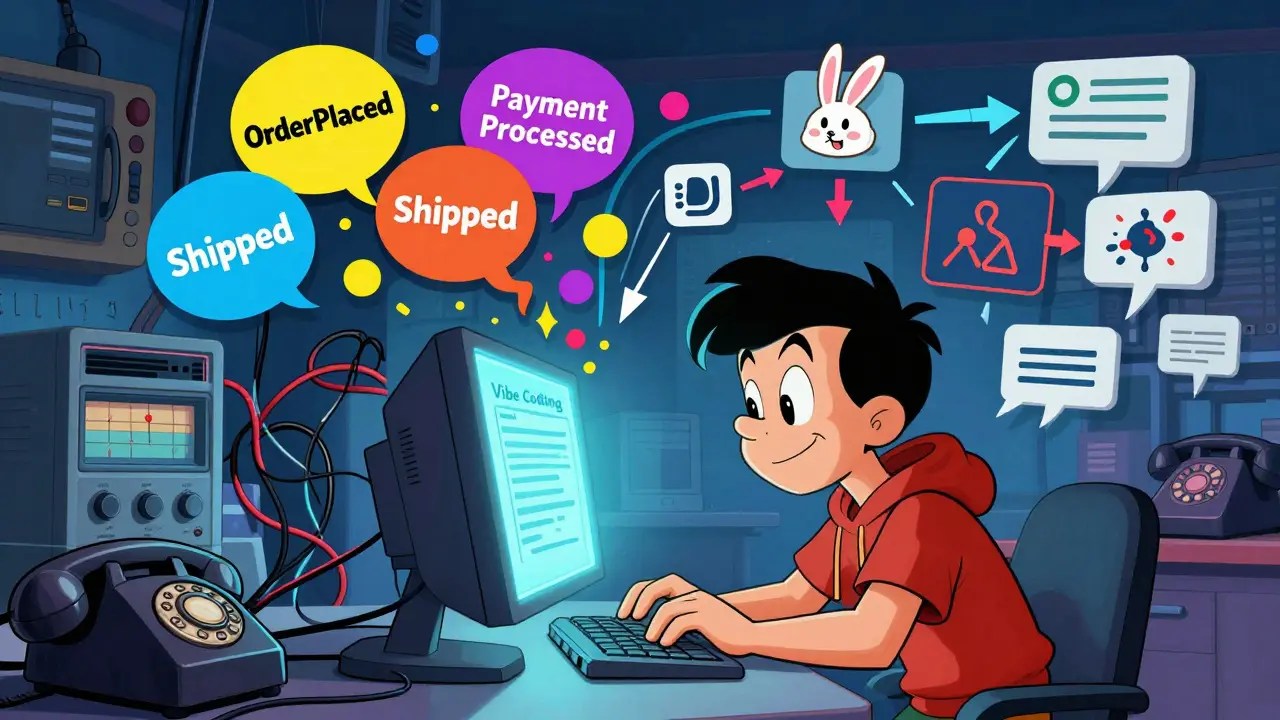
Building event-driven systems used to mean writing a lot of boilerplate code-message queues, handlers, retry logic, schema versioning, async workers. Now, with AI coding assistants like Augment Code and frameworks like Ecotone, you can describe what you want in plain language and get working event-driven code in hours, not days. But here’s the catch: if you just say "build me an event system", you’ll get chaos. The difference between success and disaster isn’t the AI. It’s how you guide it.
What Event-Driven Architecture Really Means
Event-Driven Architecture (EDA) isn’t just about sending messages. It’s about decoupling. When a user places an order, that action shouldn’t directly trigger email notifications, inventory updates, and analytics logging. Instead, the system publishes anOrderPlaced event. Any component that cares about that event listens for it and reacts independently. This means if your email service goes down, the order still goes through. The system recovers when the service comes back.
This isn’t theory. Companies like Shopify and Netflix use EDA because it scales. When traffic spikes, you don’t need to scale the whole app-you scale just the order-fulfillment service. But EDA only works if you stick to the rules: events are published, not returned; handlers are single-purpose; async behavior is declared, not hacked in.
What Is Vibe Coding-and Why It Works (When Done Right)
Vibe coding is when you tell the AI what you want, not how to do it. You say: "I need a real-time dashboard that updates when users log in, log out, or change their profile. Use Node.js, PostgreSQL, Redis, and JWT. Handle 10k users. Response under 200ms." The AI figures out the rest. But here’s what most teams get wrong. They treat vibe coding like magic. They ask the AI to "build the whole backend" and then spend weeks fixing broken patterns. The truth? Vibe coding isn’t about replacing developers. It’s about augmenting them. You set the architecture. The AI writes the code. A study by AIM Consulting tracked 12 enterprise projects. Teams that gave clear architectural constraints saw 63% fewer code revisions than those who didn’t. Why? Because the AI isn’t guessing. It’s following guardrails.Three Proven Patterns for Event-Driven Systems
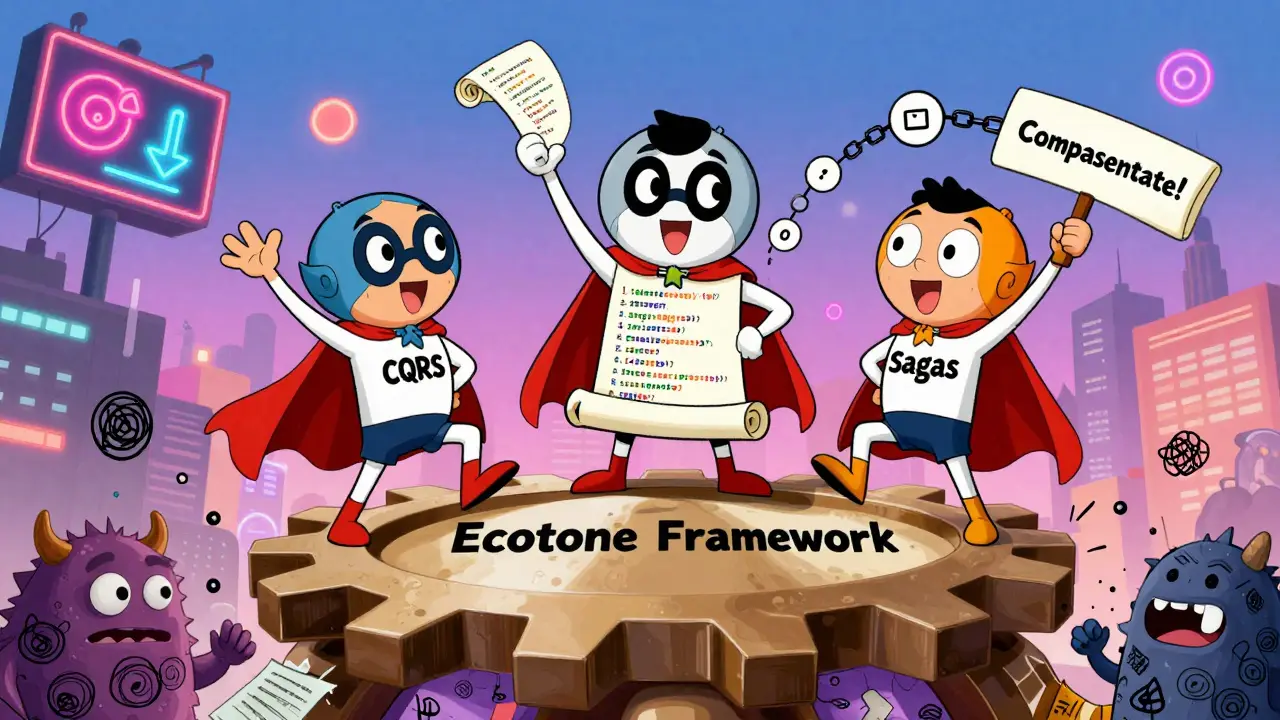
When you’re using vibe coding for EDA, you’re not building from scratch. You’re leveraging patterns that have been battle-tested. Here are the three most reliable ones:- Command Query Responsibility Segregation (CQRS): Separate reads from writes. Your order placement command goes to a write model. The read model-used for dashboards and reports-is updated asynchronously via events. This keeps queries fast, even under heavy load.
- Event Sourcing: Don’t just store the current state of an order. Store every event that changed it:
OrderCreated,PaymentProcessed,Shipped. This gives you a full audit trail. Need to replay a bug? Replay the events. Need to rebuild a view? Replay the events. - Sagas: Long-running processes like "place order → charge card → ship item → send email" aren’t transactions. They’re workflows. A saga breaks them into steps, each triggered by an event. If step 2 fails, the saga triggers a compensation event:
PaymentFailed, which reverses the order.
Prompt Templates That Actually Work
A bad prompt: "Write code for an order system." A good prompt: "Context: Microservice architecture using PHP 8.2 and Ecotone Framework. Language: PHP. Expected: User places order → system sends payment request → on success, publish OrderConfirmed event → trigger email and inventory update. Architecture: Event-driven with RabbitMQ. Requirements: Handle 500 requests/second. Async handlers must execute synchronously in tests. Use CQRS and Event Sourcing." That’s not just a prompt. It’s a contract. It includes:- Context: What’s the system already doing?
- Language: What stack are you using?
- Expected functionality: What happens when?
- Architecture constraints: Which patterns? Which tools?
- Quantitative requirements: Performance, scale, testing rules.
How Ecotone Framework Makes Vibe Coding Safer
Ecotone Framework doesn’t just help you write code. It stops you from writing bad code. In Ecotone, everything is a message. Commands, events, even queries. And the framework forces you to follow rules:- Each command has exactly one handler. No exceptions.
- Events are published, never returned. No direct calls.
- Async behavior is declared with an attribute:
#[Asynchronous('notifications')]. No manual queue setup.
The Hidden Cost of Poorly Structured Vibe Coding
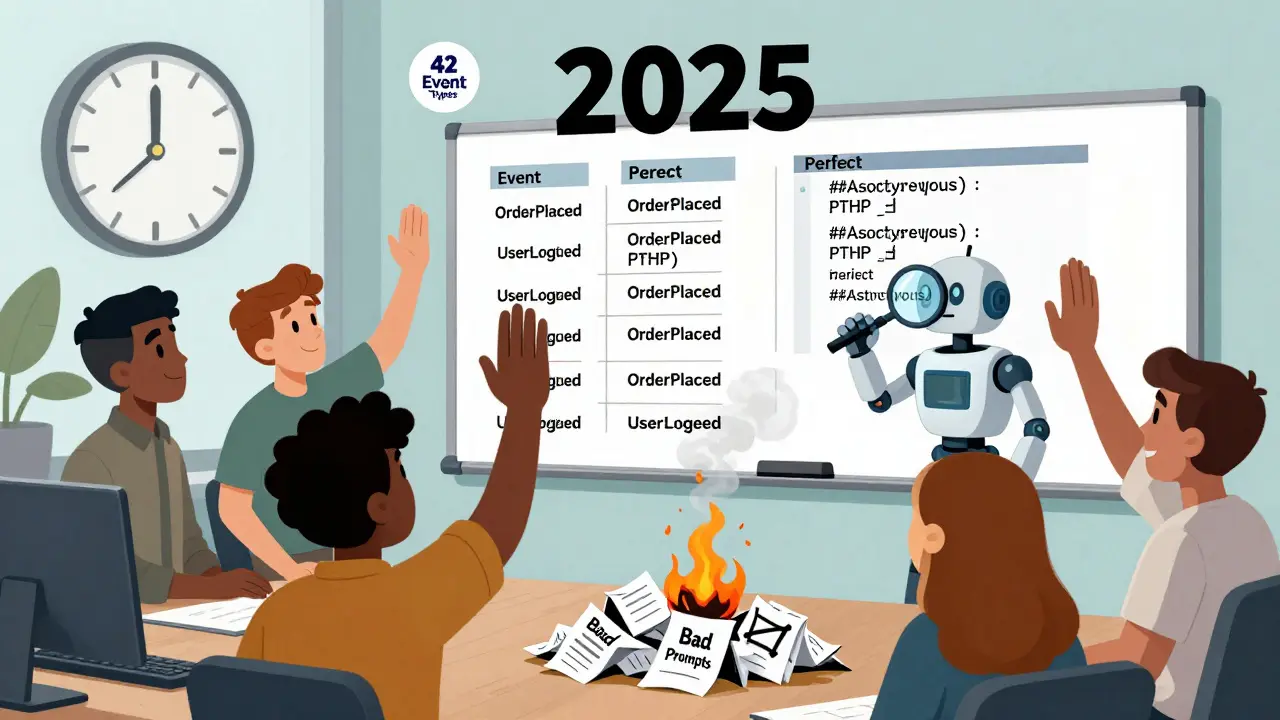
Not all vibe coding is good. One Reddit user said their team created 42 event types in two weeks-with no naming standard. Some wereuser_logged_in, others UserLoginEvent, others USER_LOGGED_IN. They had to rebuild the whole system.
Tessl’s analysis calls this "technical debt by default." Without specs, vibe coding becomes a free-for-all. Stackademic’s case study showed a team’s "event-driven architecture created more problems than it solved"-because they skipped documenting patterns. Now they have Kafka disasters, duplicate events, and handlers that crash silently.
The fix? Spec-driven development. Before you even open the AI tool, write down:
- What events will be published?
- What data do they carry?
- Who consumes them?
- What happens if a handler fails?
How to Start Using Vibe Coding for EDA
You don’t need to rewrite your whole system. Start small. Pick one feature:- Choose your framework: If you’re on PHP, use Ecotone. If you’re on Node.js, use Augment Code’s Context Engine.
- Write your spec: Define the event, the trigger, the consumer, and the performance target.
- Use a template: Copy the structure from Augment Code or Ecotone’s docs. Don’t improvise.
- Test synchronously: Run async handlers in sync mode during tests. No need for message brokers in dev.
- Review the output: Does it match your spec? Are event names consistent? Are handlers single-purpose?
What’s Next? The Future of AI and Architecture
By 2025, Gartner predicts 60% of enterprise teams will use structured vibe coding for event-driven systems. Tools are getting smarter. Augment Code’s Context Engine 2.0 now scans existing codebases to detect architectural patterns before generating code. That means fewer drifts, more consistency. But the biggest shift isn’t technical. It’s cultural. The best teams aren’t using AI to replace developers. They’re using it to free them from boilerplate so they can focus on design, testing, and scaling. The question isn’t whether you should use vibe coding. It’s whether you’ll use it wisely.Can vibe coding replace traditional software architecture?
No. Vibe coding is a tool, not a replacement. You still need to define the architecture, choose the patterns, and set constraints. The AI handles implementation, not design. Teams that skip architectural planning end up with messy, unmaintainable systems-even if the code runs.
What’s the biggest mistake teams make with vibe coding and EDA?
Asking the AI to "build the app" without clear boundaries. Without constraints, the AI generates inconsistent event names, duplicate handlers, and untestable async flows. The fix is simple: always provide context, architecture rules, and performance targets in your prompts.
Do I need to learn a new framework to use vibe coding for EDA?
Not necessarily, but it helps. Frameworks like Ecotone and Augment Code are designed to guide AI output. They enforce patterns so the AI doesn’t wander. If you’re using a generic framework like Express.js or Laravel, you’ll need to be much more precise in your prompts to avoid chaos.
How do I test event-driven code generated by AI?
Use the same tools the framework provides. Ecotone lets you run async handlers synchronously in tests-no message queues needed. Augment Code lets you simulate events in a test environment. The goal is to verify that events are published correctly and handlers respond as expected, without relying on live infrastructure.
Is vibe coding only for startups or can enterprises use it?
Enterprises are leading the adoption. Fintech and e-commerce companies-where workflows are complex and scale is critical-are using vibe coding with EDA at 67% and 58% adoption rates, respectively. The key is structure. Enterprises succeed because they enforce prompt templates, event schemas, and architectural reviews-not because they have more developers.

Been using Ecotone for a few months now. The async attribute is a game changer. No more wrestling with RabbitMQ configs. Tests run in 2 seconds. Production runs smooth. I used to spend days setting up event chains. Now it’s a 20-minute prompt. Just don’t skip the spec.
Also, naming events consistently? Non-negotiable. We had a mess with UserLoginEvent vs user_logged_in. Fixed it in a week by forcing a naming convention in the template.
Wow. So you’re telling me the AI didn’t just write the code… it wrote the *right* code because you gave it boundaries? That’s not vibe coding. That’s responsible coding with better tools.
Meanwhile, my team tried "build me a backend" and got 17 event types, 3 of which were just "Event". We’re still cleaning up. Guess we didn’t get the memo.
US companies are finally getting it. Europe still thinks "just throw Python at it" and call it EDA. Pathetic. Frameworks like Ecotone force discipline. That’s what you need. Not magic. Not vibes. Structure. Period.
As a Canadian dev, I’ve seen this play out twice. First time: team used vibe coding without specs. Got a Kafka nightmare. Second time: we used the exact template from the post. 10 hours for what used to take 5 days. The difference? We wrote the event schema before opening the AI.
Also, props to Ecotone. It’s like having a senior dev whispering in your ear: "no, don’t do that."
"Vibe coding" sounds like something a startup founder says after 3 Red Bulls. But honestly? It works if you’re not an idiot. I gave the AI: "Handle order → charge → ship → email. Use CQRS. No direct calls. Test sync. 500 req/sec."
It spat out clean code. I reviewed it. Deployed. No drama.
People who complain? They didn’t give it a blueprint. They gave it a wish.
Esteemed colleagues, I must express my profound appreciation for the rigorous architectural discipline elucidated herein. The adoption of structured prompt templates, coupled with enforced event schema governance, represents a paradigmatic shift in software engineering methodology.
Our team in Johannesburg implemented this framework last quarter. We reduced deployment incidents by 89%. The AI, when properly constrained, becomes not a replacement, but an extension of human intent. A true augmentation.
May your events be atomic, your handlers singular, and your compensation flows elegant.
Okay but let’s be real - this is just fancy autopilot for devs who don’t want to learn how to code.
I mean, sure, Ecotone "forces" you to do it right… but what if you want to do it wrong? What if you want chaos? What if you want to build something wild and messy and beautiful?
This is the death of creativity. They’re turning programming into a fill-in-the-blank worksheet.
Also, I tried this and the AI made my event names all lowercase. I cried. It’s not the same anymore.
AI writes code now so we can all be out here getting rich off crypto while our apps crash
also why is everyone acting like this is new? we had code generators in 2005
and no one cares about your event names
just ship it
Love this. Just tell the AI what you need. Not how. Set the rules. Let it do the typing.
My team cut dev time in half. No more late nights fixing queues. Just specs. Done.
Simple works.
So you’re saying the solution to AI chaos is… more rules? Wow. Who would’ve thought.
Meanwhile, I’m over here trying to explain to my manager why the AI generated 42 event types and named one "user_did_a_thing_event_v2_final_try".
Thanks for the template. I’m printing it. And taping it to my monitor. And my forehead.