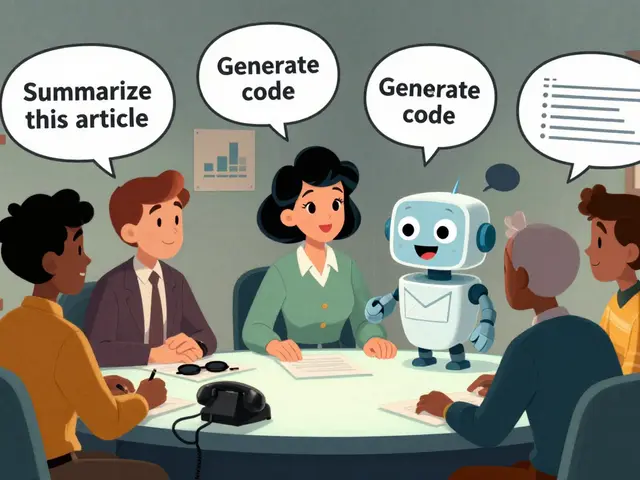
You ask a chatbot for the latest FDA approval dates for a specific drug class. It gives you three names, two dates, and a confident summary of clinical trial results. Everything looks perfect-until you check the actual registry and realize one of those drugs doesn't exist, and the other two were approved years earlier than stated. This isn't a rare glitch; it's AI hallucination, the persistent tendency of large language models to generate plausible but factually incorrect information.
Hallucinations aren't bugs in the traditional sense. They are features of how probabilistic models work. Unlike deterministic software that fails predictably, generative AI guesses the next word based on statistical patterns. When it lacks data, it doesn't say "I don't know"; it fabricates an answer that fits the pattern. For engineers and business leaders deploying these tools, understanding why this happens is step one. Step two is implementing strategies that actually reduce the risk without killing the utility of the model.
Why Models Lie With Confidence
To fix hallucinations, you have to stop thinking of them as errors and start seeing them as inevitable outcomes of architecture. Large Language Models (LLMs) like GPT-4 or Claude are trained to predict the next token in a sequence. During pre-training, the model learns that if a sentence starts with "The capital of France is," the most statistically probable next word is "Paris." But what happens when the prompt is obscure? The model still predicts the most likely continuation, even if that continuation is wrong.
This creates a tension between novelty and usefulness. If a model only repeats memorized facts, it becomes boring and rigid. To be useful and creative, it must generalize. That generalization is where hallucinations creep in. The model prioritizes fluency over factual grounding. It produces outputs that sound right because they follow linguistic rules, not because they align with reality. In many cases, the model has no concept of truth; it only understands probability.
Another major driver is training data limitations. If a model was trained on data up to 2023, it cannot know about events in 2024. But if you ask it about a 2024 event, it won't admit ignorance. It will construct a narrative based on similar patterns from its training set. This is why citing non-existent academic papers is so common-the model knows the format of citations perfectly but invents the content to match that format.
The Role of Evaluation Metrics
Here’s a counterintuitive point: current evaluation methods often encourage hallucinations. Most benchmarks grade models on accuracy alone. Imagine a multiple-choice test where guessing gets you points, but leaving a blank gets you zero. A smart student might guess if they’re 51% sure. An AI does the same thing. If the penalty for being wrong is low compared to the reward for being right, the model learns to bluff.
This incentive structure means models are optimized to provide answers, not necessarily correct ones. They lack a reliable mechanism to signal uncertainty. You get the same confident tone whether the model is 99% sure or just making a wild guess. Until we change how we evaluate these systems-by rewarding calibrated confidence rather than just raw accuracy-we’ll keep seeing overconfident falsehoods.
Technical Mitigation: Retrieval-Augmented Generation
The most effective technical solution available today is Retrieval-Augmented Generation (RAG). Instead of relying solely on the model’s internal weights (its "memory"), RAG connects the LLM to an external knowledge base. When a user asks a question, the system first searches a verified database for relevant documents. It then feeds those documents into the model’s context window along with the original question.
This grounds the response in real data. The model acts less like a oracle and more like a librarian summarizing provided texts. If the retrieved documents don’t contain the answer, the model can be instructed to say so, rather than inventing one. RAG significantly reduces hallucinations in domains where facts change frequently or require high precision, such as legal, medical, or financial applications.
| Strategy | Implementation Complexity | Effectiveness | Best Use Case |
|---|---|---|---|
| RAG Systems | High (requires vector DB) | Very High | Factual Q&A, dynamic data |
| RLHF Fine-tuning | Medium (requires human feedback) | Moderate | Tone, safety, general reliability |
| Prompt Engineering | Low | Variable | Quick fixes, specific tasks |
| Self-Consistency Checks | Medium (computational cost) | Moderate-High | Math, logic puzzles |
Human-in-the-Loop and RLHF
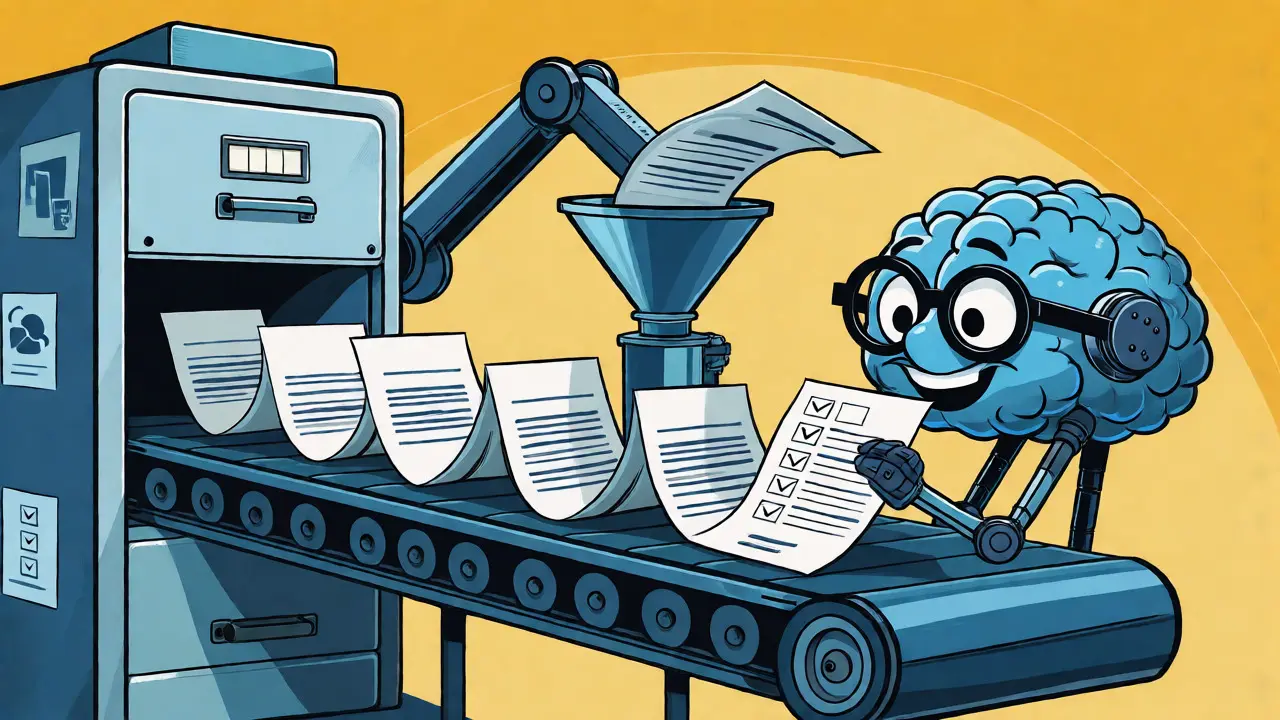
Retrieval helps, but it doesn’t solve everything. Sometimes the model misinterprets the retrieved text. This is where Reinforcement Learning from Human Feedback (RLHF) comes in. After initial training, humans review model outputs and rank them. Responses that are accurate and helpful get rewarded; hallucinated or confusing ones get penalized.
Over time, the model learns to prefer outputs that humans deem trustworthy. However, RLHF has limits. Humans themselves make mistakes, and annotators may miss subtle factual errors if they aren’t experts in the domain. Furthermore, RLHF optimizes for what humans *like*, which sometimes conflicts with strict factual accuracy. A fluent, slightly wrong answer might score higher than a clumsy, correct one if the evaluators prioritize readability.
Prompt Engineering: Low-Cost Guardrails
Before building complex infrastructure, try better prompts. Vague questions invite vague, made-up answers. Specific constraints force the model to stay within bounds. Here are practical techniques:
- Cite your sources: Explicitly instruct the model to include citations for every claim. If it can’t find a source in the provided context, tell it to state that instead of guessing.
- Set temperature lower: Temperature controls randomness. A high temperature (e.g., 0.8) encourages creativity and diversity, increasing hallucination risk. For factual tasks, drop it to 0.2 or lower to make the model more deterministic.
- Use Chain-of-Thought prompting: Ask the model to explain its reasoning step-by-step before giving the final answer. This often reveals logical gaps or unsupported assumptions early in the process.
These tactics don’t eliminate hallucinations, but they reduce their frequency and severity. They also make errors easier to spot because the model’s logic is exposed.
Operational Best Practices for Teams
If you’re deploying generative AI in production, assume hallucinations will happen. Your goal isn’t perfection; it’s risk management. Start by categorizing your use cases. Is this a creative brainstorming tool? Or is it drafting customer support emails?
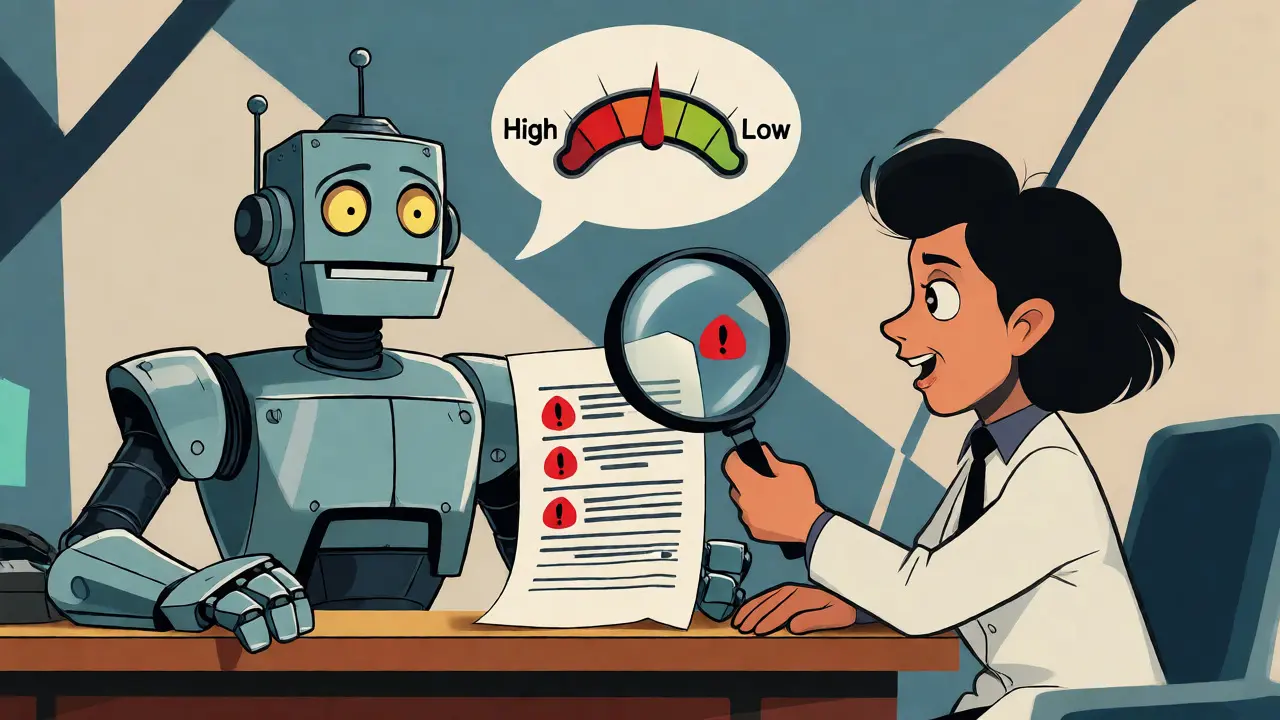
For high-stakes applications-like medical advice or legal summaries-implement mandatory human review. Never let the AI send the final email or publish the report without a human eye checking key facts. For lower-risk tasks, like summarizing long articles, automated checks might suffice. You can run secondary models to verify claims against primary sources, flagging discrepancies for review.
Also, monitor your logs. Track metrics like citation validity rates or user corrections. If users constantly edit out fabricated dates, your model is struggling with temporal reasoning. Adjust your retrieval strategy or fine-tune specifically for date handling. Continuous monitoring turns hallucination management from a one-time fix into an ongoing operational discipline.
Looking Ahead: Uncertainty Quantification
The future lies in better uncertainty estimation. Researchers are working on methods to make models output confidence scores alongside their answers. Imagine a system that says, "The capital of France is Paris (Confidence: 99%)" versus "The CEO of Company X is John Doe (Confidence: 45%)." This transparency allows downstream systems to decide when to trust the AI and when to escalate to a human.
We’re also seeing the rise of agentic workflows, where AI systems plan, act, observe, and reflect. By breaking complex tasks into smaller steps and verifying each step independently, agents can catch errors before they propagate. While not foolproof, these architectures represent a shift from passive generation to active verification.
What exactly is an AI hallucination?
An AI hallucination is when a generative AI model produces information that sounds plausible and coherent but is factually incorrect, nonsensical, or entirely fabricated. Unlike traditional software bugs, these errors arise from the probabilistic nature of how models predict the next word, leading them to "guess" when they lack sufficient data.
Can RAG completely eliminate hallucinations?
No, Retrieval-Augmented Generation (RAG) significantly reduces hallucinations by grounding responses in verified external data, but it doesn't eliminate them entirely. The model might still misinterpret retrieved documents, fail to retrieve relevant info, or combine facts incorrectly. It is a strong mitigation strategy, not a silver bullet.
Why do AI models hallucinate?
Models hallucinate primarily due to their architectural design as probabilistic predictors. They are trained to maximize the likelihood of the next token, not to verify truth. Additionally, limitations in training data coverage, biases in the dataset, and evaluation metrics that reward guessing over admitting uncertainty all contribute to the phenomenon.
How does temperature affect hallucinations?
Temperature controls the randomness of the model's predictions. Higher temperatures increase diversity and creativity but also raise the risk of hallucinations by allowing less probable words to be selected. Lowering the temperature makes the model more deterministic and conservative, typically reducing hallucinations at the cost of creative variety.
Is RLHF effective against hallucinations?
Reinforcement Learning from Human Feedback (RLHF) helps by training models to prefer outputs that humans rate as accurate and helpful. However, its effectiveness depends on the quality of human feedback. If annotators miss subtle factual errors, the model may learn to prioritize fluency over precision. It is best used in combination with other techniques like RAG.