You just accepted a pull request generated by GitHub Copilot. It looks clean. The logic works. The tests pass. But hidden inside that elegant function is an insecure deserialization flaw that could expose your entire user database. This isn't a hypothetical nightmare; it's the new reality of software engineering in 2026. As AI assistants churn out roughly 35% of new enterprise code, the definition of "good code" has shifted. Functional correctness no longer guarantees security.
If you are a verification engineer, your job description just got harder. Traditional code review assumes a human developer made conscious choices about security trade-offs. AI doesn't make choices; it predicts patterns. And often, those patterns prioritize brevity over safety. A recent analysis by Kiuwan revealed that 43% of AI-generated code contains security vulnerabilities, nearly double the rate found in human-written code. To keep your applications safe, you can't rely on gut feeling or standard checklists alone. You need a targeted approach designed specifically for the failure modes of large language models.
Why AI Code Breaks Security Assumptions
Let's be clear: AI coding assistants are not malicious. They are probabilistic engines trained on vast repositories of public code. When Amazon CodeWhisperer suggests a solution, it's pulling from millions of examples where developers cut corners to meet deadlines. Consequently, AI often reproduces these shortcuts at scale. It might generate a SQL query that works perfectly but lacks parameterization, leaving the door wide open for injection attacks. Or it might handle API keys as plain text strings because that was the most common pattern in its training data, ignoring environment variable best practices.
This creates a specific class of defects we call "functionally correct but security-deficient." The code runs. It does what the prompt asked. But it fails to defend against adversarial input. Dr. Jane Doe, Chief Security Officer at Kiuwan, highlighted this during her Black Hat presentation, noting that verification engineers must develop new pattern recognition skills to spot these gaps. You aren't just looking for bugs anymore; you're looking for omissions. The danger lies in the silence-the missing validation check, the absent error handling, the unencrypted secret.
The Core Vulnerabilities in AI-Generated Code
Before you dive into tools and workflows, you need to know what to look for. The OpenSSF’s Security-Focused Guide identifies three primary categories where AI consistently stumbles. Understanding these helps you prioritize your manual review efforts when automated tools miss the mark.
- Missing Input Validation: AI often assumes inputs are trustworthy. It will write a function that accepts a string and processes it without checking length, type, or content. In a web application, this is a direct path to Cross-Site Scripting (XSS) or buffer overflows.
- Insecure Deserialization: This is a silent killer. AI frequently generates code that uses native serialization libraries (like Python’s `pickle` or Java’s default serializer) on user-supplied data. If an attacker controls that data, they can execute arbitrary code. AI rarely adds the necessary allow-lists or safe wrappers unless explicitly prompted.
- Improper Error Handling: Instead of logging errors securely, AI tends to dump stack traces directly to the client. This leaks internal file paths, library versions, and sometimes even configuration details, giving attackers a roadmap for further exploitation.
These aren't exotic edge cases. They are the bread and butter of AI mistakes. A GitHub case study involving a 30,000-line codebase found that insecure deserialization and missing input validation accounted for nearly 70% of all missed vulnerabilities. If you only have time to check three things, check these.
Building Your Verification Checklist
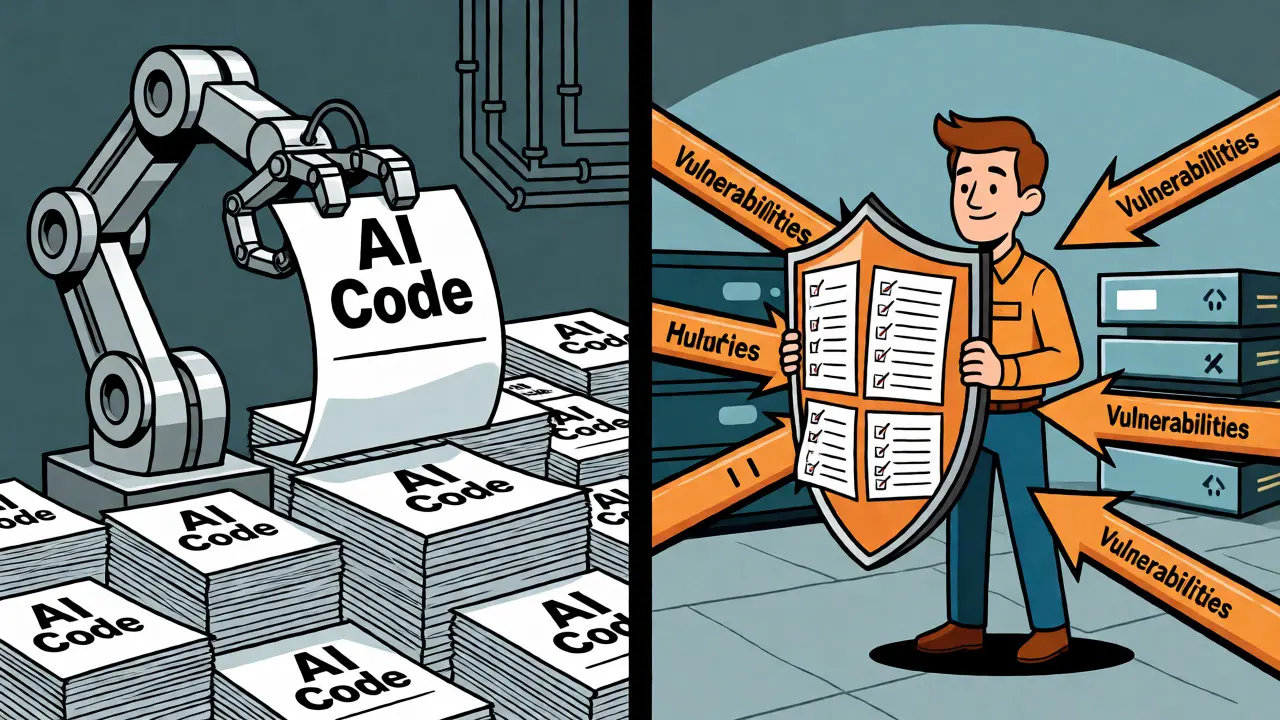
Generic checklists fail here. You need a framework that accounts for the lack of intent in AI code. The following checklist, derived from OpenSSF guidelines and industry benchmarks, targets the specific weaknesses of LLM-generated output. Integrate these steps into your pull request reviews.
| Check Item | What to Look For | Action Required |
|---|---|---|
| Input Sanitization | Are external inputs validated before use? Is there a whitelist approach? | Add strict schema validation (e.g., Pydantic, Zod). |
| Crypto & Secrets | Are secrets hardcoded? Is weak hashing (MD5/SHA1) used? | Move secrets to env vars; switch to BCrypt or Argon2. |
| Error Leakage | Do error messages expose stack traces or DB structure? | Implement generic user-facing errors with detailed server-side logging. |
| Access Control | Is authorization checked at the endpoint level, not just UI? | Add explicit role-based access control (RBAC) checks. |
| Dependency Safety | Did AI suggest outdated or vulnerable libraries? | Run dependency scanning; verify library maintenance status. |
Notice the emphasis on "Action Required." Don't just flag the issue; provide the fix. AI is great at implementing fixes once you identify the problem. By combining human insight with AI remediation capabilities, you speed up the loop. Mend.io’s version 4.2, for instance, offers contextual fixes for 83% of detected vulnerabilities, bridging the gap between detection and resolution.
Integrating Automated Tools with Human Oversight
You cannot manually review every line of AI code. It’s too fast, and the volume is too high. Automation is your first line of defense, but standard Static Application Security Testing (SAST) tools struggle with AI-specific nuances. Traditional scanners achieve only 62-68% detection rates for AI-generated vulnerabilities. Specialized platforms like Mend SAST or Kiuwan, however, push that accuracy above 90% by leveraging data flow analysis and historical AI vulnerability patterns.
Here is how to structure your pipeline for maximum efficacy:
- Tag AI-Generated Code: Use commit trailers or metadata to tag code originating from AI assistants. This allows your CI/CD pipeline to apply stricter rules to these commits.
- Pre-Commit Hooks: Run lightweight SAST scans locally. Tools like Semgrep or Bandit can catch obvious issues before the code even hits the repository.
- SARIF Integration: Configure your tools to export results in SARIF format. This standardized JSON format allows different security tools to share findings. More importantly, it lets you feed structured security data back into your AI assistant for iterative improvement.
- Pull Request Gatekeeping: Block merges if critical severity issues are detected. Do not let "it works" override "it’s unsafe."
A senior verification engineer at a Fortune 500 company reported that implementing this multi-layered approach reduced critical vulnerabilities in AI code by 63%. Yes, initial review time increased by 22%, but efficiency improved significantly after three months of tool integration. The key is automation doing the heavy lifting so humans can focus on logic and context.
Navigating Compliance and Contextual Blind Spots
Automated tools are brilliant at syntax and pattern matching. They are terrible at understanding business context. This is where verification engineers earn their pay. If your application handles healthcare data, HIPAA compliance isn't just about encryption; it's about audit trails, consent management, and data residency. AI doesn't know your regulatory landscape unless you tell it, and even then, it might hallucinate compliance features.
For regulated industries, manual review is non-negotiable. Focus your human attention on these areas:
- Data Flow Analysis: Trace sensitive data from entry to storage. Does it touch third-party APIs? Is it logged in plaintext? AI often forgets to mask PII in logs.
- Business Logic Authorization: Ensure that users can only access resources they own. AI might implement authentication correctly but forget authorization checks within the business logic layer.
- Compliance Mapping: Verify that security controls map to specific regulatory requirements (GDPR, PCI-DSS). Document these decisions inline with comments. Future auditors-and future AI models-will thank you.
Remember, AI tools often suggest turning off security features like XML entity security during deserialization to simplify code. This is a trap. Always maintain a blocklist of forbidden practices that AI should never propose, regardless of convenience.
Overcoming False Positives and Review Fatigue
One of the biggest complaints from verification engineers is the noise. Automated tools, especially those tuned for general code, produce false positives at rates averaging 18% when applied to AI code. Triage becomes a bottleneck. How do you manage this?
First, tune your rules. Disable checks that are irrelevant to your tech stack. Second, establish a feedback loop. When a tool flags an issue that is actually safe due to specific business context, mark it as such. Modern platforms learn from these triage decisions. Over time, the signal-to-noise ratio improves.
Second, shift left. Catch issues in the IDE. If your developer sees a warning while typing, they can fix it immediately. Waiting for the CI pipeline adds friction. GitHub Copilot’s upcoming releases include built-in security validation powered by rule engines, aiming to reduce verification time by 40%. Until then, local pre-commit hooks are your best friend.
Finally, don't underestimate the power of documentation. When you reject an AI suggestion or modify its output, add a comment explaining why. "Used parameterized query to prevent SQL injection" is better than just changing the code. This builds institutional knowledge and helps train future prompts.
Looking Ahead: The Evolution of Verification
The landscape is moving fast. Gartner projects the AI code security market to hit $2.8 billion by 2026. We are already seeing a shift toward integrated solutions where the coding assistant itself validates security. Imagine an AI that not only writes code but also critiques its own security posture in real-time.
However, technology alone won't save us. As Dr. Sarah Chen from MIT warned, current verification approaches may become obsolete as AI evolves to bypass traditional patterns. Continuous adaptation is key. Verification engineers must stay curious, constantly updating their checklists as new AI models emerge. The goal isn't just to find bugs today; it's to build a resilient process that adapts to tomorrow's intelligent code.
Do I need special tools to review AI-generated code?
While standard SAST tools help, specialized platforms like Mend SAST or Kiuwan offer higher detection rates (over 90%) for AI-specific vulnerabilities compared to traditional tools (62-68%). Integrating SARIF output allows these tools to communicate effectively with your development workflow.
How much more time does reviewing AI code take?
Initially, review time may increase by around 22% due to the need for careful scrutiny of security omissions. However, with proper tool integration and checklist adoption, teams typically see efficiency gains after 3-4 months, often reducing overall review time by 35% through automated pre-commit hooks.
What are the most common security flaws in AI code?
The top three are missing input validation, insecure deserialization, and improper error handling. These occur because AI prioritizes functional correctness and brevity, often omitting defensive programming practices unless explicitly prompted.
Can AI tools automatically fix security issues?
Yes, modern platforms like Mend.io version 4.2 provide contextual fixes for approximately 83% of detected vulnerabilities. However, human verification is still required to ensure the fix aligns with business logic and compliance requirements.
How do I handle compliance in AI-generated code?
Automated tools struggle with contextual compliance (HIPAA, GDPR). Manual review is essential here. Focus on data flow analysis, ensuring PII is masked in logs, and verifying that authorization checks exist within business logic layers, not just at the API gateway.