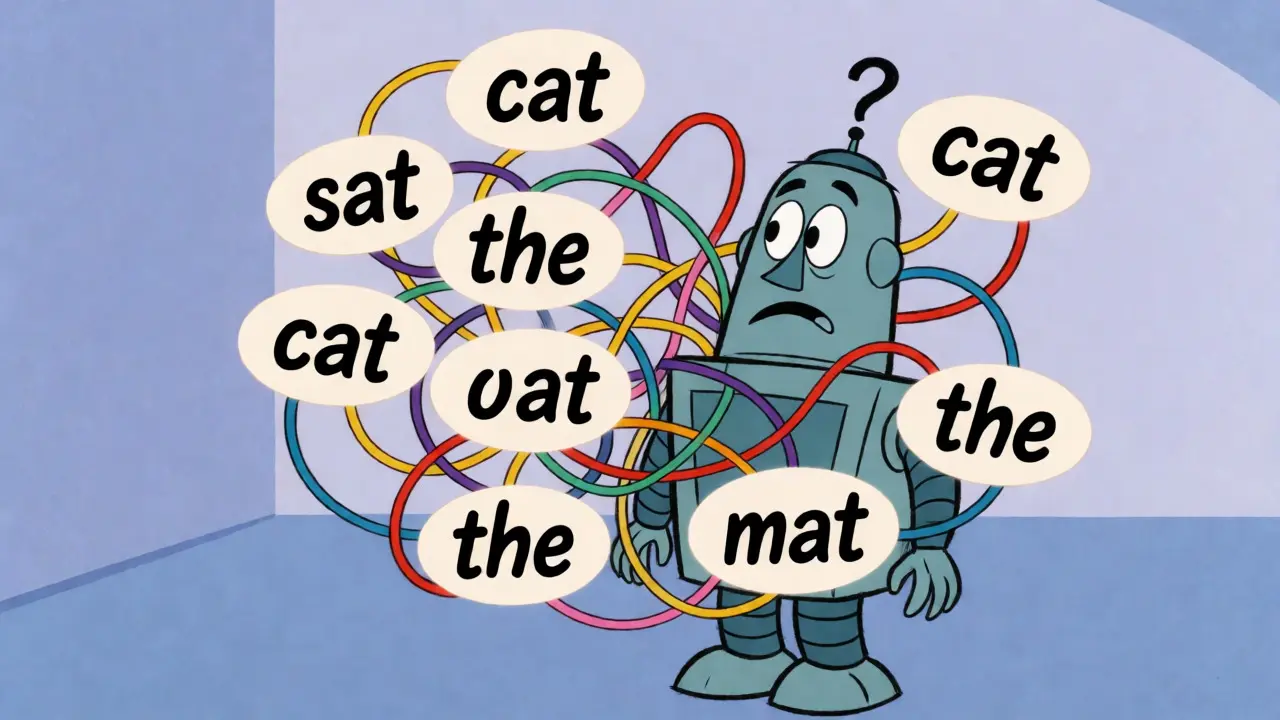
You type a sentence into an AI chatbot. It reads the words, understands the meaning, and generates a response. But here is the weird part: the model doesn't actually know which word came first. To a raw Transformer, the sequence "The cat sat on the mat" looks exactly the same as "mat the on sat cat The." Without a specific mechanism to tell it where each word sits in the line, the model would be blind to grammar and order. This is where positional encoding steps in. It is the mathematical trick that injects order into a parallel-processing architecture, allowing modern Large Language Models like GPT-4 or Llama 3 to understand syntax, context, and time.
| Concept | Why It Matters |
|---|---|
| Permutation Invariance | Transformers process tokens simultaneously, losing natural order without explicit positional data. |
| Sinusoidal Functions | The original method uses sine/cosine waves to create unique fingerprints for each position. |
| RoPE (Rotary) | The current industry standard (used in Llama/Mistral) encodes relative positions via rotation matrices. |
| Context Limits | Poor positional handling causes models to forget or hallucinate when sequences exceed training lengths. |
Why Transformers Need Help With Order
To grasp why this matters, you have to look at how older models worked. Recurrent Neural Networks (RNNs) and LSTMs processed text one word at a time, left to right. They had a built-in sense of time because they literally stepped through the sequence. If you asked an LSTM about the third word, it remembered the first two. That sequential nature was baked into its DNA.
Transformers ditched this loop for speed. By using self-attention mechanisms, they can look at every word in a sentence at once. This parallelism makes training massively faster on GPUs. But there is a catch: attention is symmetric. If you swap two words, the attention scores between them might change slightly due to semantic differences, but the structural concept of "position" vanishes. The model sees a bag of words, not a sentence. To fix this, engineers realized they needed to tag every token with its location before feeding it into the network.
The Original Solution: Sinusoidal Positional Encoding
In the seminal 2017 paper "Attention is All You Need," Vaswani et al. introduced Sinusoidal Positional Encoding. The idea was elegant: generate a fixed vector for each position using sine and cosine functions of different frequencies. Think of it like binary counting, but smooth. Low-frequency waves capture long-range dependencies (like paragraph structure), while high-frequency waves capture local details (like adjacent words).
The formula adds these vectors directly to the word embeddings. If the word "cat" has a certain numerical representation, adding the positional vector for index 5 changes that representation just enough to signal "this 'cat' is the fifth word." The beauty of this approach is extrapolation. Because the functions are continuous, the model can theoretically handle sequence lengths longer than those seen during training. It’s like knowing how to count past 100 even if you only practiced up to 50.
Learned Embeddings vs. Fixed Functions
Not everyone agreed with the fixed math approach. OpenAI, when building GPT-2, chose to train their own positional embeddings from scratch. Instead of calculating sines and cosines, they created a lookup table of learnable parameters. The model figures out what the best positional representation is during training.
This works great for tasks with fixed input sizes, like image classification or short-text translation. However, learned embeddings struggle with length generalization. If you train a model on sentences up to 512 tokens, the learned embedding for token 513 simply doesn’t exist. The model has no clue what to do. This limitation forced researchers to keep circling back to methods that could handle variable lengths better.

The Modern Standard: Rotary Positional Embeddings (RoPE)
If you are working with state-of-the-art open-source models today-like Meta’s Llama 3 or Mistral-you are likely dealing with Rotary Positional Embeddings (RoPE). Introduced by Su et al. in 2021, RoPE changed the game by encoding absolute positions in a way that naturally captures relative distances.
Instead of adding a vector to the embedding, RoPE rotates the query and key vectors in the attention mechanism based on their position. Imagine a clock hand. As the position increases, the angle of the vector rotates. When the attention mechanism calculates the dot product between two tokens, the result depends on the difference in their angles-which corresponds to the difference in their positions. This makes it incredibly effective for understanding relative distance (e.g., "the word three spots ago") without needing separate relative position buckets.
| Method | Mechanism | Best Use Case | Limitations |
|---|---|---|---|
| Sinusoidal | Adds fixed sine/cosine vectors to embeddings. | Original Transformers; simple implementations. | Struggles with very long contexts; less flexible. |
| Learned | Trainable lookup table for positions. | Fixed-length inputs (GPT-2 style). | Cannot extrapolate beyond training length. |
| RoPE | Rotates Q/K vectors based on position. | Modern LLMs (Llama, PaLM); long-context tasks. | Complex implementation; requires careful tuning. |
| ALiBi | Adds linear bias to attention scores. | Extreme length extrapolation. | Can hurt performance on non-distance-sensitive tasks. |
Handling Long Context Windows
The biggest challenge in 2026 isn't just understanding order; it's maintaining it over massive distances. Early models handled 512 or 1,024 tokens. Today, we expect 128k, 200k, or even 1 million token contexts. How do you encode position 100,000 without breaking the model?
Techniques like Position Interpolation allow us to stretch existing positional encodings. If a model was trained on positions 0-2048, we can compress the new range 0-8192 into that same space. It’s like shrinking a map so it fits on your phone screen. The model loses some resolution (fine-grained position accuracy) but gains the ability to process much more text. Another method, YaRN, fine-tunes the interpolation scales to preserve both short-term and long-term accuracy.
For developers, this means you cannot just assume a model will handle any length. If you feed a 100k-token document into a model designed for 4k, you need to check if it supports RoPE scaling or ALiBi. Failing to do so results in "lost in the middle" phenomena, where the model ignores information buried deep in the prompt because the positional signals became too noisy or saturated.

Practical Implementation Tips
If you are building or fine-tuning a transformer, here is what you need to watch out for:
- Dimension Matching: Your positional encoding vector must match the dimensionality of your token embeddings ($d_{model}$). A mismatch here causes immediate shape errors during training.
- Pre-norm vs. Post-norm: Most modern architectures apply layer normalization before attention. Ensure your positional addition happens at the correct stage (usually added to the embedding output before entering the first block).
- Zero Padding: Remember that padding tokens also get positional encodings. Masking is crucial to ensure the model doesn't treat padding as meaningful content.
- Framework Support: Libraries like Hugging Face `transformers` handle most of this automatically, but custom architectures require manual implementation of RoPE or ALiBi logic.
Frequently Asked Questions
What happens if I remove positional encoding from a Transformer?
The model becomes permutation invariant. It will treat all input sequences containing the same set of words as identical, regardless of their order. For example, "I love pizza" and "Pizza love I" would produce the exact same internal representations, making the model useless for language tasks that rely on grammar and syntax.
Is RoPE better than sinusoidal encoding?
Generally, yes, for modern large language models. RoPE explicitly encodes relative positions, which aligns better with how attention mechanisms work. It also tends to generalize better to longer sequences compared to pure sinusoidal or learned embeddings, which is why it is the default in models like Llama and Mistral.
Can a model handle sequences longer than it was trained on?
Only if the positional encoding scheme supports extrapolation. Learned embeddings usually fail because they lack entries for unseen positions. Sinusoidal and RoPE methods can theoretically extrapolate, but performance often degrades significantly unless techniques like Position Interpolation or YaRN are applied to adjust the frequency scales.
What is ALiBi and when should I use it?
ALiBi (Attention with Linear Biases) adds a static linear penalty to attention scores based on the distance between tokens. It is excellent for extreme length extrapolation without retraining. However, it assumes that closer tokens are always more important, which can hurt performance on tasks requiring long-range reasoning where distant tokens are critical.
How does positional encoding affect inference speed?
Minimal impact. Calculating sinusoidal or applying RoPE rotations involves simple element-wise operations or matrix multiplications that are highly optimized on GPUs. The computational cost is negligible compared to the heavy lifting done by the multi-head attention layers themselves.
RoPE is definitely the way to go for long context stuff now.
I tried using learned embeddings on a project last year and hit that wall hard when I tried to push past the training length. It just fell apart. Switching to RoPE saved us a ton of headaches with extrapolation.
This article is so overrated it's actually painful to read, everyone knows this basic stuff already, stop acting like you discovered fire.
The whole "permutation invariance" thing is explained in every single intro course, why are we still writing deep dives on it like it's breaking news? You're just regurgitating Vaswani's paper without adding any real value or new insight into how these models actually fail in production. It feels like filler content designed to boost SEO rather than help actual engineers understand the nuances of implementation. I'm tired of seeing surface-level explanations get upvoted while people who actually struggle with ALiBi vs RoPE trade-offs are ignored.
Bonnie, that is harsh but fair point about the basics, however the practical tips on YaRN and interpolation are what matter here.
Most people don't realize that simply swapping encodings isn't enough; you have to tune the scaling factors or your model hallucinates wildly at 100k tokens. I spent three weeks debugging a Llama fine-tune because I didn't adjust the rope theta properly, and it wasn't obvious from standard tutorials. This post highlights that gap between theory and the messy reality of deployment. We need more posts focusing on those specific hyperparameter adjustments rather than just explaining sine waves again.
Okay, so if I'm understanding this correctly, the rotation matrix approach in RoPE essentially allows the attention mechanism to calculate relative distance dynamically during the dot product, which means we don't need to store massive lookup tables for every possible position pair, right??
Because that seems like the key advantage over the old sinusoidal method where you had to add vectors beforehand, and honestly, the computational efficiency gain must be huge for inference speed even if the math looks scary at first glance?? I'm trying to wrap my head around how the angle difference maps directly to position difference without needing explicit relative position buckets, because that feels like magic but also makes perfect sense once you see the clock hand analogy...
Is there a specific library implementation you recommend for custom architectures, or does Hugging Face handle all the edge cases for YaRN scaling automatically now??
Yes exactly, HF transformers handles most of the YaRN and linear scaling logic automatically now if you use their config classes.
You just set the `rope_scaling` parameter in the model config and it adjusts the frequencies accordingly. No need to write custom CUDA kernels unless you are doing something very exotic. The relative distance calculation happens implicitly through the trigonometric identities used in the rotation, so yes, no lookup tables needed for pairs.
FINALLY someone explains this without drowning me in jargon!!!
The clock hand analogy made it click for me instantly, i was struggling with the math notation for weeks and thought i was just dumb lol. Learned embeddings were such a nightmare for my thesis project cause they broke whenever i fed them longer docs. RoPE is life saver fr.
Also shoutout to the part about padding masks, i forgot that twice and wasted days debugging weird outputs. Great post!!
theyre hiding the fact that positional encoding is just a band aid for the fundamental flaw of parallel processing
RNNs had natural order built in. Transformers broke it then tried to fix it with complex math tricks instead of solving the architecture problem properly. Now we rely on external libraries to manage these fragile frequency scales. If you change one hyperparameter wrong your model forgets everything. Its brittle. They want us to think its elegant but its actually just patchwork code holding together a broken concept.
ALiBi is better but they ignore it because its harder to market as "state of the art" hype.
To reduce the symphony of syntax to mere angular displacement is to misunderstand the ontological weight of sequence itself.
We do not merely count positions; we inhabit them. The sinusoidal function is not a trick but a harmonic resonance with the temporal fabric of language. To suggest that RoPE "fixes" order is to imply that order was ever truly lost, rather than transformed into a higher-dimensional manifold where proximity is defined by phase alignment rather than index.
Meagan's cynicism is understandable, yet misses the poetic elegance of continuous functions bridging discrete tokens. We are not patching a hole; we are tuning an instrument.
OH MY GOD Joanna you are absolutely INSANE right now 😱
"Ontological weight of sequence"??? Who talks like that?! I almost choked on my coffee reading this! But seriously, the bit about "tuning an instrument" is kinda beautiful in a pretentious way lol. I love how dramatic everyone gets about math sometimes. Meagan calling it "patchwork code" made me laugh too hard though. This comment section is more entertaining than the article!
Love the vibe here, especially the clock analogy-it’s like giving the words a little GPS tracker so they know where they stand in the line-up.
It’s wild to think that without this, "I love you" and "you love I" would look identical to the machine. That’s kind of terrifying if you think about it! Glad to see some folks sharing their war stories about padding masks and YaRN scaling. Real talk: always check your masking logic before blaming the model for being stupid. Saved my sanity more times than I can count.
Also, Joanna, you’re speaking in tongues but I respect the commitment to the bit. 🎭