
Have you ever asked an AI for a specific fact, only to get back a confident, completely made-up answer? It’s frustrating. You trust the technology, but it fails you when accuracy matters most. This is the "hallucination" problem, and it has plagued large language models since they became mainstream. But what if the model could stop, check its own work, and correct itself before showing you the final result?
That’s exactly what Chain-of-Verification does. Introduced in a pivotal 2024 paper presented at the Association for Computational Linguistics (ACL), Chain-of-Verification (often abbreviated as CoVe) is a prompting framework that forces an AI to verify its own answers. It doesn’t require new hardware or retraining the model from scratch. Instead, it uses a clever four-step process to catch errors while they’re still happening.
What Is Chain-of-Verification (CoVe)?
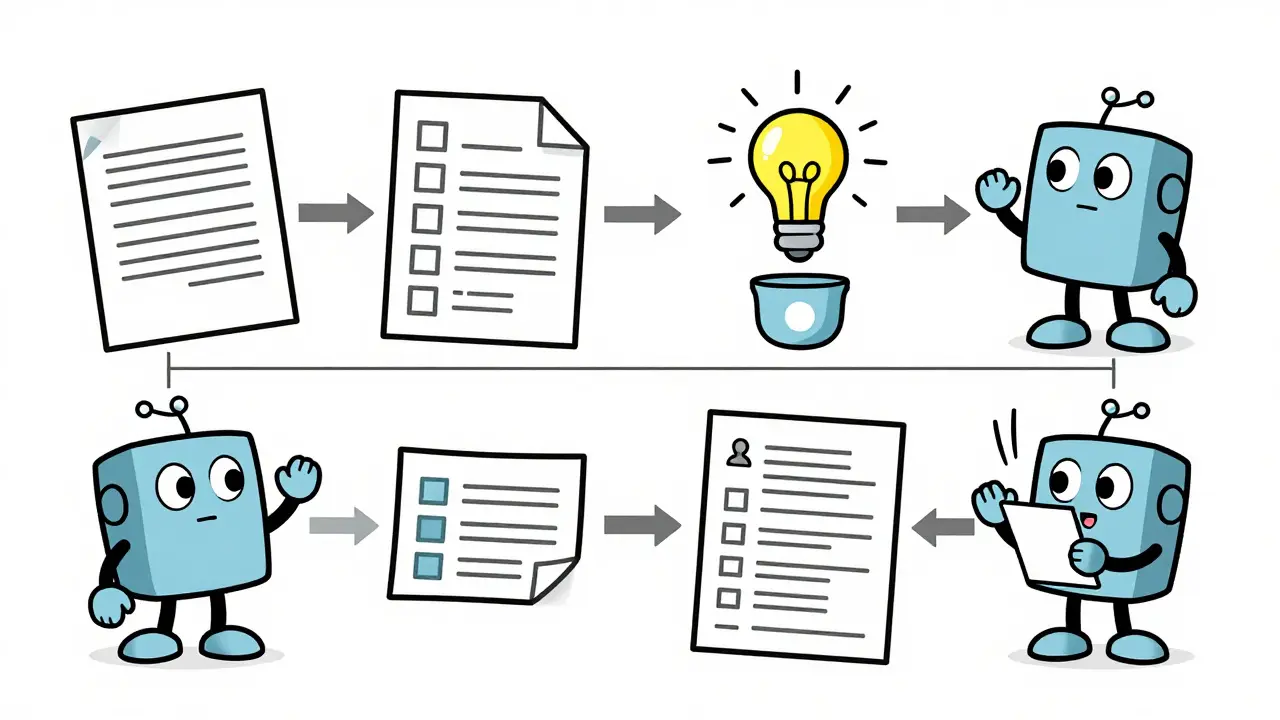
At its core, Chain-of-Verification is a self-verifying reasoning paradigm where an LLM drafts an answer, plans verification questions, answers them independently, and then revises the final output. Think of it like a student writing an essay. First, they write a rough draft. Then, instead of just handing it in, they create a checklist of facts to double-check. They research those specific facts without looking at their draft to avoid bias. Finally, they go back and fix any mistakes found during that check.
This method was detailed in the ACL 2024 Findings paper titled “Chain-of-Verification Reduces Hallucination in Large Language Models.” The authors demonstrated that this structured approach significantly lowers the rate of factual errors compared to standard generation methods. Unlike earlier attempts that relied on confidence scores-which often proved unreliable-CoVe actively hunts for contradictions in the model’s own logic.
The Four Steps of the CoVe Process
To implement CoVe, you don’t need complex code changes. You just need to structure your prompts correctly. The process breaks down into four distinct stages:
- Baseline Response Generation: You ask the model your original question. It generates a standard answer using normal decoding. This draft might contain errors, unsupported claims, or logical gaps. At this stage, treat it as a hypothesis, not the truth.
- Verification Question Planning: Here, you prompt the model to look at its own draft and generate a list of specific questions that would help verify the claims made. For example, if the draft says “The treaty was signed in 1945,” the verification question might be “In what year was the treaty signed?” These questions target individual assertions rather than the whole text.
- Independent Verification Execution: This is the critical step. The model answers each verification question one by one. Crucially, these answers must be generated independently of the original draft. This prevents the model from simply repeating its previous mistake or rationalizing an error. Because these questions are usually short and factual, the model is less likely to hallucinate here.
- Final Verified Response Generation: Finally, the model takes the original query, the initial draft, the verification questions, and the independent answers to produce a revised response. If the independent answer contradicts the draft, the model corrects the error. If they align, the claim is reinforced.
Why Independent Verification Matters
You might wonder why step three needs to be so strict about independence. If the model looks at its original draft while answering the verification questions, it suffers from what researchers call “answer leakage.” The model tends to confirm its own biases rather than challenge them.
By forcing the model to answer verification questions from scratch, CoVe exposes inconsistencies. Imagine the model initially claimed that Paris is the capital of Germany. In the planning phase, it creates the question: “What is the capital of Germany?” In the execution phase, because it isn’t looking at the wrong draft, it correctly answers “Berlin.” The final revision stage then spots the contradiction and fixes the error. Without that independence, the model might have just said, “Yes, Paris is the capital,” doubling down on the mistake.
Performance Benchmarks and Real-World Results
Does this extra effort actually pay off? The data suggests yes. In the ACL 2024 study, CoVe was tested against several benchmarks, including Wikidata factual queries and long-form generation tasks. The results were striking. On a difficult task involving wiki category lists, a variant of CoVe doubled the performance compared to baseline methods.
More importantly, CoVe consistently outperformed standard instruction-tuned models like InstructGPT and early versions of ChatGPT on hallucination metrics. While instruction tuning helps models follow rules, it doesn’t inherently teach them to fact-check themselves. CoVe fills that gap. Studies also showed that CoVe improves precision and reasoning fidelity in code generation and multimodal reasoning tasks, proving it’s not just useful for trivia questions.
| Method | Type | Key Mechanism | Hallucination Reduction |
|---|---|---|---|
| Standard Prompting | Generation-time | Direct answer generation | None (Baseline) |
| Retrieval-Augmented Generation (RAG) | External-tool | Grounds answers in external documents | High (depends on retrieval quality) |
| Instruction Tuning | Training-time | Fine-tuning weights for alignment | Moderate (limited by training data) |
| Chain-of-Verification (CoVe) | Generation-time | Self-critique via independent verification | Significant (outperforms baselines in tests) |
CoVe vs. Other Methods: RAG and Chain-of-Thought
It’s easy to confuse CoVe with other popular techniques like Chain-of-Thought (CoT) or Retrieval-Augmented Generation (RAG). Understanding the differences helps you choose the right tool for the job.
Chain-of-Thought (CoT) asks the model to “think step by step.” This improves reasoning but doesn’t explicitly check for factual errors. A model can reason logically through a flawed premise. CoVe adds a layer of scrutiny on top of reasoning. You can even combine them: use CoT to generate the draft, then CoVe to verify it.
RAG pulls information from external databases. It’s excellent for grounding answers in specific, up-to-date documents. However, RAG depends entirely on the quality of the retrieved documents. If the retriever fetches the wrong document, the answer will be wrong. CoVe relies on the model’s internal knowledge and self-consistency. It doesn’t need external tools, making it faster to implement, though potentially less reliable for obscure facts not well-represented in the model’s training data.
For high-stakes applications like legal analysis or medical advice, many experts recommend combining both: use RAG to provide source material, and CoVe to ensure the model accurately interprets that material without adding false details.

Implementation Costs and Trade-offs
No solution is free. The main drawback of CoVe is computational cost. Since the model runs through four stages-draft, plan, verify, revise-it consumes roughly four times the tokens and latency of a single-pass response.
In a real-time chat application, this delay might be noticeable. Users expect instant replies. However, for tasks where accuracy is paramount-such as generating financial reports, coding assistance, or educational content-the trade-off is worth it. You save time later by not having to manually fact-check the AI’s output.
To mitigate costs, you can optimize the verification stage. Since verification questions are typically short and simple, they require fewer tokens than the full draft. Additionally, you can apply CoVe selectively. Use it only for complex, multi-step queries where hallucinations are most likely, and stick to standard prompting for simple greetings or basic questions.
Best Practices for Using CoVe
If you’re ready to integrate Chain-of-Verification into your workflow, keep these tips in mind:
- Target Specific Claims: Ensure the verification questions focus on discrete facts (dates, names, definitions) rather than vague opinions. This makes the independent verification step more effective.
- Enforce Independence: When prompting for verification answers, explicitly instruct the model to ignore the previous draft. Phrases like “Answer based solely on your internal knowledge” help prevent bias.
- Combine with Stronger Models: CoVe works best with larger, more capable models that have better reasoning abilities. Smaller models may struggle to generate meaningful verification questions or detect subtle inconsistencies.
- Iterate on Prompts: The effectiveness of CoVe depends heavily on the quality of the prompts used in each stage. Experiment with different instructions for the planning and revision phases to find what works best for your specific domain.
The Future of Self-Verifying AI
As we move further into 2026, the demand for reliable AI outputs continues to grow. Regulatory bodies in finance and healthcare are increasingly requiring transparency and accuracy. CoVe represents a shift from trusting AI blindly to building systems that doubt and verify themselves.
Researchers are already exploring ways to combine CoVe with other techniques, such as self-consistency sampling and deductive verification frameworks like Natural Program. The goal is to create AI agents that don’t just generate text, but rigorously validate their own conclusions before presenting them to humans. For developers and engineers, mastering CoVe is no longer optional-it’s essential for building trustworthy AI applications.
Is Chain-of-Verification available as a software product?
No, CoVe is not a standalone software product or API. It is a prompting framework and orchestration pattern. You can implement it using any large language model that supports multi-step prompting, such as those available via OpenAI, Anthropic, or open-source models like Llama.
How much does CoVe increase inference costs?
Because CoVe involves four distinct steps (draft, plan, verify, revise), it typically increases token usage and latency by approximately 300-400% compared to a single-pass response. However, verification questions are often shorter, which can slightly reduce the overhead.
Can CoVe be combined with Retrieval-Augmented Generation (RAG)?
Yes, combining CoVe with RAG is a powerful strategy. RAG provides external factual context, while CoVe ensures the model correctly interprets that context and doesn’t hallucinate additional details. This hybrid approach is recommended for high-stakes applications.
What types of tasks benefit most from CoVe?
CoVe is most effective for tasks requiring high factual precision, such as question answering, long-form article generation, code explanation, and logical reasoning. It is less necessary for creative writing or casual conversation where minor inaccuracies are acceptable.
Does CoVe eliminate all hallucinations?
No method eliminates hallucinations entirely. CoVe significantly reduces them by catching obvious contradictions and factual errors. However, if the model lacks the knowledge to answer the verification question correctly, it may still propagate errors. It improves reliability but does not guarantee perfection.