
Imagine chatting with an AI assistant about your health symptoms. You expect that conversation to stay private. But what if that same chat is silently feeding into a model that learns from every word you type? This isn't just a hypothetical nightmare; it's the current reality for many users of Large Language Models (LLMs). As we move through 2026, the gap between how AI apps handle data and what users actually agree to has become a major friction point.
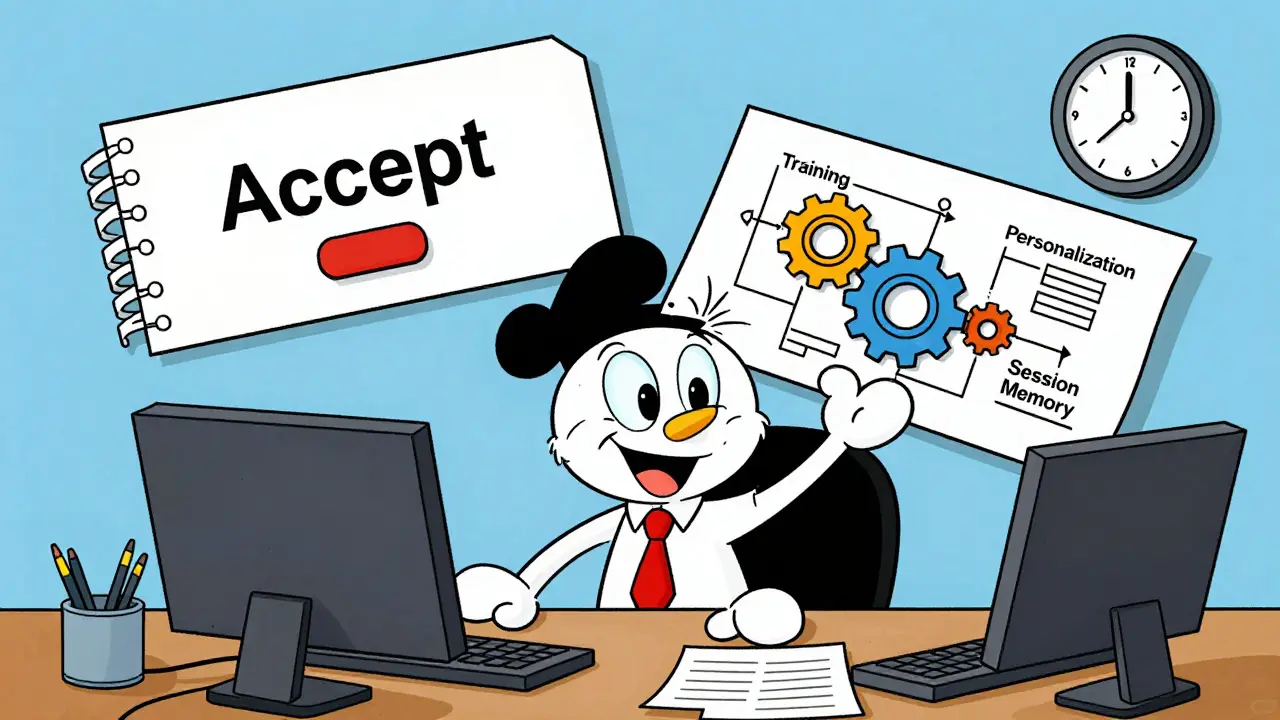
Traditional website cookies are easy to understand. You see a banner, you click 'accept,' and analytics track your page views. But Consent Management in the context of generative AI is far more complex. It involves deciding whether your prompt helps train the next version of the model, whether your personal details are stored forever, or if your data is shared with third-party vendors. For developers and businesses, getting this wrong means legal trouble under regulations like the General Data Protection Regulation (GDPR) and the California Consumer Privacy Act (CCPA). For users, it means losing trust in the technology they rely on daily.
The New Complexity of AI Consent
You might think that adding a checkbox labeled 'Allow training on my data' is enough. Unfortunately, it’s not. Dr. Michelle Dennedy, CEO of The Privacy Consulting Group, pointed out in late 2025 that traditional checkbox models are dangerously inadequate for LLM environments. Why? Because the boundaries of data usage in AI are inherently ambiguous.
In a standard web app, data collection is usually binary: either the cookie runs, or it doesn't. In an LLM-powered application, data flows through multiple stages:
- Session Processing: Using your input only to generate the immediate response, then discarding it.
- Model Improvement: Anonymizing your input to help fine-tune the model for future users.
- Persistent Personalization: Storing your preferences and history to tailor long-term interactions.
A study by MIT's Computer Science and Artificial Intelligence Laboratory (CSAIL) published in January 2026 highlighted a startling statistic: 67% of tested LLM consent implementations failed to properly enforce 'no training data' preferences. Users clicked 'no,' but their conversations still ended up in the training pipeline. This disconnect creates a massive liability for companies and confusion for users.
Why Traditional CMPs Fall Short
Most organizations use Consent Management Platforms (CMPs) like OneTrust, Osano, or CookieHub. These tools were built for tracking pixels and cookies, not for managing the intricate data flows of neural networks. While these platforms have started adapting-OneTrust released version 12.3 with experimental LLM modules as of late 2025-they still lack comprehensive enforcement capabilities for complex AI workloads.
The technical challenge is significant. Standard CMPs add about 15-30 milliseconds to API response times. However, implementing robust consent checks within an LLM inference pipeline adds approximately 85-120 milliseconds. That extra latency comes from verifying consent status at three critical points:
- Pre-inference: Checking if the user allows their specific data type to be processed.
- During processing: Masking or redacting personally identifiable information (PII) if consent is restricted.
- Post-response: Deciding whether to retain the interaction log based on user preferences.
If your system doesn't handle these steps seamlessly, you risk either violating privacy laws or degrading the user experience. Early adopters reported a 15-25% drop in response relevance when strict consent enforcement was applied to personalization data, simply because the model had less context to work with.
User Confusion and Trust Issues
Let’s talk about the people using these apps. A survey by Pew Research Center found that 73% of U.S. adults believe they have little or no understanding of how their data is used when interacting with LLM applications. Compare that to 52% for traditional websites, and you see the problem clearly.
On Reddit, frustration is palpable. In Q4 2025, analysis of over 1,200 comments across privacy-focused subreddits showed that 68% of users were confused by consent banners. One common complaint was clicking 'no' to data collection, only to find their conversation history still saved in their account dashboard. Trustpilot reviews for major LLM platforms reflect this dissatisfaction, with average consent management ratings sitting at a low 2.8 out of 5.
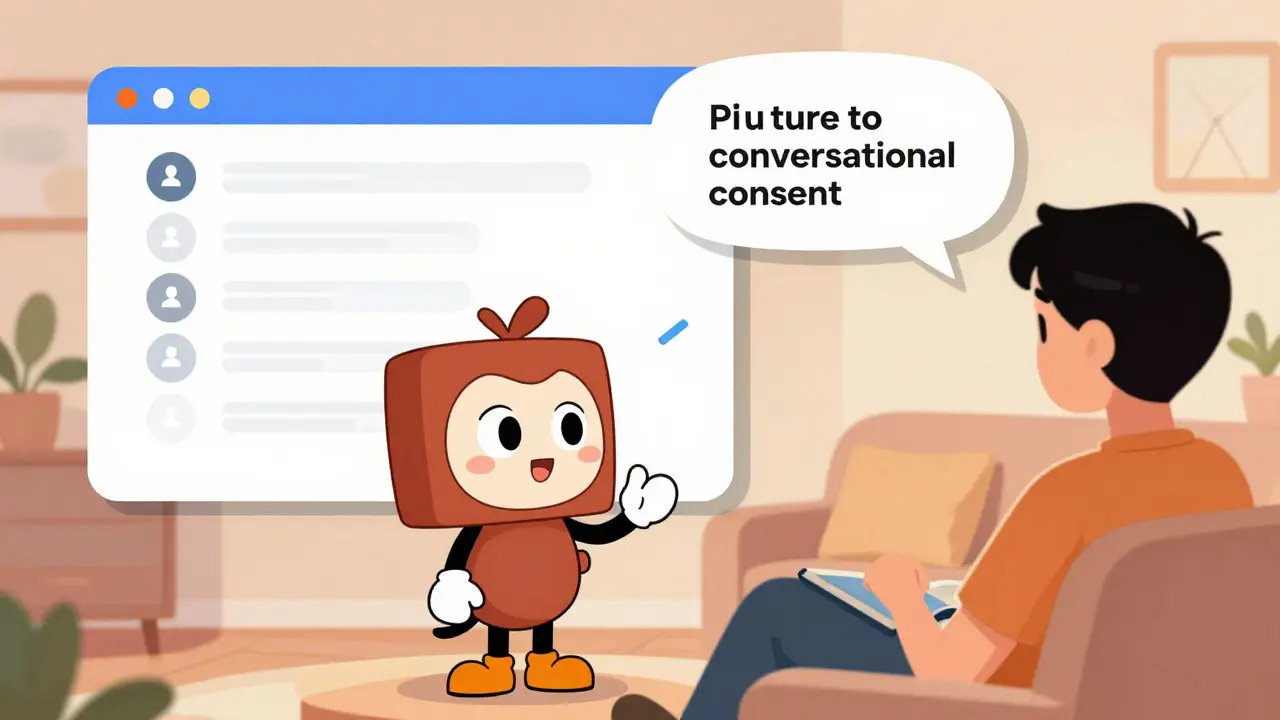
However, there is a path forward. When platforms provide immediate, contextual explanations during natural breaks in conversation flow, user satisfaction increases by 37%. Instead of a static banner, imagine the AI saying, "To remember your preference for concise answers, I'll save this setting. Would you like me to delete this chat after our session ends?" This conversational approach aligns with Gartner's prediction that by 2027, 60% of leading AI platforms will implement such interfaces.
Regulatory Landscape in 2026
The rules are tightening fast. The European Data Protection Board (EDPB) issued guidance in March 2025 stating that training LLMs on non-consented personal data likely violates GDPR Article 6. Meanwhile, the California Privacy Protection Agency released draft regulations in September 2025 requiring specific, granular consent options for AI training data usage.
For businesses operating globally, this means one-size-fits-all consent strategies are dead. You need dynamic systems that adapt to the user's location and local laws. The upcoming EU AI Act, expected to be finalized in Q2 2026, will mandate human-in-the-loop verification for high-risk AI systems, further complicating consent management requirements.
| Feature | Traditional Web App | LLM-Powered Application |
|---|---|---|
| Data Usage Scope | Cookies, Analytics, Ads | Training, Fine-tuning, Personalization, Session Memory |
| Consent Granularity | Category-based (e.g., Marketing) | Action-based (e.g., Allow Model Learning) |
| Withdrawal Mechanism | Delete Cookies / Opt-out Link | Real-time Data Purging from Training Sets |
| Latency Impact | 15-30 ms | 85-120 ms |
| Primary Risk | Fine for Non-compliance | Loss of Trust + Regulatory Fines + Model Bias |
Implementing Effective Consent Systems
So, how do you build this right? First, stop treating consent as a one-time event. The National Institute of Standards and Technology (NIST) released its draft AI Risk Management Framework Consent Module in January 2026, recommending continuous consent verification throughout the AI lifecycle.
Here are practical steps for implementation:
- Map Your Data Flows: Identify exactly where user input goes. Does it touch a vector database? Is it sent to a third-party API? Document every step.
- Offer Granular Choices: Don't just ask for 'data usage.' Ask for 'session memory,' 'model improvement,' and 'personalized recommendations' separately.
- Use Contextual Prompts: Integrate consent requests into the UI naturally. If a user asks for medical advice, prompt them to confirm if that data can be used for training.
- Test Withdrawal Mechanisms: Ensure that when a user clicks 'delete my data,' it actually removes their inputs from active training cycles. Only 12 of 47 tested LLM apps did this correctly in early 2026.
Tools like Privado AI's Consent Monitoring solution now offer specialized checks for LLM applications, including real-time detection of consent violations. While the learning curve for adapting standard CMPs to LLM contexts averages 8-12 weeks, the investment pays off in reduced legal risk and higher user trust.
Future Trends: Conversational Consent
We are moving away from static banners. The future of consent management in AI is conversational. By 2028, McKinsey predicts that 75% of enterprise LLM deployments will incorporate specialized consent management systems. These systems will explain data usage through natural dialogue rather than legalese.
For example, instead of a pop-up, the AI might say, "I noticed you mentioned your company name. To keep this private, I won't store this detail unless you tell me otherwise." This approach reduces 'consent fatigue,' which currently causes abandonment rates to increase by 33% after just three prompts in a single session.
As the market for AI-specific consent management grows from $58 million in 2025 to a projected $412 million by 2027, staying ahead of the curve isn't just about compliance-it's about building a product users feel safe using.
What is the difference between standard consent and LLM consent?
Standard consent typically covers cookies and basic data tracking for analytics or ads. LLM consent is more granular, covering how user inputs are used for immediate responses, long-term personalization, and crucially, whether the data contributes to training or fine-tuning the AI model itself.
Do I need a new Consent Management Platform for my AI app?
Not necessarily a completely new platform, but you likely need specialized modules. Traditional CMPs like OneTrust or Osano are adding LLM-specific features, but you must ensure they support real-time enforcement at the inference stage, not just initial collection.
How does GDPR affect LLM training data?
The EDPB has indicated that training LLMs on personal data without explicit consent likely violates GDPR Article 6. This means you need clear, affirmative consent before using user inputs for model improvement, especially in the EU.
What happens if a user withdraws consent in an LLM app?
Ideally, the system should immediately stop using that user's data for personalization and remove past inputs from any active training sets. However, many current systems fail to purge data from already-trained models, which remains a technical and legal challenge.
Is conversational consent better than banner consent?
Yes, for AI apps. Conversational consent explains data usage in context, leading to higher user comprehension and satisfaction. Studies show it can reduce confusion significantly compared to static banners that users often ignore.