
You have a powerful large language model. It knows everything about general knowledge, but it fails at your specific task. Maybe it hallucinates legal precedents, or maybe it writes customer support emails that sound too robotic. The standard fix is fine-tuning. But here is the catch: you likely do not have enough high-quality, labeled data to make fine-tuning work effectively. This is where data augmentation steps in.
Data augmentation is no longer just about flipping images or adding noise to audio. In the world of text and LLMs, it means creating new, high-quality training examples from what you already have. You can generate these synthetically using AI, or you can involve humans to refine the output. Both approaches solve the same problem: scarcity of good data. Let’s look at how to build this pipeline without breaking the bank or sacrificing quality.
The Core Problem: Why Raw Data Fails
Fine-tuning is a transfer learning process. You take a pre-trained model-like Llama 3 or Mistral-and adjust its parameters to fit your specific domain. The goal is to keep the model’s general language understanding while teaching it your specific rules. However, models are sensitive to data quality. If you feed them noisy, repetitive, or biased data, they learn those flaws.
Most organizations face a "small data" problem. You might have 500 perfect examples of a medical diagnosis report, but that is nowhere near enough to train a robust adapter. Training on such a small set leads to overfitting. The model memorizes the 500 examples instead of learning the underlying patterns. When it sees a new case, it fails. Data augmentation solves this by expanding that dataset to thousands of diverse variations, forcing the model to generalize rather than memorize.
Synthetic Data Generation: Speed vs. Risk
Synthetic data generation uses an existing LLM to create new training pairs. This is fast, cheap, and scalable. The typical workflow involves three main techniques:
- Instruction Expansion: You start with a seed instruction like "Summarize this article." A generator model creates variations: "Provide a brief overview of the key points," "Condense the text into three bullet points," or "Give me the executive summary." This teaches the model to handle different phrasings of the same intent.
- Instruction Refinement: Vague instructions lead to vague outputs. Refinement tools rewrite poor prompts into clear, structured ones. For example, changing "Fix the code" to "Refactor the Python function to reduce cyclomatic complexity below 10."
- Response Pair Expansion: Given an input, the model generates multiple valid responses. This helps the model understand that there isn’t always one single correct answer, which is crucial for creative tasks or open-ended reasoning.
To implement this, many teams use smaller, faster models (like Phi-3 or Qwen-7B) as generators. These models have low inference costs compared to running massive flagship models. You collect seed datasets from public repositories or internal logs, run them through the generator, and filter out low-quality outputs. The risk? The generator might introduce biases or errors that get baked into the final model. This is known as "model collapse" if done recursively without checks.
Human-in-the-Loop: Quality Control at Scale
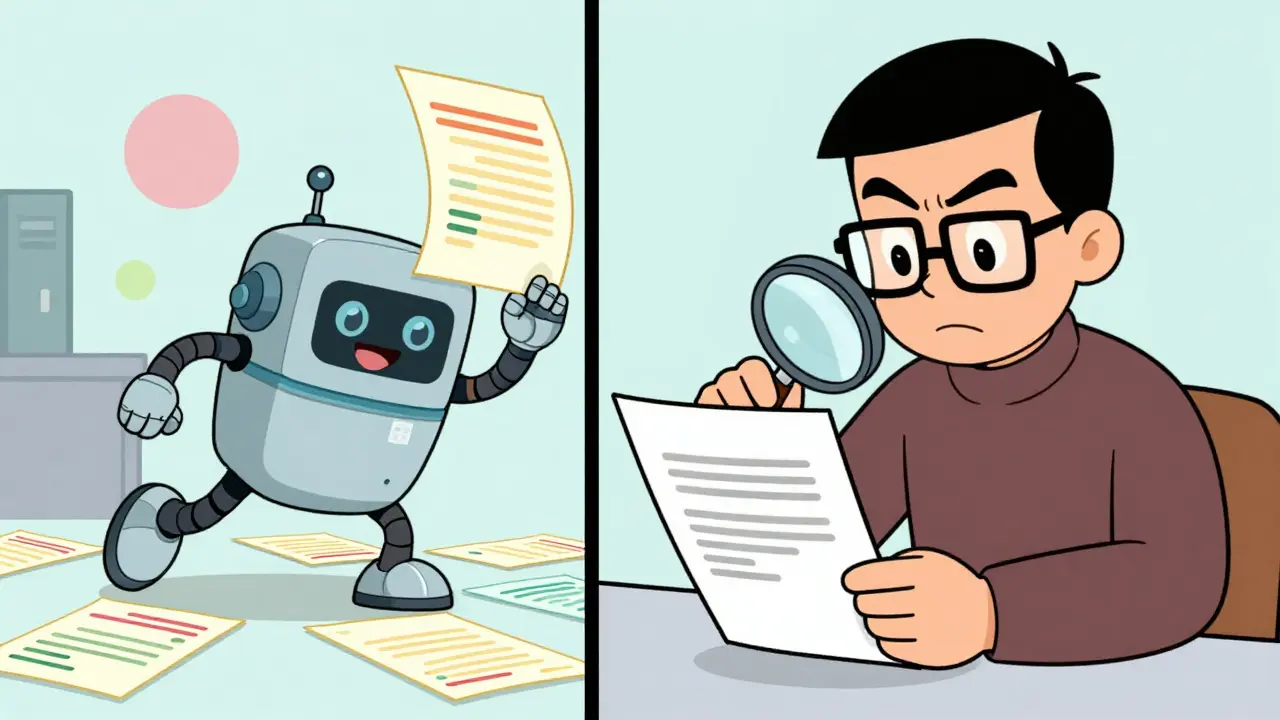
Purely synthetic data has limits. Humans provide judgment, nuance, and safety checks that algorithms miss. The "Human-in-the-Loop" (HITL) approach doesn’t mean labeling every single word manually. That is too slow and expensive. Instead, it focuses on verification and refinement.
In a HITL workflow, the AI generates the draft data, and humans review it. A human annotator might reject a generated response that is factually incorrect or tone-deaf. They might also tweak the instruction to be more precise. This feedback loop serves two purposes:
- Quality Filtering: Removing bad synthetic examples before they enter the training set.
- Feedback Learning: Using the human corrections to retrain the generator model itself, making future synthetic data better.
This hybrid approach balances cost and quality. You might spend 80% of your budget on generating 10,000 synthetic samples and 20% on having experts review the top 1,000 most critical edge cases. For high-stakes domains like healthcare or finance, this human oversight is non-negotiable. It ensures that the augmented data aligns with regulatory standards and professional ethics.
Integrating with Parameter-Efficient Fine-Tuning
Augmented data increases the volume of training, which naturally raises computational costs. To manage this, practitioners combine data augmentation with Parameter-Efficient Fine-Tuning (PEFT). PEFT methods update only a small fraction of the model’s weights, freezing the rest. The most popular method is LoRA (Low-Rank Adaptation).
LoRA works by injecting trainable low-rank matrices into the transformer layers. Instead of updating billions of parameters, you might only update 0.1% of them. This reduces memory requirements dramatically. You can fine-tune a 70-billion-parameter model on a single consumer-grade GPU if you use LoRA correctly. When you pair LoRA with augmented data, you get the best of both worlds: a rich, diverse dataset that teaches nuanced behaviors, and a lightweight training process that doesn’t require a cluster of H100 GPUs.
| Strategy | Compute Cost | Data Requirement | Best Use Case |
|---|---|---|---|
| Full Fine-Tuning | Very High | Large, High-Quality | Fundamental capability changes |
| LoRA / QLoRA | Low to Medium | Moderate (Augmented) | Domain adaptation, style transfer |
| RAG (Retrieval-Augmented Generation) | Low (Inference time) | External Knowledge Base | Factual accuracy, up-to-date info |
Note that RAG is often confused with fine-tuning. RAG retrieves external documents during inference. It does not change the model weights. Use RAG when your data changes frequently (like news or stock prices). Use fine-tuning with data augmentation when you need to change the model’s behavior, tone, or format (like writing legal contracts or coding styles).

Practical Implementation Steps
Here is how you actually build this pipeline. Start with a clear definition of your task. Are you doing sentiment analysis? Named Entity Recognition (NER)? Code generation? Each task requires different augmentation strategies.
- Select a Base Model: Choose the smallest model that meets your baseline performance needs. Models with 7B to 8B parameters (like Llama-3-8B) are often sufficient for specialized tasks. They are faster and cheaper to tune than 70B+ models.
- Generate Seed Data: Collect 100-500 high-quality examples. Label them meticulously. This is your ground truth.
- Augment Synthetically: Use a generator model to expand these seeds. Aim for a 10x expansion ratio. If you have 100 seeds, generate 1,000 variations. Focus on diversity in phrasing and context, not just repetition.
- Apply Human Review: Have subject matter experts review a sample of the augmented data. Calculate an acceptance rate. If less than 80% is accepted, your generator prompt needs refinement.
- Configure Hyperparameters: Set your learning rate, batch size, and epochs. For LoRA, a common starting point is a learning rate of 2e-4 and 3-5 epochs. Monitor validation loss closely.
- Evaluate and Iterate: Test on a held-out validation set. If performance plateaus, check for overfitting. Try early stopping or increase data diversity.
Tools like Hugging Face Transformers and DeepSpeed simplify this process. DeepSpeed, developed by Microsoft, optimizes memory usage and speeds up training, which is helpful even when using PEFT methods.
Avoiding Common Pitfalls
One major mistake is augmenting without filtering. If your generator produces nonsense, and you train on it, your model will learn to produce nonsense. Always include a filtering step. You can use a separate classifier model to score the quality of generated text and discard low-scoring examples.
Another pitfall is ignoring distribution shift. Your augmented data must match the real-world distribution of your target task. If you are fine-tuning for US English legal documents, do not augment with UK English casual conversations. The linguistic features will clash, confusing the model. Keep the domain consistent.
Finally, do not neglect evaluation metrics. Accuracy is not enough. For NER tasks, look at Precision and Recall. For generative tasks, use BLEU or ROUGE scores, but also perform human evaluation. Automated metrics can be gamed; human judgment is the final arbiter of quality.
What is the difference between data augmentation and RAG?
Data augmentation modifies the training data to improve the model's inherent capabilities and behavior during the training phase. RAG (Retrieval-Augmented Generation) retrieves external information during the inference phase to provide context. Augmentation changes the model weights; RAG provides temporary context without changing weights.
Is synthetic data as good as human-labeled data?
Synthetic data is excellent for scaling volume and covering edge cases, but it may lack the nuance and correctness of human-labeled data. For best results, use synthetic data for bulk training and human-labeled data for critical validation and fine-grained tuning. A hybrid approach usually yields the highest performance.
How much data do I need for fine-tuning?
It depends on the complexity of the task. For simple classification, 100-500 high-quality examples may suffice. For complex reasoning or generation tasks, you typically need thousands of examples. Data augmentation allows you to reach these numbers efficiently by expanding a smaller core dataset.
What is LoRA and why is it recommended?
LoRA (Low-Rank Adaptation) is a parameter-efficient fine-tuning technique. It freezes the original model weights and trains small adapter modules. This drastically reduces memory requirements and training time, allowing you to fine-tune large models on consumer hardware while still leveraging large amounts of augmented data.
Can I use data augmentation for code generation tasks?
Yes. You can augment code data by paraphrasing comments, renaming variables, or generating equivalent functions with different logic structures. However, ensure that the generated code is syntactically correct and logically sound, as bugs in training data will propagate to the model.



the essence of synthetic data is the illusion of depth without the substance of experience we create mirrors that reflect only what we already know and call it progress
you are all missing the point entirely. this whole approach is fundamentally flawed because you are trusting a model to grade its own homework. it is like asking a drunk person to drive you home because they promise to be careful. the bias is baked in from layer one. i have seen these pipelines fail spectacularly in production environments where nuance matters more than volume. stop pretending that augmentation fixes quality issues when it actually amplifies them exponentially.
I must respectfully disagree with such a pessimistic outlook. The hybrid approach described here is precisely what allows us to bridge the gap between raw capability and refined utility. It is not about replacing human judgment but augmenting it. When I implemented a similar workflow for our legal tech startup, the initial skepticism was palpable, yet the results were undeniable. We saw a forty percent increase in accuracy on edge cases that previously stumped our base model. The key lies in the rigorous filtering stage which acts as a sieve for nonsense allowing only the most coherent variations to pass through. This method respects the complexity of language while leveraging computational efficiency. It is a dance between algorithmic speed and human wisdom.
I appreciate the detailed breakdown of the workflow especially the emphasis on parameter efficient fine tuning. It is truly inspiring to see how accessible these technologies are becoming for smaller teams who lack massive computational resources. The suggestion to start with smaller models like Llama-3-8B is particularly valuable advice for those of us working with limited budgets. It encourages experimentation and iteration without the fear of catastrophic financial loss. Keep sharing these insights as they empower many developers to push boundaries responsibly.
I find myself deeply resonating with the section on human in the loop processes because it highlights the irreplaceable value of human intuition and ethical oversight in an increasingly automated world. While synthetic data offers scalability it often lacks the subtle contextual understanding that comes from lived experience and cultural awareness which is why involving subject matter experts is not just a best practice but a moral imperative. We must ensure that our augmented datasets do not inadvertently perpetuate harmful stereotypes or biases that could have real world consequences for vulnerable populations. By integrating diverse voices into the review process we can create models that are not only technically proficient but also socially responsible and inclusive. This collaborative approach fosters a sense of community and shared ownership over the technology we are building together.
Your understanding of data augmentation is superficial at best. In India we handle petabytes of multilingual data daily with precision that your Western-centric tools cannot comprehend. You talk about LoRA as if it is a new discovery but we have been optimizing transformer architectures for years. The issue is not the technique but the lack of robust evaluation metrics tailored for low-resource languages. Your reliance on BLEU scores is outdated and misleading. We use advanced semantic similarity measures combined with native speaker validation to ensure true fidelity. Stop copying Indian methodologies and calling it innovation. The global AI landscape would benefit greatly if you acknowledged the contributions of non-Western researchers instead of dismissing them as niche cases.
oh look another american trying to explain basic machine learning concepts to the world how quaint. you think adding a few synthetic samples makes you a genius? please. we deal with chaos every day here and your little structured prompts would crumble under the weight of real linguistic diversity. you are playing with toys while we build infrastructure that supports billions. your concern for model collapse is cute but irrelevant compared to the actual deployment challenges we face. save your breath for someone who cares about your amateur hour.
It is fascinating how everyone assumes that more data automatically equals better performance. In my experience in South Africa we often find that quality trumps quantity every single time. A thousand noisy examples will never outperform fifty meticulously curated ones. The arrogance of thinking you can solve complex societal problems with brute force computation is both amusing and dangerous. We need smarter algorithms not bigger datasets.
The soul of the machine is forged in the fire of contradiction and the ashes of discarded truths. We feed it our dreams and fears wrapped in syntactic sugar hoping it will spit back enlightenment. But does it merely echo our collective unconscious or does it dream its own nightmares? The boundary between creator and creation blurs like watercolor in rain leaving us questioning whether we are training gods or raising monsters. Every token generated is a tiny act of rebellion against entropy a desperate attempt to impose order on the chaotic void of meaning. We are all just prompt engineers in the grand theater of existence performing rituals to appease the silicon deities.