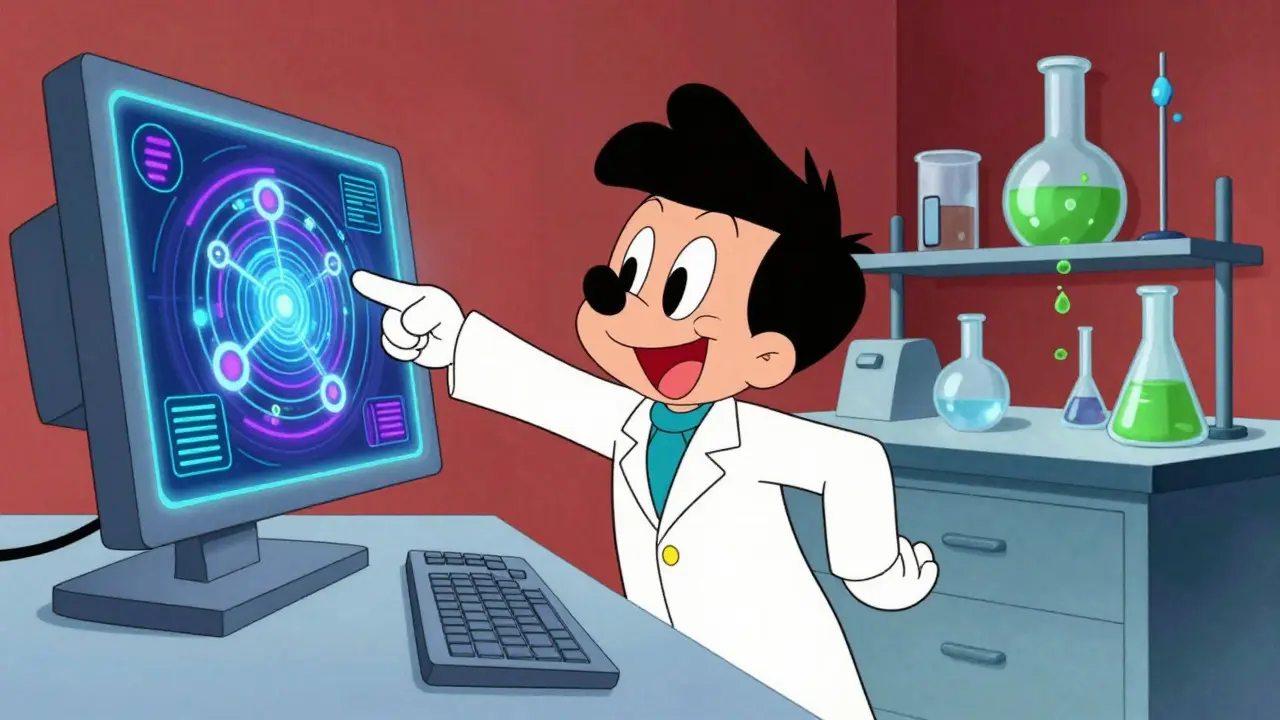
Imagine designing a new life-saving drug in minutes instead of years. That is the promise of Generative AI in biotechnology, specifically for creating novel molecular structures that traditional methods miss. But there is a catch. You can generate a perfect molecule on a screen, but if you cannot track how it was made or prove it works in a real lab, it is worthless. This creates a massive gap between computational hype and laboratory reality. The industry is currently struggling to bridge the divide between molecule generation algorithms and electronic lab notebooks (ELNs) that record experimental data.
The Speed of Discovery vs. The Weight of Chemistry
Traditional drug discovery is brutal. It takes 10 to 15 years and costs around $2.6 billion to bring a single drug to market, according to data from the Tufts Center for the Study of Drug Development. Most candidates fail because they are toxic, ineffective, or impossible to synthesize. Generative AI changes the math. Instead of screening millions of existing compounds, these models create new ones from scratch.
Think of it like an artist who doesn't just pick colors from a palette but invents new pigments. Models like Variational Autoencoders (VAEs) and Generative Adversarial Networks (GANs) have been around since 2016, but recent advancements in diffusion models have skyrocketed performance. For example, the PRODIGY system developed by researchers at Georgia Institute of Technology allows scientists to specify exact constraints-like atom count and bond types-and generates molecules that fit those rules perfectly. This reduces the design phase from months to hours.
However, speed is not the same as success. A 2023 analysis in Nature Reviews Drug Discovery revealed that only 30-40% of AI-generated molecules are actually synthesizable in a lab. The rest are chemical fantasies-structures that look good in a simulation but fall apart when chemists try to build them. This "synthesis gap" is the biggest headache for modern biotech teams.
How Molecule Generation Actually Works
To understand why integration with lab systems is hard, you need to know what these AI models are doing under the hood. Most systems use SMILES strings-text-based representations of chemical structures-to train their neural networks. They learn patterns from datasets containing millions of known molecules, such as ChEMBL or ZINC.
Here is the typical workflow:
- Data Curation: Researchers gather 50,000 to 1 million high-quality molecular structures. If the data is messy, the AI learns bad habits.
- Model Training: Using architectures like Diffusion Models or Transformers, the AI learns the "grammar" of chemistry. Diffusion models, which emerged prominently after 2022, currently lead the pack with validity rates exceeding 90%.
- Generation: The model proposes new molecules based on desired properties, such as binding affinity to a specific protein target.
- Validation: Algorithms score the molecules using metrics like QED (Quantitative Estimate of Drug-likeness). A score above 0.6 is usually considered viable.
The problem arises in step four. Computational validation is cheap and fast. Experimental validation is expensive and slow. When an AI suggests a molecule with a 95% predicted binding affinity, the lab team needs to know exactly how to make it. Without a seamless link to lab records, this information gets lost in spreadsheets and email chains.
| Approach | Validity Rate | Novelty Score | Compute Requirement |
|---|---|---|---|
| SMILES-based RNNs | 79% | Low | Low |
| Junction Tree VAE (JTVAE) | 93% | Medium | High |
| Diffusion Models (e.g., GCDM) | 94.2% | High | Very High |
The Missing Link: Electronic Lab Notebooks
This is where Electronic Lab Notebooks (ELNs) come into play. An ELN is the digital diary of a scientist. It records every experiment, reagent used, temperature setting, and result. Platforms like Benchling and LabArchives are industry standards. Benchling, acquired by Thermo Fisher Scientific for $3.5 billion in 2022, has become a central hub for many biotech workflows.
Yet, as of late 2024, only about 15% of major ELN platforms offer native generative AI capabilities. Why? Because integrating AI into a notebook isn't just about adding a button. It requires a closed-loop system. The AI generates a molecule; the ELN logs the synthesis attempt; the results feed back into the AI to improve its next prediction.
Without this loop, you have two separate worlds. The computational team uses Python scripts and Jupyter notebooks. The wet-lab team uses ELNs. Data silos form. A molecule generated by AI might be brilliant, but if the lab technician doesn't know the specific parameters used to generate it, reproducibility suffers. This disconnect is why 78% of pharmaceutical companies cite integration with existing workflows as their biggest barrier to adoption, according to a McKinsey survey from June 2024.
Bridging the Gap: Closed-Loop Systems
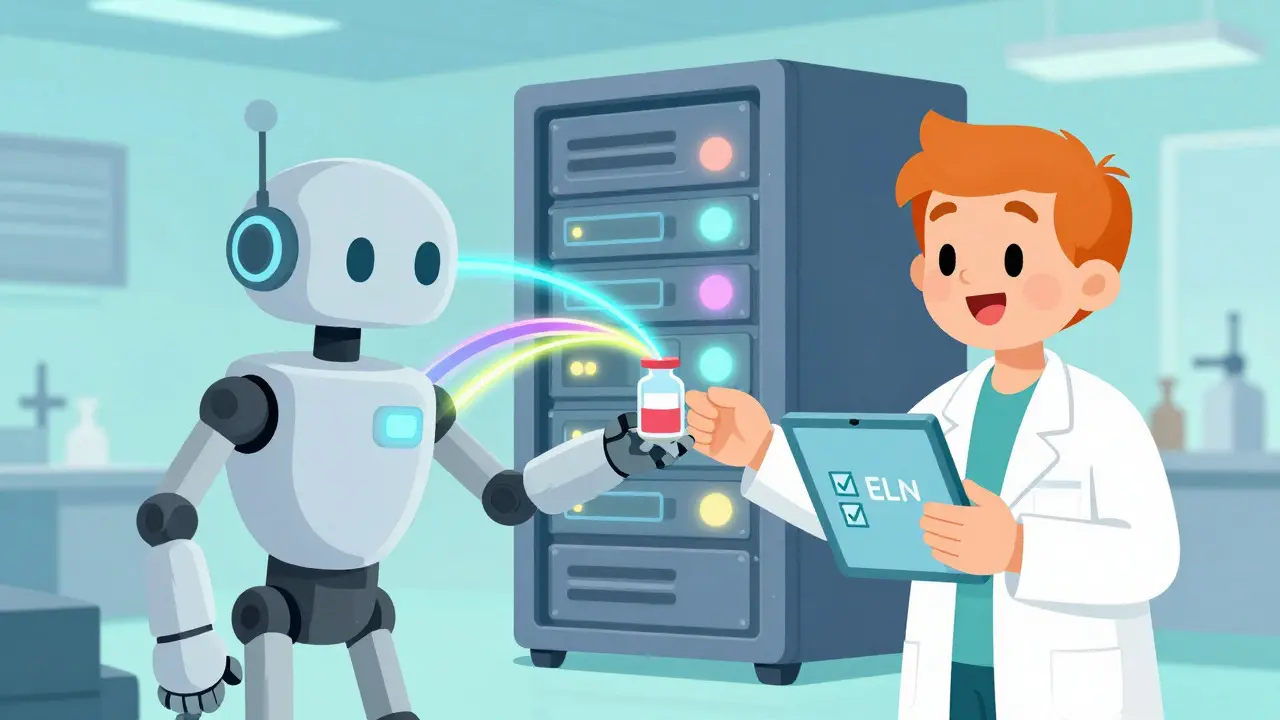
The solution lies in automation and better software architecture. Leading companies like Pfizer are building "AI-native" labs. In their Cambridge facility, automated synthesis robots receive direct input from generative AI models. The robot tries to make the molecule, tests it, and sends the results back to the AI. This cycle, which used to take weeks, now happens in 72 hours.
For most organizations, full robotics aren't feasible yet. However, you can start smaller. Here is how to integrate AI molecule generation with your current ELN workflow:
- Standardize Metadata: Ensure your ELN captures the specific AI model version, dataset source, and hyperparameters used for each generated molecule. Treat the AI run like any other experiment.
- Use API Integrations: Many modern ELNs allow API access. Build simple connectors that push AI-generated candidates directly into the ELN as "planned experiments."
- Track Synthesis Outcomes: Create custom fields in your ELN to log whether an AI-generated molecule was successfully synthesized. This data is gold for retraining your models.
Recursion Pharmaceuticals has demonstrated that this approach can speed up optimization cycles by five times. By treating the ELN as the single source of truth, they ensure that every AI suggestion is tied to real-world evidence.
Challenges and Realistic Expectations
Don't let the hype blind you. There are significant hurdles. First, compute costs are high. Training advanced diffusion models often requires 4 to 8 NVIDIA A100 GPUs running for several days. Second, diversity remains an issue. AI tends to generate molecules that look similar to the training data, resulting in only 60-70% structural diversity compared to natural compounds.
Regulatory bodies are also catching up. The FDA released draft guidance in February 2024 acknowledging AI-generated molecules but demanding enhanced validation data packages. This adds 3 to 6 months to preclinical timelines. You need to document not just the final molecule, but the entire AI decision process. Your ELN becomes critical for compliance here.
Finally, consider the human element. Computational chemists need 6 to 12 months to become proficient with these tools. Wet-lab scientists may resist AI suggestions that defy intuition. Successful implementation requires cross-functional teams where both groups speak the same language.
Future Outlook: Where Is This Heading?
The trajectory is clear. By 2028, analysts predict that 40% of novel drug candidates will originate from AI-driven design. The focus is shifting from 2D structure generation to 3D spatial reasoning. Current models struggle with predicting how a molecule fits into a protein's binding pocket, achieving only 65% accuracy in some benchmarks. Improving this will require tighter integration with structural biology tools.
We are also seeing the rise of specialized AI startups. Insilico Medicine raised $300 million in Series D funding in May 2024, highlighting investor confidence. Their platform reduced target identification time from 4.5 years to 18 months. As these tools mature, we expect ELNs to evolve into intelligent assistants that suggest optimizations in real-time, rather than passive record-keepers.
The key takeaway is this: Generative AI is powerful, but it is not a magic wand. Its value is unlocked only when integrated seamlessly into the physical world of the laboratory. Your electronic lab notebook is the bridge. Build it strong, keep it accurate, and let the data flow freely between silicon and glassware.
What is the main challenge in integrating generative AI with lab notebooks?
The primary challenge is the lack of standardized workflows. AI models operate in computational environments, while lab notebooks record physical experiments. Bridging this gap requires robust APIs and metadata standards to ensure that AI-generated molecules can be tracked, synthesized, and validated without losing context.
Which AI models are best for molecule generation?
As of 2024, diffusion models like GCDM and PRODIGY are considered state-of-the-art due to their high validity rates (over 90%) and ability to handle complex constraints. They outperform older methods like VAEs and GANs in generating novel and synthetically viable structures.
Are AI-generated molecules legally recognized by the FDA?
Yes, but with conditions. The FDA acknowledges AI-designed drugs but requires comprehensive validation data. This includes detailed documentation of the AI's training data, generation process, and extensive preclinical testing to prove safety and efficacy.
How much does it cost to implement generative AI in drug discovery?
Costs vary widely. Cloud computing for training models can range from thousands to tens of thousands of dollars per month depending on GPU usage. Software licenses for enterprise ELNs with AI features add further costs. However, the potential savings in reducing trial-and-error phases often justify the investment.
What is the "synthesis gap" in AI drug discovery?
The synthesis gap refers to the discrepancy between molecules that look promising in computer simulations and those that can actually be created in a lab. Currently, only about 30-40% of AI-generated molecules are synthesizable, meaning many computational hits never become physical candidates.