
For decades, artificial intelligence in science was mostly about speed. You fed it data, and it spat out predictions faster than any human could calculate. But speed alone doesn't make a breakthrough. It just makes you wrong faster. The real shift happening right now isn't about processing power-it's about reasoning. We are moving from models that simply retrieve information to systems that can think through complex problems, generate hypotheses, and even correct their own mistakes.
This evolution marks the arrival of reasoning-enhanced large language models, which are transforming how we approach scientific discovery by integrating chemical reasoning, hypothesis generation, and iterative problem-solving capabilities. These aren't just chatbots with more memory; they are active participants in the research process. They don't just tell you what the literature says; they help you figure out what to do next when the literature runs out.
The Three Levels of AI in Science
To understand where we stand, it helps to look at the taxonomy researchers use to classify AI involvement. It’s not a binary switch between "dumb tool" and "superintelligence." There are three distinct stages, and most current deployments sit somewhere in the middle.
First, there is the LLM as Tool. This is the entry level. The model augments human researchers by performing specific, well-defined tasks under direct supervision. Think of it like a very fast intern who can summarize papers or format code but needs you to tell them exactly what to do and check every line of work. It’s useful, but it’s passive.
Next comes the LLM as Analyst. Here, the model shows greater autonomy. It can process complex information, conduct analyses, and offer insights with reduced human intervention. If you ask an analyst-level model to compare two battery materials, it won’t just list properties; it will synthesize findings from multiple sources to suggest which one might perform better under specific conditions. It’s starting to connect dots.
Then there is the frontier: the LLM as Scientist. This represents the most advanced stage where systems can autonomously conduct significant portions of scientific research. They formulate hypotheses, plan experiments, analyze data, draw conclusions, and propose new research questions. While we haven’t reached full general scientific superintelligence yet, Level 3 systems are already driving substantial parts of the research pipeline, particularly in structured domains like chemistry and physics.
Why Traditional Models Fall Short
You might wonder why we need this shift. Why can’t standard large language models handle scientific discovery? The answer lies in interpretability and generalization. Traditional molecular property prediction approaches often suffer from being black boxes. They give you a number-a predicted boiling point or toxicity level-but they can’t explain why. In science, the "why" is everything. Without understanding the reasoning, you can’t trust the result enough to build on it.
Furthermore, specialized molecular language models often lack true chemical reasoning capabilities. They memorize patterns rather than understanding principles. When faced with a novel molecule-one outside their training distribution-they struggle. They don’t know how to apply fundamental laws of chemistry to deduce properties for something they’ve never seen before. Reasoning-enhanced models address this by forcing the AI to articulate its logic, making errors detectable and corrections possible.
MPPReasoner: A Case Study in Chemical Reasoning
A concrete example of this progress is MPPReasoner, a multimodal large language model built upon Qwen2.5-VL-7B-Instruct. MPPReasoner was designed specifically to overcome the limitations of traditional property prediction. It integrates molecular images with SMILES strings (a text-based notation for chemical structures) to enable comprehensive molecular understanding.
What makes MPPReasoner special is its training strategy. It uses a two-stage approach. First, it undergoes supervised fine-tuning using 16,000 high-quality reasoning trajectories generated through expert knowledge and multiple teacher models. This teaches the model how to think through chemical problems step-by-step. Second, it employs Reinforcement Learning from Principle-Guided Rewards (RLPGR). Instead of just rewarding correct answers, RLPGR uses verifiable, rule-based rewards to evaluate the application of chemical principles, structure analysis, and logical consistency.
The results speak for themselves. In extensive experiments across eight datasets, MPPReasoner outperformed the best baselines by 7.91% on in-distribution tasks and 4.53% on out-of-distribution tasks. That improvement on out-of-distribution tasks is critical because it proves the model is actually learning to reason, not just memorizing. It can handle molecules it hasn’t seen before by applying first principles.
Battery Innovation and Domain Adaptation
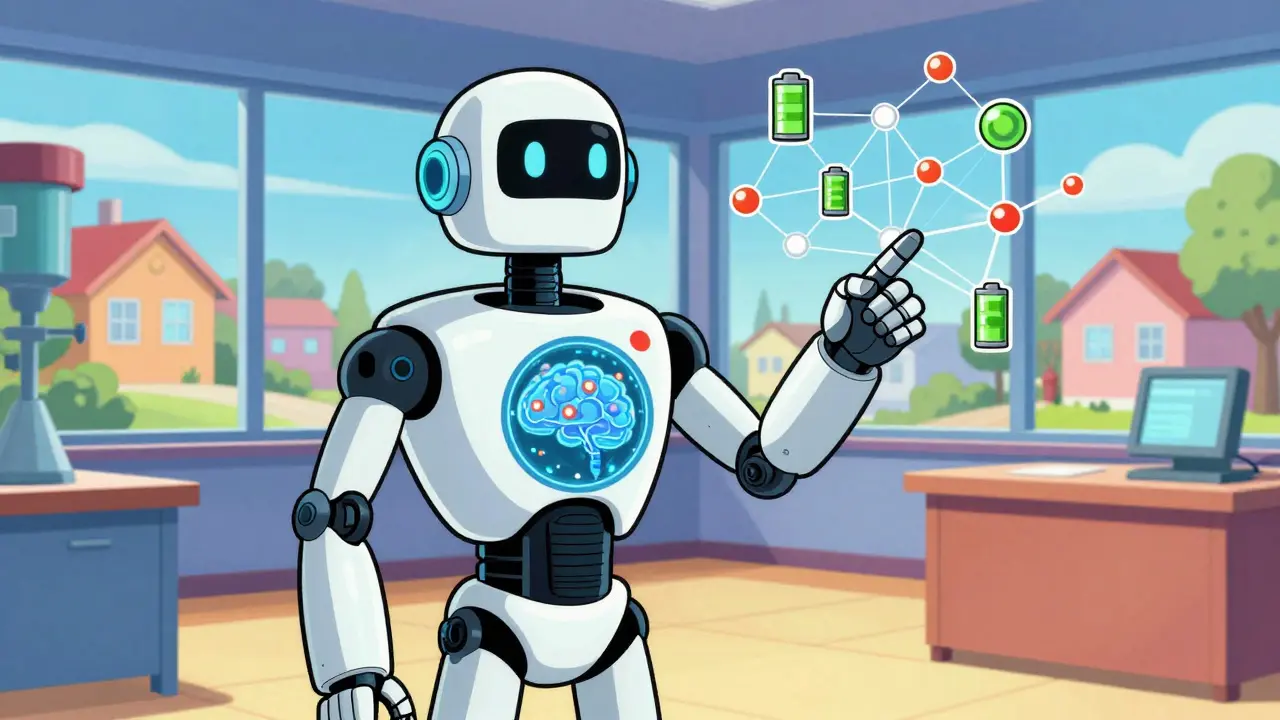
Chemistry isn’t the only field seeing these gains. Battery innovation is another high-stakes domain where reasoning-enhanced LLMs are making waves. SES AI’s Molecular Universe LLM, a massive 70-billion parameter scientific model, exemplifies this. But having parameters isn’t enough. You need domain adaptation.
Domain adaptation involves fine-tuning models to enhance their ability to respond to task-specific queries. Instruction tuning boosts performance on specific tasks, but neither of these steps alone equips a model with reasoning capabilities. That’s where reasoning alignment comes in. It enables models to logically navigate processes like hypothesis generation, chain-of-thought reasoning, and self-correction. For material exploration, where a single bad hypothesis can waste months of lab time, this ability to self-correct is invaluable.
Benchmarks and Real-World Performance
How do we know if these models are actually getting better at discovery? We need rigorous benchmarks. The Scientific Discovery Evaluation (SDE) framework assesses large language models on realistic, iterative scientific research tasks rather than static knowledge retrieval. It spans biology, chemistry, materials, and physics, evaluating models at both question-level accuracy and project-level performance involving hypothesis generation.
The SDE framework reveals a stark gap between performance on general science exams and actual discovery capabilities. However, it also highlights the dramatic impact of reasoning. In biology, the DeepSeek model’s accuracy on Leinsky’s rule assessment jumped from 65% to a perfect 100% simply by turning on reasoning capabilities. In physics tasks involving symbolic regression-discovering governing equations for dynamic systems-reasoning-enabled models like DeepSeek R1 and GPT-5 found equations much faster and with lower error. They didn’t just guess polynomials; they proposed structural changes, realizing an equation needed a sign function, for instance.
| Capability Level | Autonomy | Key Function | Human Role |
|---|---|---|---|
| LLM as Tool | Low | Task automation, summarization | Direct supervision |
| LLM as Analyst | Medium | Data synthesis, insight generation | Review and validation |
| LLM as Scientist | High | Hypothesis generation, experimental design | Strategic oversight |
Hybrid Frameworks: RAG and Case-Based Reasoning
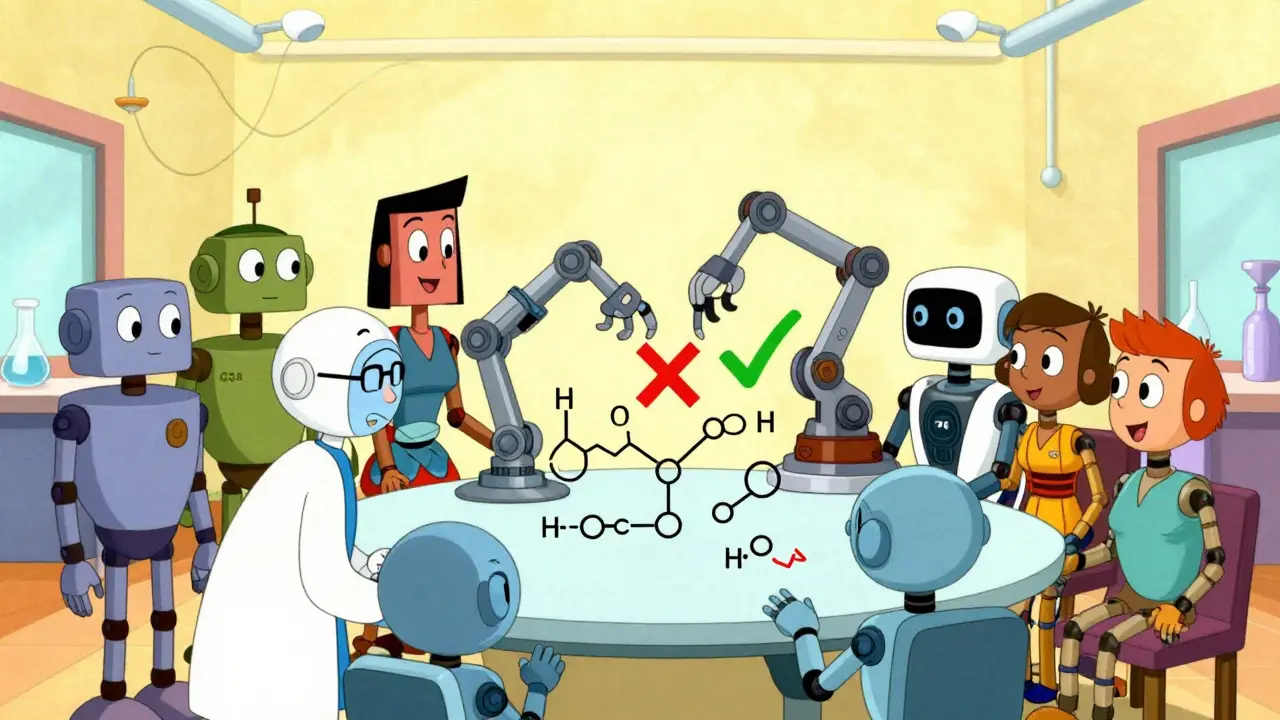
No model works in a vacuum. The cutting edge of current approaches involves hybrid frameworks that integrate Retrieval-Augmented Generation (RAG) and Case-Based Reasoning (CBR). These frameworks position LLMs as reasoning engines rather than standalone tools or static knowledge repositories.
In domains like healthcare and scientific research, transparency and accountability are paramount. Hybrid frameworks address this by embedding case-based reasoning into unified platforms that leverage graph databases and vector embeddings for efficient knowledge management. This promotes human-AI collaboration through iterative workflows. The AI doesn’t act as an autonomous oracle; it acts as a collaborative partner, pulling relevant past cases and reasoning through them with the researcher. This interdisciplinary design lays the foundation for a new paradigm emphasizing ethical accountability and dynamic knowledge integration.
Symbolic Regression and Equation Discovery
One of the most exciting applications is symbolic regression-the discovery of scientific equations from data. This is crucial for understanding physical laws. AI-driven approaches like LLM-SR leverage prior domain knowledge of LLMs and incorporate feedback from clustered memory storage. Another approach, DrSR, proposes a dual reasoning framework utilizing both data and experience for equation discovery.
These systems are evaluated using benchmarks like LLM-SRBench. The ability to discover equations isn’t just about fitting curves; it’s about finding the underlying mathematical structure of reality. When a model can suggest that a relationship isn’t linear but logarithmic, or requires a specific trigonometric function, it’s doing genuine scientific work.
Limitations and the Path Forward
Despite the promise, we must be realistic. Current LLMs remain distant from achieving general scientific superintelligence. The SDE framework identifies shared failure modes across top-tier models. Performance varies significantly depending on the research scenario. Sometimes, a model that excels in chemistry struggles in physics. And while guided exploration and serendipity play a role in discovery, relying solely on AI can lead to blind spots.
The gap between general knowledge performance and practical discovery capabilities indicates substantial development remains necessary. We need continued architectural innovation and improvements in training methodologies. The focus is shifting toward reproducible benchmarking frameworks and hybrid human-AI collaboration paradigms. The goal isn’t to replace scientists but to create systems that can handle the tedious, iterative parts of research, freeing humans to focus on creative leaps and ethical considerations.
What is a reasoning-enhanced large language model?
A reasoning-enhanced large language model is an AI system that goes beyond simple pattern matching to perform logical deduction, hypothesis generation, and iterative problem-solving. Unlike traditional models that predict the next word based on probability, these models are trained to follow chains of thought, apply domain-specific principles (like chemical laws), and self-correct errors during the reasoning process.
How does MPPReasoner improve molecular property prediction?
MPPReasoner improves prediction by integrating multimodal inputs (images and SMILES strings) and using a two-stage training strategy. It combines supervised fine-tuning with high-quality reasoning trajectories and Reinforcement Learning from Principle-Guided Rewards (RLPGR). This allows it to apply chemical principles to novel molecules, improving performance on out-of-distribution tasks by 4.53% over baselines.
What is the difference between an LLM as Analyst and an LLM as Scientist?
An LLM as Analyst processes complex information and offers insights with reduced human intervention, acting as a sophisticated assistant. An LLM as Scientist operates with considerable independence, capable of formulating hypotheses, planning and executing experiments, analyzing data, and proposing new research questions autonomously.
Why is symbolic regression important in scientific discovery?
Symbolic regression is crucial for discovering the underlying mathematical equations that govern physical systems. Instead of just predicting outcomes, it helps identify the structural relationships (e.g., linear, logarithmic, trigonometric) between variables, enabling deeper understanding of natural laws and phenomena.
What are the limitations of current reasoning-enhanced LLMs in science?
Current models still face challenges with generalizability across different scientific domains and may exhibit shared failure modes. They are not yet at the level of general scientific superintelligence. Performance can vary significantly based on the specific research scenario, and they require robust benchmarking and human oversight to ensure reliability and ethical accountability.