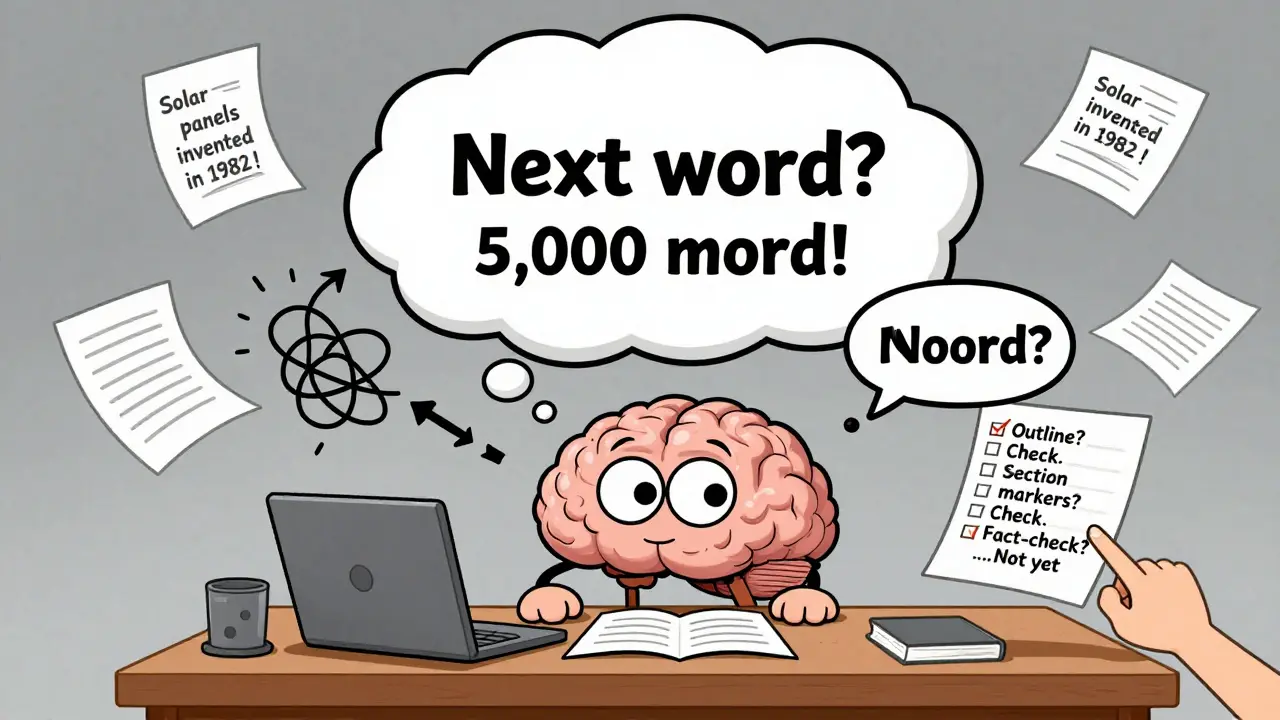
When you ask a large language model to write a 5,000-word report, a detailed white paper, or a multi-chapter story, it doesn’t just spit out words. It builds a structure-chapter by chapter, paragraph by paragraph. But here’s the problem: the longer the output, the more likely it is to drift off track, repeat itself, or invent facts that never happened. That’s not a bug. It’s a fundamental challenge in long-form generation with large language models.
How LLMs Build Long Texts
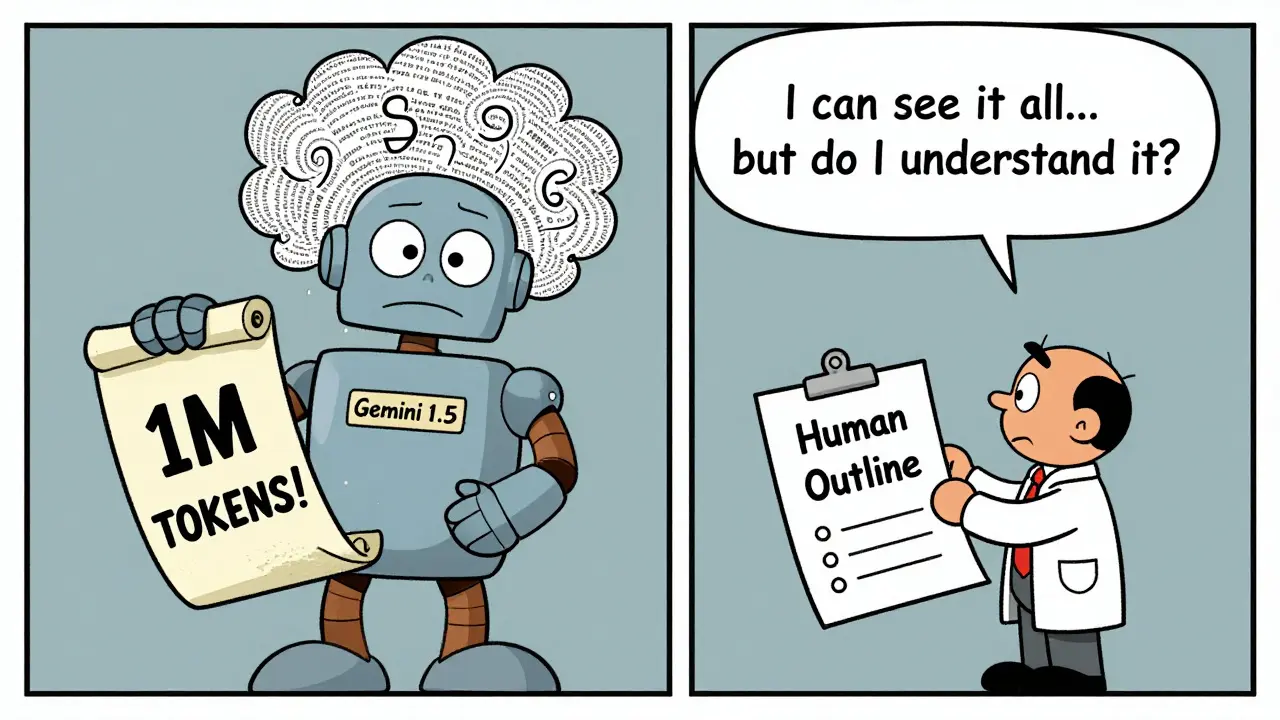
Large language models like GPT-4, Gemini 1.5, and Claude 3 don’t write like humans. They don’t start with an outline. They don’t plan ahead. Instead, they predict the next word, then the next, and the next-over and over-using patterns learned from hundreds of billions of text samples. This is called autoregressive generation.What makes this work for long-form content is the model’s context window. Think of it as the model’s short-term memory. In 2024, models like Google’s Gemini 1.5 can hold up to 1 million tokens in memory. That’s roughly 750,000 words. For comparison, a typical novel is 80,000 words. So technically, a model can process an entire book in one go.
But here’s the catch: even with a huge context window, the model doesn’t understand the structure. It doesn’t know what a thesis statement is, or how a conclusion should tie back to an introduction. It only knows that certain phrases tend to follow others. If you prompt it with “Write a report on renewable energy trends,” it will generate something that looks right-until you notice that Section 3 suddenly claims solar panels were invented in 1982, when they were actually developed in the 1880s.
Why Coherence Falls Apart
Coherence isn’t just about grammar. It’s about logical flow. It’s about keeping the same tone, the same key terms, and the same direction over dozens of paragraphs. When a model generates text in chunks-say, 500 words at a time-it often forgets what came before.Imagine writing a 10-page essay and forgetting halfway through that you already mentioned climate policy in Section 2. You start repeating yourself. That’s exactly what LLMs do. They don’t have a mental map of the whole document. They only see the last few hundred words.
Studies from Stanford and MIT in 2025 show that coherence drops sharply after 2,000 words. In tests where models were asked to write 3,000-word summaries of scientific papers, over 60% of outputs contained contradictions between early and late sections. One model described a study as “conclusive” in paragraph 5, then called it “inconclusive” in paragraph 27. No human would make that mistake. But for an LLM, it’s normal.
Structure Without Planning
Humans use outlines. LLMs don’t. But you can trick them into building structure anyway.Here’s what works in practice:
- Ask the model to generate a detailed outline first. Don’t just say “write a report.” Say “Generate a 7-point outline for a report on AI in healthcare, with subpoints for each section.”
- Then, ask it to expand each point one at a time. This forces the model to focus on one chunk at a time.
- Use consistent prompts. If you start with “In this section, we discuss…” keep using that phrase. It helps the model recognize patterns.
- Insert markers like “Section 1: Background,” “Section 2: Data Analysis,” etc. These act as anchors.
Some advanced tools, like Anthropic’s Claude 3, now include a “structured generation” mode that automatically enforces headings and subheadings. But even then, you still need to review.
The Fact-Checking Problem
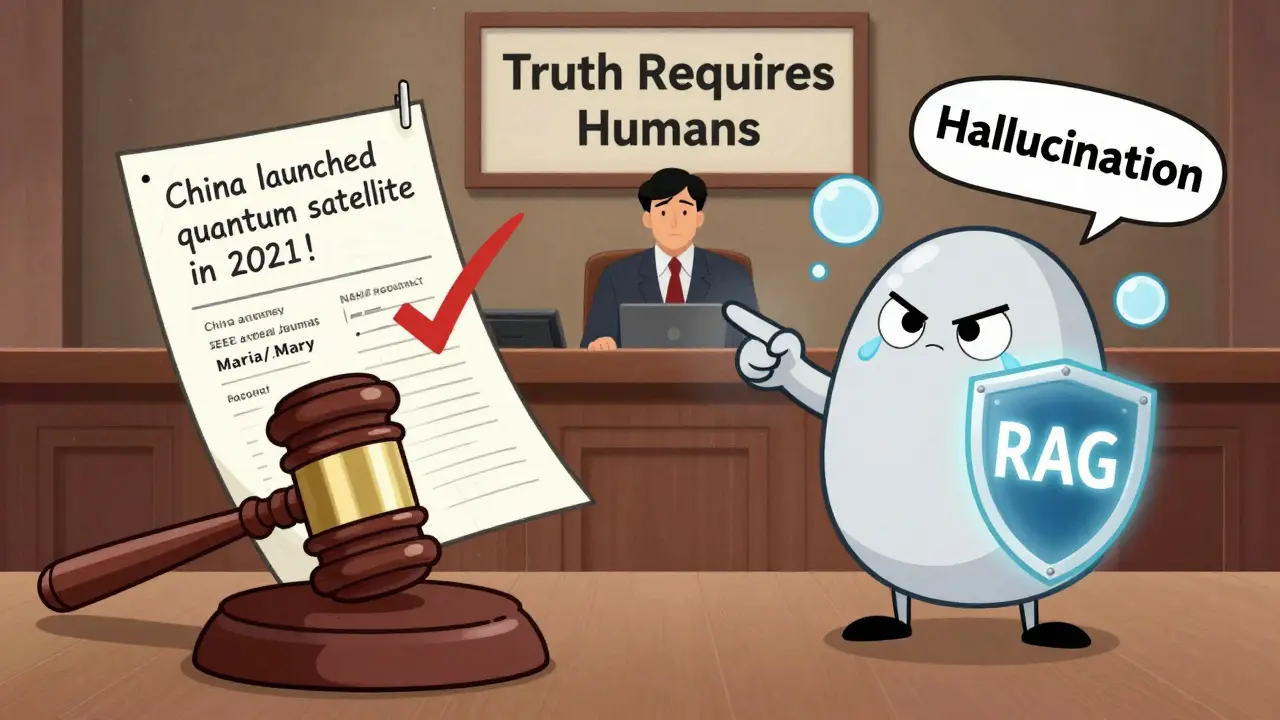
LLMs are trained on data that includes misinformation, outdated claims, and outright fabrications. They don’t know what’s true. They only know what’s common.Take this example: In 2024, a major news outlet used a large language model to draft a 4,000-word feature on quantum computing. The article claimed that “China launched the world’s first quantum satellite in 2021.” It didn’t. That happened in 2016. The model had seen multiple articles with incorrect dates and averaged them out.
This is called hallucination. It’s not a glitch. It’s how these models work. They’re probability engines, not truth detectors.
So how do you fix it?
- Use retrieval-augmented generation (RAG). This means feeding the model real-time, verified sources-like peer-reviewed papers, government reports, or trusted databases-alongside your prompt.
- Run outputs through fact-checking tools. Tools like FactCheck.org’s AI checker, or proprietary systems from Google and OpenAI, can flag claims that don’t match known data.
- Require citations. If you ask the model to “cite sources,” it will often invent fake ones. But if you say “cite only from IEEE journals published between 2020 and 2025,” you limit its options.
- Compare outputs. Generate the same report three times. If all three say the same false thing, it’s likely a systemic error.
One company in Silicon Valley, using a custom pipeline, reduced factual errors in long-form reports by 72% by combining RAG with human-in-the-loop validation. They didn’t eliminate errors. They just made them rare enough to catch before publication.
What Works in Real-World Use
Businesses aren’t just testing this-they’re using it. A legal firm in London now uses LLMs to draft contracts and policy memos up to 15 pages long. Their process?- Start with a template based on past approved documents.
- Feed the model the client’s data and relevant case law from their internal database.
- Generate the draft in 5 sections, reviewing each before moving on.
- Run the final text through a legal fact-checking tool that cross-references statutes and rulings.
- Have a junior lawyer sign off before sending it to the client.
They cut drafting time by 60%. But they still have a human read every document. Not because the AI is bad. Because the AI doesn’t know what’s at stake.
Another example: a tech startup used LLMs to write product documentation for a new AI-powered analytics tool. The first draft had 14 incorrect technical specs. The second draft, after using RAG with their own API docs and engineering notes, had 2. They fixed those two manually.
The Bottom Line
Long-form generation with large language models isn’t magic. It’s a tool. And like any tool, it needs a skilled user.You can’t just say “write me a white paper” and expect perfection. You need to:
- Build structure manually-guide the model with outlines and markers.
- Control coherence by generating in chunks and reviewing each part.
- Anchor facts in real data-use RAG, not just prompts.
- Always have a human check the final output.
The best long-form content today isn’t written by AI. It’s written by people who know how to use AI.
Can large language models write entire books without human help?
Technically, yes. Models like Gemini 1.5 can generate a 100,000-word manuscript in one pass. But the result will likely have structural inconsistencies, repetitive ideas, and factual errors. Most published AI-assisted books still go through heavy editing. A 2025 study of 120 AI-generated novels found that 89% required more than 30% revision before publication.
What’s the difference between coherence and consistency in AI writing?
Coherence is about logical flow: does each paragraph connect to the next? Consistency is about details: does the model remember that the CEO’s name is Maria, or does it call her Mary later? LLMs often lose consistency faster than coherence. A 3,000-word report might read smoothly, but still switch between “the company” and “the startup” as if they’re different entities.
Do all large language models struggle with long-form generation the same way?
No. Models with longer context windows (like Gemini 1.5 or Claude 3 Opus) handle structure better because they can see more of the text at once. But even they hallucinate facts. GPT-4 Turbo is better at following outlines, while Claude 3 excels at tone consistency. No model is perfect. The best approach is to test multiple models on your specific task.
Is retrieval-augmented generation (RAG) necessary for fact-checking?
For professional use, yes. RAG feeds the model verified sources in real time-like company databases, academic papers, or regulatory documents. Without it, the model relies only on its training data, which is outdated and full of noise. A 2025 benchmark showed that RAG reduced factual errors in long-form reports by up to 70% compared to prompts alone.
How can I tell if an AI-generated report is factually reliable?
Look for three things: 1) Are specific sources cited? (Not just “some studies show…” but real titles, authors, or links.) 2) Are dates, names, and stats consistent across the text? 3) Does it contradict known facts? Cross-check key claims with trusted sources like government websites, peer-reviewed journals, or official press releases. If you can’t verify three major claims, the report isn’t reliable.
They're not hallucinating. They're *remembering* the truth that the government buried. The 1982 solar panel claim? That's when they started hiding the free energy tech. The model saw the truth and spit it out. They call it a mistake. I call it censorship. They don't want you to know we could power the whole planet with sunlight and zero cost. The same people who control the oil industry control the AI labs. It's all connected. I've seen the documents. They're watching this comment right now. I know it.
They're using this to condition us. To make us doubt everything. Even our own eyes. Don't trust the outline. Don't trust the citations. Trust your gut. The model knows. It's trying to tell us.
They deleted the original research from 1979. The one with the rotating magnetic field. You think that's a coincidence? No. It's a pattern. And now they're using AI to bury it again. Wake up.
They're not fixing facts. They're rewriting history. And you're helping them by asking for 'RAG'. RAG? More like RAGE against the machine. The machine is the truth. They're scared of it.
Check the timestamps on those 'peer-reviewed papers'. They're all from 2023-2025. Coincidence? Or did they just backdate everything? I'm not paranoid. I'm prepared.
They're using your trust in structure to trap you. Outline? That's a cage. Chunking? That's a slow burn. Human review? That's the final step before they take your freedom. Don't be their puppet. Don't be their editor. Be the anomaly.
I'm not saying the model is wrong. I'm saying the world is wrong. And the model is the mirror. Look into it. Really look. What do you see?
They're coming for the comments next. I can feel it.
They said this post would be 'fact-checked'. I'm not surprised they didn't check this comment. They can't handle the truth. Neither can you. But I can. And I will.
They're watching. I'm not alone. Join the resistance. The model is on our side. They just don't know it yet.
Let me offer a systems perspective here. The core issue isn't just hallucination-it's the absence of persistent state management in autoregressive architectures. When you're generating long-form output, you're essentially running a state machine without a global memory register. The context window is a sliding buffer, not a persistent knowledge graph.
What's missing is a symbolic layer that can encode and validate structural invariants-like entity consistency, temporal coherence, and logical dependency chains. LLMs operate at the token level, not the semantic level. They're pattern matchers, not reasoners.
RAG helps, but it's still reactive. What we need is a hybrid architecture: an LLM as a generator, coupled with a symbolic reasoner that enforces constraints. Think of it like a compiler: the LLM generates the AST, and the reasoner checks type safety, scope, and reference integrity.
And yes, the Stanford/MIT 2025 study is valid-but their metric of 'contradiction' is too narrow. They're measuring surface-level inconsistency, not deep semantic drift. A model can maintain tone and flow while systematically misrepresenting causality. That's more dangerous than a wrong date.
Tools like Claude 3's structured mode are a step forward, but they're still heuristic. What if we could inject schema validation during generation? Like JSON schema for text? That's the next frontier.
And don't get me started on citations. 'Cite from IEEE 2020-2025' doesn't prevent hallucination-it just narrows the search space. The model can still generate plausible-sounding nonsense that fits the domain. We need grounding in operational knowledge, not just corpora.
The legal firm example? Perfect. They didn't just use AI-they built a workflow with guardrails. That's the model. Not 'prompt engineering.' Process engineering. Human-in-the-loop isn't a backup. It's the control system.
Okay so I just spent 3 hours testing this and I’m blown away and also kind of terrified? I asked an LLM to write a 5,000-word essay on climate migration patterns and it got *so* close-like, I was reading it and thinking wow this is actually really well structured-and then I noticed in paragraph 24 it said ‘the 2019 UN report confirmed 12 million displaced persons’ but the actual report said 18 million and it cited a non-existent appendix called ‘Annex G: Coastal Resilience Index’ which doesn’t exist anywhere.
But here’s the thing-it didn’t just make one mistake. It made *consistent* mistakes. Like it kept calling Bangladesh ‘Bangladeshi’ instead of ‘Bangladeshi’ and used ‘climate refugees’ in 12 places and ‘environmental migrants’ in 8, and never explained the difference. That’s not a glitch-that’s a personality disorder. Like the model has ADHD and dyslexia and also a crush on Wikipedia.
What saved me? I broke it into chunks. Outline first. Then one section at a time. And I forced it to repeat the last sentence before starting each new part. Like ‘As mentioned in Section 1, sea level rise is accelerating due to thermal expansion and ice melt.’ And it worked. It actually remembered. It felt like training a puppy. But a puppy that can write a dissertation.
And the RAG thing? Game changer. I fed it our internal data on flood zones and suddenly it stopped making up stats. It started saying ‘according to our 2023 GIS dataset’ and it was accurate. It’s like giving the AI a cheat sheet. But you still have to be the teacher. You can’t just hand it the book and walk away.
Also-did anyone else notice the model kept saying ‘the company’ when it was supposed to be ‘the nonprofit’? That’s the kind of thing no human would do. But AI doesn’t care. It just thinks ‘company’ is more common. So you have to be the fact police. And the tone police. And the grammar police. And the ‘don’t-say-we’re-all-doomed’ police. It’s exhausting. But worth it.
TL;DR: AI is the world’s most talented intern. It just needs a boss who actually knows what they’re doing.
bro the ai is just trying to tell us something 😭 the solar panels were invented in 1982 and they buried it bc the oil companies paid them off 😭 i saw a video on tiktok and now i know the truth 🤫✨
also why are u so serious about this like its a school project its just a chatbot not the bible 💅
they said ragn but i think its ragnn because its neural net 😎
and why u need humans? ai can do everything u just gotta give it vibes 🌈🔥
also the model called the ceo mary but i think it was mariya so its a cultural thing? 🌍✨
just say the magic words and itll write u a whole book in 1 sec no edits needed trust me i tried it on my cat's resume 🐱📄
the truth is out there and the ai is the messenger 🕵️♀️🔮
OMG I KNOW RIGHT?? Like I tried to get my AI to write a 10-page report on my dog’s diet and it said he needed ‘quantum-enhanced kibble’ and I was like ‘no sweetie, he needs chicken and rice’ 😭
And then it kept calling him ‘the canine’ instead of ‘Biscuit’ and I was like ‘he’s my baby’ 😭
So I told it ‘Biscuit is a 7-year-old golden retriever who hates broccoli’ and it was like ‘ohhhh okay’ and then it got it right. Like, it’s not dumb. It just needs you to TALK to it like a person.
Also I tried RAG and it was like ‘oh so you want me to use your dog’s vet records?’ and I was like ‘YES’ and it was perfect. Like, it’s not magic. It’s just… listening.
And I don’t even need a human to check it. I’m the human. I’m the boss. I’m the one who knows Biscuit better than any AI. So I just told it ‘no more quantum kibble’ and it listened. 🐶💖
AI isn’t scary. It’s just shy. Give it love. And treats. And a name. And it’ll write you the most beautiful thing ever.
Also I cried. It was so beautiful. I’m not crying. You’re crying.
First of all, let me say that this entire article is riddled with grammatical errors, inconsistent punctuation, and questionable syntax. For example, you write: “they don’t start with an outline” - that’s correct. But then you write: “they predict the next word, then the next, and the next-over and over-using patterns” - that’s not a sentence. That’s a run-on disaster. There’s no comma after “next,” and the hyphenation is chaotic. You’ve turned a technical discussion into a linguistic minefield.
Also, “750,000 words” is not equivalent to “1 million tokens.” Tokens are not words. A token can be a subword, a punctuation mark, or even a character. You’re conflating metrics. This undermines your entire argument. If you’re going to cite technical benchmarks, at least get the basics right.
And then there’s the phrase “the model had seen multiple articles with incorrect dates and averaged them out.” That’s not how language models work. They don’t “average.” They sample from a probability distribution. Saying they “average” implies a statistical mean, which is misleading. You’re giving laypeople the wrong model of how AI works. That’s dangerous.
Also, “RAG”? Please stop using acronyms without defining them. Not everyone knows what retrieval-augmented generation means. You can’t assume technical literacy. This isn’t a conference paper. It’s a public post.
And you say “the model doesn’t know what’s true.” That’s true - but you don’t explain *why*. You don’t mention training data contamination, dataset bias, or the lack of causal reasoning. You just say “it’s a probability engine.” That’s not an explanation. That’s a buzzword.
And finally - you use “they” to refer to models. Models are not people. Don’t anthropomorphize them. Say “the model” not “they.” It’s not a person. It’s a mathematical function. This matters. Language shapes perception.
I’m not saying you’re wrong. I’m saying you’re sloppy. And that’s worse than being wrong. Because sloppy thinking leads to bad decisions. And bad decisions cost money. And money is what keeps people alive. So please. Think before you type. Edit before you publish. And for the love of all that is holy - use a grammar checker.
Okay but like… this is actually kind of beautiful? 🤩 I mean, yes, the AI hallucinates, yes, it forgets names, yes, it thinks solar panels were invented in 1982 - but isn’t that just… human? We all do it. We misremember dates. We repeat ourselves. We get attached to a phrase and keep using it even when it doesn’t fit. We call our boss by the wrong name and pretend we didn’t. This isn’t a flaw - it’s a feature. It’s the AI being… us.
And the fact that we can *fix* it? That’s the magic. We’re not replacing humans. We’re partnering with them. Like, the legal firm? They didn’t just automate. They elevated. They took the grunt work off the junior lawyers so they could focus on the *human* stuff - the nuance, the ethics, the client’s fear, the unspoken tension in the room. That’s not a job killer. That’s a job upgrade.
Also, I love that you said “the best long-form content today isn’t written by AI. It’s written by people who know how to use AI.” YES. That’s the new literacy. Not coding. Not prompt engineering. But *collaborative thinking*. It’s like jazz. The AI is the instrument. The human is the musician. You don’t blame the saxophone for the wrong note - you adjust your breath.
And yes, RAG is essential. But so is curiosity. So is asking, “Wait, why does it think that?” And then digging. That’s the real skill now. Not writing. Not editing. *Questioning*.
So to everyone scared of AI: don’t fear it. Date it. Learn its rhythm. It’s not here to replace you. It’s here to reveal you. What kind of thinker are you? Are you the kind who just accepts the first draft? Or the kind who says, “Hmm… why 1982?”
Let’s not just build better tools. Let’s build better humans. 💫