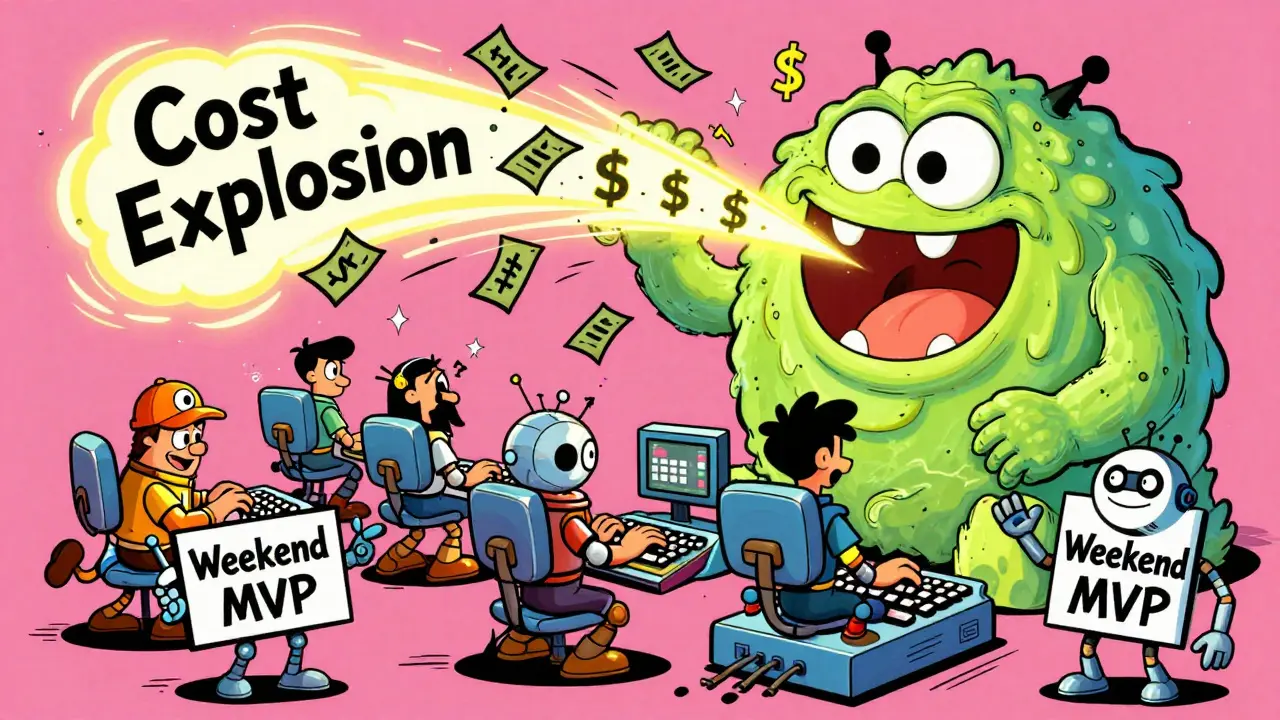
Most teams building AI apps start with an API. It’s fast. It’s easy. You write a prompt, send it to OpenAI or Anthropic, and get a reply in under a second. You build a prototype in a weekend. You show it to your boss. They love it. Then comes production. And that’s where things fall apart.
APIs are great for proving an idea. But they’re terrible for running a real business. The cost explodes. The latency spikes. Your data leaves your network. And when the provider changes their model silently, your app breaks without warning. Meanwhile, teams that switch to open-source LLMs self-hosted on their own servers aren’t just saving money-they’re gaining control, consistency, and compliance.
Why APIs Work for Prototyping
When you’re just testing a concept, you don’t care about infrastructure. You care about speed. That’s why GPT-4 API is the default choice for early-stage AI projects. You don’t need to train anything. You don’t need GPUs. You just need a Python script and a few lines of LangChain to chain prompts together.
Imagine you’re building a contract review tool. You feed it 10 sample clauses. You tweak the prompt. You test responses. Within hours, you’ve got a working MVP. No engineers needed. No cloud setup. No monitoring. You’re validating product-market fit, not building an enterprise system.
APIs win here because they offer:
- Instant access to state-of-the-art models
- No hardware investment
- Automatic scaling for testing
- Simple integration with FastAPI or Jupyter notebooks
At this stage, cost doesn’t matter. You’re not sending millions of requests. You’re sending a few hundred. A $50 bill for API usage is a small price to pay for a working demo.
The Production Cliff
But when you scale, the API model breaks. Hard.
One company using GPT-4 for contract review hit a wall when their usage jumped from 1,000 requests per day to 50,000. Their monthly bill went from $300 to $8,200. That’s not sustainable. Worse, each request took 3.5 seconds to return because of network lag. Clients complained. The product felt sluggish.
Then came the data privacy issue. Contracts contained sensitive financial terms. Every prompt and response was sent to OpenAI’s servers. That violated GDPR. It violated their internal compliance rules. Legal shut it down.
And then there was the silent model update. One Tuesday morning, the model started hallucinating contract clauses. No one at OpenAI notified them. No changelog. Just a drop in accuracy. Their system was now rejecting valid clauses. Revenue dropped 12% in one week.
This isn’t rare. It’s standard. Most teams hit this wall. They call it the “production cliff.” You can prototype fast. But production? That’s a different game.
What Production Hardening Really Means
Production hardening means building a system that runs reliably, securely, and affordably at scale. It’s not about making the model smarter. It’s about making the whole pipeline bulletproof.
The contract review team switched to Llama 3 8B, fine-tuned with LoRA on their own contract data. They deployed it on AWS SageMaker with NVIDIA A10G GPUs. They added:
- LangSmith to track every prompt and response
- Prometheus and Grafana to monitor latency and error rates
- Vectorstore caching to reuse responses for similar queries
- Canary releases to test new model versions on 5% of traffic first
- Human review gates for high-risk clauses
The results? Inference time dropped from 3.5 seconds to 1.2 seconds per page. Accuracy improved by 12% on ROUGE scores. Monthly costs fell by 45%. And their legal team finally approved the system-because no contract data ever left their AWS VPC.
Costs Don’t Add Up-They Multiply
API costs look small until they don’t.
At 10,000 requests/day, GPT-4 Turbo costs about $150/month. Sounds fine. But what if one user triggers a loop? A bot sends 500 prompts in a minute? That’s $75 in 60 seconds. No warning. No cap. Just a bill that spikes overnight.
Self-hosted models have upfront costs. An A100 GPU costs $15,000. But once you pay it, you own it. No per-token fees. No surprise charges. At 500,000 requests/month, the self-hosted system pays for itself in under three months.
And here’s the kicker: open-source models are getting better fast. Llama 3 70B now outperforms GPT-3.5 on most benchmarks. You don’t need the latest frontier model to win in production. You need a stable, controllable, and cost-efficient one.
Latency Isn’t a Bug-It’s a Feature
APIs add network delay. Always. Even if OpenAI’s servers are in the same region as your app, you still have:
- DNS lookup
- TCP handshake
- SSL negotiation
- Request queuing on their end
That’s 500-800ms before the model even starts processing. Add 1-2 seconds for generation. You’re at 2-3 seconds minimum.
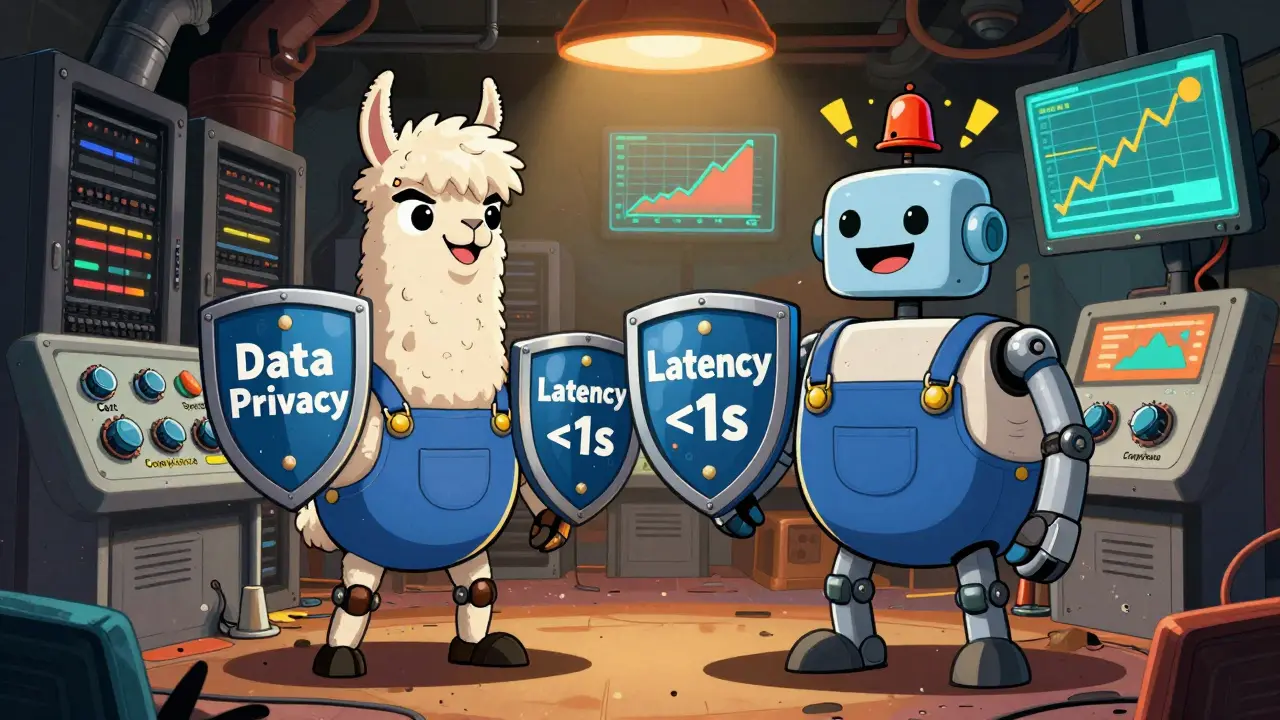
Self-hosted models run on the same server as your app. No network hops. No queuing. With quantization and optimized inference engines like vLLM, you can hit under 1 second-even on a single GPU.
For a customer service bot, 2 seconds feels slow. 1 second feels instant. That’s the difference between a product people use-and one they abandon.
Data Privacy Isn’t Optional
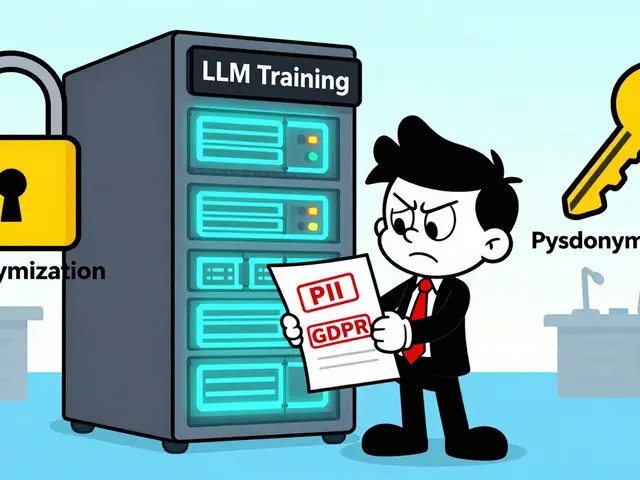
If you’re in healthcare, finance, or government, you can’t send sensitive data to third parties. HIPAA, GDPR, SOC 2-they all require data residency. That means no API.
One financial services startup tried using Claude 3 for loan application analysis. They got 90% accuracy. But every application contained SSNs, bank statements, and income records. Their compliance officer shut it down immediately.
They switched to Mistral 7B self-hosted on an on-prem server. No data left the building. No audits failed. No legal risk. The model was slightly less accurate-but close enough. And now they can scale without fear.
Hybrid Is the Real Winner
You don’t have to pick one. Most successful teams use both.
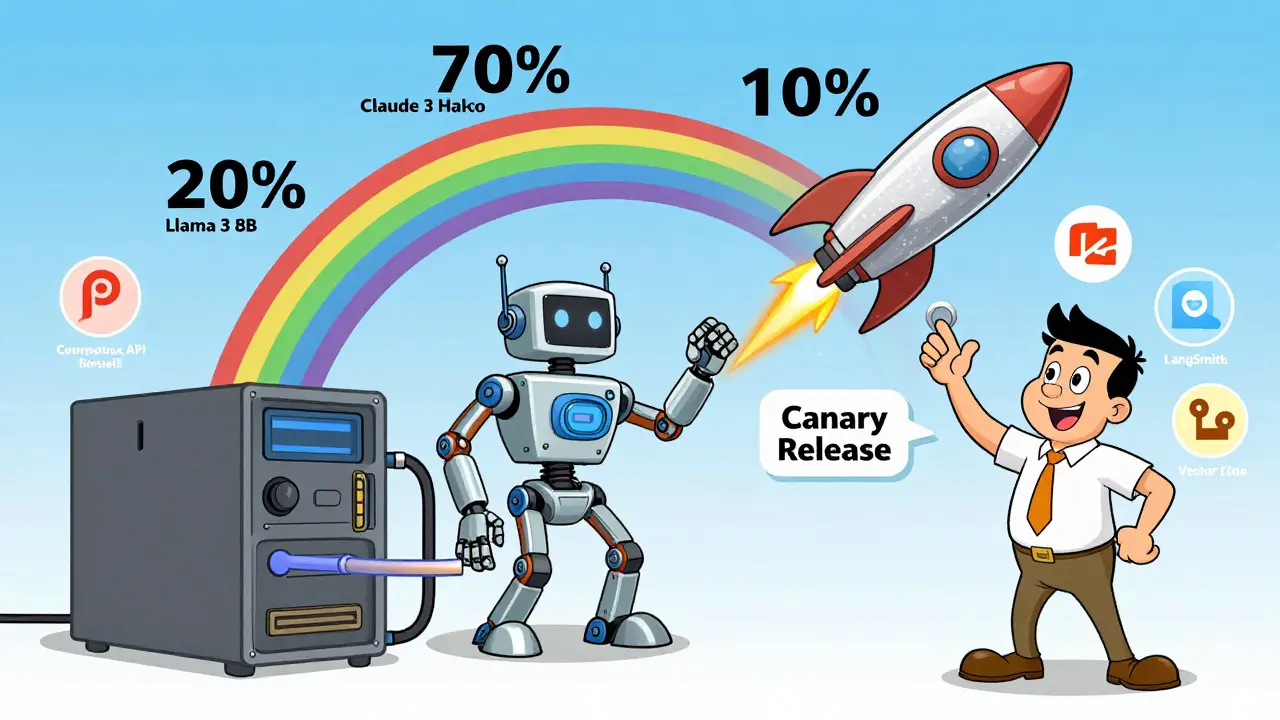
Here’s how one team routes traffic:
- 70% → Llama 3 8B (self-hosted, low cost, fast)
- 20% → Claude 3 Haiku (API, for edge cases)
- 10% → GPT-4 Turbo (API, for complex reasoning)
They use semantic caching to store responses for queries with 0.95+ similarity. That cuts costs another 60%. They use LangSmith to log every request and flag anomalies. If a self-hosted model starts hallucinating, they auto-route those requests to the API until they fix it.
This isn’t a compromise. It’s strategy. You get speed, cost control, and reliability-all at once.
Monitoring Is Your New Best Friend
APIs hide problems. Self-hosted models expose them. And that’s a good thing.
With an API, you get a response. You don’t know if it’s accurate. You don’t know if it’s slow. You don’t know if it’s changed.
With self-hosted models, you log everything:
- Latency per request
- Token count
- Response quality (using LLM-as-evaluator)
- Input distribution shifts
They set up alerts: if accuracy drops more than 5% in 24 hours, a ticket opens. If latency spikes above 2 seconds, they auto-scale. If a new prompt causes 10% error rate, they roll back.
This is operational maturity. And it’s the only thing that keeps AI systems alive in production.
When to Switch
Don’t switch just because you’re scared. Switch when:
- Your monthly API bill exceeds $2,000
- You have 50,000+ monthly requests
- Legal or compliance blocks external data
- Latency is affecting user retention
- You need to fine-tune for your domain
If none of those apply? Keep using the API. There’s no shame in it. But if even one does? Start planning your migration now.
Final Thought
Prototyping with APIs is like renting a sports car. You can test the speed, the handling, the thrill. But if you need to drive 100 miles a day, 365 days a year? You’ll go broke. And the car won’t be yours.
Production hardening with open-source LLMs is like building your own fleet. It takes time. It takes money. It takes expertise. But once it’s running? You control the fuel, the maintenance, the route. And you never get a surprise bill.
Can I use both APIs and open-source models at the same time?
Yes, and most teams that succeed in production do. Route the majority of routine requests to self-hosted open-source models for cost and speed. Use APIs for edge cases, complex reasoning, or fallback when your model fails. This hybrid approach cuts costs by 60-80% while keeping performance high.
Is self-hosting really cheaper than APIs?
It depends on volume. For under 10,000 requests/month, APIs win. Beyond that, self-hosting usually pays for itself in 3-6 months. A team running 500,000 requests/month saved $32,000 in one year by switching from GPT-4 to Llama 3 70B on AWS. The upfront cost of a GPU is a one-time investment. API costs keep growing.
Do I need a PhD to self-host an LLM?
No. You need engineers who understand Docker, Linux, and basic monitoring-not AI researchers. Tools like Hugging Face Transformers, vLLM, and LangSmith have made deployment accessible. Many teams deploy their first self-hosted model in under a week. The real challenge isn’t technical-it’s operational. You need to monitor, log, and improve continuously.
What if the open-source model isn’t as good as GPT-4?
It doesn’t have to be. Llama 3 70B matches GPT-3.5 on most benchmarks and beats it on reasoning tasks. For production, you don’t need the best model-you need the right one. A model fine-tuned on your data, running locally, with low latency and zero data leaks, is far more valuable than a slightly better model that costs $10,000/month and sends your data to a third party.
How do I know if my prompt is drifting in production?
Set up weekly sampling. Take 100 real production prompts and compare their outputs to your baseline test cases. Use a metric like ROUGE or BLEU. If performance drops more than 5%, investigate. Prompt drift happens because real users ask questions you never tested. Monitoring this is critical. APIs hide this problem. Self-hosting forces you to see it.
Can I use open-source models for regulated industries?
Yes, and many are. Healthcare and finance companies use Mistral, Llama 3, and Phi-3 self-hosted on private clouds to meet HIPAA, GDPR, and SOC 2 requirements. The key is zero data leaving your infrastructure. If your model runs on your servers, and your data never leaves your network, you can comply-even with strict regulations.


Been there, done that. Started with GPT-4 for a legal doc tool, loved the speed, then got slapped with a $9k bill one month. Legal team nearly had a stroke. Switched to Llama 3 8B on a single A10G-cost dropped to $400/month, latency cut in half, and no more data leaving our VPC. The real win? Our compliance officer actually smiled. Who knew AI could make legal people happy?
Oh sweet jesus, another ‘APIs are evil’ sermon. Let me guess-you’ve never tried running a 70B model on a budget server and watched it melt into a puddle of CUDA errors? Self-hosting isn’t magic, it’s just… expensive, brittle, and full of ‘oh shit’ moments. And don’t even get me started on ‘fine-tuning’ with LoRA when your data’s a mess of PDFs from 2017. I’ve seen teams waste six months ‘optimizing’ a model that still hallucinated ‘$5M contract’ into ‘$50M contract’. APIs? At least they’re predictable. Even if they’re overpriced.
I read this and just cried. Not because it’s bad-it’s actually brilliant-but because I’ve lived this. I built a customer support bot with GPT-4. It worked like a charm. Then the bill hit. Then the data leak alert popped up. Then my boss said ‘we need to cut costs’ and I realized I’d built a house of cards made of API tokens. I switched to Mistral. Took me 3 days. Now I sleep. Really. I don’t dream about cloud bills anymore. If you’re still using APIs past 10k requests a month… you’re not being smart. You’re just scared to grow up.
There’s something deeply human about this whole shift-from outsourcing intelligence to owning it. APIs give us convenience, yes, but they also distance us from the machinery. When you self-host, you’re not just deploying a model-you’re building a relationship with it. You see its quirks. You learn its limits. You debug its silences. And in that process, you stop treating it like a black box and start treating it like a teammate. It’s not just about cost or compliance. It’s about responsibility. The moment you stop asking ‘how fast can it answer?’ and start asking ‘how well does it understand?’-that’s when AI stops being a tool and becomes a partner. I’ve seen teams go from panic to peace in under a week after switching. It’s not technical. It’s emotional. And that’s the real upgrade.
Hybrid is the only sane approach. Self-host the bulk. Let APIs handle the edge. Monitor everything. Cache aggressively. Costs drop. Latency drops. Risk drops. Done.