
Ever stared at a blinking cursor while waiting for an AI response? That pause isn't just your internet lagging. It's the result of complex mathematical processes happening inside a Large Language Model (LLM) as it crunches numbers to predict the next word. Understanding prompt-to-response latency is no longer optional for developers and product managers. As we move through 2026, users expect near-instant interactions. If your application feels sluggish, they leave. But what exactly happens during that delay? Is it the hardware? The code? Or the architecture itself?
To optimize performance, you need to look under the hood. The delay you experience is not a single block of time. It is composed of distinct phases, each with its own bottlenecks and optimization strategies. By breaking down these mechanics, you can make informed decisions about infrastructure, model selection, and prompt engineering.
The Two Faces of Latency: TTFT vs. ITL
When people talk about slow AI, they often conflate two very different metrics. In the industry, we separate latency into Time to First Token (TTFT) and Inter-Token Latency (ITL), also known as Time Per Output Token (TPOT). Treating them as one metric leads to misguided optimizations.
Time to First Token (TTFT) is the time from when you hit "Send" to when the first character appears on your screen. This phase is critical for user perception. A low TTFT makes the application feel responsive and alive. If this number is high, users assume the system is broken or frozen, even if the subsequent text streams out quickly. TTFT is primarily driven by the processing of your input prompt. The model must read every token in your request before it can generate a single token of output.
Inter-Token Latency (ITL) measures the speed of the stream after the first token arrives. This is the "typing speed" of the AI. While TTFT affects the initial impression, ITL determines how long it takes to complete a long answer. High ITL results in a choppy, disjointed reading experience. These two metrics are influenced by different factors, meaning you might fix TTFT without improving ITL, or vice versa.
| Metric | Definition | Primary Driver | User Impact |
|---|---|---|---|
| TTFT | Time from submit to first character | Prompt length, KV Cache build time | Perceived responsiveness |
| ITL / TPOT | Average time between subsequent tokens | Model size, GPU compute power | Completion speed, fluidity |
| End-to-End Latency | Total time for full response | Sum of TTFT + (ITL * Token Count) | Total wait time |
The Hidden Cost: Building the KV Cache
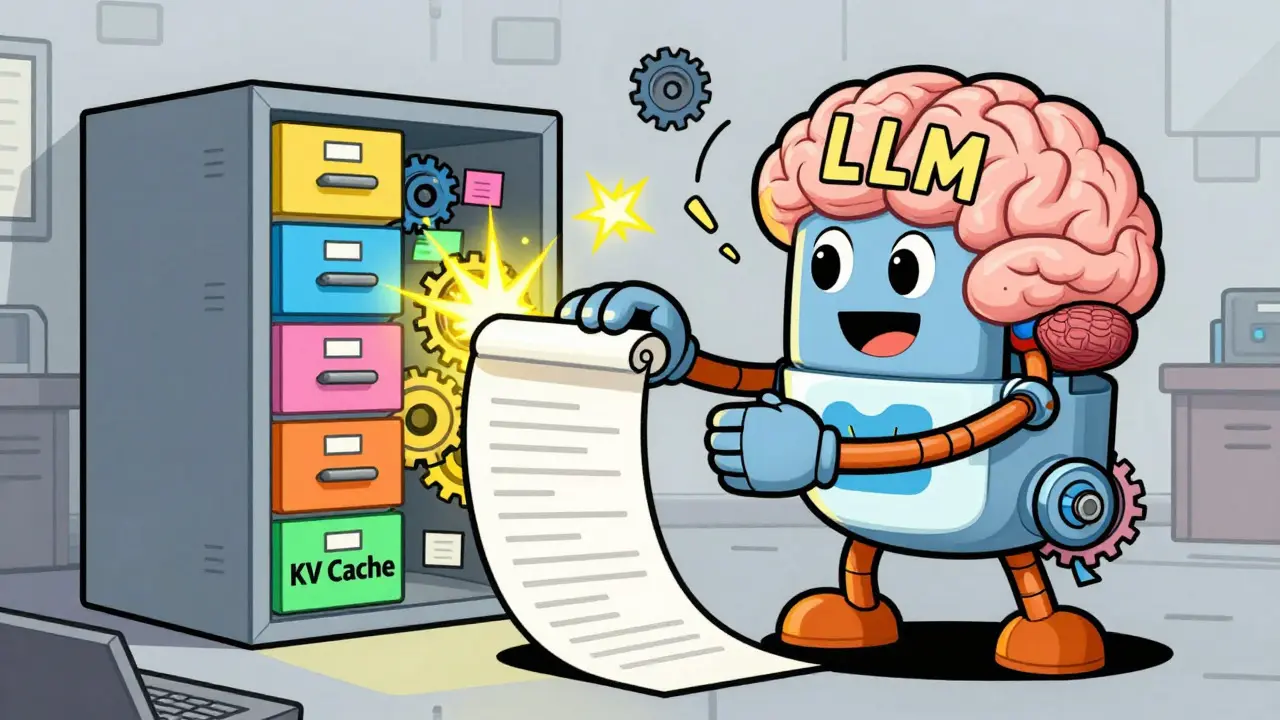
Why does the model need time before it starts writing? The answer lies in the Transformer Architecture. Modern LLMs use a mechanism called attention to weigh the importance of different words in your prompt. To avoid recalculating this attention for every new word it generates, the model stores intermediate calculations in a Key-Value (KV) Cache.
During the prefill phase (which dictates TTFT), the model processes your entire input prompt and builds this cache. Imagine trying to have a conversation where you must re-read the entire transcript of the previous hour every time you want to say one sentence. That would be exhausting and slow. The KV cache solves this by storing the "context" so the model only needs to process the new token it just generated.
However, building this cache is computationally expensive. For a short prompt, this happens in milliseconds. For a long context window-say, a 100-page document-the model must perform massive matrix multiplications to populate the cache. Benchmarking research has shown that processing time correlates directly with prompt length. For example, increasing a prompt from 500 tokens to 4,000 tokens significantly increases the normalized processing time because the model must do more work upfront to establish the context.
The Sequential Bottleneck: Why Streaming Isn't Parallel
Once the KV cache is built, the model enters the decoding phase. This is where ITL comes into play. Here is the hard truth about LLM inference: it is inherently sequential.
Unlike image generation or classification tasks that can be parallelized across thousands of cores, text generation must happen one token at a time. The model predicts the probability of the next token based on all previous tokens. It cannot predict the 10th word until it has confirmed the 9th word. This creates a fundamental ceiling on how fast a response can be generated.
This sequential nature means that GPU Compute Power becomes the limiting factor. Faster GPUs, such as the NVIDIA H100 or A100, reduce the time required for each forward pass. They allow the model to calculate the next token's probabilities quicker. However, even with the most powerful hardware, the sequential constraint remains. You can optimize the kernel efficiency and memory bandwidth, but you cannot skip steps in the chain of thought.
Hardware and Infrastructure Levers
If software architecture sets the floor, hardware sets the ceiling. Your choice of infrastructure directly impacts both TTFT and ITL. Here is how specific components influence performance:
- GPU Memory Bandwidth: Large models require moving vast amounts of data between memory and the processor. High-bandwidth memory (HBM) is crucial. If the memory bus is saturated, the GPU sits idle waiting for data, spiking ITL.
- Interconnects: When sharding a large model across multiple GPUs, the speed of communication between those chips matters. Technologies like NVIDIA NVLink minimize the overhead of passing data between nodes, preventing latency spikes during distributed inference.
- Batching Strategies: In production environments, servers handle multiple requests simultaneously. Increasing the batch size (max_num_seqs) improves throughput (Tokens Per Second) by keeping GPUs busy. However, aggressive batching can increase individual request latency because requests may queue behind others. Finding the right balance is key to maintaining low TTFT under load.
Prompt Engineering as a Performance Tool
We often think of prompt engineering solely for accuracy, but it is equally vital for latency. Every token in your prompt adds to the TTFT cost. Longer prompts mean a larger KV cache to build, which takes more time and memory.
Consider the trade-offs of common techniques:
- Few-Shot Prompting: Providing examples within the prompt helps guide the model's behavior without fine-tuning. However, each example adds hundreds of tokens. If you include three detailed examples, you might double your TTFT compared to a zero-shot prompt. Use few-shot prompting sparingly, or consider P-Tuning, which encodes task-specific instructions into virtual tokens, reducing the visible prompt length.
- Context Window Management: Not all parts of a long document are relevant to the current query. Using retrieval-augmented generation (RAG) to fetch only the most relevant snippets reduces the input token count, directly lowering TTFT.
- Token Efficiency: Some languages and formatting styles are more token-dense than others. Concise prompts reduce computational load. Avoid verbose pleasantries or redundant instructions that add noise without adding value.
The Economic Reality of Latency
Latency isn't just a technical metric; it's a financial one. Most cloud providers bill per token. Longer prompts cost more to process. Higher latency often correlates with higher costs because you are paying for the compute time required to build the KV cache and generate the output.
There is a dual incentive to optimize: improve user experience by reducing wait times, and reduce operational costs by minimizing unnecessary token usage. For real-time applications like customer service chatbots or AI search engines, high latency is a dealbreaker. Users will abandon a session if the initial response takes more than a couple of seconds. Therefore, optimizing for low TTFT should be a primary KPI alongside accuracy.
Future Directions and Mitigations
While the sequential nature of transformers is a fixed constraint, innovation continues. Researchers are exploring speculative decoding, where a smaller, faster model predicts several tokens ahead, and the larger model verifies them in parallel. This can effectively bypass some of the sequential bottleneck, improving ITL without changing the core architecture.
Additionally, advancements in specialized inference hardware and optimized kernels continue to squeeze out milliseconds. As models grow larger, the focus shifts from raw parameter counts to efficient inference patterns. Understanding the mechanics of prompt-to-response latency allows you to navigate these changes proactively, ensuring your applications remain fast, affordable, and competitive.
What is the biggest factor affecting Time to First Token (TTFT)?
The primary driver of TTFT is the length of the input prompt. The model must process every token in the prompt to build the Key-Value (KV) cache before generating any output. Longer prompts require more computation and memory access, directly increasing the time before the first token appears.
Can I parallelize LLM text generation to reduce latency?
Not directly. Text generation is inherently sequential because each token depends on the previous ones. However, techniques like speculative decoding allow a smaller model to predict multiple tokens ahead, which the main model then verifies in parallel, effectively speeding up the process.
How does batching affect individual request latency?
Batching improves overall system throughput by keeping GPUs busy with multiple requests. However, it can increase individual request latency (both TTFT and ITL) because requests may have to wait in a queue or share compute resources with other active requests.
What is the role of the KV Cache in LLM inference?
The Key-Value (KV) Cache stores intermediate attention calculations from the input prompt. This allows the model to avoid recalculating the context for every new token generated, significantly speeding up the decoding phase. Building this cache is the main task during the TTFT phase.
Does using fewer-shot prompting always improve latency?
Yes, reducing the number of examples in few-shot prompting decreases the prompt length, which lowers TTFT and cost. However, it may reduce accuracy. Techniques like P-Tuning offer a middle ground by encoding instructions efficiently without inflating the prompt token count.



Listen up devs, stop blaming your internet connection when the cursor blinks forever. It is literally just math crunching numbers inside that transformer architecture. You need to understand TTFT vs ITL or you are flying blind in 2026.
i love how this breaks down the hidden costs of ai latency 🤯 its like peeling an onion but with gpu memory bandwidth instead of tears lol
It is quite fascinating how the KV Cache acts as a memory buffer for the model's attention mechanism. One might consider it the digital equivalent of short-term memory retention in human cognition, allowing for efficient processing without redundant calculations. This architectural choice significantly mitigates the computational overhead associated with re-evaluating previous tokens during the generation phase.
great read man really helps clarify why my app feels sluggish even on good hardware. just keep optimizing those prompts and you will be golden
Most people ignore the sequential bottleneck. Speculative decoding is nice but it does not change the fundamental physics of token prediction. Hardware limits are real.
We need domestic silicon production to fix these latency issues at the root level rather than relying on foreign chip architectures that dictate our performance ceilings. The supply chain vulnerabilities are becoming too apparent in critical infrastructure applications where every millisecond counts towards national security and economic competitiveness.
totally agree with the prompt engineering section. i noticed huge drops in ttft just by trimming down my few-shot examples. its crazy how much noise we add to prompts thinking it helps accuracy but it just kills speed
The distinction between Time to First Token and Inter-Token Latency is not merely semantic; it is fundamentally operational. Product managers who fail to distinguish between perceived responsiveness and actual completion speed are setting their teams up for failure. The user experience is fractured if one metric is optimized while the other degrades, leading to a disjointed interaction flow that undermines trust in the system.
thinking about the philosophical implications of sequential generation. it mirrors the linear nature of time itself. we cannot predict the future token because the past has not yet been fully computed into the present context window. perhaps this constraint is a feature not a bug forcing us to engage with the process step by step
I have been experimenting with RAG pipelines to reduce input token counts and the improvement in TTFT is noticeable. It seems like the best balance between cost and speed right now until hardware gets cheaper.