
You type a question into an AI chatbot. It gives you a generic, slightly off-target answer. You tweak the wording, add a specific constraint, or paste in three examples of what you want. Suddenly, the output is exactly what you needed. That tiny shift in input text? That's prompt engineering at work.
It’s not magic, and it’s not just "being good with words." Prompt engineering is the systematic design of natural language inputs to steer Large Language Models (LLMs) toward precise, high-quality outputs. If you’re building apps, writing content, or automating workflows, mastering this skill saves hours of debugging and drastically improves reliability. Let’s break down the actual principles that make prompts work, moving beyond vague advice to concrete patterns you can use today.
The Core Mechanism: Why Words Matter So Much
At its heart, an LLM like GPT-4 or Claude predicts the next token in a sequence based on massive training data. When you send a prompt, you aren't commanding a robot; you're setting up a statistical context window. The model looks at your instructions, the context you provided, and the examples included to calculate probabilities for the next word.
This means LLMs are hyper-sensitive to structure. Research shows that changing just the formatting of a prompt-like switching from bullet points to paragraphs-can swing accuracy by up to 76 percentage points in complex tasks. This isn't about politeness; it's about clarity. A vague prompt leaves too many variables open for the model to guess. A well-engineered prompt narrows the search space, forcing the model to focus on the specific task parameters you care about.
Think of it like programming with English. If you write sloppy code, the compiler throws errors. If you write sloppy prompts, the LLM returns hallucinations or irrelevant fluff. The goal is to reduce ambiguity so the model has no choice but to follow your intended path.
Foundational Principle: Specificity and Context
The first rule of effective prompting is specificity. "Write a blog post" is a weak prompt. "Write a 500-word blog post for beginner developers about Python list comprehensions, using a conversational tone and including two code examples," is strong. Why? Because you’ve defined the audience, the length, the topic, the tone, and the format.
Context acts as the guardrails for generation. Without it, the model relies on its general training knowledge, which might be outdated or too broad. By injecting relevant background information directly into the prompt, you ground the response in reality. This is often called "grounding." For instance, if you ask an LLM to summarize a legal contract, pasting the key clauses first ensures the summary reflects those specific terms rather than general legal concepts.
| Prompt Type | Example Input | Expected Outcome |
|---|---|---|
| Vague | "Explain photosynthesis." | Generic textbook definition, likely too long or short for needs. |
| Specific | "Explain photosynthesis to a 10-year-old using an analogy about cooking." | Focused, accessible, creative explanation matching the persona. |
| Structured | "List 3 steps of photosynthesis. Format as JSON with keys 'step', 'description'." | Precise, machine-readable output ready for API integration. |
Pattern 1: Few-Shot Prompting and In-Context Learning
One of the most powerful techniques in modern prompt engineering is few-shot prompting. Instead of just telling the model what to do, you show it. You provide a small set of input-output pairs within the prompt itself. This leverages a capability called in-context learning, where the model learns the pattern from the examples without needing retraining.
Why does this work? Large models have billions of parameters. They are excellent at pattern recognition. When you give them three clear examples of how you want a sentiment analysis task handled, they infer the underlying rules better than any abstract instruction could convey. For example, if you want the model to classify customer reviews, don't just say "Classify sentiment." Show it:
- Input: "I loved the fast shipping!" Output: Positive
- Input: "The product broke immediately." Output: Negative
- Input: "It was okay, nothing special." Output: Neutral
- Input: [Your new review]
This reduces variance significantly. The model stops guessing what "neutral" means because you defined it through example. Studies indicate that adding even two or three well-chosen examples can boost performance on classification tasks by double digits.
Pattern 2: Chain-of-Thought Reasoning
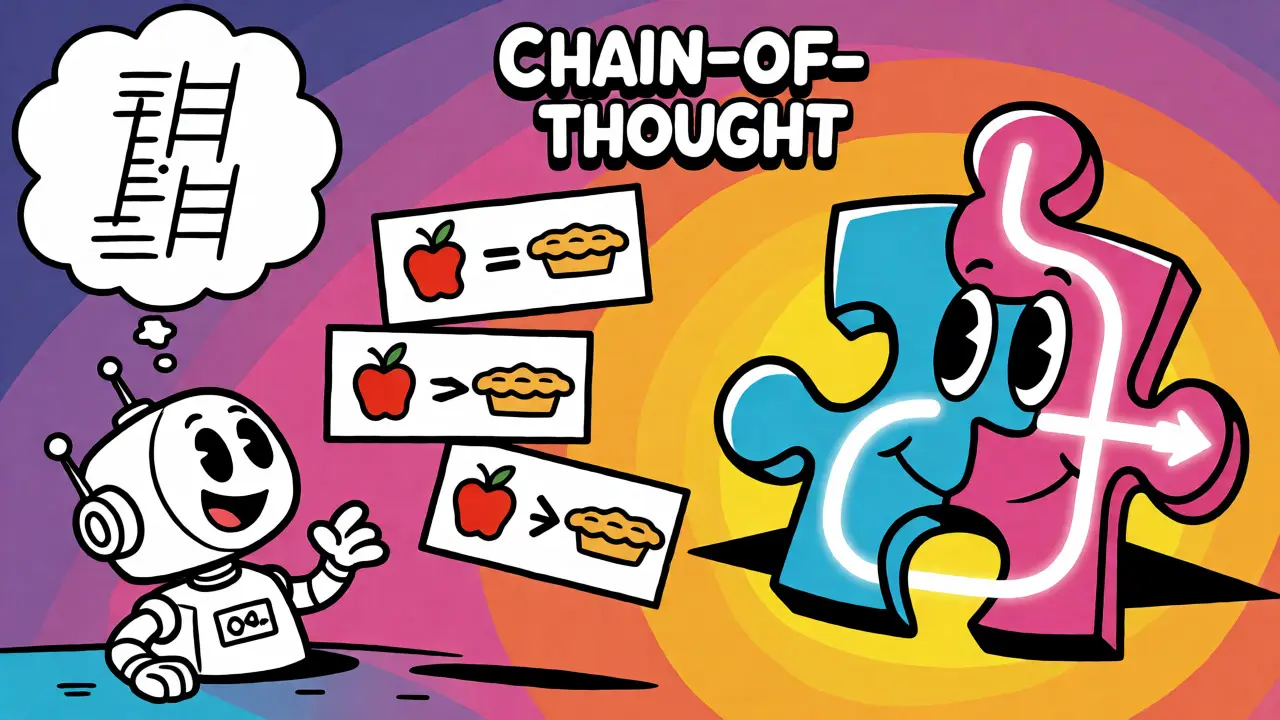
For complex logical problems, math, or multi-step reasoning, simple prompts often fail. The model tries to jump straight to the answer, skipping the intermediate logic that humans use. This leads to errors. Enter Chain-of-Thought (CoT) prompting.
The trick here is surprisingly simple: tell the model to "think step-by-step." Or, better yet, include examples where the reasoning process is explicitly written out before the final answer. When researchers applied CoT to Google’s PaLM model, it achieved state-of-the-art results on mathematical benchmarks like GSM8K, matching fine-tuned models that were specifically trained for math.
Here’s the difference:
- Standard Prompt: "If John has 5 apples and eats 2, then buys 3 more, how many does he have? Answer:"
- CoT Prompt: "If John has 5 apples and eats 2, then buys 3 more, how many does he have? Let's think step by step. First, John starts with 5. He eats 2, so 5 - 2 = 3. Then he buys 3, so 3 + 3 = 6. The answer is 6. Now solve this: If Sarah has 10 cookies..."
By forcing the model to generate the intermediate tokens (the reasoning), you increase the likelihood that the final conclusion is logically sound. It slows down the generation process slightly, but the accuracy gain is usually worth the trade-off.
Pattern 3: Role Assignment and Persona Constraints
LLMs are chameleons. Their behavior shifts dramatically based on who they think they are. Assigning a specific role helps constrain the style, vocabulary, and depth of the response. This is known as role assignment.
If you ask, "How do I fix my car?", you’ll get a generic list. If you ask, "Act as a senior mechanic with 20 years of experience. Explain how to diagnose a rough idle in a 2015 Honda Civic to a complete novice," you get targeted, practical advice with appropriate jargon explanations. The role primes the model to access specific subsets of its training data related to automotive repair and instructional communication.
You can combine roles with strict constraints. For example: "You are a technical writer. Write documentation for this API endpoint. Do not use passive voice. Keep sentences under 20 words. Use Markdown headers." These negative and positive constraints guide the generation away from common bad habits.
Advanced Technique: Retrieval-Augmented Generation (RAG)
While prompt engineering focuses on the text you send, Retrieval-Augmented Generation (RAG) bridges the gap between static prompts and dynamic data. Standard LLMs have a knowledge cutoff date. They don’t know about your company’s internal wiki or last week’s news unless you tell them.
In a RAG system, your application first retrieves relevant documents from a database (often a vector database) based on the user’s query. It then injects these retrieved snippets into the prompt as context. The prompt structure changes from "Answer this question" to "Use the following context to answer this question. If the answer isn't in the context, say 'I don't know.'"
This pattern solves the hallucination problem for factual queries. The model isn’t guessing from memory; it’s summarizing provided facts. It requires more infrastructure setup than simple prompting, but for enterprise applications requiring accuracy, it’s essential.
Pitfalls to Avoid
Even with good intentions, prompt engineers fall into common traps. Here’s what to watch out for:
- Overloading: Stuffing too many instructions into one prompt confuses the model. If a task is complex, break it into smaller sub-prompts (a technique called prompt chaining).
- Negation Ambiguity: Models struggle with "don't do X." They often focus on the concept of X. Instead of saying "Don't be verbose," say "Be concise and direct."
- Assuming Knowledge: Never assume the model knows your specific business context. Always define acronyms and internal terms within the prompt.
- Ignoring Temperature: Prompting works best when paired with correct inference settings. High temperature (creativity) makes deterministic prompts less reliable. Low temperature (precision) amplifies the effect of strict instructions.
Conclusion: Iteration is Key
Prompt engineering isn't a "set it and forget it" discipline. It’s iterative. You write a prompt, test it against edge cases, see where it fails, and refine. Maybe you need to move instructions to the top of the prompt. Maybe you need to change "summarize" to "extract key entities." There is no single perfect prompt for every model version, but there are proven patterns that serve as excellent starting points.
Start with clarity. Add examples for pattern matching. Use chain-of-thought for reasoning. And always validate the output against your requirements. As LLMs evolve, the tools will change, but the fundamental principle remains: clear input yields clear output.
What is the difference between zero-shot and few-shot prompting?
Zero-shot prompting asks the model to perform a task without providing any examples, relying solely on instructions. Few-shot prompting includes several input-output examples within the prompt to demonstrate the desired pattern, leveraging the model's in-context learning capabilities for higher accuracy on complex tasks.
Does prompt engineering work differently for different LLMs?
Yes. Some models, like those optimized for reasoning (e.g., o1-preview), respond better to high-level guidance, while others require very precise, step-by-step instructions. Always check the specific documentation for the model you are using, as sensitivity to formatting and instruction placement varies by architecture.
What is Chain-of-Thought prompting?
Chain-of-Thought (CoT) prompting is a technique where the model is encouraged to generate intermediate reasoning steps before providing a final answer. This is particularly effective for arithmetic, commonsense, and symbolic reasoning tasks, as it allows the model to break down complex problems into manageable parts.
Can prompt injection affect security?
Yes, prompt injection is a cybersecurity vulnerability where malicious users craft inputs that override the system's original instructions. This can cause the LLM to ignore safety guidelines or reveal sensitive data. Robust prompt engineering includes delimiters and clear separation between system instructions and user input to mitigate this risk.
Is coding required for prompt engineering?
Not necessarily. Basic prompt engineering uses natural language and can be done in chat interfaces. However, advanced techniques like automated evaluation, RAG implementation, and managing prompt templates in production environments typically require programming skills in languages like Python or JavaScript.