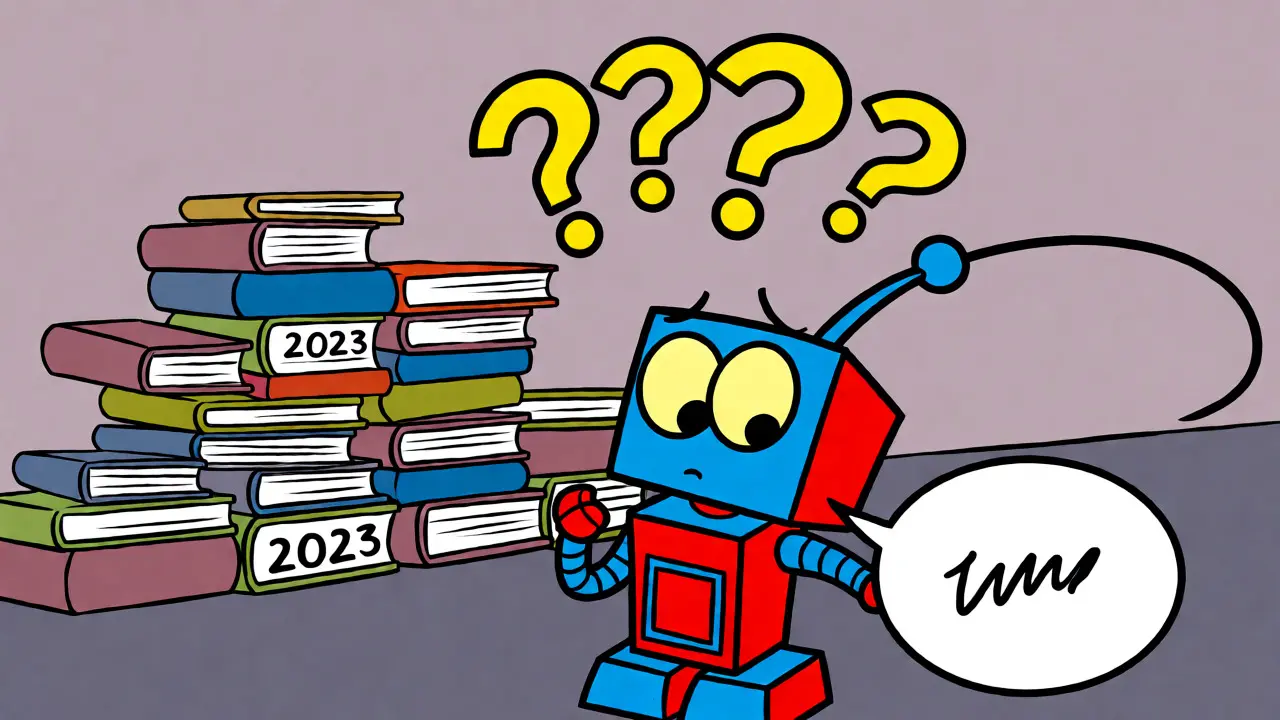
You ask a large language model about your company's latest product update from last week. It gives you a confident, well-structured answer that is completely wrong. This isn't a glitch; it's a feature of how these models work. They predict the next word based on patterns learned during training, not by checking a live database. If the information wasn't in their training data, or if they misinterpreted a pattern, they will invent facts to fill the gap. This is called hallucination, and it's the biggest barrier to trusting AI for serious business tasks.
Retrieval-Augmented Generation (RAG) is the architectural fix for this problem. Instead of forcing the model to remember everything, RAG lets it look things up right before answering. Think of it like giving an open-book exam instead of a closed-book test. By connecting the model to external, authoritative data sources at query time, RAG grounds outputs in reality. This article breaks down exactly how RAG works, why it stops hallucinations, and what you need to know to implement it effectively.
The Core Problem: Why LLMs Make Things Up
To understand why RAG matters, you have to understand the limitations of standard Large Language Models (LLMs). These models are essentially massive statistical engines trained on vast amounts of text up to a specific cutoff date. Once that training ends, the model's knowledge freezes.
This creates two major issues:
- Knowledge Cutoffs: The model doesn't know about events, products, or policies created after its training data was finalized. Ask a model trained in 2023 about a law passed in 2025, and it might guess based on old patterns.
- Hallucinations: When the model doesn't know the answer, it doesn't say "I don't know." It predicts the most probable sequence of words. Often, this results in plausible-sounding but factually incorrect statements. In high-stakes fields like healthcare or legal advice, a confident lie is worse than silence.
Fine-tuning-retraining the model on new data-is one solution, but it’s expensive, slow, and requires re-doing the process every time new information arrives. You can't retrain a billion-parameter model every time a support ticket comes in. That's where RAG changes the game.
How RAG Works: The Four-Step Pipeline
RAG isn't magic; it's a systematic pipeline that combines information retrieval with generative AI. Here is the step-by-step workflow that happens behind the scenes when you use a RAG-enabled system.
1. Ingestion and Chunking
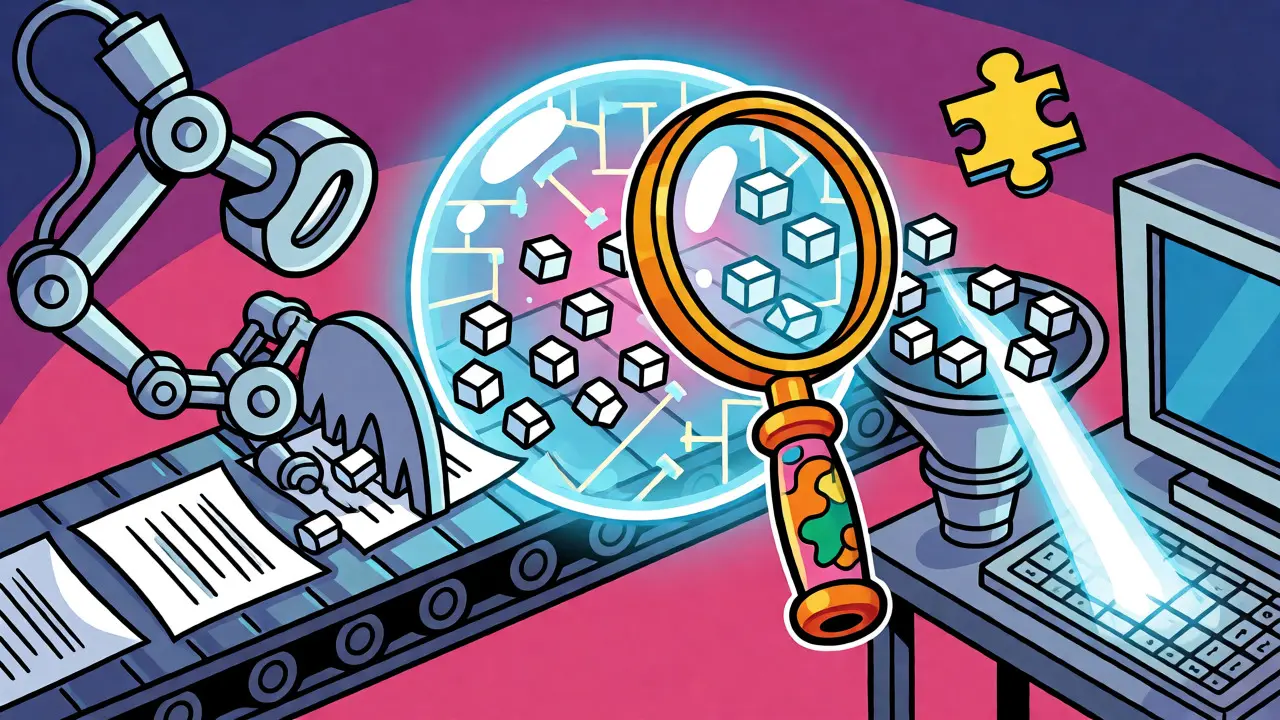
Before any queries happen, you must prepare your data. This involves taking your source documents-PDFs, internal wikis, databases-and breaking them into smaller, manageable pieces called chunks. Chunking is critical because embedding models work best with focused context. Too big, and the semantic meaning gets diluted; too small, and you lose necessary context. A common rule of thumb is 500-1000 tokens per chunk, but this varies by domain.
2. Vector Embedding and Indexing
Once chunked, each piece of text is converted into a numerical representation called a vector embedding. An embedding model analyzes the semantic meaning of the text and maps it to a point in high-dimensional space. Texts with similar meanings end up close together in this space. These vectors are stored in a vector database like Pinecone, Weaviate, or Milvus, which is optimized for fast similarity searches.
3. Retrieval
When a user asks a question, the system converts that query into a vector using the same embedding model. It then searches the vector database for the top-k most similar chunks. This isn't just keyword matching; it's semantic search. If you ask "how do I reset my password," the system retrieves chunks about authentication and login errors, even if those exact words aren't present.
4. Augmentation and Generation
The retrieved chunks are combined with the original user query to create a new, augmented prompt. This prompt explicitly instructs the LLM to answer using only the provided context. The LLM then generates a response grounded in that fresh, relevant data. Because the facts are right there in the prompt, the model has less room to improvise and hallucinate.
Why RAG Beats Fine-Tuning for Factuality
Many developers wonder whether they should fine-tune their model or use RAG. For factual accuracy, RAG usually wins. Here’s a direct comparison of the two approaches.
| Feature | Retrieval-Augmented Generation (RAG) | Fine-Tuning |
|---|---|---|
| Cost | Low (storage and API costs) | High (GPU compute for training) |
| Update Speed | Instant (update database) | Slow (requires retraining) |
| Transparency | High (can cite sources) | Low (black box weights) |
| Data Privacy | Data stays in your DB | Data mixed into model weights |
| Best For | Dynamic, factual, proprietary data | Style, tone, and format consistency |
Fine-tuning teaches the model *how* to speak or act in a certain style. RAG teaches the model *what* to say based on current facts. If your goal is to ensure the output is factually correct and up-to-date, RAG provides the verifiability that fine-tuning lacks. Plus, with RAG, you can delete or update a document in your database, and the next query reflects that change immediately. With fine-tuning, you'd have to wait days or weeks for a new model version.
Advanced Techniques to Boost Precision
A basic RAG setup often fails if the retrieval step picks irrelevant documents. To fix this, engineers use advanced strategies to refine the search and generation process.
Hybrid Search: Pure vector search sometimes misses exact terms, like error codes or specific product names. Hybrid search combines dense vector retrieval with sparse keyword matching (like BM25). This ensures that both semantic concepts and exact keywords are considered, significantly improving recall.
Reranking: After the initial retrieval pulls the top 50 chunks, a reranking model evaluates them more carefully. It scores each chunk based on its relevance to the specific query, allowing you to pass only the top 5 most relevant snippets to the LLM. This reduces noise and prevents the model from getting confused by irrelevant context.
Agentic RAG: This is the next evolution. Instead of retrieving once, the LLM acts as an agent. It can decide to retrieve information, realize it needs more, retrieve again, and even critique its own draft answer before finalizing it. This iterative loop allows for complex multi-hop reasoning, where the answer depends on combining facts from multiple different documents.
Implementing RAG: Practical Tips for Success
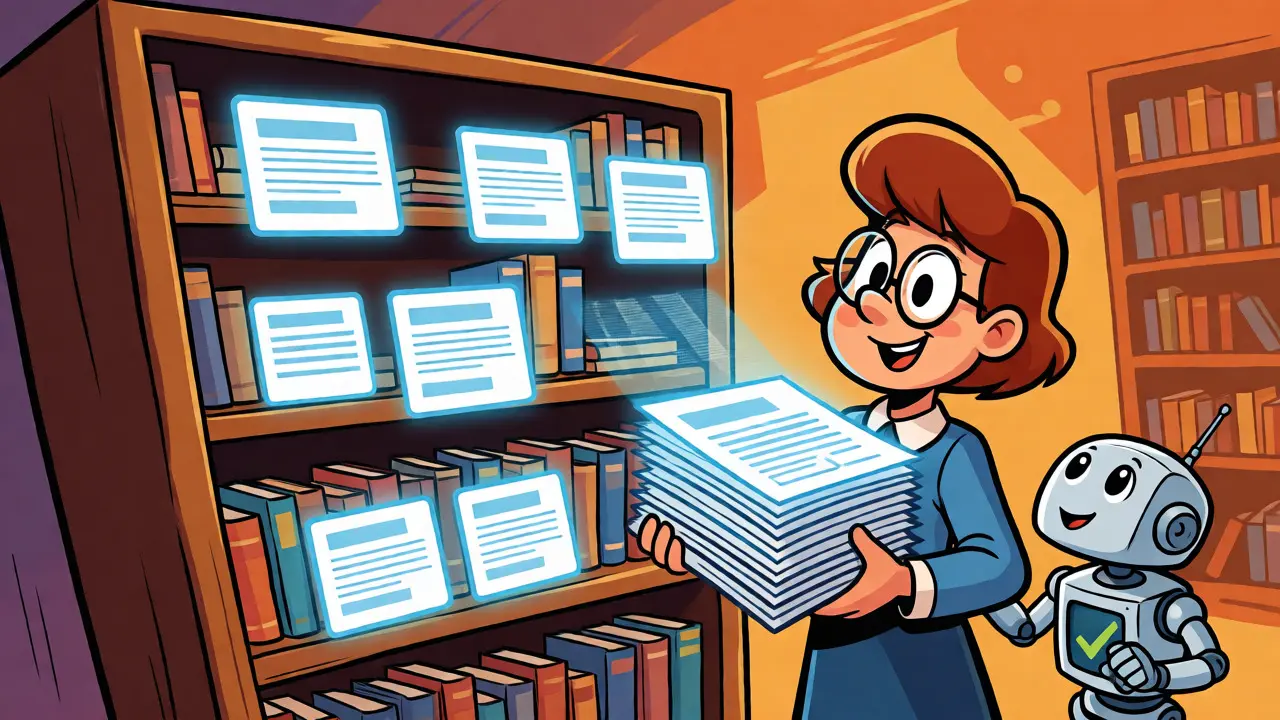
If you're building a RAG system, don't just plug in a database and hope for the best. The quality of your output is directly tied to the quality of your input data and retrieval logic.
- Clean Your Data: Garbage in, garbage out. Remove headers, footers, and broken tables from your source documents before chunking. Messy PDFs lead to messy embeddings.
- Optimize Chunk Size: Experiment with different chunk sizes. For technical documentation, smaller chunks (200-400 tokens) often work better because they isolate specific procedures. For narrative content, larger chunks preserve flow.
- Prompt Engineering Matters: Your prompt to the LLM must be strict. Use instructions like "Answer ONLY using the provided context. If the answer is not in the context, state 'I do not know.'" This prevents the model from reverting to its pre-trained memory.
- Evaluate Retrieval Separately: Don't just evaluate the final answer. Check if the right documents were retrieved. If the retrieval failed, no amount of good prompting will save the answer.
The Future: Trustworthy AI Through Transparency
RAG is more than a technical hack; it's a shift toward trustworthy AI. By grounding responses in retrievable sources, we move away from black-box predictions to transparent, verifiable answers. Users can see citations, auditors can check sources, and businesses can maintain control over their knowledge base without constantly retraining models.
As we move into late 2026, expect RAG systems to become more autonomous. They will handle real-time data streams, manage persistent memory across conversations, and offer deeper explainability. The goal isn't just to generate text, but to generate truth.
Does RAG eliminate all hallucinations?
No, it significantly reduces them but doesn't eliminate them entirely. If the retrieved documents contain contradictory information, or if the LLM misinterprets the retrieved context, it can still generate inaccurate statements. However, RAG makes these errors easier to detect and debug because you can trace the output back to specific source chunks.
Is RAG cheaper than fine-tuning?
Generally, yes. Fine-tuning requires expensive GPU clusters for training, which can cost thousands of dollars per run. RAG primarily incurs costs for vector database storage and API calls for embeddings and generation. Updating data in RAG is nearly free compared to the computational expense of retraining a model.
Can I use RAG with any LLM?
Yes, RAG is model-agnostic. It works with open-source models like Llama 3 or Mistral, as well as proprietary APIs like GPT-4o or Claude 3.5 Sonnet. The key requirement is that the LLM supports long-context windows to accommodate the retrieved chunks along with the user query.
What is the role of the vector database?
The vector database stores the numerical representations (embeddings) of your data chunks. Its job is to perform fast similarity searches. When a user query is embedded, the database finds the stored vectors that are mathematically closest to the query vector, effectively identifying the most semantically relevant text fragments.
How does chunk size affect RAG performance?
Chunk size is a trade-off between precision and context. Small chunks allow for precise retrieval of specific facts but may lack surrounding context, leading to fragmented answers. Large chunks provide better context but dilute the semantic signal, making it harder for the embedding model to pinpoint relevance. Most systems use overlapping chunks to balance this.
the comparison with fine tuning is spot on especially regarding the update speed because retraining a model for every new document is just not scalable for most enterprises and i have seen this firsthand in production environments where we switched to rag for our internal knowledge base and the latency dropped significantly while accuracy went up
one thing i would add to the implementation tips is that you really need to pay attention to your embedding model selection as different models perform vastly differently on domain specific jargon so benchmarking those before committing to a vector db schema saves weeks of debugging later