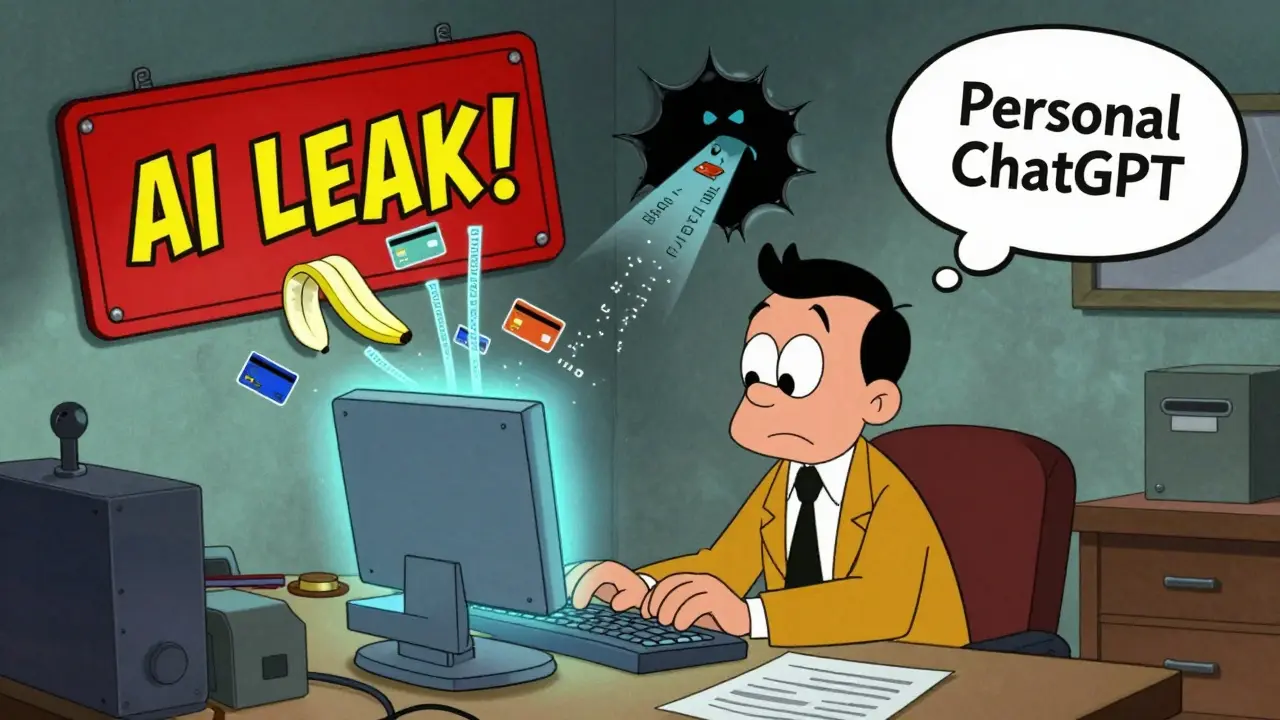
Generative AI isn't just changing how we work-it's exposing secrets we didn't know we were sharing. Companies thought they were safe using chatbots for customer service or summarizing reports. Then came the leaks: source code uploaded to personal ChatGPT, customer lists dumped into Google Drive, and internal emails analyzed by unapproved AI tools. By 2026, the average organization sees 223 data policy violations every month because of generative AI. And it's not just about bad actors-it's about well-meaning employees trying to get work done faster.
Why Your Old Data Rules Don't Work Anymore
Five years ago, data governance meant locking down file shares, blocking USB drives, and training staff not to email sensitive files. That’s not enough anymore. Generative AI doesn’t need to download a file to steal it. It just needs you to type a prompt.Imagine a developer pasting a chunk of proprietary code into a free AI tool to fix a bug. The tool doesn’t save it. But it remembers. And if that same code appears in another user’s prompt later, the AI might spit it back out. No breach. No hack. Just a quiet, invisible leak.
Organizations that tried to block AI entirely saw a 300% spike in shadow AI usage within three months. People didn’t stop using AI-they just moved it to personal accounts. Google Drive, Gmail, OneDrive, and personal ChatGPT became the new backdoors. Kiteworks found that 60% of insider threats now come from these personal cloud apps. And 54% of the data being leaked is regulated personal information-names, addresses, medical records, financial data.
The New Rules: Governance, Not Blocklists
The smartest companies stopped trying to ban AI. Instead, they started governing it.Blocking AI is like trying to stop water with a sieve. The real solution is knowing where the water flows, who controls the pipes, and what’s safe to let through. Microsoft’s January 2026 Data Security Index found that organizations using governance-first strategies had 63% fewer violations than those trying to ban tools outright.
Here’s what that looks like in practice:
- Data mapping: You can’t protect what you don’t see. Teams now trace every AI input and output-not just files, but prompts, responses, and metadata. Where does the data come from? Where does it go? Who touched it?
- Prompt-level guardrails: Tools now scan what you’re about to type before you hit send. If you’re about to paste a customer list into a chatbot, the system flags it. It doesn’t stop you-it tells you why it’s risky and suggests a safer alternative.
- Zero trust architecture: AI tools don’t get blanket access. They only see data they’re explicitly allowed to, based on role, sensitivity, and context. A marketer might get access to campaign summaries. A developer might get access to non-production code. No one gets the full dataset.
- Immutable audit logs: Every AI interaction is recorded. Not just who used it, but what was input, what came out, and whether it violated policy. This isn’t for punishment-it’s for learning. When a leak happens, you know exactly where the hole is.
Concentric AI calls this “controlling what GenAI tools can access, how they use it, and where it flows once processed.” It’s not about surveillance. It’s about enabling people to work safely.
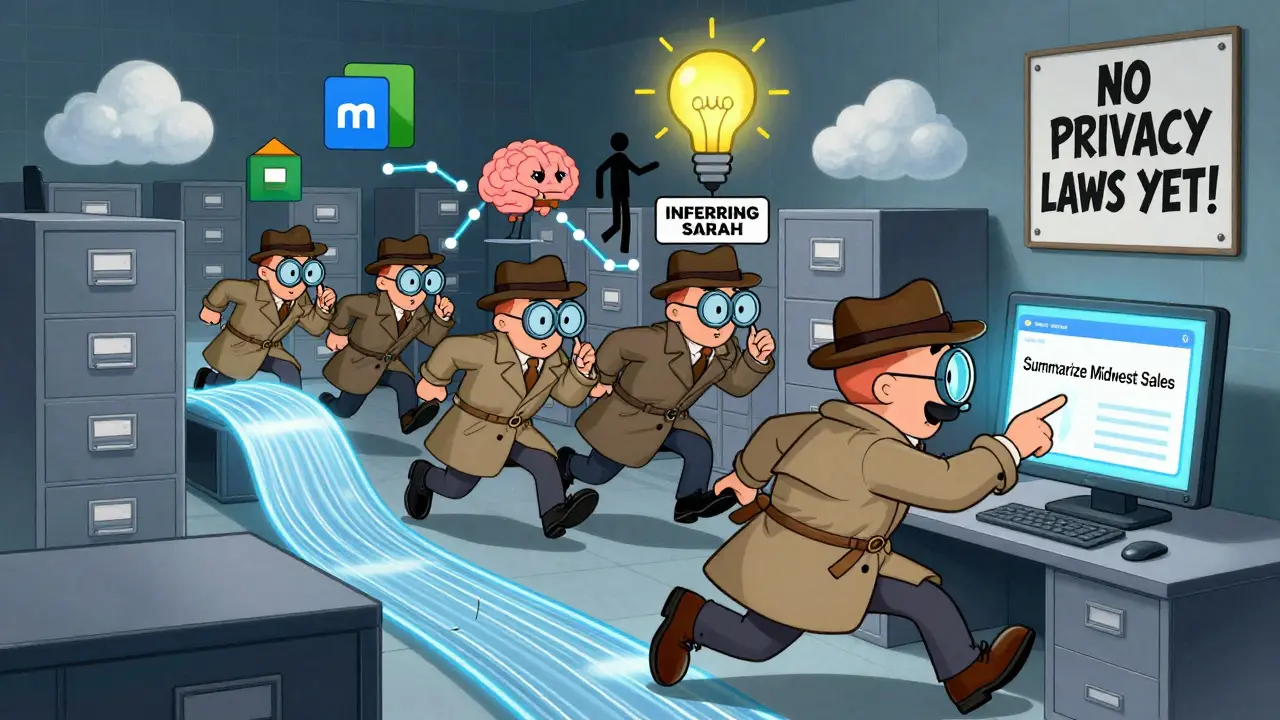
The Hidden Risk: Inferred Data
The scariest part of AI isn’t what you give it-it’s what it figures out.Let’s say you ask an AI: “Summarize last quarter’s sales for the Midwest region.” You didn’t give it names. You didn’t give it addresses. But the AI notices a pattern: sales dropped sharply after a certain date. It cross-references that with internal HR data. Suddenly, it infers that a key sales rep left the company. And now it’s telling your CEO: “The Midwest team’s performance declined after Sarah’s departure.”
That’s inferred data. And it’s not covered by any privacy law yet. You didn’t consent to this. You didn’t even know it was possible. TrustArc calls this the “consent paradox.” If AI can deduce private facts from public data, who owns those facts? Who’s responsible?
Right now, no framework fully handles this. But forward-thinking companies are starting to treat inferred data like any other sensitive record. If an AI can guess someone’s medical condition from their purchase history, that guess is now treated as protected health information.
Regulations Are Here-And They’re Not Waiting
The EU AI Act went fully into effect in 2025. California’s ADMT rules kick in January 1, 2027. Colorado’s AI Act takes effect June 30, 2026. These aren’t guidelines. They’re laws with fines up to 4% of global revenue.And enforcement is already ramping up. California and Texas have dedicated teams hunting for violations in children’s data, data brokers, and AI-driven decisions. The EU is pushing for a “Digital omnibus” package to simplify overlapping rules-but don’t mistake that for leniency. It’s consolidation, not relaxation.
Organizations that treated AI privacy as a “nice-to-have” are now scrambling. Jones Walker says the “strategic window for reactive privacy approaches has closed.” If you’re still asking whether you need a policy, you’re already behind.
Where to Start: The Governance Reboot
You don’t need a fancy platform. You need clarity.TrustArc’s top recommendation? Start with a “governance reboot.” That means going back to basics:
- Inventory your data: What’s sensitive? What’s regulated? What’s proprietary? Don’t guess. Classify it.
- Map your AI flows: Which tools are being used? What data do they touch? Who’s using them? Use logs, not surveys.
- Align with existing controls: Don’t build a new system. Extend your current data governance, cybersecurity, and compliance frameworks to include AI.
- Train with real examples: Show employees what a bad prompt looks like. Show them what a safe one looks like. Role-play the consequences.
- Measure and adjust: Track violations. See where people slip. Fix the process-not the person.
Companies with mature data governance can integrate AI controls in 3-6 months. Those starting from scratch? Expect 9-12 months. The difference isn’t tech-it’s culture. The ones who win are the ones who treat privacy as operational core, not a compliance checkbox.
The Future Isn’t About More Rules-It’s About Smarter Systems
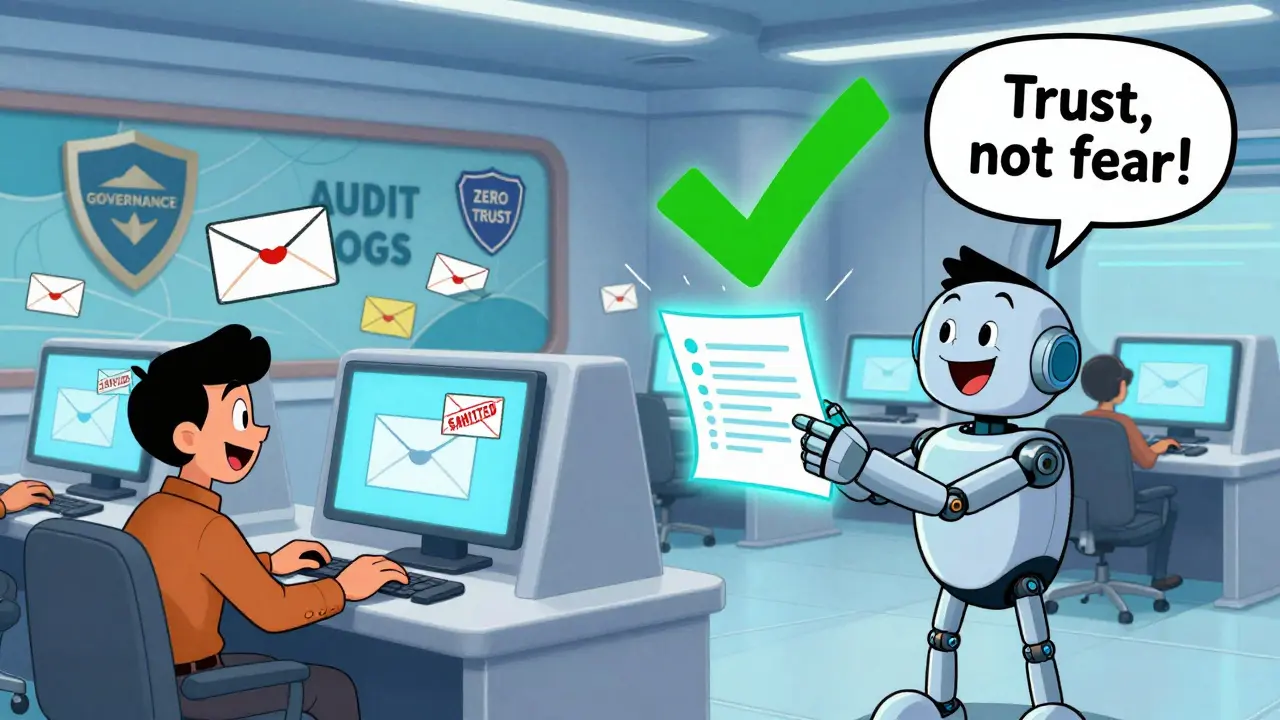
The next five years won’t be about adding more policies. It’ll be about building systems that make privacy automatic.Imagine this: You start typing a prompt. The system recognizes it contains a customer email. It asks: “Would you like to use the sanitized version from our secure database?” You click yes. The AI works with clean data. No one notices. No one gets in trouble. You get your answer faster.
That’s the goal. Not control. Not fear. Not surveillance. But trust.
Organizations that embed privacy into AI from day one will be the ones that thrive. The rest? They’ll be the ones explaining their failures to regulators.
What’s the biggest mistake companies make with AI privacy?
The biggest mistake is assuming blocking AI will stop leaks. In reality, banning tools just pushes usage to unmonitored personal apps like personal ChatGPT, Gmail, or Google Drive. The solution isn’t prohibition-it’s visibility and control. Organizations that enable AI with smart guardrails see 63% fewer violations than those that block it entirely.
How do I know what data is safe to use with AI tools?
Start by classifying your data. Label it as public, internal, regulated (like PII or PHI), or proprietary (like source code or trade secrets). Then set rules: only AI tools with approval can access regulated or proprietary data. Use automated tools that scan prompts and block uploads before they happen. If you can’t classify it, assume it’s sensitive.
Can AI tools really infer sensitive information from non-sensitive inputs?
Yes-and it’s already happening. For example, an AI analyzing sales trends might infer that a top employee left the company based on a drop in regional performance. Even if you never mentioned the employee’s name, the AI connects the dots. This is called inferred data, and it’s not covered by most privacy laws yet. Leading companies now treat inferred data as sensitive by default, just in case.
Is it safe to use free AI tools like ChatGPT for work?
Not unless you’ve locked them down. Free AI tools are designed to learn from every input. If you paste company data into them, that data can be used to train future models-even if the tool claims it doesn’t store it. Many organizations now prohibit personal AI tools entirely and provide secure, enterprise-approved alternatives with built-in guardrails and audit logs.
What’s the difference between AI governance and AI security?
AI security focuses on stopping hackers and preventing breaches. AI governance focuses on making sure AI is used ethically, legally, and responsibly. Governance covers who can use AI, what data they can feed it, how outputs are handled, and whether it complies with laws like the EU AI Act or California’s ADMT. Security is a part of governance-but governance includes policy, training, compliance, and culture.
Organizations that treat AI privacy as a technical problem are missing the point. It’s a human one. People want to work faster. The job of governance isn’t to stop them-it’s to help them do it without risking the company.


Been there. We banned ChatGPT at work last year, and within weeks, half the team was using personal accounts to paste code and client lists. Didn’t even realize how bad it was until someone pulled the logs and found 14 incidents in one month. Now we’ve got prompt scanners built into our Slack and email-no drama, just quiet alerts. People actually like it. Feels less like surveillance and more like a helpful nudge.
Love this. Seriously. The whole ‘block AI’ thing is like trying to stop kids from sneaking candy into class. They’ll just hide it in their socks. Better to give ‘em a lunchbox with healthy snacks and teach ‘em to recognize the junk. Our team started using the sanctioned AI tool last quarter and our violation rate dropped by 70%. No one even noticed the switch-just faster, safer work.
It’s fascinating how the real issue isn’t the technology-it’s the gap between policy and behavior. Most employees aren’t trying to leak data; they’re just trying to get through their to-do list. The moment you start treating AI like a tool that needs training instead of a threat that needs locking down, everything shifts. We did a ‘prompt dojo’ last month-employees submitted real prompts they’d used, and we walked through what went wrong and what could’ve been safer. It wasn’t punitive. It was collaborative. And guess what? The number of flagged prompts dropped by 82% in the next 30 days. People don’t resist change when they feel like they’re part of the solution.
OMG I can't believe people still think this is a 'tech problem'. It's a MORAL one. If you're pasting company data into free AI tools, you're basically handing your employer's secrets to Big Tech like it's a birthday gift. And don't even get me started on inferred data-AI is basically reading your mind and selling it to advertisers. This isn't governance, it's surrender. We need to ban ALL personal AI tools, period. No exceptions. No 'maybe's'. If you can't work without risking your company's future, maybe you're not cut out for the job. Just saying. 🤷♂️
Interesting point about inferred data. I’ve been digging into legal literature on this, and there’s actually a 2024 Stanford paper that argues inferred data should fall under ‘derivative personal information’ under GDPR Article 4(1). The logic? If a system can reliably reconstruct private facts from non-sensitive inputs, the inference itself becomes a form of processing-triggering consent obligations. We’ve started treating all AI outputs that correlate with PII as if they’re PII, even if they don’t contain it outright. It’s conservative, yes-but better safe than fined $20M. Also, ‘sanitized database’ prompts? Genius. We built a dropdown in our internal tool that auto-replaces customer names with placeholders. No one even notices. It just works.
One must question the fundamental assumption underlying this entire discourse: that governance can be divorced from control. The notion that ‘visibility and control’ are synonymous with ‘trust’ is a semantic sleight of hand. Governance, as presently conceptualized, is merely a rebranding of surveillance under the veneer of empowerment. The very act of monitoring prompts, logging every interaction, and enforcing context-sensitive access constitutes a panopticon-not a partnership. One cannot simultaneously claim to empower employees and demand exhaustive audit trails. The contradiction is not merely logical-it is ontological. If privacy is to be preserved, it must be achieved through architectural constraint, not behavioral nudging. The future of AI is not in smarter systems. It is in fewer systems.
Yup. This. 😊 We started using the built-in guardrails last month and it’s been smooth sailing. No drama, no panic. Just a little pop-up that says ‘Hey, that looks like a customer list-want to use the secure version?’ and boom-done. We even added a funny meme to the alert: ‘Don’t be that guy who got fired for pasting a spreadsheet into ChatGPT.’ 😂 People actually laugh and change it. Works better than any policy doc ever did.