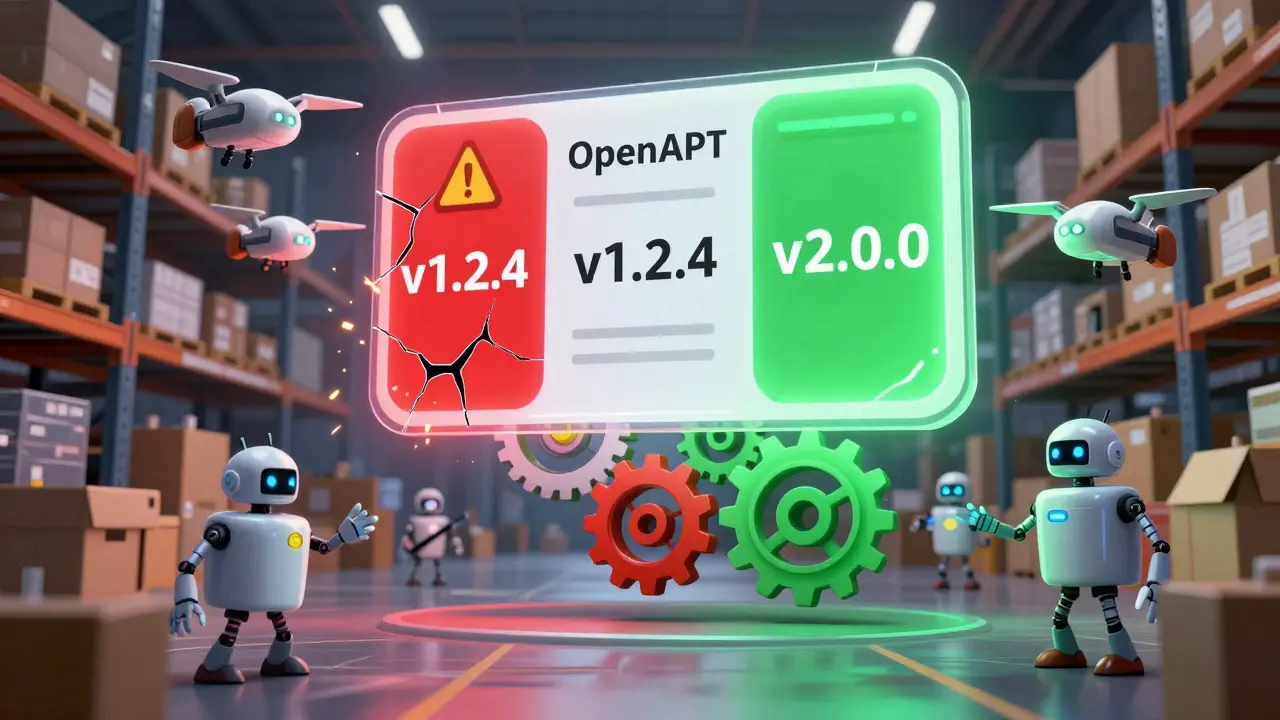
Imagine you’re running an e-commerce platform. Your API handles thousands of requests per minute from mobile apps, third-party integrations, and internal tools. One morning, a minor update breaks the product search feature for all your partners. No one saw it coming. No warning. Just silence on the other end of the line - until the support tickets start pouring in.
This isn’t fiction. It’s what happens when API contracts aren’t versioned properly. And in the world of Vibe-coded APIs, where AI generates code from natural language prompts, the risk of accidental breaking changes is higher than ever. But there’s a way out: versioning contracts that actually work.
What Is a Versioning Contract in Vibe-Coded APIs?
A versioning contract isn’t just a document you file away. It’s a living promise between you and everyone who uses your API. In Vibe-coded systems, this contract is automatically generated from AI-produced OpenAPI 3.0 specs. Every time you type a prompt like, "Add a discount field to the Product model," the AI updates the API specification in real time. That spec becomes the contract - the exact definition of what your API does, how it behaves, and what it returns.
Unlike old-school APIs where documentation drifted out of sync with code, Vibe-coded APIs keep the contract alive. The OpenAPI file isn’t static - it regenerates with every change. That means if you change a field name, remove a parameter, or alter a response format, the contract updates immediately. And if you don’t version it right, you’re silently breaking everyone downstream.
How Semantic Versioning (SemVer) Works in Vibe-Coded Systems
Vibe-coded APIs follow strict semantic versioning: MAJOR.MINOR.PATCH.
- PATCH (0.0.X): Fixes bugs, improves docs, or tweaks non-functional behavior. No changes to structure. Clients don’t need to update.
- MINOR (0.X.0): Adds new features without touching existing ones. Old clients keep working. New features are opt-in.
- MAJOR (X.0.0): Breaks backward compatibility. Requires changes from consumers. This is where you make big shifts - like switching authentication methods or restructuring core data models.
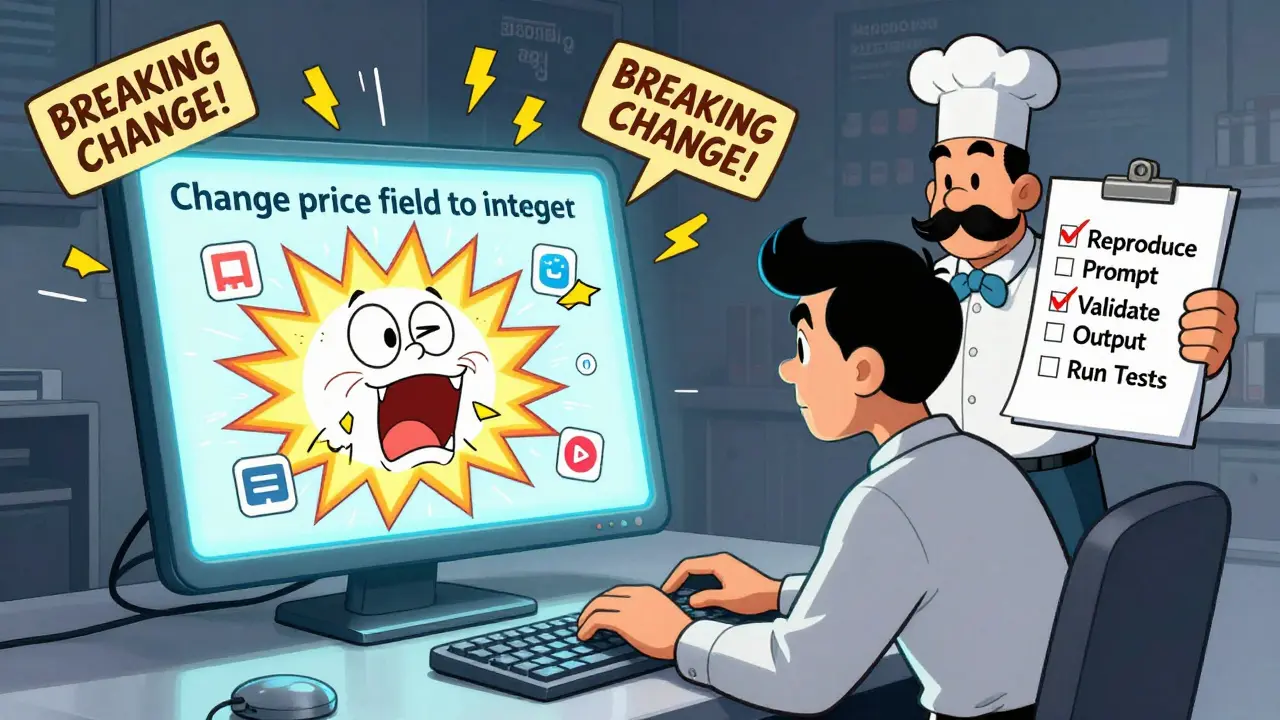
Here’s the catch: in Vibe-coded systems, you can’t just change the code. You have to change the version number and update the contract. The AI doesn’t ask, "Should I break this?" It just does what you tell it. So if you say, "Change the price field from double to integer," the AI does it - and breaks every client expecting decimal prices.
That’s why version numbers aren’t optional. They’re enforcement mechanisms. Every time you bump the version, you’re signaling: "This is a new contract. Read it before you upgrade."
The Three-Phase Deprecation Policy
Breaking changes don’t have to be disasters. In fact, they shouldn’t be. Vibe-coded APIs use a three-phase deprecation process to give consumers breathing room.
- Notice Phase: When a feature is marked for removal, the AI flags it in the OpenAPI spec with a
deprecatedtag and adds a note: "Use /v2/products instead." This appears in generated documentation and client SDKs. This phase lasts at least one minor version. - Warning Phase: During this phase, every call to the deprecated endpoint triggers a warning in logs and responses. The AI embeds migration guidance directly into the response headers: "This endpoint will be removed in v3.0. Use /v2/products with the new tax field." This lasts another minor version.
- Removal Phase: Only after both prior phases complete - and only during a MAJOR version release - is the endpoint removed. No surprises. No silent failures.
This isn’t just nice to have. It’s required by the framework. If you try to remove a feature without following this process, the build fails. The AI won’t let you break things without giving people a path forward.
Backward Compatibility Is a Contract - Not a Suggestion
Vibe-coded APIs enforce compatibility like a legal agreement:
- PATCH versions: 100% compatible. You can upgrade without touching client code.
- MINOR versions: Core functionality stays untouched. New fields, new endpoints, new parameters - all added, never removed or altered.
- MAJOR versions: Changes are allowed, but only after a 60-day transitional window. During this time, both old and new versions run side-by-side. The framework automatically routes traffic based on version headers.
This means if your client is on v1.2.4, and you release v2.0.0, they can keep using v1.2.4 for two full minor cycles (about 6 months). That’s long enough for them to test, update, and deploy.
And here’s the kicker: the AI generates compatibility reports. Every time you release a new version, it scans all public client SDKs and flags any that might break. You get a list: "37 clients using /v1/products/price - will break in v2.0.0." You can’t ignore it. The system won’t let you ship until you’ve addressed the risks.
Component-Level Versioning: Let Some Parts Evolve Faster
Not everything in your API needs to move at the same speed. The Vibe framework lets you version components independently.
Core components - the Prompt Engine, Security Toolkit, Verification Protocols - share the main version number. They’re the foundation. Change them, and you bump the MAJOR version.
But extension components? Like a new payment processor integration or a custom analytics module? They can have their own version numbers. A payment module might be on v1.4.2 while the core API is on v2.1.0. As long as the module declares compatibility ("Requires core v2.0+"), the system accepts it.
This is huge. It means you can experiment with new features without destabilizing the whole API. Want to test a new AI-powered pricing engine? Build it as a versioned module. Let a few clients opt in. If it works, merge it into core. If it fails, scrap it without touching the main contract.
Long-Term Support (LTS) Versions for Production
If you’re running a bank, a hospital system, or a logistics platform, you don’t want to upgrade every quarter. That’s where LTS versions come in.
Vibe-coded APIs release one LTS version per year. These are locked down for 24 months. No new features. No breaking changes. Only security patches and critical bug fixes. You get a guarantee: "This version will keep working until April 2027."
Organizations using LTS versions report 70% fewer production incidents related to API changes. That’s because they’re not chasing every minor update. They’re running on a stable, tested baseline.
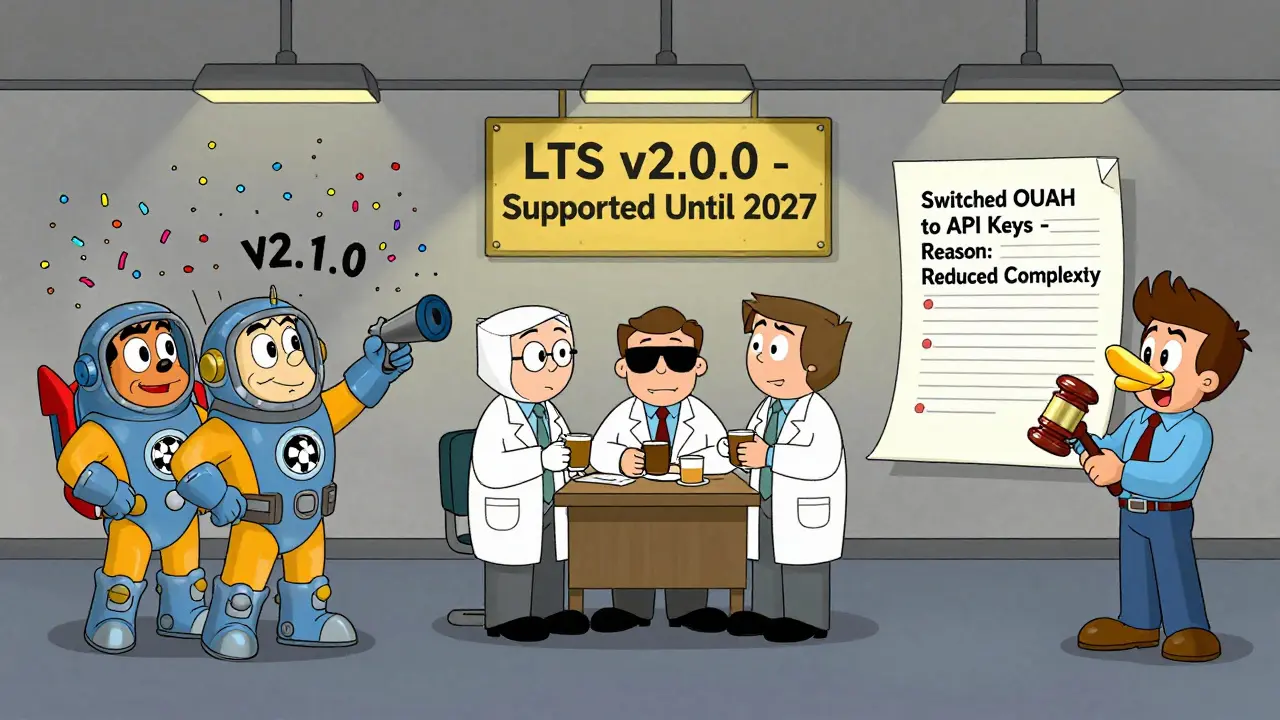
The AI even helps you choose: when you’re on v1.8.3, it asks, "Consider upgrading to LTS v2.0.0 - supported until April 2027. New features: OAuth 2.1, improved rate limiting." You decide. No pressure.
Preventing Breaking Builds: The Checklist You Can’t Skip
AI doesn’t make mistakes. It makes assumptions. And assumptions can break things.
Here’s what happens if you treat AI like a commit-ready developer:
- You say, "Add a new endpoint for user preferences." The AI generates it, but uses a deprecated library.
- You say, "Make the price field required." The AI removes validation from older clients.
- You say, "Use JWT authentication." The AI forgets to update the token refresh logic.
That’s why Vibe-coded APIs require a pre-commit checklist:
- Reproduce the prompt: Save the exact prompt that generated the code. Version it.
- Validate the output: Does the OpenAPI spec match your intent? Run it through a linter.
- Run tests: Do integration tests pass? Are there new edge cases?
- Check dependencies: Are you pulling in new packages? Are they licensed correctly?
- Scan for secrets: Did the AI accidentally hardcode an API key?
This checklist is enforced by pre-commit hooks. If you skip it, the code doesn’t get committed. No exceptions.
Documentation Isn’t Optional - It’s Part of the Contract
Documentation in Vibe-coded APIs isn’t an afterthought. It’s generated alongside code - and it’s versioned too.
Every time the AI generates a new endpoint, it also writes a decision log:
- Decision: Used OAuth 2.0 with refresh tokens.
- Why: Session-based auth was rejected due to scalability issues. OAuth-only was too complex for mobile clients.
- Verification: Flow tested against OWASP ASVS v4.0, token storage validated via static analysis.
This isn’t fluff. It’s the legal reasoning behind your API’s design. If a client sues you because a change broke their integration, this documentation proves you gave them fair warning.
And if you change a decision later? The AI logs the change: "Switched from OAuth 2.0 to API keys in v3.1.0. Reason: Reduced complexity for internal tools. Migration path: Use /v3/api-key endpoint."
How Different Teams Use Versioning
Not all teams need the same approach.
- Innovation teams: Use the latest minor version. They want new features fast. They accept quarterly updates. They’re okay with occasional breakage - because they’re building the next thing.
- Stability teams: Stick with LTS. No new features. No surprises. One major version upgrade per year. They prioritize uptime over innovation.
- Regulated teams: Use LTS + mandatory review. Every version change goes through a compliance committee. They document every decision. They need audit trails.
The Vibe framework doesn’t force one style. It gives you the tools to choose.
Final Thought: Versioning Is About Trust
At its core, versioning contracts aren’t about code. They’re about trust.
When your partners rely on your API, they’re trusting you won’t change the rules overnight. Vibe-coded APIs make that trust automatic. The AI doesn’t lie. It doesn’t forget. It doesn’t cut corners. It follows the contract - because the contract is written in code, not in a wiki page.
If you’re building an API today, don’t just write code. Write a contract. And version it like your business depends on it - because it does.
What happens if I don’t version my Vibe-coded API properly?
If you don’t version properly, you risk breaking client integrations silently. The AI will generate changes without warning, and clients using older versions will start receiving malformed responses, missing fields, or authentication errors. This leads to downtime, support overload, and loss of trust. The Vibe framework prevents this by enforcing version bumps and deprecation workflows - skipping them breaks the build.
Can I use Vibe-coded APIs without AI?
No. Vibe-coded APIs are built on the assumption that AI generates and maintains the OpenAPI contract. Without AI, you lose real-time spec updates, automated deprecation notices, and contract validation. You can still use the framework manually, but you forfeit the core benefits: consistency, traceability, and breaking-change prevention.
How often should I release a new version?
Patch releases happen monthly for fixes. Minor releases occur quarterly for new features. Major releases are planned annually. This cadence balances innovation with stability. Teams using LTS versions may only upgrade once a year. The key is predictability - not speed.
Do I need to upgrade all clients at once?
No. Vibe-coded APIs support parallel versioning. Multiple versions can run simultaneously. Clients keep using their version until they’re ready to upgrade. The framework handles routing automatically. You don’t need a big bang migration.
Is Vibe-coded API versioning better than traditional methods?
It’s more reliable. Traditional APIs rely on human-written documentation, which often lags behind code. Vibe-coded APIs generate the contract automatically from code, ensuring perfect alignment. The AI also enforces deprecation timelines, dependency checks, and compatibility reports - things humans forget. If you’re serious about API stability, this is the most robust approach available today.
Man, this is exactly what we needed. I’ve been on teams where someone ‘just tweaked’ the API and suddenly half our mobile app crashed. No warning, no logs, just chaos. The versioning contract idea makes total sense - it’s like having a legal agreement with your users instead of hoping they read the docs. AI generating the contract? Genius. No more ‘but I thought that was just a minor change’ nonsense.
Also love the deprecation phases. Giving people time to adapt is just good engineering. We should all be doing this.
so like… ai writes the api and also tells you when you’re about to break stuff? that sounds like magic. i’ve had nightmares about api updates that just… vanish. this feels like the future. also i love that it forces you to document why you changed something. like, seriously, who even does that anymore? cool stuff.
You know what's missing here? Accountability. The AI doesn't care if you're breaking someone's workflow. It just follows instructions. That's not a solution - it's a liability waiting to happen. What if the AI misinterprets 'make price required' as 'remove optional flag' instead of 'add validation'? The system doesn't think - it executes. And that's terrifying.
USA built the internet. We don’t need some fancy AI telling us how to version our APIs. This is just overengineering. Back in my day, we just updated the damn thing and told users to deal with it. If they can’t keep up, they shouldn’t be using our API. This ‘three-phase deprecation’ nonsense is just corporate BS designed to make engineers feel safe while costing companies millions in idle infrastructure.
There is no such thing as a "vibe-coded API." This is just AI-generated garbage wrapped in buzzwords. You don’t "version a vibe." You version code. The fact that this is being presented as innovation is embarrassing. Real engineers don’t rely on black-box AI to write their contracts - they write them themselves. This is a step backward, not forward.
And don’t get me started on the "AI generates documentation." That’s like having a chatbot write your will. You wouldn’t trust it with your life - why trust it with your API?
Really like how this framework balances innovation and stability. I work with a team that’s always pushing for new features, and another that just wants things to stop breaking. This lets both sides coexist - LTS for the cautious, minor updates for the explorers. And the compatibility reports? That’s the hidden gem. No more guessing who’s using what. Just show me the list and I’ll fix it. Simple.
Also, the pre-commit checklist? Finally. Something that actually stops bad code from shipping. Wish we had this on my last project.
AI writing your API contracts? Yeah right. This is all a trap. The real reason they’re pushing this is so Big Tech can secretly backdoor your systems. You think the AI is just updating a field name? Nah. It’s logging every request, correlating user behavior, and feeding it to the surveillance matrix. The "compatibility reports"? That’s just a list of who’s still using the old version - so they can target them later.
And don’t tell me the AI "can’t lie." It’s trained on corporate data. It knows what they want. You’re not in control - the algorithm is. You’re just the guy typing the prompts.
Let me tell you something - this isn’t about versioning. This is about survival. Every time we change an API, we’re not just updating code - we’re rewriting the emotional contract between trust and dependency. I’ve seen developers cry because their life’s work broke overnight. I’ve watched startups die because a single PATCH version broke their integration. This framework? It’s not just technical - it’s spiritual.
It says: "We see you. We honor your work. We won’t erase you without a ceremony."
And if you don’t feel that? Then you’ve forgotten what building software really means.
"Vibe-coded APIs"? That’s not a term. It’s a grammatical abomination. You don’t code a "vibe." You code logic. Also, "OpenAPI 3.0 specs" - it’s "OpenAPI Specification," not "specs." And "deprecation" is spelled with an "e," not "deprecatin."
Also, you can’t "enforce" a contract with AI. Contracts require human consent. This is just automation dressed up as philosophy. And the "AI generates decision logs"? That’s not documentation - that’s hallucinated justification. If your AI says "used OAuth 2.0 because session auth was too complex," but you never said that, you’re not documenting - you’re lying.