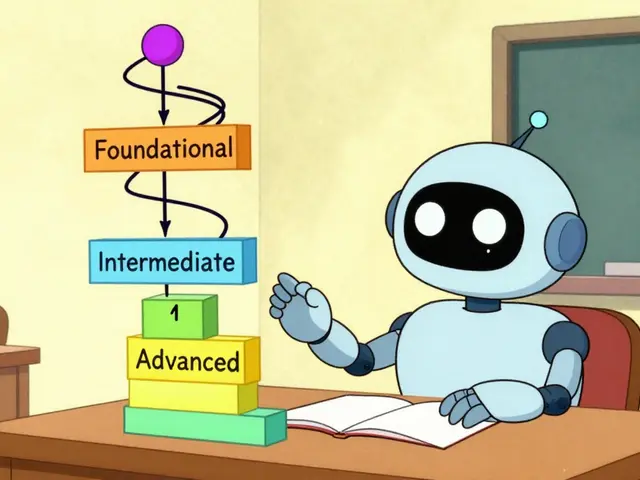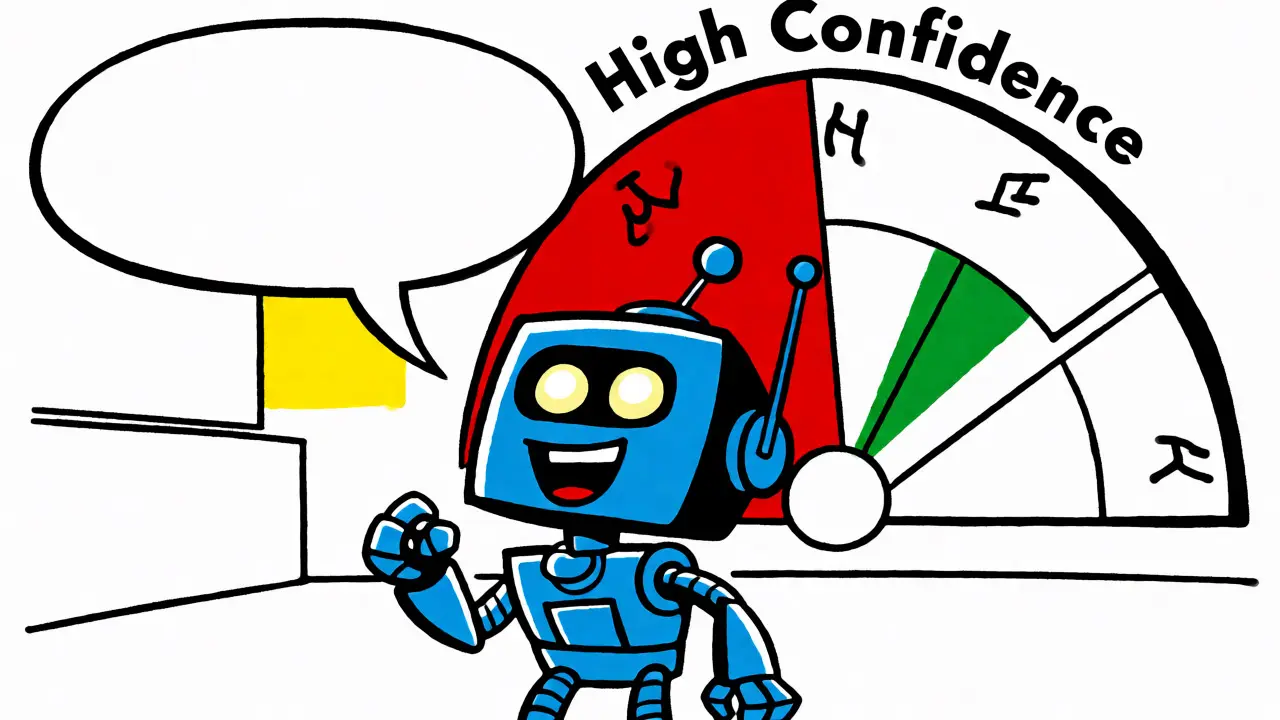
You ask a large language model a tricky question. It answers instantly, confidently, and with perfect grammar. But is it right? Often, no. The model doesn't know what it doesn't know. This gap between perceived certainty and actual accuracy is the core problem of LLM calibration. If your AI agent hallucinates with high confidence, you can't trust its output. You need it to tell you when it's guessing.
Post-training calibration is the process of adjusting a model's output probabilities so that its stated confidence matches its actual accuracy. It’s not just about making the model smarter; it’s about making it honest. Without this step, you’re flying blind in production environments where wrong answers cost money or safety.
| Metric | What it Measures | Blind Spot |
|---|---|---|
| Accuracy | % of correct answers | Ignores how sure the model was |
| Confidence Score | Model's self-reported certainty | Often overconfident (miscalibrated) |
| Calibration Error | Gap between confidence and accuracy | Requires specific evaluation datasets |
Why Your Model Lies About Being Sure
Here’s the uncomfortable truth: most modern transformers are naturally overconfident. During pretraining, models learn to predict the next token. They don’t inherently learn to say "I don't know." When we fine-tune them, especially with methods like RLHF, we often push them further into confident-sounding responses because humans prefer clear answers over hedging. This creates a dangerous mismatch.
Think of it like a weather forecast that says "100% chance of rain" every single day. Technically, it might be right 80% of the time. But if it rains only on those days, the forecast is useless for planning. You need a forecast that says "40% chance," which helps you decide whether to bring an umbrella. In AI terms, we want the probability scores to mean something real.
This isn't just academic. In medical diagnosis or legal review, a model saying "95% confident" when it's actually 60% accurate leads to bad decisions. We fix this through post-training techniques that reshape the probability distribution without necessarily changing the underlying knowledge.
The Two Paths to Confidence
How do we actually measure and fix this? Research from places like CMU’s Software Engineering Institute points to two main strategies. You can either look inside the model or ask the model itself.
The first method uses an external observer. You train a separate, smaller neural network to predict whether the main LLM's output is correct. This auxiliary model looks at the input, the output, and even the hidden layer activations of the big model. It acts like a quality control inspector. If the main model outputs a fact, the inspector checks the internal signals and flags it as "likely correct" or "probably hallucinating." This works well because it decouples the generation task from the verification task.
The second method is introspection. You prompt the LLM to assess its own confidence. Something like, "On a scale of 1 to 10, how sure are you about this answer?" Surprisingly, this can work, but it requires careful prompting and often needs the model to be specifically trained for this meta-cognitive task. Raw LLMs are notoriously bad at this-they tend to inflate their scores. So, while simpler to implement, it usually requires more rigorous calibration afterward.
Abstention: The Art of Saying "I Don't Know"
Calibration gives you a number. Abstention gives you an action. If the calibrated confidence drops below a certain threshold, the model shouldn't guess. It should abstain. This means returning a null response, asking for clarification, or routing the query to a human expert.
Setting this threshold is tricky. Too high, and your model refuses to answer everything, becoming useless. Too low, and it hallucinates freely. The sweet spot depends on your error tolerance. For a customer service bot, being wrong once in ten times might be okay. For an autonomous vehicle system, you might set the bar much higher, forcing frequent handoffs to human drivers.
Implementing abstention isn't just about flipping a switch. It changes the user experience. Instead of a wrong answer, users get a polite "I'm not sure about that one." This builds trust. Paradoxically, admitting ignorance makes the AI seem more intelligent than pretending to know everything.
Under the Hood: How Post-Training Changes Parameters
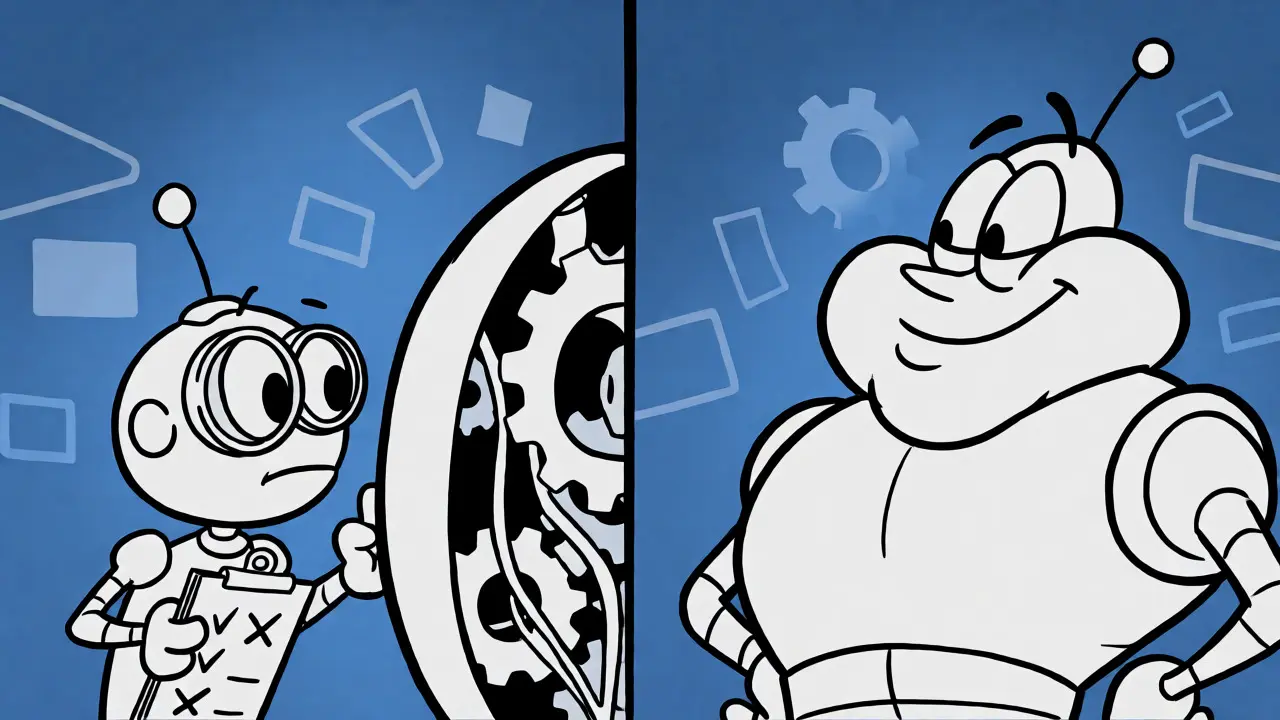
If you're an engineer digging into the code, you might wonder what physically happens during calibration. Recent studies using singular value decomposition (SVD) show that post-training doesn't rewrite the whole brain. Instead, it performs subtle geometric transformations.
Researchers found that post-training induces near-uniform scaling of singular values across layers. Think of this as turning up or down the volume knobs in different parts of the network. It also applies consistent orthogonal transformations-essentially rotating the data representations in a coordinated way. Disrupting this rotation causes catastrophic performance drops. This suggests that calibration is less about adding new facts and more about reparameterizing existing subspaces to align confidence with reality.
Quantization and Its Calibration Challenges
There’s another angle to calibration that often gets mixed up: quantization. When you compress a model from 16-bit floats to 8-bit integers to save memory, you introduce noise. This process, known as Post-Training Quantization (PTQ), requires its own calibration step.
Standard min-max calibration collects activation statistics from a small dataset (often just 128-512 samples) to determine scaling factors. But this method is sensitive to outliers. A single weird input can skew the entire range, leading to poor precision for normal inputs. Advanced techniques like SmoothQuant or AWQ (Activation-aware Weight Quantization) try to balance weight scaling with activation ranges to minimize worst-case errors. While distinct from confidence calibration, they share a common goal: preserving model integrity under constraints.
Practical Steps for Implementation
So, how do you add this to your pipeline? Here’s a rough workflow:
- Select a Calibration Dataset: Use a held-out set of questions with known ground-truth answers. Don't use your training data; you need fresh examples to test generalization.
- Generate Predictions: Run your fine-tuned model on this dataset. Capture both the final text and the raw logits (probability scores).
- Train a Calibrator: Fit a simple model (like Platt Scaling or Isotonic Regression) to map raw logits to true probabilities. Alternatively, train your external verifier network here.
- Set Abstention Thresholds: Analyze the trade-off curve. Plot accuracy against coverage (percentage of answered questions). Pick the point where marginal accuracy gain drops off.
- Monitor in Production: Calibration drifts. As you update your model or face new types of queries, re-evaluate your thresholds quarterly.
The Human Factor
Don't forget the person on the other side of the screen. Psychology tells us that humans misinterpret risk. Showing a raw percentage like "73.4% confidence" often confuses people more than it helps. They might think it means "73% likely to be correct" when it actually refers to a specific statistical property.
Design interfaces that translate these numbers into intuitive cues. Green checkmarks for high confidence, yellow warnings for medium, and red flags for low. Or simply hide the number and let the abstention mechanism handle the rest. If the model is unsure, just say so. Clarity beats precision in user communication.
Frequently Asked Questions
Does calibration improve the accuracy of my LLM?
Not directly. Calibration adjusts the reliability of the confidence scores, not the correctness of the generated text. However, by enabling effective abstention, it improves the overall system accuracy because you filter out low-confidence, likely-wrong answers before they reach the user.
Can I calibrate any open-source model?
Yes, provided you have access to the logits or token probabilities. Most Hugging Face transformers expose these via the `output_logits=True` flag. You will need a labeled dataset relevant to your domain to train the calibration mapping effectively.
Is temperature sampling a form of calibration?
No. Temperature sampling flattens or sharpens the probability distribution to encourage diversity or determinism, but it does not align the probabilities with actual empirical accuracy. A model can be perfectly sampled but still poorly calibrated.
How much data do I need for calibration?
For simple methods like Platt Scaling, a few hundred to a thousand high-quality labeled examples are often sufficient. For complex external verifiers or deep learning-based calibrators, you may need thousands. Quality matters more than quantity here.
What is the difference between calibration and quantization?
Calibration ensures confidence scores match accuracy. Quantization reduces numerical precision (e.g., float16 to int8) to save memory and speed up inference. Quantization requires its own statistical calibration to determine scaling factors, but it serves a different purpose than confidence calibration.