
Imagine teaching a child to read by handing them a library of books and saying, "Figure it out." That is essentially how Large Language Models are trained. They do not start with dictionaries or grammar textbooks. Instead, they devour billions of words from the internet, trying to predict what comes next. This process, known as self-supervised learning, allows these models to master the complex rules of language-both the structure (syntax) and the meaning (semantics)-without any human teacher correcting every sentence.
You might wonder how a model can understand that "The cat sat on the mat" makes sense while "The mat sat on the cat" sounds wrong, just by guessing the next word. The secret lies in a specific mathematical tool called the attention mechanism. It acts like a spotlight, helping the model focus on the parts of a sentence that matter most for understanding the current word. In this guide, we will break down exactly how this works, why position matters, and how recent innovations are making these models even smarter about context.
The Core Engine: Self-Attention Explained
Before 2017, computer programs processed language mostly one word at a time, moving strictly from left to right. This was slow and often missed the bigger picture. Then came the Transformer architecture, introduced in the paper 'Attention Is All You Need'. This design replaced older sequential methods with self-attention, allowing the model to look at all words in a sentence simultaneously.
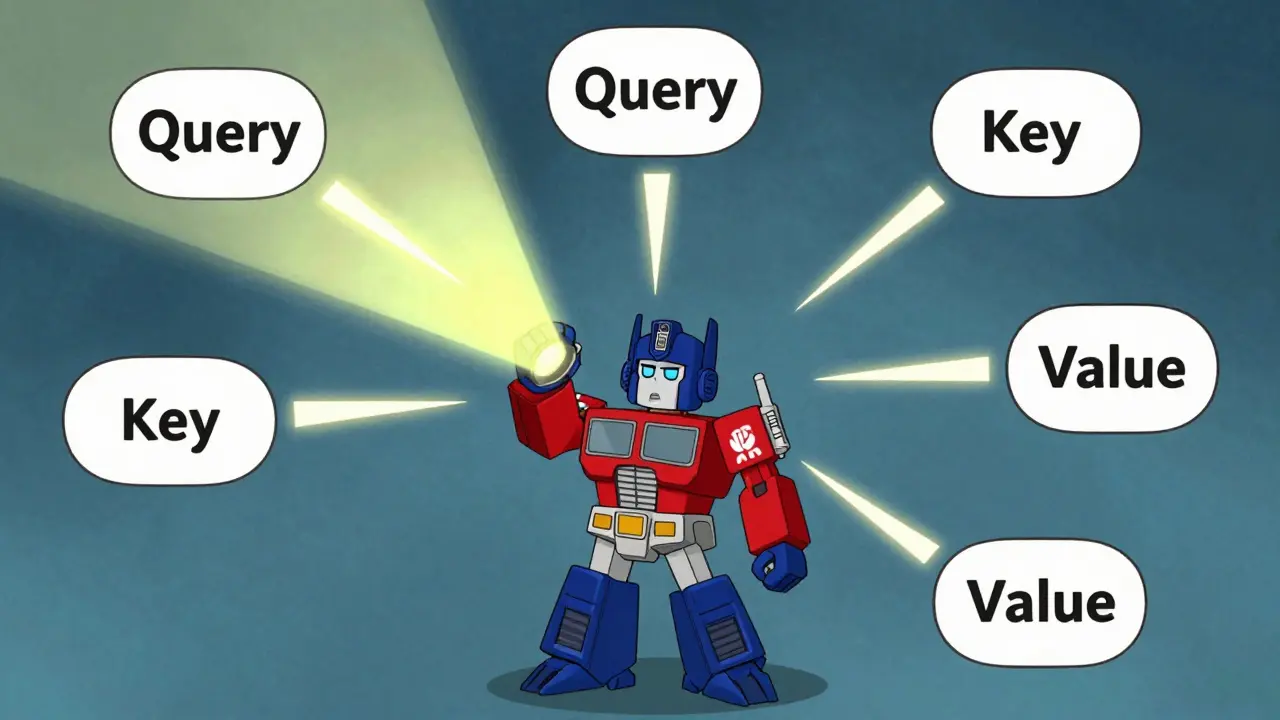
Think of self-attention as a way for each word to ask questions about every other word in the sequence. To do this, the model uses three types of vectors:
- Query vectors: These represent the question the model asks about a specific word. For example, if the model is looking at the word "it," the query might be asking, "What does 'it' refer to?"
- Key vectors: These act like labels or index cards for every other word in the sentence. They help the model find which words match the query.
- Value vectors: These contain the actual information or meaning associated with each word.
When the model calculates the attention scores, it compares the Query of one word against the Keys of all other words. If there is a strong match, the model pulls the Value from that matching word. This creates a weighted sum where relevant words have a stronger influence on the final representation. This dynamic weighting is crucial because it allows the model to resolve ambiguity. For instance, in the sentence "I saw the man with the telescope," the attention mechanism helps determine whether the person had the telescope or the man did, based on the surrounding context.
Capturing Syntax: The Structure of Language
Syntax refers to the rules governing how words combine to form sentences. Humans learn this implicitly; we know that adjectives usually come before nouns in English. LLMs capture syntax through the same self-supervised process. When the model tries to predict the next word, it must implicitly learn grammatical structures to make accurate guesses.
Research has identified specific "attention heads" within transformers that specialize in syntactic dependencies. For example, some heads consistently track subject-verb relationships or noun-preposition links. However, syntax in LLMs is not isolated from meaning. A study examining models like BERT and Llama 2 found that semantic plausibility affects syntactic attention. If a sentence contains a semantic error-like an animal performing a human action-the attention patterns shift. This suggests that the model integrates syntax and semantics rather than keeping them in separate boxes, much like the human mind does.
| Feature | Traditional RNNs/CNNs | Transformer LLMs |
|---|---|---|
| Processing Style | Sequential (word-by-word) | Parallel (all tokens at once) |
| Context Handling | Limited window size | Full sequence awareness via attention |
| Long-Range Dependencies | Weak (information fades over distance) | Strong (direct connections between distant words) |
| Positional Awareness | Inherent in sequence order | Requires explicit positional encoding |
The Position Problem: Why Order Matters
Here is a tricky part: the self-attention mechanism itself does not care about word order. Mathematically, "The cat sat on the box" and "The box sat on the cat" would look similar if you just shuffled the words. Since syntax relies heavily on position, LLMs need a way to encode location.
Traditionally, models used techniques like Rotary Position Embedding (RoPE). RoPE assigns a fixed rotation to each token based on its position in the sequence. While effective, it has limitations when dealing with very long texts. Recent innovations like PaTH Attention, developed by MIT-IBM researchers, offer a more flexible approach. PaTH treats the space between words as a path made of small, data-dependent transformations. Imagine each word passing through a series of tiny mirrors that adjust their angle based on the content. This allows the model to better track information over long distances and follow complex instructions without getting confused by intervening text.
Self-Supervision: Learning Without Labels
The term "self-supervised" often confuses people. It doesn't mean the model supervises itself in a managerial sense. It means the data provides its own labels. In a typical supervised task, you give the model a picture of a dog and label it "dog." In self-supervised learning for language, the label is hidden within the data itself.
The standard task is "next-token prediction." The model sees the first 90% of a sentence and must guess the last 10%. If the input is "The sky is," the correct output is likely "blue." If the model predicts "green," it receives a penalty (loss), and its internal weights are adjusted slightly to make "blue" more likely next time. By repeating this billions of times across diverse texts, the model builds a rich statistical map of language. It learns that certain verbs require certain objects (syntax) and that certain concepts co-occur frequently (semantics).
This method scales incredibly well. Unlike supervised learning, which requires expensive human annotators to label data, self-supervised learning can utilize the vast amount of unlabeled text available on the web. This abundance of data is a primary reason why modern LLMs are so capable.

Semantics: Beyond Word Definitions
Semantics is about meaning. How does a model understand that "bank" can mean a financial institution or the side of a river? Through context. In self-supervised training, the model encounters "bank" in thousands of different sentences. Over time, it develops distinct representations for each usage. When it sees "river," the attention mechanism strengthens the connection to the geographical definition of "bank." When it sees "money," it strengthens the financial connection.
Studies show that LLMs perform surprisingly well on Semantic Role Labeling (SRL) tasks, even without being explicitly trained on them. SRL involves identifying who did what to whom in a sentence. The fact that models can do this implies they have captured deep structural semantics. However, performance varies. It is not just about model size; the architecture and the quality of the pre-training data play huge roles. A smaller model with high-quality, diverse data can sometimes outperform a larger model trained on noisy text.
Recent Advances: Forgetting and Focus
As models get better, new challenges emerge. One issue is that attention mechanisms can become overwhelmed by too much information. Recent developments like the combined PaTH-FoX system address this by integrating selective forgetting. Inspired by human cognition, where we ignore irrelevant details to focus on the present, FoX allows the model to discard outdated information dynamically. This improves efficiency and accuracy in long-context scenarios, such as analyzing lengthy legal documents or codebases.
These advancements highlight that capturing semantics and syntax is an ongoing process. It is not just about having more parameters; it is about refining how the model attends to, positions, and interprets the flow of information.
What is self-supervised learning in LLMs?
Self-supervised learning is a training method where the model generates its own labels from the input data. Typically, this involves predicting the next word in a sequence. The model learns patterns, grammar, and meaning by minimizing the error between its predictions and the actual next word, without needing human-labeled datasets.
How does the attention mechanism work?
The attention mechanism allows the model to weigh the importance of different words in a sequence relative to each other. It uses Query, Key, and Value vectors to calculate relevance scores. Words with higher scores contribute more to the final representation, enabling the model to capture long-range dependencies and contextual nuances.
Why do LLMs need positional encoding?
The core self-attention mechanism is permutation-invariant, meaning it does not inherently understand word order. Positional encoding adds information about the position of each token in the sequence, allowing the model to distinguish between sentences like "Dog bites man" and "Man bites dog."
Can LLMs understand syntax without explicit grammar rules?
Yes. LLMs learn syntax implicitly through exposure to large amounts of text. Specific attention heads emerge during training that specialize in tracking syntactic dependencies, such as subject-verb agreement or noun phrase boundaries, purely through statistical pattern recognition.
What is the difference between syntax and semantics in LLMs?
Syntax refers to the structural rules of language, such as word order and grammar. Semantics refers to the meaning of words and sentences. In LLMs, these are deeply intertwined; the model uses syntactic structures to infer meaning and semantic context to refine syntactic predictions.