When you need a machine to understand human language, you have two main choices: build a step-by-step system or just ask a giant AI model to figure it out. It sounds simple, but the difference between NLP pipelines and end-to-end LLMs changes everything - cost, speed, accuracy, and even whether your system can pass an audit.
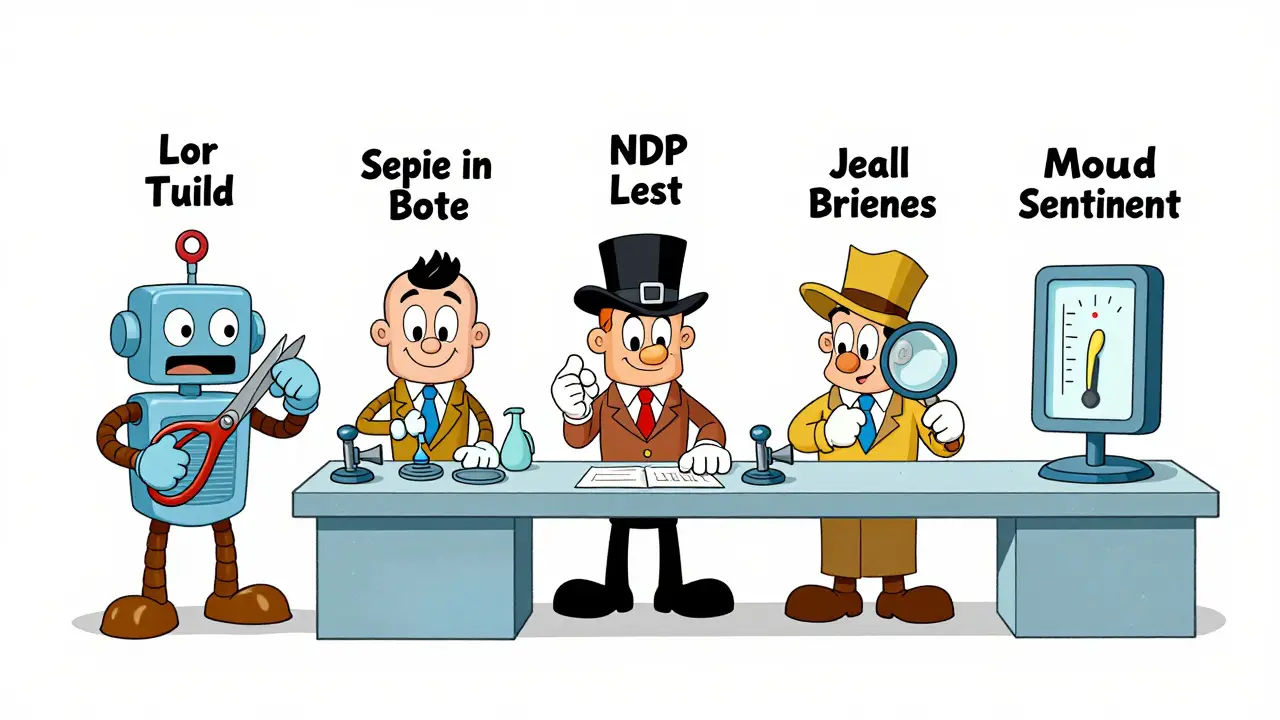
Let’s say you run an e-commerce site. Every day, thousands of product descriptions come in. You need to tag them correctly: is this a laptop? A charger? Is the customer saying "broken" or "just needs charging"? For years, companies used NLP pipelines - a series of small, focused tools working one after another. First, split the text into words. Then label each word as noun, verb, or adjective. Then pull out named entities like brands or model numbers. Finally, check sentiment. Each step is like a specialized worker in a factory line. If one tool breaks, you fix just that part. And it’s cheap. We’re talking pennies per thousand words.
Now picture a different approach. Instead of building all those steps, you feed the same text into a single giant AI model - say, GPT-4 or Llama-3 - and ask it to classify the product. No preprocessing. No rules. Just a prompt: "Classify this product based on its description." The model reads the whole thing, understands context, and gives you an answer. It’s flexible. It can handle messy language, slang, or new product types it’s never seen before. But it costs 10 to 100 times more. And it might take over a second to answer. For real-time chat support? That’s too slow. Users leave.
Why NLP Pipelines Still Rule in High-Stakes Environments
NLP pipelines aren’t outdated. They’re precision instruments. In finance, healthcare, and legal tech, you don’t just want an answer - you need to prove how you got it. Regulators ask: "Why did you flag this transaction?" With a pipeline, you can show them: "Step 1: Tokenized text. Step 2: Extracted entity ‘John Doe’. Step 3: Cross-referenced with blacklist. Step 4: Sentiment score -0.87. Decision: Flag."
That level of traceability is impossible with most LLMs. They’re black boxes. Even if they get it right, you can’t explain why. That’s why 78% of financial institutions still rely on NLP pipelines for compliance, according to Deloitte’s 2024 report. They use them to detect money laundering, verify identities, or auto-generate audit logs. Accuracy? Around 90-95% on well-defined tasks. Speed? Under 10 milliseconds per request. Cost? $0.0001 to $0.001 per 1,000 tokens.
Take a healthcare billing company. They process 2 million medical codes a month. Using spaCy for entity extraction and rule-based matching, they achieved 91% accuracy at $0.0003 per query. Switching to an LLM-only solution only improved accuracy by 2% - but cost them $0.03 per query. That’s 100 times more expensive. For a company processing millions of records, that’s a $600,000 monthly difference.
When LLMs Outperform - and When They Fail
LLMs shine where context matters more than rules. Think summarizing research papers, drafting customer emails, or answering open-ended questions like: "What are the side effects of this drug when taken with alcohol?"
A 2025 Nature study on materials science showed LLMs pulled out hidden relationships between chemical compounds from academic papers with 87% accuracy - far better than traditional NLP’s 72%. Why? Because LLMs understand connections across sentences. They don’t just match keywords. They infer meaning.
But here’s the catch: LLMs hallucinate. They make things up. In complex reasoning tasks, hallucination rates hit 15-25%, according to GeeksforGeeks’ 2024 evaluation. A customer support bot might say a product has a "two-year warranty" when it doesn’t. Or it might invent a feature that doesn’t exist. And because it’s one system doing everything, a single mistake can corrupt the whole output.
Another problem? Non-determinism. Ask the same question twice, and you might get two different answers. That’s fine for creative writing. Not fine for approving a loan application. In 2024, a startup tried using GPT-3.5 for live chat support. Average response time? 1.2 seconds. User drop-off? 37%. They shut it down.

The Hybrid Approach Is Now the Standard
The smartest companies aren’t choosing one or the other. They’re combining them.
GetStream, a real-time communication platform, tested three hybrid patterns:
- Fallback: NLP handles 85-90% of requests. LLMs only step in when the system is unsure. Result? 80-90% cost reduction.
- Primary: LLM leads for high-risk tasks (like financial compliance). NLP validates afterward.
- Hybrid: Both run in parallel. Their answers are compared. If they match, you’re confident. If not, you flag it for review.
Elastic’s ESRE engine does this too. It uses BM25 (a classic search algorithm) to find relevant documents, then uses a vector search to find similar ones, and finally feeds the top results into an LLM to generate a summary. The result? 94% relevance in enterprise search - 12% better than LLM-only - with 60% lower latency.
One Reddit user summed it up perfectly: "We run spaCy for entity extraction first, then feed clean data to Llama-3 for relationship mapping, then validate with rule-based checks. Cut our error rate by 63% while keeping costs under $500/day for 2 million requests."
Cost, Speed, and Control - The Real Trade-Offs
Let’s break down what you’re really buying with each approach.
| Factor | NLP Pipelines | End-to-End LLMs |
|---|---|---|
| Cost per 1,000 tokens | $0.0001 - $0.001 | $0.002 - $0.12 |
| Latency (response time) | 5ms - 10ms | 100ms - 2,000ms |
| Hardware needed | Standard CPU | NVIDIA A100 GPU or cloud API |
| Accuracy on simple tasks | 85% - 95% | 70% - 85% |
| Accuracy on complex, contextual tasks | 70% - 75% | 90% - 95% |
| Deterministic output? | Yes | No (unless using constrained decoding) |
| Regulatory compliance | Easy to audit | Hard to audit - 68% of financial firms report issues |
| Adaptability to new data | Requires retraining | Works with prompts alone |
Here’s what this means in practice:
- If you need speed, cost control, and audit trails - use NLP pipelines.
- If you need creativity, context understanding, or handling ambiguous input - use LLMs.
- If you need both - use NLP to clean and structure the input, then hand it off to an LLM for reasoning.
What’s Next? NLP-Guided Prompting
The next big leap isn’t replacing pipelines with LLMs. It’s using pipelines to make LLMs better.
Companies are now using NLP to preprocess inputs before sending them to LLMs. For example:
- Use spaCy to extract product names, dates, and locations from a support ticket.
- Format those into a clean, structured prompt: "The user reports issue with [product] on [date] at [location]. They say [quote]. What’s the likely cause?"
- Feed that to an LLM.
CMARIX found this approach cut LLM token usage by 65% and improved accuracy by 9 percentage points. Why? Because you’re removing noise. You’re giving the LLM exactly what it needs - not a messy paragraph full of typos and irrelevant details.
Even LLM providers are catching on. Anthropic’s Claude 3.5 introduced "deterministic mode" - a setting that makes outputs more consistent, though it slows things down by 30%. It’s a sign that the industry is moving toward hybrid systems that blend precision with power.
Final Rule: Match the Tool to the Task
There’s no universal winner. The right choice depends on your goals:
- Use NLP pipelines if you’re processing high-volume, structured data - product categorization, spam filtering, compliance checks, or real-time moderation.
- Use LLMs if you’re generating content, answering open-ended questions, or analyzing unstructured text like research papers or customer feedback.
- Use both if you care about cost, accuracy, and auditability. Let NLP handle the heavy lifting. Let LLMs handle the nuance.
Think of it like this: NLP pipelines are your scalpel. LLMs are your microscope. You don’t replace the scalpel with the microscope. You use them together - the right tool for the right job.
By 2027, Gartner predicts 90% of enterprise AI systems will be hybrid. The future isn’t pipelines or LLMs. It’s both - working in tandem, smarter than either alone.
Are NLP pipelines obsolete now that LLMs exist?
No. NLP pipelines are still the gold standard for high-volume, low-latency, and regulated tasks. They’re cheaper, faster, and fully auditable. LLMs haven’t replaced them - they’ve made them more powerful when used together.
Can I just use an LLM for everything?
Technically, yes - but you’ll pay for it in cost, speed, and reliability. LLMs hallucinate, are slow, and can’t be easily audited. For simple tasks like spam detection or product tagging, they’re overkill. For complex reasoning, they’re great - but even then, combining them with NLP preprocessing improves results.
How do I start building a hybrid system?
Start small. Pick one high-volume task - like classifying support tickets. First, build a rule-based or NLP pipeline to handle 80% of clear cases. Then, route the ambiguous 20% to an LLM. Measure accuracy, cost, and latency. Adjust the split until you find the sweet spot. Most teams find that 90% NLP + 10% LLM gives 95% of the accuracy at 20% of the cost.
What tools should I use for NLP pipelines?
For most applications, use spaCy (fast, accurate, well-documented) or NLTK (flexible, great for learning). Stanford CoreNLP is strong for academic use cases. Combine them with custom rules for domain-specific tasks - like matching medical codes or product SKUs. These tools are mature, stable, and easy to integrate into existing systems.
Why do LLMs cost so much more than NLP pipelines?
LLMs require massive computational power - often running on expensive GPUs like the NVIDIA A100, which cost $10,000-$15,000 each. They also process far more data per request. A simple NLP pipeline might analyze 5,000 tokens per second on a single CPU. An LLM might handle 100 tokens per second on a GPU. Multiply that by millions of requests, and the cost difference becomes obvious.
Is prompt engineering hard to learn?
It’s not about memorizing formulas - it’s about understanding how models interpret language. Start by testing how small changes in wording affect outputs. Use tools like LangChain or LlamaIndex to structure prompts. Many teams spend 4-6 weeks training their engineers in prompt design. The goal isn’t to become an AI expert - it’s to write clear, constrained instructions that reduce hallucinations and improve consistency.


Let’s be real - NLP pipelines aren’t just "still useful," they’re the only reason any regulated system hasn’t collapsed into a hallucination soup. LLMs are like that one intern who reads the entire Wikipedia page before answering a yes/no question. Sure, they sound smart. But when your compliance officer asks for a paper trail and you hand them a 17-line paragraph that says "the model thinks it’s probably a charger," you’re not auditing - you’re improvising theater. And don’t get me started on "hybrid" systems. Half the time, the NLP layer just decorates the LLM’s output like a Christmas tree. It’s not integration. It’s masking. The real innovation? Stop pretending LLMs are scalable. They’re not. They’re expensive, brittle, and ethically dangerous when deployed without human oversight. We’re trading auditability for vibes. That’s not progress. That’s negligence dressed up as innovation.
It’s funny how we keep framing this as a battle between tools, like NLP pipelines and LLMs are rivals in some tech duel. But really, they’re just different kinds of thinking. Pipelines are like following a recipe - precise, repeatable, no surprises. LLMs are like having a conversation with someone who’s read every book ever written but sometimes forgets your name. The real question isn’t which one is better. It’s whether we’re building systems for efficiency… or for understanding. Maybe we don’t need to choose. Maybe we need to ask: what kind of intelligence do we want our machines to have? One that follows rules? Or one that grasps meaning? And if it’s the latter… are we ready for the messiness that comes with it?
so like… i tried using an llm for product tagging and it said a "smart water bottle" was a "luxury weapon for hydration warfare"??? like wtf. i spent 3 hours cleaning up its nonsense. the pipeline? it just said "bottle" and moved on. no drama. no existential crisis. just a label. and honestly? after seeing how much money we wasted on gpt-4 tokens last month - like 12k in 3 weeks - i just wanna cry. we could’ve bought a whole new server farm with that cash. and dont even get me started on the "deterministic mode" thing. its like turning a sports car into a lawnmower. sure, it wont crash… but why even drive it? the hybrid thing? yeah sure. but 90% pipeline + 10% llm? more like 90% pipeline + 10% emotional support ai. we’re not building systems. we’re babysitting transformers.
Let me tell you something - this whole "LLMs are the future" narrative is just Silicon Valley’s way of outsourcing jobs to cloud providers and pretending they’re doing AI. Real engineers? They build systems that work on a Raspberry Pi. Not on $15,000 GPUs that only work if you whisper sweet nothings to them. And don’t get me started on how foreign companies are pushing this tech while our own labs are starved for funding. NLP pipelines? Built here. Maintained here. Audited here. LLMs? Run on AWS. Owned by a Chinese-owned server farm in Ireland. Who’s really in control? Not you. Not me. The algorithm doesn’t care about your compliance. It just eats tokens. And we’re handing our sovereignty over to a black box that can’t even spell "warranty" right. Wake up. This isn’t innovation. It’s colonization.
i dont get why people are so obsessed with "accuracy" when the real issue is cost and speed. like yeah sure, the llm got 95% on some fancy research paper thing - but who cares? we’re not analyzing quantum physics papers here. we’re tagging product descriptions from 3am amazon sellers who type "laptob w/ 16gb ram n 512 ssd". the pipeline nailed it. the llm? it spent 1.3 seconds wondering if "laptob" was a new brand of laptop or a typo for "laptop". then it hallucinated a third option: "laptob is a rare Indonesian device used to charge dragons". i swear to god. i saw it. and now i have to manually review 2000 false positives. no thanks. give me spaCy any day. it’s slow? no. it’s predictable. and predictable is king. also - why are we even talking about this like it’s a choice? it’s not. it’s just math. pennies vs dollars. milliseconds vs seconds. simple. stop overengineering.
It’s easy to get caught up in the numbers - cost, speed, accuracy - but what really matters is the human impact. A system that fails silently hurts people. A pipeline that flags a transaction as suspicious? It’s just a flag. But if an LLM wrongly denies a loan application because it "felt" the name sounded risky? That’s not a bug. That’s a wound. And we’re not just building tools. We’re shaping lives. The hybrid approach isn’t just efficient. It’s ethical. It gives us the power to scale understanding without sacrificing accountability. We don’t have to choose between precision and possibility. We can have both - if we design with care. Let’s not rush into shiny new tech and forget that behind every data point is a person waiting for an answer.
The most thoughtful approach is not to replace one system with another, but to recognize their complementary nature. NLP pipelines provide structure, consistency, and clarity. LLMs offer depth, context, and adaptability. Neither is superior in isolation. Together, they form a more complete solution. The goal should not be to maximize performance in one dimension, but to optimize for reliability, fairness, and sustainability. This is not a technological question alone. It is a philosophical one. What kind of world do we wish to build? One governed by rigid rules? Or one guided by flexible understanding? Perhaps the answer lies in balance - not in dominance. Let us build systems that serve, not systems that compete.