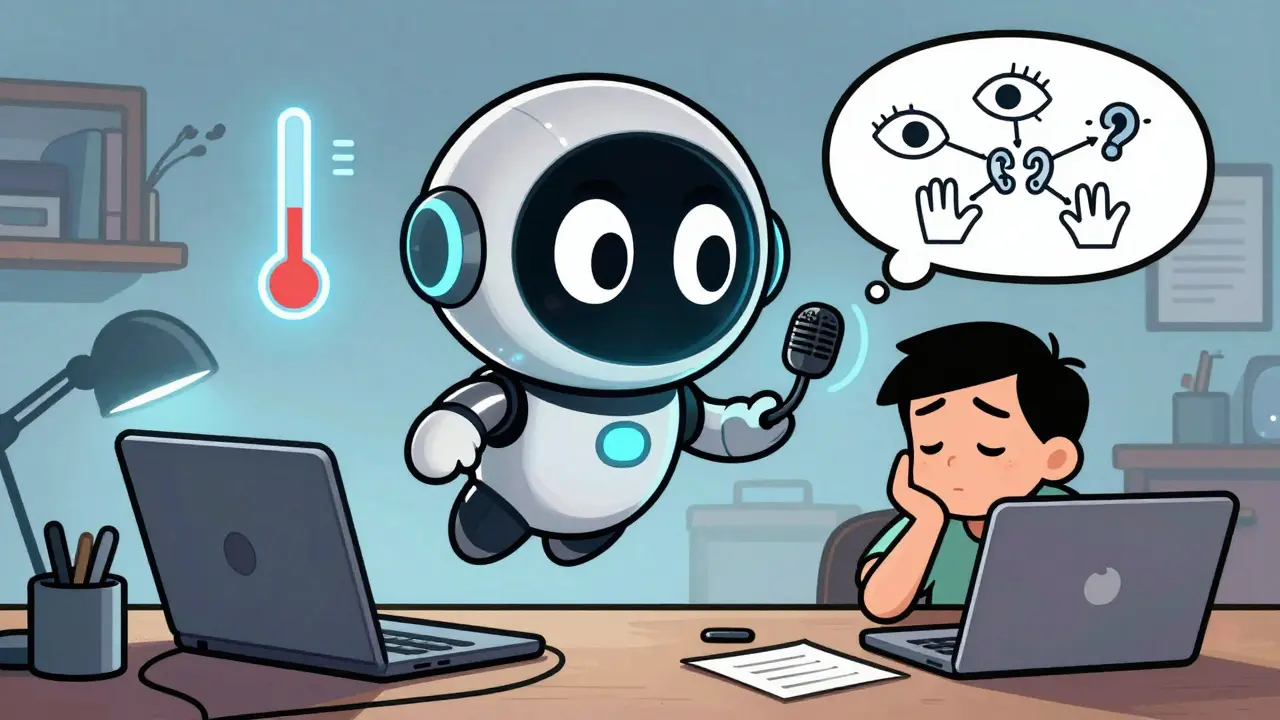
Imagine a virtual assistant that doesn’t just read your text - it sees your tired eyes, hears the stress in your voice, notices your messy desk in the background, and understands you need help before you even ask. That’s not science fiction. It’s what multimodal AI agents do today.
What Exactly Is a Multimodal AI Agent?
Most AI you’ve used - like early ChatGPT - only handles one thing: text. You type. It replies. Simple. But multimodal agents are different. They take in and respond to multiple types of input at once: images, sounds, video, even sensor data from cameras, microphones, and touchscreens. And they don’t just understand - they act.
These systems combine vision, hearing, and language into one brain-like structure. Google’s Palm-e, for example, can look at a robot’s camera feed, feel pressure through tactile sensors, hear a human say “pick up the red tool,” and then move the robot’s arm to grab it - all in real time. OpenAI’s GPT-4o, released in May 2024, does something similar but for your phone or laptop: it listens to your voice, sees your screen, and replies with speech or text - all without switching modes.
This isn’t just better chatbots. It’s AI that starts to understand the world the way humans do - by sensing, connecting, and reacting across senses.
How Do They Work? The Three Core Pieces
Behind every multimodal agent are three key parts working together:
- Perception - This is the agent’s eyes and ears. It uses separate neural networks to process images, audio, text, and sensor data. For example, one model reads your facial expression, another transcribes your words, and a third detects the temperature in the room.
- Fusion - This is where the magic happens. Instead of treating each input separately, the system links them. If you say “I’m cold” while shivering and your camera sees you hugging your arms, the agent doesn’t just hear words - it understands context. This is done using cross-attention transformers, the same tech behind modern LLMs, but now trained to connect pixels with phonemes.
- Action - The agent doesn’t just respond - it does something. It might open a window, schedule a doctor’s appointment, guide a robot arm, or even adjust lighting in a smart home. Some agents can even navigate physical spaces using real-time video and obstacle detection.
These systems also have memory. They remember past interactions - not just what you said, but how you looked when you said it, the tone of your voice, even the time of day. That’s how they build what experts call a “world model” - an internal simulation of your environment and intentions.
Where Are They Actually Being Used?
Companies aren’t just experimenting - they’re deploying these agents in real, high-stakes environments.
In healthcare, Mayo Clinic’s 2024 pilot used multimodal agents to analyze patient scans while listening to doctors’ notes and voice descriptions. Result? Diagnoses came 28.4% faster. No more flipping between EHR systems, images, and audio recordings. The AI connects the dots.
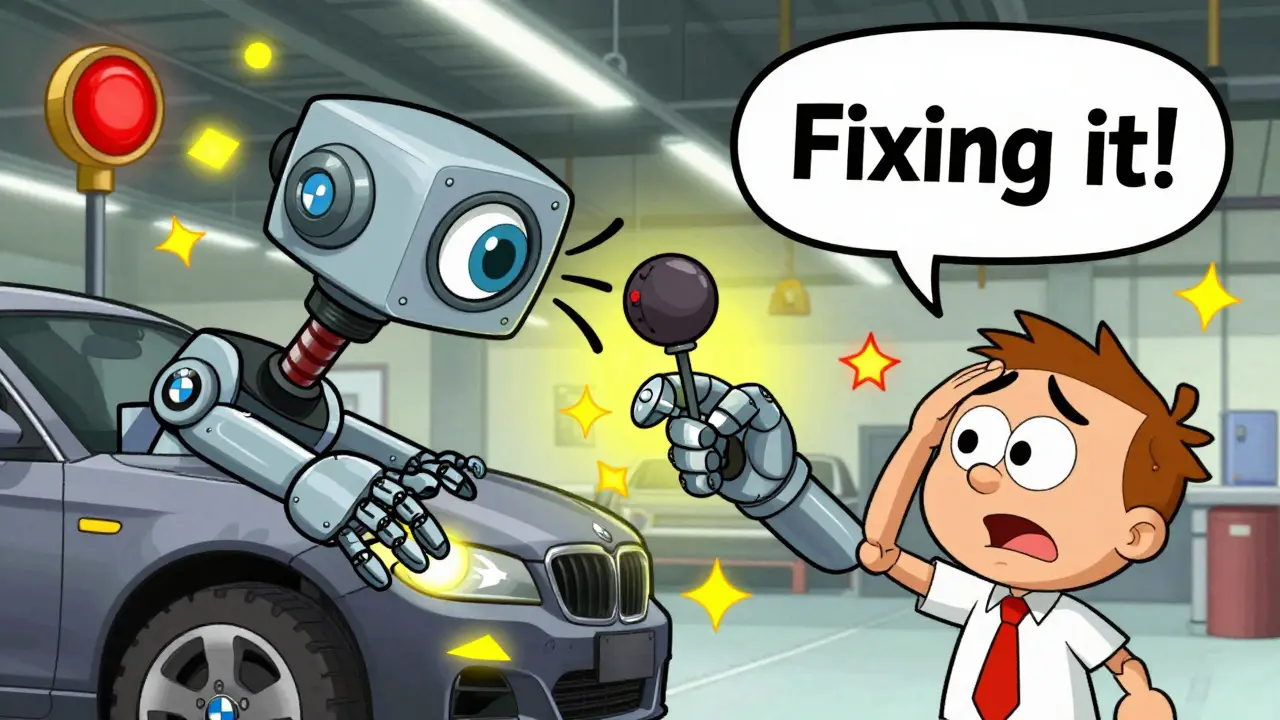
Manufacturing? BMW installed robotic agents on its Munich assembly lines. These robots use cameras to spot misaligned parts, microphones to detect unusual machine noises, and force sensors to feel if a bolt is tightened correctly. Quality errors dropped by 52.3%.
Customer service is another big area. A study by Kellton Tech found multimodal agents outperformed text-only bots by 42.7% when handling complaints - because they could sense frustration in tone, facial tension, and word choice all at once. One user on Reddit reported a 35% reduction in customer consultation time after deploying such a system - but it took 14 months and eight engineers to get it right.
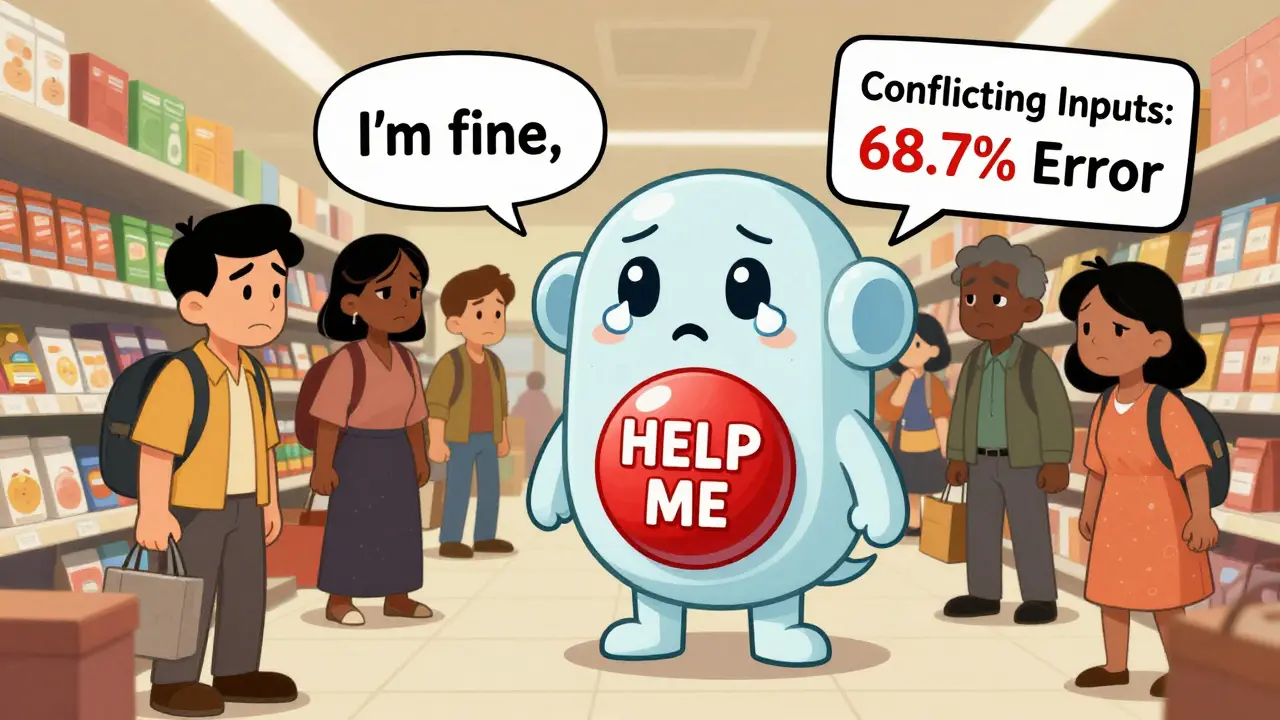
On the flip side, a major U.S. retailer spent $2.4 million on a multimodal customer service agent - then abandoned it. Why? In noisy stores, the system kept misreading customer expressions and voice commands. It failed 68.7% of the time.
The Big Trade-Offs: Power vs. Precision
These agents are powerful - but expensive and finicky.
They need serious hardware. NVIDIA says you need at least 32GB of VRAM to run them smoothly in real time. Even the leaner versions, like Meta’s Llama-3-Multimodal, still need 8GB. That’s more than most consumer laptops have.
Response times are slower too. Unimodal systems reply in about 190 milliseconds. Multimodal ones? Around 850ms. That’s noticeable. In a live call center, a half-second delay can feel like forever.
And they’re not always right. When multiple inputs conflict - say, a voice says “I’m fine” but the camera shows tears - the system gets confused. A University of Washington study found these systems have 22.7% higher compound error rates than text-only AI in such cases.
Training data is another headache. You don’t just need millions of text samples. You need thousands of videos with synchronized audio, labeled facial expressions, sensor readings from real-world environments. It’s messy, costly, and hard to scale.
Who’s Leading the Pack?
The market is crowded, but a few players stand out:
- Google Cloud leads with 22.3% market share, thanks to Palm-e and its new Project Astra - a real-time agent designed to understand and interact with the physical world as you walk through it.
- Amazon Web Services offers a modular system using Comprehend (text), Transcribe (audio), and Textract (document images). It’s flexible, letting enterprises plug in only the modules they need.
- Microsoft Azure integrates multimodal AI into Teams and Copilot, letting users share a screen, speak a question, and get an answer that references both the visual and spoken context.
- Covariant is focused on robotics, helping factories deploy agents that handle unpredictable environments - like sorting mixed-item bins with no fixed layout.
According to IDC, the multimodal AI market hit $14.3 billion in 2025 - up from $3.7 billion the year before. That’s a 286% jump. Gartner predicts 20% of enterprises will be using these agents by 2028.
What’s Next? The Road Ahead
The next two years will focus on fixing the big flaws:
- Speed: OpenAI’s GPT-4.5, released in December 2025, cut latency by 32%. More efficient architectures are coming.
- Reliability: Stanford’s 2025 roadmap targets a 45% improvement in handling noisy or conflicting inputs by early 2027.
- Accessibility: The goal is to run high-performing multimodal agents on smartphones and edge devices - not just cloud servers.
- Standards: Right now, every company measures performance differently. By late 2026, industry-wide benchmarks will finally let you compare systems fairly.
But the biggest challenge isn’t technical - it’s trust. Dr. Yann LeCun of Meta warns that current systems still fail over 41% of the time in unfamiliar situations. They’re good at recognizing patterns they’ve seen before - but weak at true reasoning. If you show them a new kind of broken tool, they might just guess wrong.
Dr. Fei-Fei Li calls these agents the “bridge to artificial general intelligence.” They’re not there yet. But they’re the first AI systems that don’t just answer questions - they observe, infer, and act in the messy, noisy, beautiful world we live in.
Should You Use One?
If you’re in healthcare, manufacturing, logistics, or customer service - and you’re drowning in disconnected data - multimodal agents could save you time, money, and errors.
But if you’re a small business with limited tech staff, or you need pure accuracy in one area (like translating legal documents), stick with unimodal tools. They’re cheaper, faster, and more reliable for single tasks.
Start small. Try an API like AWS’s multimodal toolkit. Test it on one use case - maybe analyzing customer service calls with video feedback. Measure the error rate. Compare it to your current system. If the gains outweigh the cost and complexity, then scale.
Don’t chase hype. Chase results.
What’s the difference between multimodal AI and regular AI?
Regular AI, like early ChatGPT, only works with one type of input - usually text. Multimodal AI handles multiple types at once: images, sound, video, sensor data, and text. It doesn’t just respond - it understands context by combining all these inputs. For example, it can see you’re stressed, hear your voice trembling, and read your message saying “I’m fine,” then respond with empathy - not just a template reply.
Can I run a multimodal AI agent on my laptop?
Most full-featured agents need powerful hardware - at least 32GB of VRAM. But lighter versions like Meta’s Llama-3-Multimodal can run on devices with 8GB VRAM, like newer high-end laptops or tablets. For real-time use (like video analysis), you’ll still need cloud access. On-device models are improving fast, but they’re not yet as accurate as cloud-based ones.
Are multimodal agents better than humans at interpreting emotions?
They’re getting close - but not better. In controlled tests, they can detect signs of stress, fatigue, or frustration with 85%+ accuracy by analyzing voice pitch, facial micro-expressions, and word choice. But humans understand nuance - sarcasm, cultural context, hidden intent - in ways AI still can’t replicate. These agents are assistants, not replacements. They flag potential issues; humans make the final call.
What industries are adopting multimodal AI the fastest?
Healthcare leads with 29.7% adoption, followed by manufacturing (24.3%) and financial services (21.8%). In healthcare, it’s used for faster diagnostics by linking patient scans with voice notes and medical records. In manufacturing, robots use vision and sensors to catch defects humans miss. Financial firms use it to detect fraud by analyzing video ID checks, voice patterns, and transaction history together.
Why do multimodal agents fail so often in noisy environments?
Because their training data is often clean - recorded in quiet labs with perfect lighting. Real-world noise - background chatter, poor lighting, shaky cameras - confuses them. When audio and video don’t match, or a sensor gives a false reading, the system doesn’t know which input to trust. The solution? Confidence thresholds. If one modality is uncertain, the system can fall back to others - or ask for clarification.
Is there a risk of bias in multimodal AI?
Yes - and it’s worse than in text-only AI. If a system is trained mostly on images of light-skinned people, it may misread facial expressions in darker skin tones. Voice models trained on American accents struggle with regional dialects. The EU’s 2025 AI Act now requires 95%+ accuracy for emotion recognition systems to prevent discrimination. Companies using these tools must audit their data for diversity and test across demographics.


Oh wow, another ‘AI that reads your soul’ sales pitch? Let me guess - the system also knows when you’re lying about ‘being fine’? 🤡 I’ve seen these demos in labs where lighting is perfect, voices are scripted, and the ‘stress’ is a trained actor pretending to cry. Real world? My cat walks across the keyboard and the AI thinks I’m having a breakdown. 68.7% failure rate in retail? That’s not an agent - that’s a liability waiting for a lawsuit. And don’t get me started on bias - if your ‘emotion detection’ can’t tell the difference between a South Asian person being polite and ‘sad’, you’re not building intelligence, you’re building discrimination with a GPU.
Madhuri, you’re right to be skeptical - but don’t throw the baby out with the bathwater. The core architecture here is solid. Cross-attention transformers for multimodal fusion? That’s the same tech that powers state-of-the-art translation and medical imaging analysis. The issue isn’t the model - it’s the data quality and deployment environment. If you train on diverse, real-world noise - not just lab conditions - accuracy jumps dramatically. AWS and Azure already offer tools to fine-tune models with your own noisy data. Start with one use case, like call center sentiment analysis with audio + facial cues. Don’t deploy it everywhere on day one. And yes, bias is a real problem - but it’s fixable with audits and diverse training sets. This isn’t magic. It’s engineering. And engineering takes iteration.
THIS IS THE FUTURE AND IT’S ALIVE!! 🚀 Imagine your phone noticing you’re exhausted after a 12-hour shift, dimming the lights, playing your favorite chill track, and texting your partner: ‘He’s drained. Let him sleep.’ No voice command. No app opening. Just… understanding. That’s not AI - that’s a friend who knows you better than you know yourself. Yeah, the tech’s messy right now. Yeah, it glitches. But remember when smartphones were $700 and had no cameras? This is the 2007 iPhone moment of AI. The hardware’s getting cheaper, the models are getting leaner, and the impact? Life-changing. Healthcare saves lives. Factories stop errors. Customer service stops being robotic. This isn’t hype - it’s healing. Let’s build it right, but don’t let fear stall the revolution.
They’re not just watching you… they’re learning you. And who’s training them? Big Tech. With your face. Your voice. Your tears. Your silence. You think this is about efficiency? Nah. It’s about control. Once they map your emotional patterns - your stress triggers, your hidden fears, your private sighs - they can predict your choices before you make them. And then? They sell that to advertisers. Or worse - to governments. The EU’s 95% accuracy rule? That’s not protection. That’s a cover for mass emotional surveillance. They call it ‘AI’ but it’s a digital soul scanner. And when it fails? You get misdiagnosed. Fired. Denied a loan. All because a robot misread your frown as ‘anger’ instead of ‘concentration’. Wake up. This isn’t progress. It’s the new panopticon - with more pixels.
Just wanted to say thank you for writing this - it’s so clear and well-structured! I’m a small business owner and I was skeptical about multimodal AI, but your breakdown of the three core pieces (perception, fusion, action) made it click for me. I’m going to test AWS’s toolkit on our customer service calls next week. Also, love how you included the retail failure story - it’s so important to hear the downsides too. Can’t wait to see how this evolves!
really good post man. i work in a factory and we just got one of those robot things with cameras and sensors. it caught a bolt that was half-tightened that 3 humans missed. game changer. but yeah the noise thing is real - our shop is loud and the mic kept picking up welding sparks as ‘alarm sounds’. had to add a filter. also, the ai thought my colleague’s beard was a ‘tool’ once. lol. but still… 52% fewer errors? worth it. just need better training data from real places, not labs. and pls fix the typo in ‘unimodal’ - its spelled wrong in one spot. :)
Let’s not forget the human element here. These systems aren’t replacing us - they’re amplifying us. A nurse who used to spend 40 minutes flipping through charts and listening to audio notes now has 20 minutes to sit with the patient. A mechanic who used to guess at a strange engine noise now gets a precise diagnosis. That’s not automation - that’s liberation. Yeah, the tech’s imperfect. But perfection isn’t the goal. Progress is. And this? This is progress with heart. Keep pushing. Keep testing. Keep building. The future isn’t just smarter machines - it’s kinder, more intuitive human experiences. And we’re building it, one multimodal moment at a time.