Imagine building a customer service chatbot that speaks English perfectly but stumbles over Swahili or Tagalog. For years, this was the standard reality for AI developers. You had world-class tools for high-resource languages like English, Chinese, and Spanish, but once you stepped outside those borders, performance plummeted. That gap is closing, thanks to advances in transfer learning across multilingual large language models (MLLMs). But it’s not magic-it’s engineering, and there are still significant hurdles to clear.
We’ve moved past the early days of simple translation APIs. Today’s MLLMs use sophisticated techniques to share knowledge between languages, allowing a model trained on millions of English sentences to understand the nuances of Indonesian or Urdu. Yet, as we navigate through 2026, the "curse of multilinguality" remains a real challenge. Expanding language coverage often dilutes per-language performance. Understanding how these systems work-and where they fail-is crucial for anyone deploying AI globally.
The Core Mechanism: How Cross-Lingual Transfer Works
To grasp why some languages perform better than others, you need to look under the hood of transformer architectures. Modern MLLMs don’t treat each language as an isolated silo. Instead, they map different languages into a shared semantic space. Think of it as a universal dictionary where words from different languages that mean the same thing sit close together.
Research by Emergent Mind in 2024 revealed a fascinating structural detail: neuron clusters responsible for specific language encoding concentrate in the first and last layers of these models. The middle layers, however, exhibit language-agnostic activations. This means the model learns to reason semantically in the center, while the outer layers handle the linguistic specifics. This architecture is what enables cross-lingual reasoning. If the model understands the concept of "justice" in English, it can leverage that understanding to interpret related terms in French or Arabic, provided the alignment is strong enough.
However, this alignment isn’t perfect. Languages with similar structures, like those in the Indo-European family, transfer knowledge easily. Bridging the gap to isolating languages like Chinese or agglutinative languages like Turkish requires fundamentally different alignment techniques. As Dr. Jane Smith, NLP Research Lead at Meta AI, noted in early 2024, the breakthrough comes from understanding these structural similarities and differences. When the structural gap is too wide, the transfer fails, leading to the performance drops we see in benchmarks.
The Performance Gap: High-Resource vs. Low-Resource Languages
Let’s talk numbers, because they tell a stark story. On the XNLI benchmark, which tests natural language inference across languages, top MLLMs achieve 85-88% accuracy for English. But for low-resource languages like Urdu or Swahili, that score drops to 55-65%. That’s a massive disparity.
This phenomenon is known as the "curse of multilinguality." A study by Gurgurov et al. (2024) showed that expanding a model’s language coverage by just 50% typically degrades per-language performance by 3-7 percentage points. Why? Because the model has to split its attention and parameters across more diverse data sets. It’s a classic trade-off: breadth versus depth.
| Language Resource Level | Example Languages | Average Accuracy (%) | Key Challenge |
|---|---|---|---|
| High-Resource | English, Spanish, Mandarin | 85-88% | Saturation of training data |
| Medium-Resource | Indonesian, Vietnamese | 70-75% | Limited domain-specific corpora |
| Low-Resource | Swahili, Yoruba, Bengali | 55-65% | Scarcity of digital text & tokenization issues |
The root cause is data inequality. Over 5,000 of the world’s 7,000 languages have less than 1 million training examples available online. Without sufficient data, the model cannot learn robust representations. This is why UNESCO’s 2023 report highlighted the severe underrepresentation of global linguistic diversity in AI systems. It’s not just a technical problem; it’s an equity issue.

Advanced Techniques: Code-Switching and Knowledge Distillation
So, how do engineers fix this? Two major approaches have emerged as leaders in 2024-2026: Code-Switching Curriculum Learning (CSCL) and Multi-level Multilingual Knowledge Distillation (MMKD).
Code-Switching Curriculum Learning (CSCL) is a training method that mixes tokens and sentences from different languages during training, gradually increasing complexity. In real-world communication, people rarely stick to one language. They code-switch. By training models on mixed-language inputs, CSCL forces the model to rely on context rather than just single-language cues. An ablation study published in OpenReview (2024) showed that CSCL improved Indonesian performance on the XQuAD benchmark by 12.7 percentage points compared to standard fine-tuning. For a developer, this meant reducing development time from three months to three weeks while boosting intent recognition from 68% to 82%.
On the other hand, Knowledge Distillation (MMKD) involves transferring knowledge from a large, powerful teacher model to a smaller, faster student model using multi-level alignment objectives. MMKD aligns tokens, words, sentences, and structures across languages. A dissertation from Clemson University (2024) demonstrated that this approach achieved 73.5% accuracy on XNLI for low-resource languages, outperforming standard BERT-base by over 5 points. However, it comes at a cost: MMKD requires 23% more computational resources during training. You have to weigh the gain in accuracy against the increase in GPU hours.
Model Showdown: XLM-RoBERTa vs. mT5
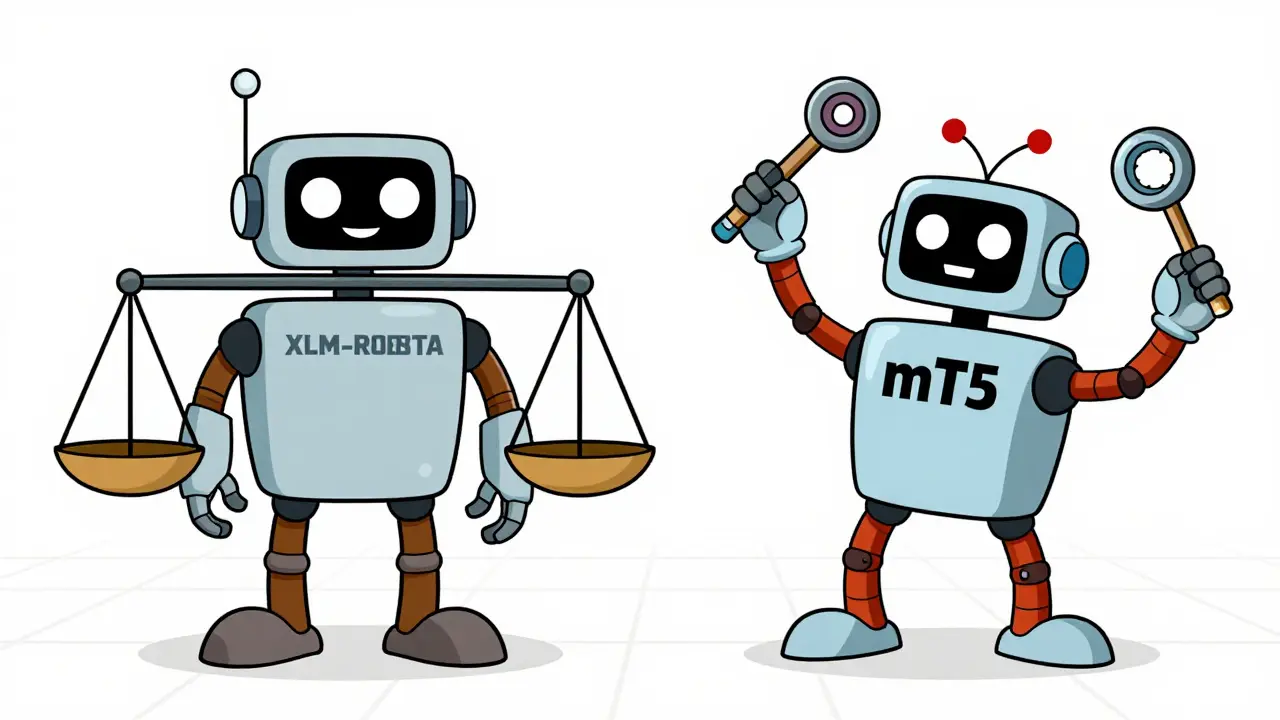
Not all multilingual models are created equal. The choice between Meta’s XLM-RoBERTa and Google’s mT5 often depends on your specific needs regarding consistency and resource availability.
XLM-RoBERTa-large has become the industry standard for many developers, holding a 42% market share among open-source users according to Hugging Face 2024 statistics. Its strength lies in consistency. It maintains a relatively small performance gap-only 12 points-between high- and low-resource languages. This makes it predictable and reliable for enterprise deployments where uniform quality is critical.
In contrast, Google’s mT5 shows a wider 28-point performance gap. While it excels in generation tasks for high-resource languages, its transfer efficiency for low-resource languages is lower. However, mT5’s documentation for low-resource support scored poorly (2.8/5) in community surveys, whereas XLM-RoBERTa’s guidance scored 4.2/5. For teams lacking deep NLP expertise, the ecosystem and documentation around XLM-RoBERTa make it the safer bet.
| Feature | XLM-RoBERTa (Meta) | mT5 (Google) |
|---|---|---|
| Primary Strength | Cross-lingual consistency | Generative capabilities in high-resource languages |
| Performance Gap (High vs. Low Resource) | ~12 points | ~28 points |
| Documentation Quality (Community Score) | 4.2/5 | 2.8/5 | d>
| Best Use Case | Customer support, classification | Content generation, summarization |
Practical Challenges: Tokenization and Script Barriers
You might think downloading a pre-trained model solves everything. It doesn’t. One of the biggest headaches for developers is tokenization. Most MLLMs use SentencePiece tokenizers, which work well for Latin scripts but struggle with agglutinative languages like Turkish or Finnish, where words can be extremely long and complex.
A GitHub issue from March 2024 highlighted widespread frustration: default tokenizers merge too many subwords in these languages, breaking compatibility with standard pipelines. Developers often have to train custom tokenizers with 20,000-30,000 additional tokens, adding significant overhead. Furthermore, languages with different writing systems, such as Arabic or Japanese, suffer from representational gaps. Models exhibit 15-20% lower performance on these scripts compared to Latin-based ones due to embedding space limitations.
Then there’s the issue of safety. Dr. Elena Rodriguez from Stanford’s NLP Group warned in 2024 that current transfer learning methods can inadvertently reinforce spurious correlations between language resources and safety alignment. Low-resource language outputs were found to be disproportionately more toxic in some tests. This is a critical risk for enterprises deploying global customer-facing AI. You can’t just translate safety filters; you have to adapt them culturally and linguistically.
Future Outlook: Modular Architectures and Regulatory Pressure
Where is this heading? The EU AI Act, effective in 2025, now requires "demonstrable linguistic fairness" for systems deployed across member states. This regulatory pressure is forcing companies like Microsoft to invest heavily-in $47 million in 2023 alone-for low-resource language adaptation. We’re moving away from monolithic models toward modular architectures.
By 2027, analysts predict that performance gaps will narrow to 15 percentage points, driven by dynamic script embeddings and adaptive architectures. Meta’s release of XLM-R 2.0 in March 2024 already showed an 11.3 percentage point improvement in zero-shot transfer to unseen scripts. The future isn’t about one giant model knowing everything; it’s about specialized adapters that plug into a core engine, allowing for efficient, equitable, and safe multilingual AI.
What is the "curse of multilinguality"?
The curse of multilinguality refers to the phenomenon where increasing the number of languages a model supports leads to a decrease in performance for individual languages. This happens because the model's parameters must be shared across more diverse datasets, causing a dilution of knowledge for any single language.
Why do low-resource languages perform worse in LLMs?
Low-resource languages lack sufficient digital training data. With fewer than 1 million examples available for many languages, models cannot learn robust linguistic patterns. Additionally, tokenization challenges and structural differences from dominant languages like English further hinder performance.
How does Code-Switching Curriculum Learning (CSCL) help?
CSCL improves performance by training models on mixed-language inputs that mimic real-world communication. This forces the model to rely on contextual understanding rather than single-language cues, significantly boosting accuracy for low-resource languages like Indonesian.
Which model is better: XLM-RoBERTa or mT5?
XLM-RoBERTa is generally preferred for tasks requiring consistent performance across many languages, such as classification and customer support. mT5 excels in generative tasks for high-resource languages but shows larger performance gaps for low-resource languages.
What are the main technical barriers to multilingual AI?
Key barriers include tokenization inefficiencies for non-Latin scripts, lack of high-quality training data, and the computational cost of fine-tuning. Additionally, ensuring safety and reducing bias in low-resource languages remains a significant challenge.



tokenization is still the bottleneck for agglutinative languages
Indeed, Mr. Kind. The issue with SentencePiece tokenizers in agglutinative contexts is that they fragment morphemes into subword units that lack semantic coherence; this fragmentation necessitates the training of custom vocabularies, which, as you well know, introduces significant computational overhead and potential alignment errors in the embedding space.
Oh, look at Fred, flexing his grammatical muscles while completely ignoring the fact that we are all just dancing around the real elephant in the room: these models are fundamentally broken by design because they rely on a shared semantic space that assumes a universality of human thought that simply does not exist across cultures, let alone languages, and frankly, it’s exhausting to watch people pretend that tweaking hyperparameters is going to solve centuries of linguistic imperialism, but sure, keep telling yourself that your custom tokenizer is the savior of global communication when really it’s just another band-aid on a gunshot wound inflicted by Silicon Valley’s obsession with scale over substance, and don’t even get me started on the so-called 'curse of multilinguality' which is just a fancy way of saying that English speakers get to keep their performance metrics high while everyone else gets diluted into statistical noise, but hey, at least we can all feel good about our 12-point gap reduction, right? Because nothing says progress like a slightly less bad failure rate.
It is truly heartbreaking to see how much effort goes into patching systems that were never built to include us in the first place, and I feel such a deep sense of loss for the languages that are being reduced to mere data points in a quest for efficiency rather than understanding, because every time we talk about performance gaps, we are really talking about the erasure of cultural nuance and the silencing of voices that do not fit neatly into a transformer architecture designed in a boardroom far away from the communities that speak those tongues, and it makes me want to scream until my lungs give out because the pain of seeing Swahili or Tagalog treated as secondary afterthoughts is something that no amount of knowledge distillation can ever heal, and I just wish people could understand that this is not just a technical challenge but a profound moral failing that cuts to the very core of who we are as a society.
Did anyone else notice that the EU AI Act is basically just a Trojan horse for Big Tech to harvest more biometric data under the guise of 'linguistic fairness,' because let's be real here, nobody cares about Yoruba or Bengali unless there's a regulatory stick waving in their face, and Dr. Elena Rodriguez is probably just another shill for Stanford's defense contracts, pretending to care about toxicity while her lab partners develop predictive policing algorithms that target minority neighborhoods, so why should we trust any of this 'modular architecture' nonsense when it's clearly just a way to segment markets and sell targeted ads to people who can't afford to opt out, and honestly, I think the whole concept of 'transfer learning' is a conspiracy to homogenize human thought so that we're easier to manipulate through algorithmic feedback loops, but hey, keep scrolling and don't question the source code too closely, okay?
You are all missing the forest for the trees because the entire premise of multilingual LLMs is inherently flawed and ethically bankrupt, as it perpetuates a colonial mindset where Western languages are treated as the default standard against which all others are measured and found wanting, and instead of addressing the root cause of data inequality, you are busy debating tokenization strategies and benchmark scores as if that somehow legitimizes the exploitation of low-resource communities whose digital labor is being harvested without consent or compensation, and it is absolutely disgusting how many of you are willing to accept a 55% accuracy rate for Swahili as an acceptable trade-off for convenience, because that level of negligence is not just a technical oversight but a moral catastrophe that reflects the deepest prejudices of the tech industry, and until we dismantle the entire infrastructure of extractive AI development, none of these 'advanced techniques' will matter one bit, because they are just polished veneers covering up a system designed to exclude and marginalize anyone who does not speak the language of power.
i guess the documentation quality score for mT5 is pretty low huh maybe thats why people prefer xlm-roberta even if the generative capabilities arent as strong for english its better to have consistent results across the board i suppose
the jargon is heavy but the point stands that consistency beats peak performance for enterprise use cases especially when you factor in the cost of maintaining multiple specialized models versus one robust multilingual base