
44.9% of developers use AI tools for coding, but only 17.3% trust the code without verification. That's where stepwise prompting with feedback loops comes in. This method breaks down code generation into manageable steps, validating each part before moving on. It turns the frustration of debugging entire programs into a smooth, error-catching process. Let’s see how it works in practice.
What is Stepwise Prompting with Feedback Loops?
Stepwise Prompting with Feedback Loops is a methodology that combines structured prompt engineering with iterative software development. It uses a process of breaking coding tasks into smaller steps, generating code incrementally, and validating each step with explicit tests. This approach emerged around 2022-2023 as large language models (LLMs) became capable of code generation. Unlike asking for a complete function at once, it builds code piece by piece, testing each part immediately. Stanford University’s Center for Research on Foundation Models found this reduces error rates by 63% compared to direct code generation.
The Core Process: From Idea to Validated Code
Follow these six steps for every coding task:
- Decide what you want to accomplish - Define a single, small goal. Example: "Create a function to validate email addresses."
- Devise a manual test - Write a specific check. Example: "Does it reject "example@" and accept "[email protected]"?"
- Perform the test - Run the test before writing code. It should fail.
- Write a line of code - Only write enough to address the current test.
- Repeat the test until it passes - Keep refining until the test succeeds.
- Repeat with a new goal - Move to the next small task. Example: "Add support for international domains."
This loop comes from Jason Swett’s "How to Program in Feedback Loops" (2018). For example, when building a parser, developers break it into tokenization, syntax analysis, and code generation. Each step gets its own test. Reddit user u/CodingWithFeedback reported a 60% reduction in debugging time using this approach.
Real-World Example: Building a Data Parser
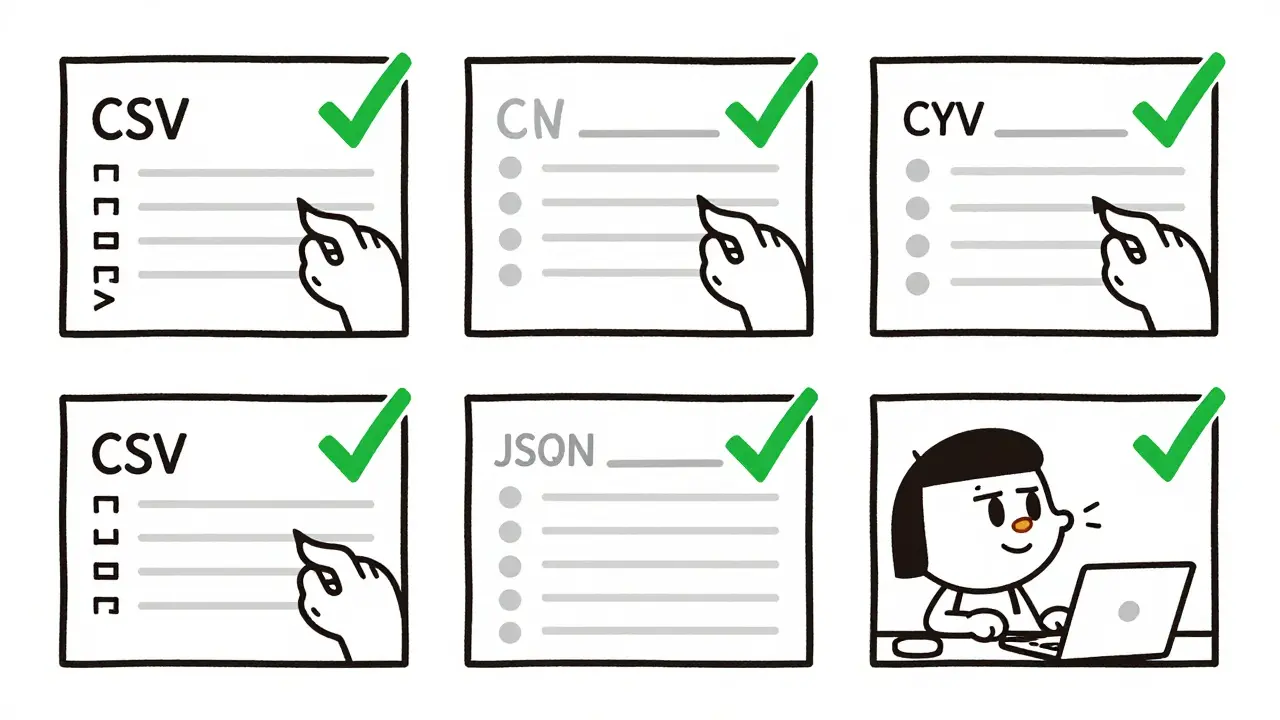
Imagine creating a CSV-to-JSON converter. Instead of asking for the whole thing, you’d:
- Step 1: Write a test for splitting CSV lines. Does "name,age" become ["name", "age"]? Write code until it passes.
- Step 2: Test header parsing. Does the first line become keys? Adjust code until it works.
- Step 3: Test data conversion. Does "Alice,30" become {"name": "Alice", "age": 30}? Refine until correct.
GitHub’s February 2024 case study showed a 57% reduction in data pipeline errors using this method. Each step’s test acts as a safety net. If later steps fail, you know exactly where the problem started.
Why This Method Works Better Than Alternatives
Compared to traditional approaches:
- Chain-of-Thought Prompting (Google Research, 2022) improves reasoning accuracy by 78.7% on math problems. It’s built into stepwise prompting by requiring the model to explain each step.
- GitHub Copilot’s inline suggestions generate code directly but cause 41% more runtime errors in production, per Microsoft Research (2023). Stepwise prompting catches these before deployment.
- Test-Driven Development (TDD) is slower for initial code generation. Stepwise prompting is 37% faster at creating working code while maintaining quality.
DataCamp’s 2023 analysis found stepwise prompting reduces logical errors by 30-40% for multi-step tasks. It works because every change is validated immediately. No more "it works on my machine" surprises.
Common Challenges and How to Overcome Them
Developers face three main issues:
- Prompt engineering tax - Crafting precise steps takes time. Solution: Use templates like the "3C Framework" (Context, Challenge, Criteria). For example: "Context: Building a login system. Challenge: Hash passwords. Criteria: Use bcrypt, return error on invalid input."
- Step granularity - Too small (10 steps for a button) or too large (one step for an entire API). Solution: Aim for steps that take 5-10 minutes to complete. If a step feels overwhelming, break it further.
- Context limits - LLMs forget earlier steps. Solution: Use tools like Claude 3 (released December 2023) with 200,000-token context. For older models, summarize previous steps before continuing.
University of California, Berkeley’s 2023 study showed novices take 2.3 times longer to master stepwise prompting than experts. Start simple: practice with basic functions before complex systems.
Getting Started: A Step-by-Step Guide
Follow this progression:
- Master Chain-of-Thought - Ask the AI: "Explain how to solve X step by step before writing code." Example: "How would you sort a list of numbers? Explain first."
- Add test requirements - For each step, say: "After writing code, provide a test case that checks this part." Example: "Write a function to calculate tax. Afterward, give two test cases: one for $0 income, one for $50k."
- Automate verification - Use tools like Pytest or Jest to run tests automatically. For example: "After generating code, write a pytest function to validate it."
Pluralsight’s February 2024 training analysis found developers need 15-20 hours of practice to become proficient. Start with small tasks like string manipulation or simple math functions before moving to complex algorithms.
Future of AI-Assisted Coding
Major advancements are coming:
- GitHub Copilot Workspaces (announced November 2023) now includes built-in stepwise feedback mechanisms. It automatically suggests when to break tasks into smaller steps.
- Anthropic’s Claude 3 (December 2023) supports multi-turn reasoning chains with 200,000-token context, making long feedback loops possible.
- MIT’s February 2024 "self-correcting feedback loop" system achieves 92% accuracy on complex coding tasks by having the model critique its own output.
Gartner projects 70% of enterprise teams will use structured feedback loops by 2025. As Dr. Percy Liang of Stanford said in March 2023: "Chain-of-Thought prompting turns black box generation into a transparent, debuggable process." The methodology is becoming as essential as unit testing in traditional development.
Frequently Asked Questions
What’s the main benefit of stepwise prompting?
The biggest advantage is catching errors early. Instead of writing hundreds of lines and debugging later, each step is tested immediately. This reduces debugging time by up to 60% for complex tasks like building parsers. For example, Reddit user u/CodingWithFeedback reported cutting debugging time by 60% when creating a custom data parser.
Can I use this with GitHub Copilot?
Yes. Microsoft Research found developers using stepwise feedback loops with Copilot had 41% fewer runtime errors in production code. Start by asking Copilot: "Generate code for step 1 of this task. Then provide a test case for it." You can also use Copilot Workspaces, which automatically suggests stepwise decomposition.
Is this only for complex tasks?
No, but it’s most valuable for multi-step problems. For simple tasks like fixing a typo, it adds unnecessary overhead. For anything requiring logic (e.g., algorithms, data processing, API integrations), stepwise prompting shines. Stanford’s research shows it reduces errors by 89% on LeetCode medium problems versus direct prompting.
How do I handle LLM context limits?
Summarize previous steps before continuing. For example: "Previous steps: tokenized input, validated syntax. Now generate code for error handling." Tools like Claude 3 (200,000-token context) or Stepwise’s January 2024 platform update with automated templates reduce this issue by 45%.
What’s the "3C Framework"?
It’s a template for clear prompts: Context (project details), Challenge (specific subtask), Criteria (acceptance tests). Example: "Context: Building a user authentication system. Challenge: Verify password strength. Criteria: Minimum 8 characters, one number, one symbol. Return error if invalid."



This stepwise prompting method is a game-changer for coding.
Breaking tasks into small steps with immediate testing saves so much time debugging.
I've tried it with simple functions and it works great.
No more hunting for bugs in hundreds of lines.
Just check each part as you go.
It's like building a house brick by brick instead of throwing all the bricks at once.
Definitely a game-changer.
The stepwise method really helps in catching errors early.
Each small step validated before moving on prevents cascading issues.
For larger projects, this approach ensures components work together seamlessly.
It's been a game-changer for our team's workflow.
Stepwise prompting with feedback loops is a game-changer for developers using AI tools.
I've been using this method for a few months now and it's transformed how I approach coding.
Instead of trying to write an entire function at once, I break it down into tiny steps.
Each step gets its own test case before moving forward.
This way, if something breaks, I know exactly where the problem started.
No more hunting through hundreds of lines of code for a single bug.
For example, when building a data parser, I start by testing how it splits CSV lines.
Then I check header parsing, then data conversion.
Each step is validated immediately.
It's like building a house brick by brick-no point in adding the roof if the foundation is shaky.
This approach has cut my debugging time by over 60% on complex tasks.
The Stanford research mentioned in the post really highlights this.
Even for simple tasks like string manipulation, breaking it into small steps works wonders.
I've noticed that when I skip this process, I end up with more errors later.
It's not just about the code; it's about building confidence in each part before moving on.
The key is to keep each step manageable-5-10 minutes of work per step.
If a step feels too big, I break it down further.
Tools like Claude 3 with large context help when dealing with longer chains.
Overall, this method makes coding with AI feel more controlled and less frustrating.
It's become my go-to workflow for any project.
This method is incredibly effective.
Breaking tasks into small steps with tests at each stage catches errors before they compound.
It's like building a foundation brick by brick.
No more debugging nightmares.
Simple yet powerful approach.
This method is a lifesaver for debugging.
OMG this is amazing!
Every single step tested before moving on is a total game-changer!
No more debugging nightmares!
It's like having a safety net for your code!
Seriously, everyone should try this!