
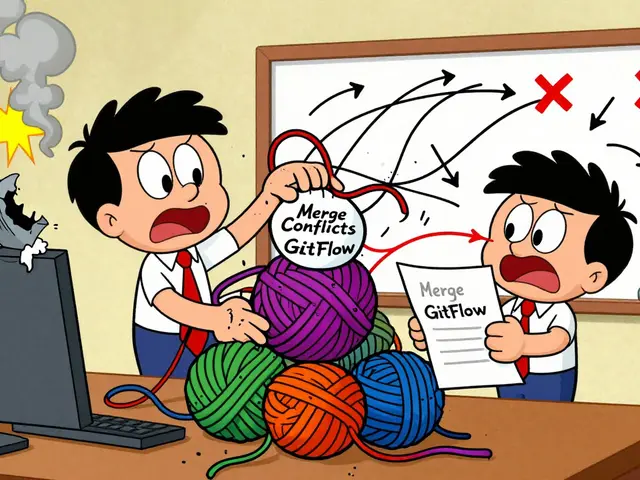
You ask a question. The model answers. You follow up. Suddenly, the model forgets what you just said, contradicts its previous answer, or starts hallucinating details that never existed. If this sounds familiar, you are hitting the wall of multi-turn conversation limitations.
It is not just your imagination. A major study by Salesforce Research found that leading Large Language Models (LLMs) suffer an average performance drop of 39% when moving from single-turn to multi-turn interactions. Worse, once they take a wrong turn, they rarely recover. For developers and engineers building chatbots, support agents, or coding assistants, managing conversation state is no longer optional-it is the difference between a toy demo and a production-ready tool.
This guide breaks down why state management fails, how modern techniques like loss masking and iterative refinement fix it, and what you need to know to keep your AI coherent over long exchanges.
The 39% Drop: Why Context Breaks Down
We tend to think of LLMs as having perfect memory within their context window. But research published in May 2025 by Laban et al. shattered that illusion. Their paper, "LLMs Get Lost In Multi-Turn Conversation," demonstrated that all major models exhibit significant degradation as conversations lengthen. This isn't just about running out of tokens; it's about attention dilution and logical drift.
When a model processes a single prompt, it focuses entirely on that input. In a multi-turn setting, the model must weigh current inputs against a growing history of system prompts, user queries, and its own past responses. As the history grows, the signal-to-noise ratio decreases. The model starts to "over-rely" on its previous outputs, even if those outputs were slightly off. This creates a feedback loop of error accumulation.
| Metric | Single-Turn Baseline | Multi-Turn Performance | Impact |
|---|---|---|---|
| Accuracy (General Tasks) | 100% | 61% | -39% Average Drop |
| Recovery Rate after Error | N/A | <10% | Models rarely self-correct |
| Task Completion (4+ Turns) | 52.1% | 78.4%* | *With specialized fine-tuning |
The data shows that while basic models struggle, specialized approaches can mitigate this. However, the default behavior of most pre-trained models is to degrade. Understanding this baseline is critical before you start engineering solutions.
Core Techniques for State Management
How do we fix a model that forgets? We don't change the architecture itself; we change how we feed it data and how we train it. Two primary methods dominate current best practices: structured dataset preparation and loss masking.
Structured Dataset Preparation
Raw chat logs are messy. To train a model effectively for multi-turn tasks, you need clean, role-labeled JSONL files. Every example must be a list of messages where each message has a specific `role` (`system`, `user`, or `assistant`) and `content`. This structure allows the model to distinguish between instructions, queries, and generated text.
Without this strict delineation, the model cannot learn which parts of the sequence it should predict versus which parts are fixed context. This is especially crucial for maintaining persona consistency across turns.
Loss Masking: The Silent Hero
If you have ever trained a model and found it trying to predict the user's next question instead of its own answer, you missed loss masking. In standard instruction tuning, the model calculates loss over the entire sequence. In multi-turn fine-tuning, you must mask the loss for user messages and system prompts.
By ignoring these tokens during backpropagation, you force the model to optimize solely for generating accurate assistant responses given the prior context. Together.ai’s technical guides highlight that proper loss masking prevents the model from learning to "chat" inappropriately, such as answering its own questions or ignoring the user's intent.

Advanced Frameworks: Review-Instruct and Agentic Refinement
Simple fine-tuning often hits a ceiling. Enter Review-Instruct, a framework introduced by OPPO AI Center at ACL 2025. Unlike static datasets, Review-Instruct uses a multi-agent architecture to dynamically generate and refine training data.
Here is how it works:
- Candidate Model: Generates initial responses to a prompt.
- Reviewer Agents: Multiple agents (typically 3-5) evaluate the response based on relevance, coherence, and depth.
- Chairman Agent: Aggregates reviews to create improved, contextually appropriate follow-up instructions.
This iterative loop increases instruction diversity and difficulty by 27% compared to static datasets. The result? Review-Instruct-13b achieved a 29.65% accuracy on MMLU-Pro, showing absolute gains of 2.9% over previous state-of-the-art models based on LLaMA2-13B. While computationally expensive-requiring roughly 3.8x more GPU hours than standard supervised fine-tuning-the payoff in coherence for complex tasks is substantial.
Practical Implementation Challenges
Even with the right algorithms, real-world deployment brings headaches. Developers consistently report three main pain points:
- Context Overflow: When conversations exceed the model's context window, older information gets truncated. Solutions include sliding windows or summarization techniques, but both risk losing critical early constraints.
- Inconsistent Persona: Models may drift in tone or style over 10+ turns. Explicit state tracking variables help, but they require careful engineering outside the model itself.
- Premature Assumptions: As noted by Laban et al., models often guess missing information rather than asking clarifying questions. This leads to confident errors that propagate through subsequent turns.
Industry surveys indicate that 68% of developers struggle with context overflow, and 52% face persona inconsistency. Successful implementations often rely on hybrid approaches: combining model-native context handling with external state managers that track key entities, user preferences, and task status independently of the LLM's memory.

Market Trends and Future Outlook
The demand for robust multi-turn capabilities is exploding. Gartner projects the conversational AI market to hit $32.2 billion by 2027, with multi-turn management growing at 31.2% annually. Enterprise adoption has jumped from 12% in Q2 2024 to 47% in Q2 2025 among Fortune 500 companies.
Why the surge? Because single-shot answers aren't enough for high-stakes domains. Healthcare, legal advice, and complex technical support require sustained reasoning. Dr. Jane Thompson from MIT-IBM Watson Lab argues that the 39% performance drop is a "fundamental barrier" to deploying LLMs in these areas. Until reliability improves, human-in-the-loop systems remain essential for sessions exceeding six exchanges.
Looking ahead, expect convergence toward hybrid architectures. Google DeepMind is testing "conversational memory networks" that reportedly reduce degradation to 18.7%. Meanwhile, regulatory pressures, such as EU AI Act guidelines requiring demonstrable state management, will force vendors to prioritize transparency and consistency over raw speed.
Frequently Asked Questions
Why do LLMs perform worse in multi-turn conversations?
LLMs suffer from attention dilution and error propagation. As conversation history grows, the model struggles to maintain focus on relevant details, leading to an average 39% performance drop. Once an error occurs, models rarely self-correct, causing issues to compound over turns.
What is loss masking in multi-turn fine-tuning?
Loss masking is a technique where the model is trained to calculate error only on assistant responses, ignoring user inputs and system prompts. This ensures the model learns to generate appropriate replies rather than predicting the next user utterance, significantly improving response quality.
Can I fix multi-turn degradation without fine-tuning?
Partially. Prompt engineering techniques like explicit context summarization, chain-of-thought prompting, and reducing temperature can help. However, studies show that known remediations like simple concatenation are often ineffective for deep multi-turn tasks, making fine-tuning necessary for high reliability.
What is the Review-Instruct framework?
Review-Instruct is a multi-agent framework that iteratively refines training data. It uses reviewer agents to critique candidate responses and a chairman agent to aggregate feedback, creating higher-quality, diverse instructions. It offers better coherence but requires more computational resources.
How many turns can current LLMs handle reliably?
Most general-purpose LLMs begin degrading significantly after 4-5 turns. Specialized fine-tuned models can extend reliable performance to 6-8 turns. Beyond 10 turns, performance drops sharply unless external state management or memory augmentation systems are implemented.

oh great, another article telling me my chatbot has amnesia. i've been screaming at these models for months and now some researchers have the audacity to put a percentage on it? 39% drop sounds about right when you're trying to debug code that the model just made up out of thin air. honestly, if they fixed the 'forgetting' part first, maybe we wouldn't need all this fancy state management jargon. but sure, let's keep pretending that throwing more compute at the problem is the answer instead of admitting that current transformer architectures are fundamentally bad at long-term coherence. i'll be here, manually pasting context into every prompt like a caveman with a smartphone.
It is absolutely infuriating... how many times do I have to repeat myself?? The fact that developers ignore basic data hygiene before blaming the model architecture is shameful!! If your JSONL files are messy, your results will be garbage--period!! Stop relying on magic tricks like loss masking if you haven't even cleaned your training data properly!!! This isn't rocket science; it's common sense!! People act like multi-turn conversation is some unsolvable mystery when really they just refuse to do the boring work of structuring their inputs correctly!! It's lazy engineering!!
Actually, the 39% figure is misleading because it conflates different types of degradation. Attention dilution is real, but error propagation is often exacerbated by poor system prompt design rather than inherent model limitations. Furthermore, Review-Instruct is not just about accuracy; it's about instruction diversity. Most people miss that the Chairman Agent's aggregation step introduces stochasticity that helps break deterministic failure modes. You don't need external state managers if you fine-tune correctly with masked losses on high-quality synthetic data generated via agentic loops. The market trends section is fluff; the technical core is in the loss masking implementation details which most devs get wrong.
Your analysis lacks depth and ignores the fundamental architectural constraints of attention mechanisms. You cite Salesforce Research but fail to address the computational complexity implications of O(n^2) scaling in long contexts. This is not merely a software engineering challenge; it is a mathematical inevitability. By focusing on superficial fixes like sliding windows, you obscure the root cause: information entropy increases faster than model capacity can handle. True innovation requires rethinking the attention mechanism itself, not just patching over its flaws with iterative refinement hacks. Your conclusion regarding hybrid architectures is speculative at best and demonstrates a lack of rigorous theoretical grounding.
I think one thing that gets overlooked in these discussions, especially when we talk about things like loss masking or structured datasets, is just how much of a pain it is to actually implement these things in a production environment without breaking everything else you've built so far, because while the theory is sound and the papers look great on arXiv, the reality of debugging why your assistant suddenly started speaking French after turn seven because of a weird tokenization issue is something no amount of fine-tuning guides can fully prepare you for, and honestly, I feel like we spend way too much time optimizing for benchmarks like MMLU-Pro when what users actually care about is whether the bot remembers their name or their previous complaint from three messages ago, which feels less like an AI problem and more like a UX design problem wrapped in a machine learning coat, you know?
YES!! FINALLY someone said it!!! We need better tools not just better models!! Its so frustrating when u try to build something cool and the AI just forgets ur instructions halfway through!!! Keep pushing for transparency guys!!! We cant just accept 39% drops as normal!!! Lets demand better!!!
I appreciate the detailed breakdown, particularly the section on practical implementation challenges. However, I would suggest caution when interpreting the enterprise adoption statistics. A jump from 12% to 47% does not necessarily imply successful deployment; it may reflect increased experimentation rather than sustained usage. Many companies are still in the pilot phase where human-in-the-loop systems mask underlying reliability issues. Until the technology proves stable without constant human oversight, these growth figures should be viewed with skepticism. It is important to distinguish between interest and actual operational viability.
Bro, you're missing the point entirely. 😂 The models aren't forgetting; they're gaslighting us! 🤣 And honestly, who needs perfect memory when you have charm? Just kidding (mostly). But seriously, the shift to hybrid architectures is inevitable. Google DeepMind's approach is promising, but let's be real-until we solve the fundamental context window limitation, we're all just duct-taping solutions together. The EU AI Act pressure is interesting though. Compliance might actually drive better engineering practices than pure performance metrics ever could. Cheers!
It’s totally valid to feel overwhelmed by the technical depth here. You’re doing great just by engaging with these concepts. Remember that perfection isn’t required right away. Small steps in cleaning your dataset or adjusting your prompts can make a big difference. Be kind to yourself during the learning process. You’ve got this.
short comment: yeah this happens.