Stop treating your AI workflow like a one-size-fits-all solution. If you are using the same large language model for everything-from writing quick emails to debugging complex code-you are likely wasting money or settling for mediocre results. The landscape of artificial intelligence has shifted dramatically. As of mid-2026, the gap between the top models has narrowed in general capabilities but widened in specific strengths. This is where multi-model prompting comes in.
Multi-model prompting is not just a buzzword; it is a strategic approach where you route different tasks to different models based on their unique architectural advantages. Think of it like hiring a team instead of relying on a single generalist. You wouldn't ask your accountant to fix your car engine, right? Similarly, you shouldn't ask GPT-4o to analyze a 100-page legal contract if there is a better tool for that job. By understanding the distinct profiles of Claude, GPT-4, and Gemini, you can optimize for speed, cost, accuracy, and depth simultaneously.
The Core Strengths of Each Model
To build an effective multi-model strategy, you first need to understand what each player does best. While all three are capable of handling most daily tasks, their performance diverges significantly when pushed to the limits of their design.
OpenAI's GPT-4o remains the king of speed and multimodal versatility. It is designed to be fast, responsive, and highly accurate across text, audio, and image inputs. In benchmarks like MMMU (Multimodal Matching Accuracy), GPT-4o leads with 69.1%, significantly outperforming competitors in visual reasoning tasks. Its response times are blistering, often generating tokens twice as fast as previous generations, with audio responses hitting speeds as low as 232 milliseconds. If you need real-time interaction, such as customer service bots or live transcription analysis, GPT-4o is your go-to.
Anthropic's Claude 4 (including the Sonnet variant) is the precision instrument. Independent reviewers consistently highlight Claude’s superiority in dense logic-heavy problems and instruction following. When tested on creating a full-featured Tetris game, Claude produced a complete application with scores, previews, and refined controls, while other models generated basic clones. Claude excels in scenarios where deviation from instructions introduces risk, such as drafting legal contracts, refactoring code with strict test requirements, or generating compliance-sensitive documents. It may cost more, but its adherence to complex constraints reduces the need for manual correction.
Google's Gemini 2.5 Pro brings the heavy lifting power. Its defining feature is its massive context window, which substantially exceeds that of its competitors. This allows Gemini to process sprawling documents, long transcripts, and cross-referenced materials without the information loss that occurs when chunking data for smaller windows. Additionally, Gemini 2.5 Flash offers extreme cost efficiency, costing approximately 20 times less than Claude 4 Sonnet for equivalent workloads. If you are analyzing thousands of pages of research or need to run high-volume tasks on a budget, Gemini is the economic and structural choice.
Decision Framework: Which Model for Which Task?
Knowing the strengths is step one. Applying them requires a clear decision framework. Here is how you should map your common workflows to the right model.
| Task Category | Primary Recommendation | Why This Model? | Alternative |
|---|---|---|---|
| Complex Coding & Refactoring | Claude 4 Sonnet | Superior logic, instruction adherence, and fewer hallucinations in code structure. | GPT-4o (for simple scripts) |
| Long Document Analysis | Gemini 2.5 Pro | Largest context window minimizes data chunking and preserves cross-reference links. | Claude (if document is under 100k tokens) |
| Real-Time Customer Support | GPT-4o | Fastest latency and strong conversational flow. | Gemini Flash (for cost savings) |
| Multimodal Image/Video Analysis | GPT-4o | Leads in multimodal matching accuracy (69.1% on MMMU). | Gemini 2.5 Pro (for video generation) |
| Budget-Constrained Bulk Processing | Gemini 2.5 Flash | Approximately 20x cheaper than premium models for similar output quality. | GPT-4o Mini |
Optimizing Costs Through Smart Routing
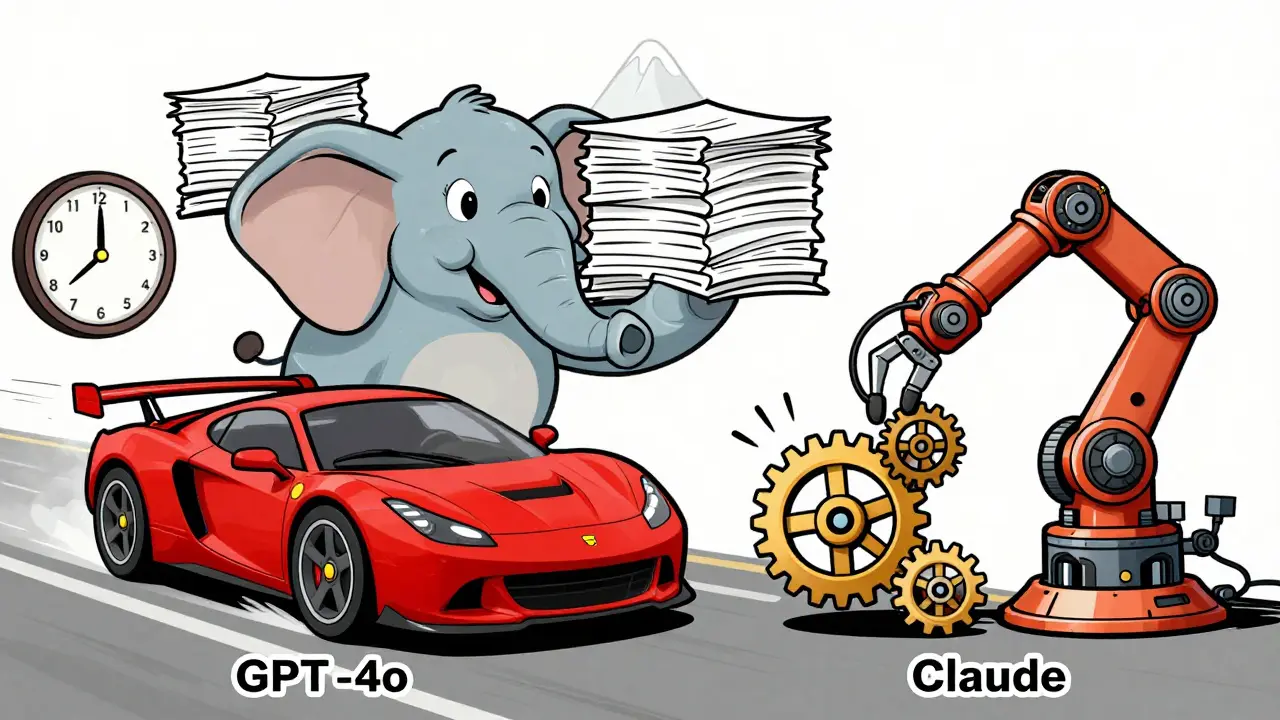
One of the biggest misconceptions about multi-model prompting is that it increases costs. In reality, it optimizes them. Using a premium model like Claude 4 Sonnet for every task is like using a sports car to deliver groceries-it works, but it burns fuel inefficiently. Conversely, using a cheap model for critical tasks can lead to expensive errors later.
Consider the pricing disparity: Claude 4 Sonnet is roughly 20 times more expensive than Gemini 2.5 Flash. If you have a pipeline that involves summarizing 1,000 short customer feedback forms, routing those to Gemini Flash will save you significant capital with negligible quality loss. However, if you are asking the AI to draft a merger agreement, that same switch could result in catastrophic legal oversights. The key is to identify which tasks are "high-risk" versus "low-risk."
Prompt caching also plays a role here. For deep prompts that repeat across multiple runs-such as iterative analysis or policy blocks-caching strategies produce meaningful cost reductions. Models like Claude benefit heavily from caching because the overhead of processing the initial system prompt is eliminated in subsequent turns. If your workflow involves long rubrics or repeated context injections, ensure your orchestration layer supports caching to maximize ROI.

The Leapfrogging Reality: Why Static Choices Fail
You might wonder if you should just pick the current leader and stick with it. The answer is no. The AI industry is defined by a "leapfrogging" pattern. As of early 2026, we have seen GPT-4o, Claude 3.5, and Gemini 1.5 emerge in rapid succession, each reclaiming leadership in areas where competitors previously dominated. A model that is superior in coding today might be surpassed in six months.
This dynamic means that static model selection decisions become outdated quickly. Instead of betting on a single vendor, focus on mastering the mechanics of multi-model orchestration. Build your systems to be agnostic-able to swap out the underlying model via API configuration without rewriting your entire application. This flexibility ensures that as new versions release, you can seamlessly route traffic to the newest, most capable model for specific tasks.
Furthermore, frontier models are converging toward feature parity in general tasks. The differences are now at the margins. Mastery of prompt engineering and data preparation matters more than the raw capability differences between models. A well-crafted prompt for a slightly weaker model often outperforms a vague prompt for the strongest one.
Building Your Multi-Model Workflow
Implementing this strategy doesn't require a complete overhaul of your tech stack. Start small. Identify one bottleneck in your current workflow. Is it slow response times in chat? Route that to GPT-4o. Is it inaccurate code generation? Route that to Claude. Is it missing context in long reports? Route that to Gemini.
Use a lightweight orchestration layer or even simple conditional logic in your scripts to direct requests. For example:
- If input contains an image → Send to GPT-4o.
- If input length > 100,000 tokens → Send to Gemini 2.5 Pro.
- If task is "generate Python code" → Send to Claude 4 Sonnet.
- Default → Send to GPT-4o for balance of speed and cost.
This approach gives you the best of all worlds. You get the speed of OpenAI, the precision of Anthropic, and the depth of Google, all while keeping costs under control. The future of AI usage isn't about choosing one champion; it's about conducting an orchestra.
What is multi-model prompting?
Multi-model prompting is a strategy where users deploy different large language models for specific tasks based on each model's strengths, rather than using a single model for all applications. This approach optimizes for cost, speed, accuracy, and specialized capabilities like coding or long-context analysis.
Which model is best for coding in 2026?
As of 2026, Claude 4 (specifically the Sonnet variant) is widely considered the best for complex coding tasks. It demonstrates superior instruction adherence, handles dense logic better, and produces more complete code structures with fewer hallucinations compared to GPT-4o and Gemini.
Why should I use Gemini for long documents?
Gemini 2.5 Pro features a significantly larger context window than its competitors. This allows it to process extensive documents, transcripts, and cross-referenced materials in a single pass without the need for chunking, which often leads to lost information or broken logical links in other models.
Is GPT-4o faster than Claude and Gemini?
Yes, GPT-4o is generally the fastest among the top-tier models. It generates tokens up to 2x faster than previous generations and offers ultra-low latency for audio responses (as low as 232ms), making it ideal for real-time interactions like customer support chats.
How much more expensive is Claude compared to Gemini?
Claude 4 Sonnet is approximately 20 times more expensive than Gemini 2.5 Flash for equivalent workloads. This price difference makes Gemini a highly attractive option for bulk processing and cost-sensitive applications where marginal quality differences are acceptable.
Do I need to rewrite my code to use multiple models?
Not necessarily. Most modern AI APIs share similar structures. You can implement a simple routing layer in your existing codebase that directs requests to different endpoints based on task type, input size, or content format, allowing you to leverage multiple models without a full rebuild.


Listen up because I am only going to say this once. You are literally throwing money into the void if you keep using GPT-4o for your legal contracts. It is not just about speed it is about precision and Claude does that better. Stop being lazy with your workflow. You have the tools to optimize so use them. If you are still treating all AI models like they are the same you are part of the problem. Get your act together and route your tasks properly or stay broke.
Actually, from a technical standpoint, the architectural divergence between the transformer-based models necessitates a more nuanced approach than simply 'routing' based on superficial task categories. While the post suggests a binary decision matrix, the reality involves complex latency trade-offs and context window saturation points that vary by specific API implementation. One must consider the tokenization efficiency of each model when dealing with non-English inputs, which significantly impacts the effective context length. Furthermore, the claim regarding Gemini's cost efficiency ignores the hidden costs of data egress fees and the potential need for additional preprocessing steps to align the output format with enterprise standards. It is a multifaceted ecosystem requiring rigorous benchmarking rather than heuristic shortcuts.
nah its all the same garbage just repackaged by big tech to steal our data. they want us fighting over which one is slightly less broken while they harvest every prompt we type. wake up sheeple. i stick to local models because at least then i know who owns my thoughts
the concept of choice is an illusion when the underlying architecture is dictated by corporate greed. we are merely selecting flavors of control. is it truly freedom if the menu is curated by algorithms designed to maximize engagement? perhaps the real optimization is in refusing to play the game entirely but most lack the philosophical fortitude to disconnect from the digital hive mind
You guys are missing the point completely. The whole premise of multi-model prompting is flawed because it assumes stability in a market that changes weekly. By the time you build your routing layer the benchmarks will be obsolete. Also your grammar is terrible Edward. And stop acting like you discovered fire with these 'strategic approaches'. It is basic load balancing dressed up as AI wisdom. Nobody cares about your orchestration layer when the models themselves are hallucinating half the time anyway.