
Imagine spending six months building a perfect AI-driven feature, only for your provider to update their model overnight and suddenly your prompts stop working. Or worse, you realize that the monthly bill for your API calls is now higher than the salary of a full-time engineer. This is the reality of the "black box" problem with managed services.
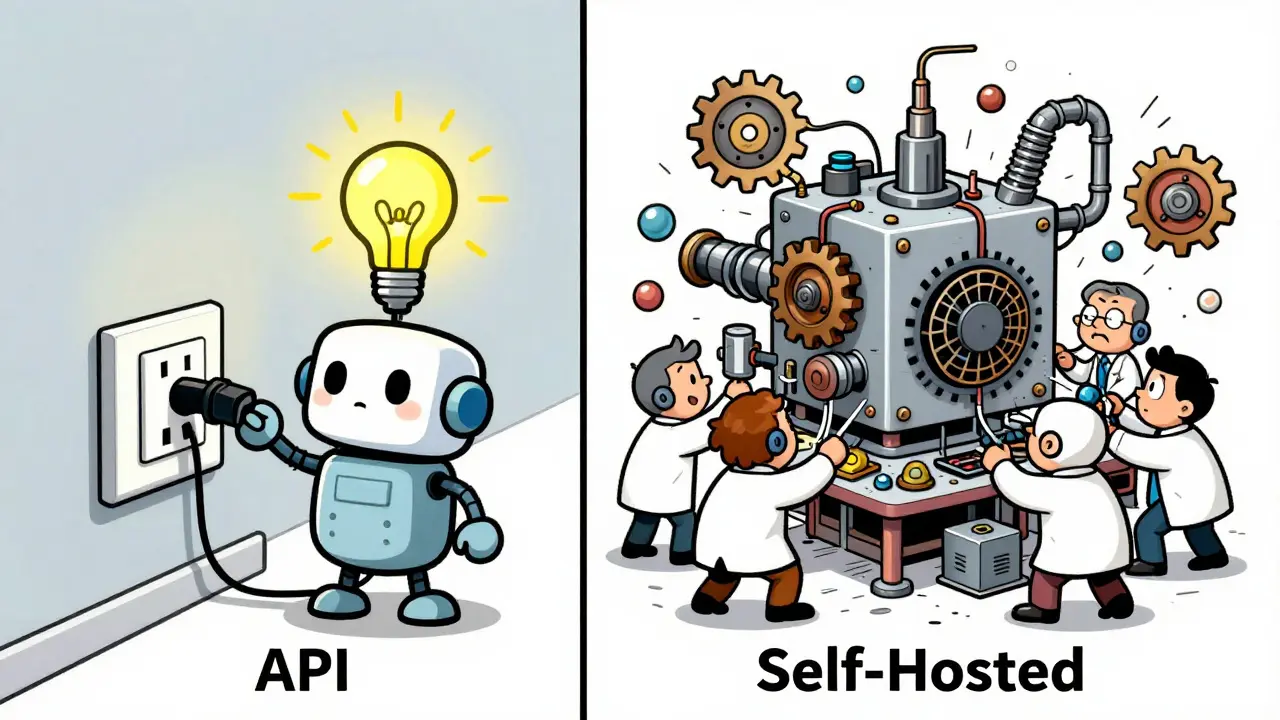
Choosing between a managed API is a cloud-hosted large language model accessed via a third-party provider, effectively acting as AI-as-a-Service and a self-hosted setup isn't just a technical choice-it's a business strategy. You're essentially deciding whether you want to rent your intelligence or own the factory that produces it.
| Feature | Managed APIs (e.g., OpenAI, Anthropic) | Self-Hosted (e.g., Llama, Mistral) |
|---|---|---|
| Setup Speed | Minutes (API Key) | Days/Weeks (Infra Setup) |
| Data Privacy | Provider-dependent | Full Organizational Control |
| Cost Structure | Pay-as-you-go (OpEx) | Upfront Hardware/Staff (CapEx) |
| Customization | Limited / Fine-tuning APIs | Total Control (Weights, Hyperparameters) |
| Scalability | Instant / Automatic | Manual / Hardware Provisioning |
The Convenience of Managed APIs
For most startups and lean teams, the managed route is the only logical starting point. You don't need to worry about GPU clusters or CUDA drivers; you just send a request and get a response. These services give you access to the "behemoths"-models like GPT-4 is a proprietary large-scale model from OpenAI with an estimated 1.7 trillion parameters. Trying to host something of that scale on your own would cost millions in hardware alone.
The real draw here is speed. You can move from an idea to a production-ready prototype in a weekend. The provider handles the scaling, the availability, and the hardware optimizations. However, this ease comes with a price: you are renting. If the provider changes their pricing, throttles your rate limits, or changes the model's "personality" through a stealth update, your application is at their mercy.
The Power of Self-Hosting and Open-Source
Then there's the other side of the coin. Self-hosted models are LLMs deployed on infrastructure controlled by the user, typically utilizing open-source weights. While you won't find a 1.7 trillion parameter model for your local server, the gap is closing. Models like Llama 2 is a prominent open-source model family by Meta that provides high-performance alternatives to proprietary LLMs have proven that smaller, specialized models can punch way above their weight.
In fact, if you take a 7B or 13B parameter model and fine-tune it on your own specific industry data-say, legal contracts or medical records-it can often outperform a general-purpose giant. You're not paying for the model to know who the 14th president of the US was; you're paying for it to be an expert in your specific niche. This is where the real competitive advantage lives.
Breaking Down the True Cost of AI
Many people look at a monthly OpenAI bill and think, "I could just buy a GPU and save money." It's not that simple. You have to look at the utilization rate. A common rule of thumb in the industry is that self-hosting becomes cheaper than a managed service like GPT-3.5 once your model is running at about 50% capacity. If you have erratic traffic with huge peaks and long silences, paying per token is actually cheaper.
But the "hidden cost" of self-hosting isn't just the electricity or the NVIDIA H100 is a high-performance GPU designed specifically for AI training and inference. It's the people. You can't just "install" an LLM and walk away. You need MLOps is a set of practices that aims to deploy and maintain machine learning models in production reliably and efficiently experts to handle versioning, monitoring for "hallucinations," and optimizing inference speed. If you don't have a team that can manage a Linux server and optimize Python environments, the "cheaper" self-hosted option will quickly become a nightmare.
Privacy, Compliance, and the "Air Gap"
For companies in healthcare, finance, or government, the conversation ends with privacy. Sending sensitive patient data or trade secrets to a third-party cloud is often a non-starter. Even with "Enterprise" agreements that promise not to train on your data, the data still leaves your perimeter. That's a massive regulatory risk.
Self-hosting allows for a complete air-gap environment. Your data never leaves your virtual private cloud (VPC) or your physical server room. You control the logs, the retention policies, and exactly who has access to the weights. In highly regulated industries, this isn't a luxury-it's a requirement for compliance with standards like HIPAA or GDPR.
Customization and Strategic Control
If AI is just a "feature" for you-like a chatbot to answer basic FAQs-a managed API is plenty. But if AI is your LLM strategy and the core of your product, you need control. With a self-hosted model, you can tweak the hyperparameters, change the temperature for more creative or deterministic outputs, and experiment with different quantization methods to make the model run faster.
You can also leverage platforms like Hugging Face is a central hub for the machine learning community providing a repository of pre-trained models and datasets to find a model that is already 80% of the way to your goal. From there, you can perform supervised fine-tuning (SFT) to make the model speak your brand's voice or follow a very specific logical flow that a general API would struggle with.

Making the Final Call: A Decision Framework
So, which one do you pick? It usually comes down to where you are in your company's journey and what your data looks like. If you are in the "exploration phase," start with an API. Don't waste three weeks setting up a Kubernetes cluster only to realize your product idea doesn't actually work. Fail fast and cheap.
Once you hit a specific scale-either in terms of monthly token spend or a requirement for sub-second latency that APIs can't guarantee-start looking at a hybrid approach. Use the big managed models for complex reasoning and use a small, self-hosted, fine-tuned model for the repetitive, high-volume tasks. This "Router" architecture gives you the best of both worlds: the brainpower of a giant and the efficiency of a specialist.
Can a small self-hosted model really beat GPT-4?
In general knowledge, no. But in a narrow domain (like analyzing specific legal documents), a 7B model fine-tuned on a high-quality, domain-specific dataset can often match or even beat the accuracy of a general-purpose giant because it isn't distracted by irrelevant information.
Is it possible to self-host on a regular laptop?
Yes, for small models (like 7B parameters) using techniques like quantization (reducing the precision of model weights). Tools like Ollama or llama.cpp allow you to run these on consumer-grade GPUs or even Apple Silicon Macs, though they won't handle high concurrent traffic.
What is the biggest risk of using managed APIs?
Model drift and vendor lock-in. Providers may update the model to be "safer," which can accidentally break the logic of your prompts. Additionally, if you build your entire workflow around a specific provider's proprietary features, switching costs can be incredibly high.
How much RAM do I need for a 13B parameter model?
In full precision (FP16), you'd need about 26GB of VRAM just to load the model. However, most people use 4-bit quantization, which brings that down to roughly 8-10GB, making it possible to run on a high-end consumer GPU like an RTX 3090 or 4090.
Do managed APIs train on my data?
It depends on the tier. Standard consumer accounts often have their data used for training unless opted out. Enterprise tiers usually offer a contractual guarantee that your data will not be used to improve their global models, but the data still physically resides on their servers.
Next Steps and Troubleshooting
If you're feeling overwhelmed, start with a small-scale pilot. Try running a Llama-based model locally using a tool like Ollama to see if the performance meets your needs for a specific task. If the quality is "good enough," you've just found a way to slash your future OpEx.
If you're sticking with APIs but worry about lock-in, implement an abstraction layer. Don't hard-code OpenAI's library into your app; instead, create a wrapper that allows you to switch the underlying API provider or swap to a self-hosted endpoint with a single configuration change. This keeps you agile and prevents you from becoming a hostage to your provider's pricing whims.


the abstraction layer tip is a lifesaver.
The point regarding model drift is absolutely critical; many developers overlook the instability of proprietary versioning until it is far too late!
We need to really lean into the synergistic potential of deploying localized LLM instances to minimize latency and maximize throughput across our entire tech stack! If you are not leveraging quantization to optimize your VRAM utilization and implementing a robust RAG pipeline to mitigate hallucinations while maintaining a high-fidelity knowledge base, you are essentially leaving performance on the table and failing to optimize your compute efficiency in a way that scales linearly with your user growth trajectory!
Oh sure, because hiring a full-time MLOps engineer to babysit a Linux server just to save a few bucks on tokens is just a brilliant financial strategy for a seed-stage startup! I love how we pretend that managing CUDA drivers and orchestrating Kubernetes clusters is a walk in the park while we're trying to achieve a product-market fit with a skeleton crew and a prayer! It is just so incredibly efficient to spend weeks on infrastructure instead of actually building the product, right?
I think the hybrid router approach is a great middle ground for teams that want the best of both worlds.
Weights are basically just big matrices. Quantization is the way to go for home rigs.
It is absolutely heart-wrenching to think about a developer pouring their soul into a project for half a year only to have a stealth update from a provider rip the heart out of their application's logic! We must empower the community to take ownership of their intelligence and move toward open-source sovereignty to protect the creative spirit from the whims of corporate boardrooms! It is a tragedy of the digital age that our most innovative tools can be rendered useless by a single API change!
agree with the privacy bit. some industries just cant risk the cloud