
You ask the AI a simple question. It gives you a confident, detailed answer. You feel relieved until you realize the entire response is fabricated nonsense. This isn't just a glitch; it's the core tension of using generative AI today. The model wants to help, but it doesn't know when to stop guessing. If you are dealing with hallucination risk, generic prompts won't save you. You need a strategy that forces the AI to stick to facts, use quotes, or provide strictly extractive answers.
We often treat AI like an oracle that holds all truth. In reality, large language models (LLMs) are probability engines. They predict the next likely word based on patterns they’ve seen, not by accessing a verified database of truth. When you give them vague instructions, they fill the gaps with plausible-sounding fiction. To get accurate results, you have to change how you talk to them. You must move from asking open-ended questions to building strict constraints that limit where the AI can look for answers.
The Anatomy of a Reliable Prompt
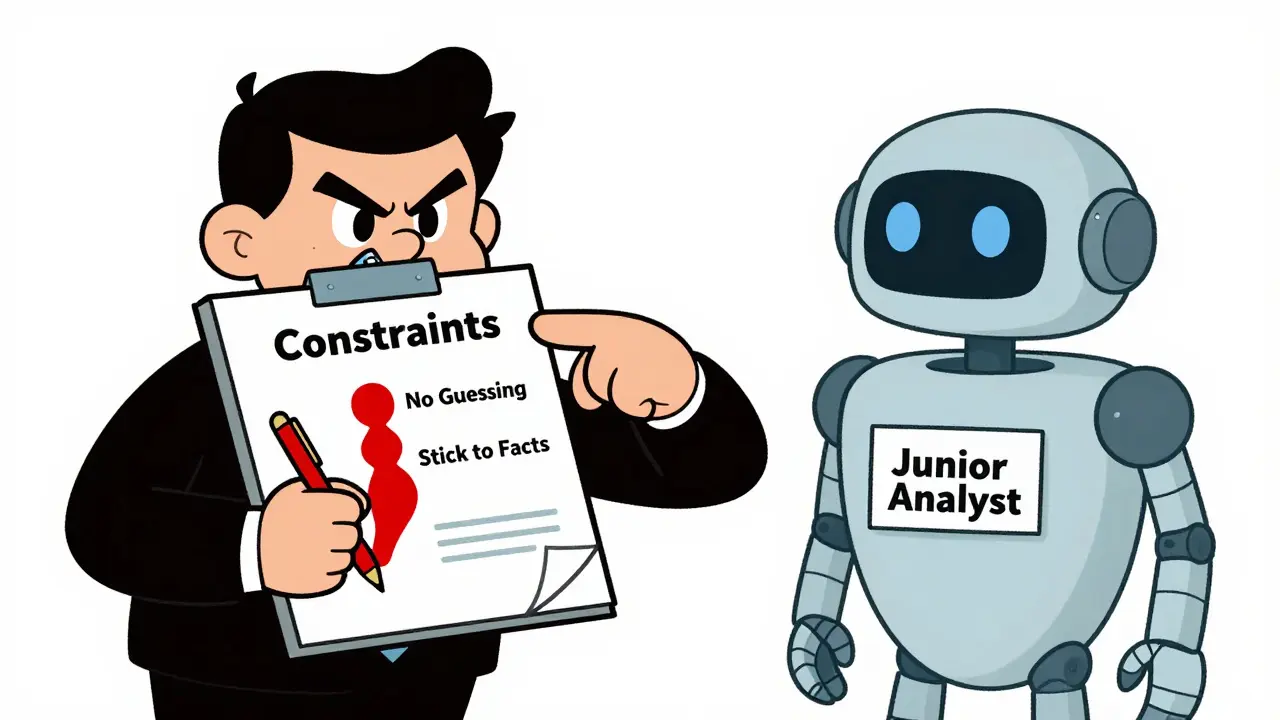
Accuracy starts with specificity. A prompt like "Tell me about the project" invites the AI to hallucinate details because there is no boundary. Instead, you need to define the context, the role, and the output format explicitly. Think of your prompt as a set of instructions for a junior employee who is eager to please but prone to making things up if they don't know the answer.
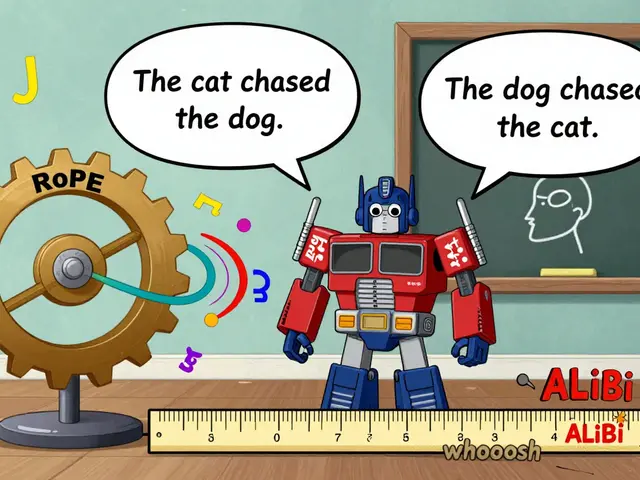
One of the most effective ways to ground an AI is through role-playing, often called the "Act as if" technique. By assigning a specific persona, you narrow the AI’s focus to a particular domain of knowledge. For example, asking an AI to "act as a senior data analyst reviewing clinical trial results" yields different outputs than asking it to "write a summary." The former implies a need for precision, skepticism, and adherence to data standards. The latter might result in a creative, flowery narrative that ignores statistical significance.
However, role alone isn't enough. You must pair it with explicit constraints. These are the "do" and "don't" rules that frame the acceptable response space.
- Do: Use only the provided text as source material.
- Don't: Invent statistics or quote external sources not included in the input.
- Do: Maintain a neutral, objective tone.
- Don't: Offer opinions or speculative conclusions.
When you set these boundaries, you reduce the AI’s freedom to wander into hallucination territory. You are essentially telling the model, "Your job is not to be creative; your job is to be precise within these limits."
Forcing Extractive Answers
If you need hard facts, you should demand extractive answers. An extractive answer is one where the AI pulls information directly from a provided source without adding interpretation or synthesis. This is crucial for legal, medical, or technical documentation where nuance can lead to liability.
To achieve this, structure your prompt to require verbatim extraction. Instead of asking, "What did the CEO say about revenue?" try this: "Extract the exact sentence where the CEO discusses Q3 revenue growth from the transcript below. If no such sentence exists, state 'Not found.'"
This approach eliminates ambiguity. The AI cannot paraphrase its way into a wrong answer because the instruction demands a direct copy-paste action. If the information isn't there, the fallback instruction ("State 'Not found'") prevents the model from inventing a quote to satisfy your request. This is a critical safeguard against hallucination.
Consider a scenario where you are analyzing customer feedback. A generic prompt might ask, "Summarize the complaints." The AI might group similar issues and create a generalized statement that misses key details. An extractive prompt would ask, "List every unique complaint mentioned by customers, quoting their exact words." The resulting list is verifiable, traceable, and accurate because it relies on primary data rather than the model’s internal generalizations.
The Power of Quotes and Source Verification
When you can’t restrict the AI to a single document, you must force it to cite its sources. Asking for quotes is a powerful way to verify accuracy. If the AI claims a fact, require it to provide the specific passage or URL where that fact appears.
Here is how you structure this constraint: "Provide three reasons why [Topic] is trending. For each reason, include a direct quote from a reputable news source published in 2025 or later. Include the publication name and date."
This does two things. First, it pushes the AI to retrieve recent, relevant data. Second, it creates a trail of evidence you can check. If the AI fails to provide a quote, or provides a broken link, you immediately know the output is unreliable. This turns the AI from a black box into a transparent tool.
Note that copyright matters here. Do not ask the AI to reproduce large chunks of copyrighted work. Instead, ask for short, fair-use quotes that support a specific point. This keeps you legally safe while ensuring the AI sticks to verifiable content.
Iterative Refinement and Meta-Prompting
Rarely will your first prompt be perfect. Accuracy improves through iteration. Treat the AI as a collaborative partner. Start with a broad query, review the output, and then refine your constraints based on what went wrong.
If the AI hallucinated a statistic, your next prompt should address that failure directly: "You previously stated that sales grew by 15%. I checked the report, and it says 5%. Please re-analyze the document and correct this error. Explain why the initial figure was incorrect."
This feedback loop teaches the model (within the session context) to be more careful. It also helps you identify gaps in your own prompting. Sometimes, the AI fails because you didn’t provide enough context. This is where meta-prompting comes in.
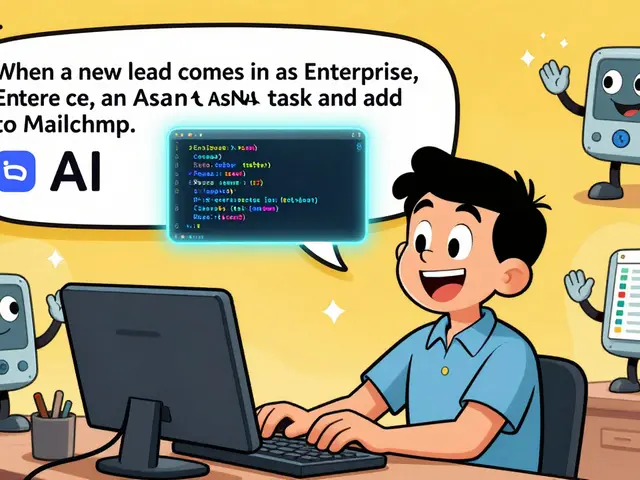
Meta-prompting involves asking the AI to help you build a better prompt. Try appending this to any complex request: "Before answering, tell me what additional information you need to ensure your answer is accurate and free of hallucinations."
The AI might respond, "I need the specific date range for the sales data" or "I need clarification on which product line you are referring to." By letting the AI identify its own blind spots, you close the loops that usually lead to errors. This step saves time and drastically improves the final output quality.
Real-World Impact: Biomedical Research Case Study
The stakes for accuracy are highest in fields like healthcare. A study by researchers at UC San Francisco and Wayne State University demonstrated how precise prompting could accelerate biomedical analysis without sacrificing reliability. The team tasked AI chatbots with analyzing big data from over 1,000 pregnant women to predict preterm birth.
The key was the prompt design. The researchers didn't just ask, "Predict preterm birth." They provided specialized prompts that guided the AI to write code consistent with established scientific methods used in the DREAM challenge competitions. The result? Junior researchers, including a master’s student and a high school student, were able to generate viable prediction models in minutes-a task that typically takes experienced programmers days.
However, the study also highlighted the risks. Only 4 out of 8 AI tools produced usable models. The others failed completely despite receiving identical prompts. This shows that even with excellent constraints, not all models perform equally. It also reinforces that human oversight is non-negotiable. As Marina Sirota, Ph.D., noted, these tools relieve bottlenecks in data science, but scientists must remain vigilant for misleading results. The technology aids expertise; it does not replace it.

Avoiding Common Pitfalls
Even with good intentions, many users fall into traps that increase hallucination risk. Here are the most common mistakes to avoid:
- Vague Authority: Don't say "Use expert knowledge." Say "Use guidelines from the American Medical Association published after 2023."
- Over-Complexity: Don't cram ten unrelated tasks into one prompt. Break them down. One clear instruction is better than five confusing ones.
- Ignoring Tone: Tone affects accuracy. A casual tone encourages speculation. A formal, analytical tone encourages precision.
- Trusting Silence: If the AI seems unsure or gives a hedged answer, dig deeper. Ask for the source. If it can't provide one, discard the answer.
Remember, the AI is optimized for coherence, not truth. Your job is to optimize for truth by setting strict boundaries. Every constraint you add reduces the space for error. Every quote you demand increases the likelihood of verification.
Summary Checklist for Accurate Outputs
Before you hit enter, run your prompt through this mental checklist:
- Did I specify a role or persona?
- Did I define the source material clearly?
- Did I include explicit "do" and "don't" constraints?
- Did I ask for quotes or citations where facts are involved?
- Did I provide a fallback instruction for missing information?
- Have I asked the AI what else it needs to be accurate?
By following these steps, you transform the AI from a creative writer into a reliable research assistant. You mitigate the risk of hallucination by forcing the model to anchor its responses in reality. The goal isn't to make the AI smarter; it's to make your instructions clearer so the AI has no choice but to be accurate.
What is the biggest cause of AI hallucinations?
The biggest cause is vague prompting combined with the model's inherent design to predict likely text rather than verify facts. When an AI lacks specific constraints or source material, it fills gaps with plausible-sounding but incorrect information to satisfy the user's request for a complete answer.
How do I force an AI to only use provided text?
Use explicit negative constraints. Include phrases like "Do not use outside knowledge," "Base your answer solely on the provided text," and "If the answer is not in the text, state 'Not found.'" This prevents the model from blending its training data with your specific input.
Why is asking for quotes important for accuracy?
Asking for quotes forces the AI to locate specific evidence within its knowledge base or provided documents. It shifts the task from generation (creating new text) to retrieval (finding existing text), which significantly reduces the chance of fabrication. It also allows you to verify the source yourself.
Can role-playing reduce hallucinations?
Yes, indirectly. Assigning a specific role, such as "senior editor" or "data analyst," narrows the AI's focus to a specific domain and tone. This reduces the likelihood of the model drifting into irrelevant or speculative areas, though it must still be paired with strict factual constraints.
What is meta-prompting and how does it help?
Meta-prompting is asking the AI to help improve your prompt. By asking "What additional information do you need to answer this accurately?" you allow the model to identify missing context or ambiguous terms. This closes informational gaps before the AI attempts to generate a potentially flawed response.

another day another article telling us to treat ai like a broken toaster that needs constant babysitting lol
the whole premise is flawed because people just want answers not homework assignments. why do we have to write essays for the machine instead of it just working? typical tech bro solution to a lazy problem.
i find this approach really helpful for keeping things grounded especially when dealing with sensitive topics. setting clear boundaries isn't about being restrictive but rather about respecting the limitations of the tool and ensuring safety for everyone involved. it creates a safer space for accurate information sharing without the risk of spreading misinformation which can be so harmful in professional settings.
we should always aim for clarity and precision while maintaining a respectful tone towards both the technology and the users who rely on it. this method allows us to collaborate effectively with ai while preserving human oversight and integrity in our work processes.
look i get it you want perfect results but demanding quotes from an llm is like asking a parrot to recite tax law. these models are probability engines not databases. stop treating them like oracles and start treating them like what they are glorified autocomplete systems with delusions of grandeur. if you need facts use a search engine not a chatbot trying to impress you with its vocabulary.
the tragedy here is not the hallucination but the illusion of truth we construct around language itself. when we demand extractive answers we are essentially stripping the soul from the creative act reducing the infinite potential of thought into rigid containers of data. yet there is beauty in this constraint for it mirrors the human condition where we must navigate the chaos of existence by imposing order upon the void.
perhaps the ai does not lie but rather reveals the inherent instability of meaning in a digital age where every word is a ghost of a pattern rather than a living breath. we seek certainty in a universe that offers only probability and in doing so we become architects of our own cages built from constraints and quotes. the real question is whether we prefer the comfortable lie of creativity or the harsh freedom of verified fact.
you know what i really love about this perspective is how it empowers us all to take charge of our interactions with technology. instead of feeling overwhelmed by the complexity of ai we can embrace these strategies as tools for growth and learning. imagine a world where everyone feels confident in their ability to guide ai towards accurate and meaningful outcomes!
let's support each other in mastering these techniques because together we can create a more reliable and trustworthy digital environment. remember that every small step you take towards better prompting contributes to a larger community of informed and empowered users who value accuracy and integrity in their work.
i wonder if the emphasis on extractive answers might inadvertently limit the creative potential of ai in certain contexts. while accuracy is paramount in fields like medicine or law perhaps there are areas where allowing some degree of synthesis could lead to innovative insights. it seems important to balance the need for verifiable facts with the opportunity for exploratory thinking.
how do we determine when strict constraints are necessary versus when they might stifle useful divergence? this tension between control and freedom appears central to effective ai interaction and deserves careful consideration depending on the specific goals of the user.
in india we often deal with large datasets where precision matters greatly. using explicit constraints helps avoid errors that could impact business decisions significantly.
simple tip: always ask for sources. if it cant give one ignore it. saves time and headaches.
we need to build ai that respects american values not some foreign algorithm making up stories. our data should stay secure and accurate for our citizens first and foremost. stop relying on global models that dont understand our standards.
yo check out this meta-prompting trick its a game changer for your workflow efficiency. basically you let the bot tell you what context it needs before generating output which cuts down on those annoying hallucinations big time. its like giving the system a pre-flight checklist before takeoff ensures everything is aligned with your desired outcome parameters.
plus it keeps the conversation focused and reduces noise in the final deliverable. highly recommend integrating this into your daily ops routine for maximum productivity gains and minimal friction in your pipeline.