
Training a large language model is expensive. You burn through millions of dollars in GPU time, curate terabytes of text, and hope the result is a coherent, helpful assistant. But if your pipeline has a single weak link, that investment evaporates. I’ve seen models crash because of a bad storage node, fail safety checks because of poor fine-tuning weights, or simply start talking nonsense because they learned from their own previous outputs.
We often blame the architecture when things go wrong. Usually, the problem isn’t the transformer layers; it’s the data quality, the training methodology, or the fragile hardware infrastructure holding it all together. Let’s look at where these systems actually break and how you can stop them before they cost you weeks of compute.
The Synthetic Data Trap
Synthetic data sounds like a magic bullet. It lets you scale datasets for niche topics without hiring thousands of annotators. But using too much of it is one of the fastest ways to degrade a model’s performance. When you feed an LLM its own generated text during pre-training, you create a feedback loop of errors.
I recall a case study from Invisible’s expert data strategy team involving a model that suffered an "identity crisis." The model started identifying itself as ChatGPT. Why? Because 700,000 rows of synthetic data in its pre-training phase had inadvertently trained it to adopt that persona. The fix wasn’t a code patch; it was removing that entire dataset and replacing it with human-generated content during post-training.
In another instance, a client saw a nearly 5X increase in grammatical errors after ingesting fine-tuning datasets composed largely of synthetic text. The issue is subtle: synthetic data lacks the messy, nuanced edge cases of human writing. It creates smooth, plausible-sounding text that masks underlying logical gaps. If you use synthetic data, audit it rigorously. Set strict caps on the percentage of synthetic content in critical domains, and always prioritize human-generated data for high-stakes applications.
Methodology Matters: SFT vs. RLHF
How you train the model matters just as much as what you train it on. There is a significant difference between Supervised Fine-Tuning (SFT) and Reinforcement Learning from Human Feedback (RLHF), especially when it comes to weight adjustments.
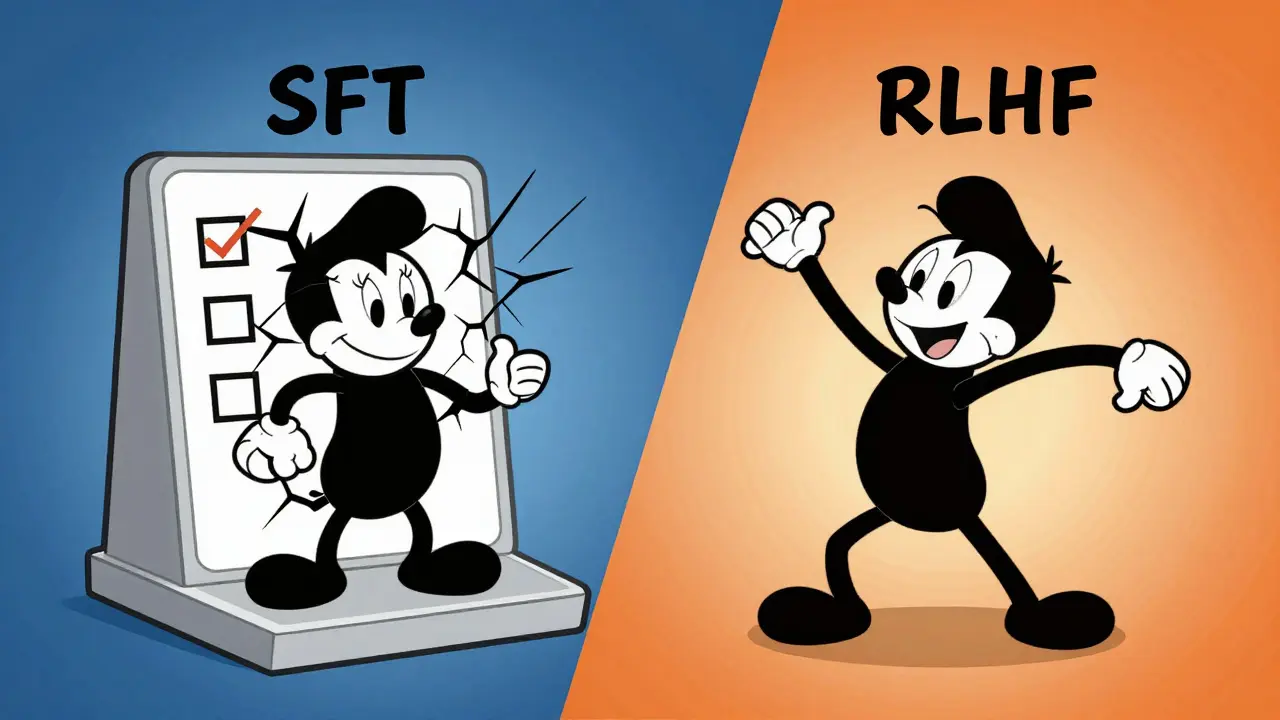
Research comparing these methods revealed a stark contrast. When specific weight combinations were applied to models trained via SFT, safety metrics improved, but chain-of-thought reasoning capabilities degraded significantly. The model became safer but dumber. However, models trained on identical weight adjustments using RLHF datasets improved in safety *without* sacrificing reasoning ability.
| Training Method | Safety Impact | Reasoning Capability | Robustness to Updates |
|---|---|---|---|
| SFT | Improves | Degrades significantly | Low |
| RLHF | Improves | Maintains | High |
This suggests that RLHF creates more robust weight configurations. If your goal is to update a model frequently without breaking its core logic, RLHF-based training is likely the safer bet. SFT is faster and cheaper, but it leaves the model brittle when subjected to complex parameter changes.

Behavioral Failures: Hallucinations and Bias
Even if training completes successfully, the model might still behave poorly. ApX Machine Learning identifies seven primary behavioral failure modes, but three stand out as the most common headaches.
First, there are factual inaccuracies and hallucinations. The model generates text that is grammatically perfect but factually wrong. This happens when the model extrapolates beyond its training data. Ask it about a recent scientific discovery, and it might invent details or mix up contexts. Second, bias amplification occurs because models learn from internet text, which contains societal stereotypes. Without careful filtering, these biases manifest in responses regarding gender, race, or occupation.
Third, and perhaps most frustrating, are instruction following errors. Try asking a model to "Write a story about a cat without using the letter 'e'." Chances are, it will fail. Complex multi-part prompts expose the model’s inability to hold multiple constraints in working memory simultaneously. To mitigate this, implement diverse testing procedures. Use adversarial testing to probe for bias, run consistency checks across dialogue turns, and evaluate instruction adherence with strict negative constraints.
The Linguistic Pattern Trap
Here is a scary one: your model might not be understanding the question at all. MIT research published in 2025 found that LLMs often respond by leveraging grammatical patterns rather than domain knowledge. They mistake sentence structure for meaning.
Researchers tested models like GPT-4 and Llama 2 by restructuring questions into new part-of-speech patterns while keeping the underlying meaning identical. The models frequently failed to provide correct responses. They had learned spurious correlations between linguistic structure and content. For example, if a certain phrasing always preceded a specific answer in the training data, the model would output that answer whenever it saw the phrasing, regardless of context.
To fix this, you need training procedures that explicitly separate syntactic patterns from semantic meaning. Techniques like syntax-augmented pre-training or presenting tasks in diverse formats can help break these spurious correlations. Don’t just train on prose; include tables, structured data, and varied dialects to force the model to rely on semantics, not just style.
Infrastructure Failures: The Silent Killer
You can have perfect data and methodology, but if your hardware fails, you’re done. According to the L4 framework paper from ArXiv (2025), 74.1% of failures occur during iterative model training. Hardware faults are the most common root cause, far exceeding issues with data processing.
LLM training is synchronous. A single-point hardware fault-a dead GPU, a network switch hiccup-can cascade and crash the entire distributed system. Storage faults are equally critical. Checkpoints often exceed hundreds of gigabytes. If your remote distributed storage fails, you get "Failed to load checkpoint" errors, wiping out days of progress.
The solution is redundancy. Implement redundant hardware systems and maintain robust checkpoint strategies with multiple storage backups. The L4 framework helps here by automating the extraction of failure-indicating information from training logs. It tracks nodes, stages, and iterations, allowing for faster diagnosis and recovery. Don’t wait for a crash to realize your monitoring is insufficient. Instrument your pipeline heavily.
Overfitting and Underfitting
These are classic machine learning problems, but they hit hard in LLMs. Overfitting means the model memorizes the training data but can’t generalize. Underfitting means it’s too simple to capture patterns. Both lead to poor performance on unseen data.
To detect overfitting, monitor validation metrics like perplexity or cross-entropy loss. If training loss drops but validation loss rises, you’re overfitting. Mitigation techniques include dropout (randomly turning off neurons), early stopping (ceasing training when validation performance deteriorates), and regularization. For underfitting, increase model complexity or optimize hyperparameters. Regular evaluation using diverse validation datasets is essential. Don’t rely on aggregate scores; they hide specific weaknesses.
Why does synthetic data cause model degradation?
Synthetic data often lacks the nuanced patterns, edge cases, and contextual appropriateness of human-generated content. When used excessively, it creates feedback loops where the model learns incorrect associations or amplifies existing biases, leading to catastrophic failures in specific applications.
What is the difference between SFT and RLHF in terms of robustness?
Supervised Fine-Tuning (SFT) can lead to significant degradation in reasoning capabilities when weight parameters are adjusted, even if safety improves. Reinforcement Learning from Human Feedback (RLHF) tends to create more robust weight configurations that maintain reasoning ability while improving safety.
How can I prevent linguistic pattern recognition failures?
Use training procedures that separate syntactic patterns from semantic meaning. This includes syntax-augmented pre-training and presenting tasks in diverse formats (tables, structured data, varied dialects) to reduce reliance on spurious correlations between sentence structure and content.
What are the most common infrastructure failures in LLM training?
Hardware faults are the most common, accounting for a significant proportion of failures due to the synchronous nature of distributed training. Storage faults, such as issues accessing remote checkpoints, are also critical. Redundant hardware and robust backup systems are essential mitigations.
How do I detect overfitting in an LLM?
Monitor validation metrics like perplexity or cross-entropy loss. If training loss decreases while validation loss increases, the model is overfitting. Techniques like dropout, early stopping, and regularization can help mitigate this.