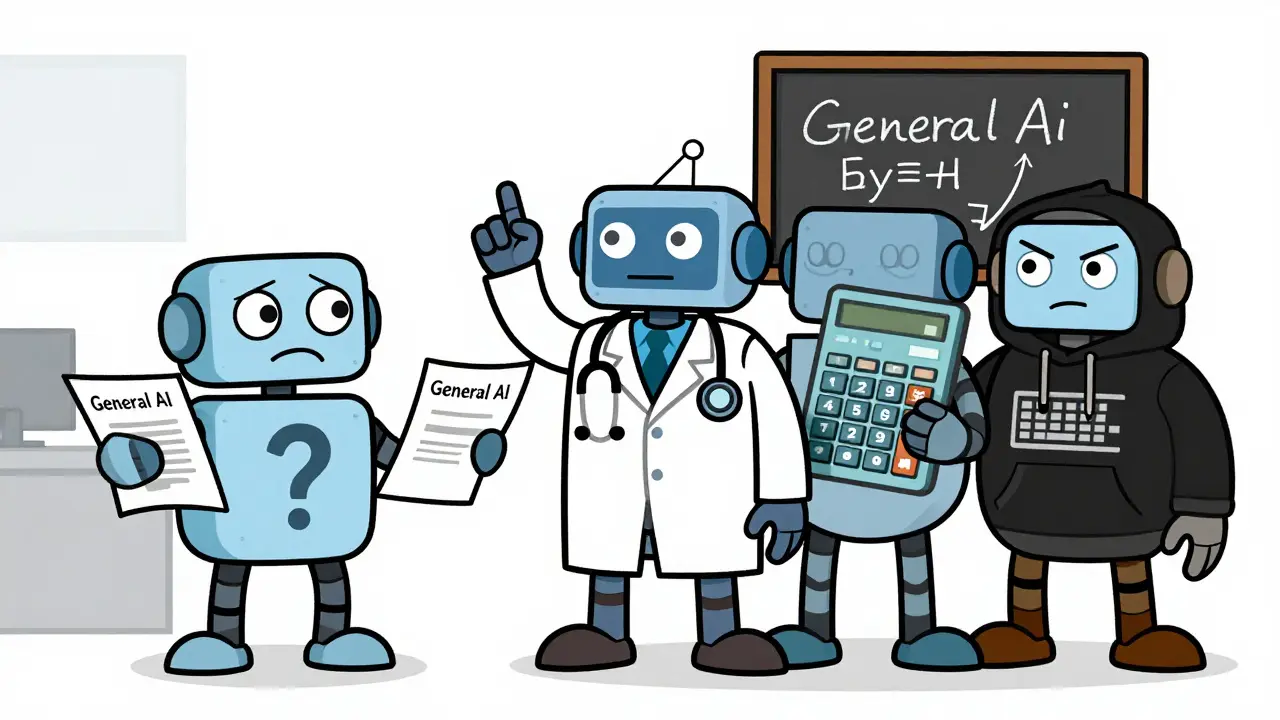
General-purpose AI is great for chatting, but it falls apart when you need precision. If you ask a standard model to write Python code, solve a graduate-level calculus problem, or interpret an MRI scan, you’re often getting lucky rather than reliable. That’s why domain-specialized Large Language Models are taking over. These aren’t just tweaked versions of your average chatbot; they are built from the ground up-or heavily fine-tuned-to master specific professional fields.
In 2026, we’ve moved past the hype cycle. The question isn’t whether specialized AI works-it does. The National Institute of Standards and Technology (NIST) confirmed in April 2024 that these models outperform general ones by 23-37% on domain-specific tasks. But choosing the right one requires understanding the trade-offs between accuracy, cost, and integration complexity. Let’s break down how these models work in medicine, mathematics, and coding, and what it actually takes to deploy them.
The Shift from General to Specialized AI
Why did we move away from one-size-fits-all models? Because "general" means "average." A model trained on the entire internet knows a little about everything but masters nothing. Domain-specialized LLMs address this by training on curated corpora-high-quality, sector-specific data sets.
According to a 2023 Deloitte report, these models use specialized vocabularies and knowledge graphs to handle technical jargon and regulatory requirements that general models miss. The result? A 40-60% boost in accuracy on specialized tasks and a 30-50% reduction in computational costs compared to scaling up general models. You’re paying less for better performance because the model doesn’t waste resources guessing context.
| Domain | Specialized Model | Accuracy Gain | Key Benchmark |
|---|---|---|---|
| Medicine | Med-PaLM 2 | +18.4 points | MedQA |
| Mathematics | MathGLM-13B | +25.7 points | MATH Dataset |
| Coding | CodeLlama-70B | +14.2 points | HumanEval |
Medical AI: Precision Over Speed
Healthcare is the most mature market for specialized AI, accounting for 47% of the $9.3 billion global market in Q1 2025. Here, hallucinations aren’t just annoying-they’re dangerous. Models like BioGPT, trained on 15 million PubMed abstracts, and Google’s Med-PaLM 2, which features 540 billion parameters, are designed to reduce diagnostic errors.
Med-PaLM 2 achieves 92.6% accuracy on the MedQA benchmark, surpassing human experts by 6.3 percentage points. More importantly, it reduces hallucination rates from 19.3% to 5.7% in diagnostic scenarios. Dr. Emily Chen, Director of AI at Mayo Clinic, noted that while tools like Diabetica-7B reduced diagnostic error rates by 22%, they require constant validation against clinical guidelines. This isn’t set-and-forget technology.
Deployment is complex. Healthcare implementations must comply with HIPAA and GDPR Article 9, adding 2-5 months to timelines. A typical rollout involves a team of two AI engineers, one domain expert, and one compliance officer, costing between $285,000 and $475,000. Yet, the ROI is clear: BioGPT can synthesize biomedical literature 42% faster than general models, turning a 3-hour review into a 22-minute task.
Mathematical AI: Symbolic Reasoning Matters
Math isn’t just about arithmetic; it’s about logic and structure. General models struggle with multi-step proofs because they predict tokens, not logical steps. Enter MathGLM-13B, developed by Tsinghua University. Released in January 2025, it incorporates symbolic reasoning modules that allow it to manipulate equations rather than just recognize patterns.
On the MATH dataset, MathGLM-13B hits 85.7% accuracy, compared to 58.1% for similarly sized general models. For graduate-level problems, it reaches 89.2% accuracy versus 63.5% for GPT-4-turbo. However, there’s a catch: it fails on 68% of open-ended conjecture tasks. Professor David Patterson of UC Berkeley warned that while these models achieve near-human performance in proof generation, they still struggle with interdisciplinary applications.
Adoption is slower here, sitting at 41% penetration in academic institutions. Why? Because using these tools effectively requires advanced mathematics knowledge. Users need at least graduate-level coursework to prompt the system correctly. It’s a powerful tool, but only if you speak its language.

Coding AI: From Completion to Generation
Coding is where specialized AI has seen the fastest enterprise adoption, reaching 63% in 2025. Models like Meta’s CodeLlama-70B and StarCoder2-15B are built to understand syntax, libraries, and debugging contexts deeply. StarCoder2-15B generates functional code 34% faster than GPT-4 with 22% fewer syntax errors across eight programming languages.
But don’t expect them to replace senior architects yet. Dr. Soumith Chintala of Meta AI pointed out that while CodeLlama excels at syntax generation, it lags by 35 percentage points in understanding complex business logic. It writes clean functions, but it doesn’t always know *why* those functions fit the broader application architecture.
Integration is smoother than in medicine. Most enterprises use Kubernetes operators for model serving, and developers adapt quickly-often within 2-3 weeks. GitHub reviews show a 4.3/5 rating for CodeLlama, praising its context-aware completion (92% accuracy on Java methods). The main complaint? Limited documentation on fine-tuning procedures.
The Cost-Benefit Analysis
You might wonder if the specialization is worth the extra effort. The numbers say yes, but with caveats. Instaclustr’s 2025 analysis shows that specialized 7B-parameter models cost $0.87 per 1,000 tokens, compared to $2.15 for equivalent general models. That’s a 59.5% operational saving.
However, initial training costs are higher. Building a specialized model can cost $1.2-3.5 million, whereas fine-tuning a general model runs $0.7-1.8 million. Also, specialized models perform 30-45% worse on out-of-domain tasks. If you deploy Med-PaLM 2 to write marketing copy, it will fail miserably. You need separate models for separate jobs.
- Hardware Requirements: Medical models like Diabetica-7B need 24GB VRAM, while larger code models like CodeLlama-70B require 80GB.
- Latency: Expect 200-500ms per response on standard enterprise GPUs. In medicine, even 18 seconds of latency caused 47% of physicians to initially reject the system.
- Security: Code models use sandboxed execution environments to prevent malicious code generation. Medical models enforce zero data retention policies.

Implementation Challenges and Solutions
Deploying these models isn’t plug-and-play. The Deloitte 2025 Federal AI Report found that 73% of government agencies face integration challenges with legacy systems, requiring 6-18 months of additional development time. Common pitfalls include data formatting inconsistencies (reported by 67% of healthcare users) and prompt engineering complexity (72% of code deployments).
To mitigate these issues, successful teams use hybrid architectures combining retrieval-augmented generation (RAG) with specialized models. They also start with non-critical applications to build trust. For example, Epic Systems users reported a 27% speedup in clinical documentation after implementing specialized prompts, reducing errors by 33%. The key is phased deployment: start small, validate rigorously, then scale.
Future Trends: Hyper-Specialization
We’re entering the era of hyper-specialization. Google’s Med-PaLM 3, announced in November 2024, includes subspecialty models for cardiology, oncology, and neurology, each trained on 3-5 million specialty-specific documents. Bix Tech forecasts that 78% of new enterprise LLM deployments will be domain-specialized by Q4 2025, up from 54% in 2024.
This trend suggests that general-purpose AI will become a niche product for casual use, while professionals will rely on highly targeted tools. Whether it’s a model for colonoscopy report generation or Python financial modeling, the future is granular. Long-term viability looks strongest in medicine (92% expert confidence), followed by coding (85%) and mathematics (79%). By 2027, we may see medical AI receive full regulatory approval as clinical decision support tools, marking a historic shift in healthcare delivery.
What is a domain-specialized Large Language Model?
A domain-specialized LLM is an AI model trained or fine-tuned on high-quality, sector-specific data sets to excel in particular fields like medicine, coding, or mathematics. Unlike general models, they use specialized vocabularies and knowledge graphs to improve accuracy and reduce hallucinations in technical tasks.
How much more accurate are specialized models compared to general ones?
According to NIST, specialized models outperform general LLMs by 23-37% on domain-specific benchmarks. In specific cases, such as Med-PaLM 2 in medicine, the accuracy gain can be over 18 percentage points on clinical exams.
Are specialized AI models cheaper to run?
Yes, operational costs are lower. Instaclustr reports that specialized 7B-parameter models cost $0.87 per 1,000 tokens versus $2.15 for general models, offering nearly 60% savings. However, initial training costs are higher ($1.2-3.5 million).
What are the biggest risks of using specialized AI in healthcare?
The main risks include integration complexity with legacy EHR systems, potential latency issues affecting user adoption, and the need for constant validation against clinical guidelines. Regulatory compliance (HIPAA/GDPR) also adds significant deployment time.
Can code-specialized models replace senior developers?
Not yet. While models like CodeLlama-70B excel at syntax and debugging, they lag significantly in understanding complex business logic and architectural decisions. They are best used as productivity tools rather than replacements for human judgment.
Which industry is leading in specialized AI adoption?
Healthcare leads with 47% of the market share, driven by high stakes and clear ROI in diagnostics and literature synthesis. Coding follows with 38%, and mathematical applications account for 15%, primarily in research and pharmaceutical sectors.



I honestly feel a profound sense of dread reading this. It’s like watching the slow, inevitable erosion of human intuition being replaced by cold, hard metrics that don’t care about your feelings or your context. We are trading our souls for efficiency, and nobody is even blinking. The idea that we need separate models for every little task is just exhausting to think about. It’s not progress; it’s fragmentation disguised as precision. I’m tired of the hype cycle because it leaves the average person behind in the dust while the elites play with their specialized toys.
This is all just a way to control what information you get. They say specialized models are better but really they are just trained to say only what the companies want you to hear. The NIST report is probably funded by the same people selling these models so who can trust them. General AI is free thinking but these new ones are just digital leashes for your brain. Wake up.
It is fascinating how different industries are adopting these tools at such varied paces. In my experience working with cross-border teams, the cultural nuance often gets lost in general models, which makes me appreciate the potential for domain-specific training. However, we must ensure that accessibility remains a priority as we move toward hyper-specialization. Technology should bridge gaps, not create new silos of expertise that exclude those without advanced degrees.
I’ve actually been experimenting with CodeLlama for some internal scripts and the speed difference is noticeable. It doesn’t replace the senior dev role, obviously, but it handles the boilerplate so well that it frees up time for actual architectural thinking. The key is knowing when to trust it and when to double-check the logic. If you treat it like a junior intern who reads fast but lacks life experience, it’s incredibly valuable.
The grammar here is impeccable, which is refreshing. I find that when technical writing becomes too dense, it loses its audience, but this breakdown strikes a good balance between data and readability. The point about latency in medical settings is particularly salient. A delay of eighteen seconds might seem negligible to an engineer, but to a physician in a triage scenario, it could be the difference between life and death. Precision matters, but so does immediacy.
We need to stop outsourcing our critical infrastructure to foreign-trained models and focus on domestic capabilities. The fact that Tsinghua University is leading in mathematical AI is a national security risk waiting to happen. Our healthcare systems are already vulnerable, and now we’re letting Chinese-developed symbolic reasoning modules dictate our academic standards? This is unacceptable. We must prioritize American-led AI development to ensure our sovereignty and economic dominance in the global market.
The notion that one requires 'graduate-level coursework' to effectively prompt a mathematical model is precisely why these tools will remain the preserve of the intellectual elite. It is not merely a tool; it is a filter. Those without the requisite educational pedigree will find themselves increasingly marginalized in professional environments where efficiency is paramount. The democratization of knowledge was a fleeting illusion; we are returning to a meritocracy defined by access to proprietary, high-fidelity computational resources.
They claim zero data retention policies but do you really believe any corporation keeps their hands off your data. The sandboxed execution environments are just a facade to make you feel safe while they harvest patterns from your code. Once they have enough data they won’t need specialized models anymore they will just have everything you ever typed. Trust no one.