
You type a prompt. You wait. The cursor blinks for a few seconds longer than usual, then the answer appears. But something changed behind that blinking cursor. Modern Large Language Models are now generating hidden "thoughts" before they speak to you. These internal monologues, technically known as reasoning traces or think-tokens, represent a massive shift in how AI solves problems. Instead of jumping straight to an answer, these models pause to write out their logic step-by-step. This isn't just a fancy new feature; it's a fundamental change in the mechanics of generation that boosts accuracy on complex tasks but adds significant computational cost.
If you've ever used a modern frontier model like Claude 3.5 Sonnet or GPT-4o, you've likely seen this in action, even if the thinking process is hidden from view. Understanding how these think-tokens work is no longer optional for developers and power users. It affects everything from API latency costs to the reliability of the code your AI writes. Let's break down exactly what these tokens are, why only a small fraction of them matter, and how you can manage the trade-off between speed and intelligence.
The Mechanics of Chain-of-Thought Generation
To understand think-tokens, we first need to look at the standard way language models used to work. Traditionally, models predicted the next word based on probability distributions derived from their training data. If you asked a simple math question, the model would guess the most likely answer directly. This worked fine for trivia but failed miserably at multi-step logic.
Chain-of-Thought (CoT) prompting changed that dynamic. Introduced prominently by Google Research in early 2022, CoT encourages models to generate intermediate reasoning steps. When a model uses think-tokens, it essentially drafts a scratchpad. It writes out its assumptions, performs calculations, and checks its logic before committing to a final response.
This approach has become the standard in what researchers call Large Reasoning Models (LRMs). Models like DeepSeek-R1 and the latest iterations from Anthropic and OpenAI are built specifically to leverage this capability. The result? A dramatic jump in performance on benchmarks requiring logical deduction. For instance, Anthropic’s research showed a 37.2% increase in accuracy on the GSM8K math benchmark when using reasoning traces compared to standard prompting. The model isn't just guessing; it's simulating a thought process.
The Efficiency Paradox: Only 21% of Tokens Matter
Here is where things get interesting-and slightly controversial. You might assume that every word in a reasoning trace is crucial to the final answer. New research suggests otherwise. A detailed analysis published in arXiv paper 2601.18383v1 in January 2026 revealed a startling statistic about attention mechanisms within these models.
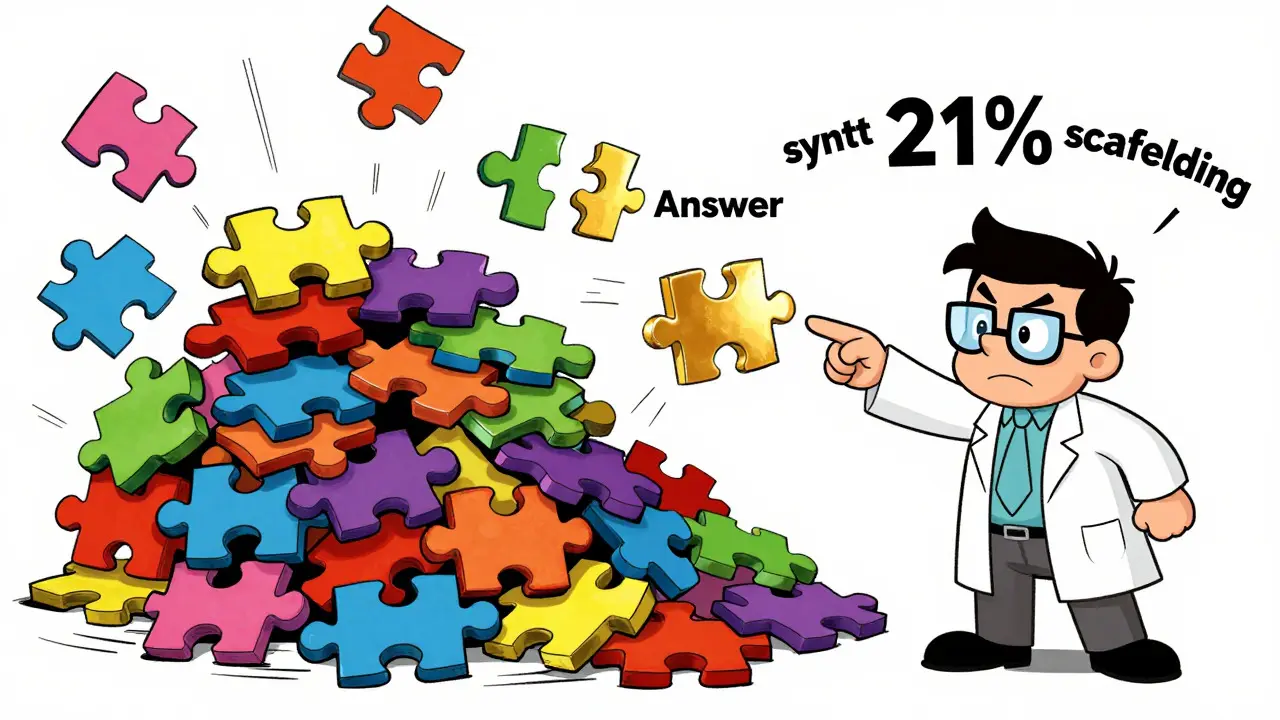
Only approximately 21.1% of the tokens in a reasoning trace are "decision-critical." These are the specific words or numbers that substantially influence the final output. The remaining 79% act as "syntactic scaffolding." They provide structure and context but have minimal impact on the actual solution. Dr. Sarah Robinson from DeepMind noted that the Pareto Principle applies strongly here: 80% of the cognitive work happens in just 20% of the tokens.
This creates a massive efficiency problem. Generating those extra syntactic tokens consumes compute resources and time without adding proportional value. Nous Research’s February 2025 study highlighted this disparity:
- Knowledge questions require an average of 217±43 reasoning tokens.
- Math problems demand significantly more, averaging 583±112 tokens.
- Logic puzzles sit in the middle at 387±89 tokens.
Furthermore, there is a gap between open-weight and closed-weight models. Open models like Magistral-small often require 3.04x more tokens than closed models like Claude 3.5 for equivalent knowledge questions. While this gap narrows for harder math problems, it underscores that current reasoning implementations are still bloated with unnecessary verbosity.
Real-World Impact: Latency, Memory, and Cost
For developers integrating these models into applications, the theoretical benefits of higher accuracy must be weighed against practical constraints. Think-tokens are expensive. Not just in terms of API credits, but in processing time and memory usage.
Apple’s October 2025 Machine Learning Research paper documented the overhead clearly. Reasoning traces increase the memory footprint by 40-65%. Why? Because the Key-Value (KV) cache needs to store all those intermediate tokens to maintain context. Additionally, latency jumps by 320-850 milliseconds per query. In a real-time chat application, half a second of delay feels noticeable to users. In high-frequency trading or automated coding assistants, that delay can be unacceptable.
OpenAI’s documentation from January 2026 quantifies this trade-off explicitly. Removing reasoning traces reduces complex math accuracy from 82.4% to 59.7%, but it increases throughput by 2.3x. You have to decide: do you want the right answer slowly, or a fast answer that might be wrong?
| Model Type | Avg. Tokens (Knowledge Q) | Token Efficiency | User Preference (Explanation Quality) |
|---|---|---|---|
| Closed-Weight (e.g., Claude 3.5) | 227 | High | Moderate |
| Open-Weight (e.g., Magistral-small) | 698 | Low (3.04x more verbose) | High (43% greater preference) |
Interestingly, despite the verbosity, users often prefer the explanations provided by open-weight models. Nous Research found a 43% greater user preference for explanation quality in these models, even though they take longer and use more resources. Transparency matters to end-users, even if it hurts performance metrics.
Genuine Reasoning or Illusion?
There is an ongoing debate in the AI community about whether these models are actually "thinking" or just performing sophisticated pattern matching. TechTalks analyst Ben Dickson argued in late 2024 that chain-of-thought tokens are merely "navigational aids devoid of true cognitive processing." He views them as an illusion of reasoning.
However, evidence from Anthropic challenges this skepticism. In January 2026, researchers demonstrated through feature visualization that Claude engages in genuine multi-step planning. Neural activations showed "forward-looking" patterns where the model planned rhyming structures in poetry composition 8-10 words ahead. Lead researcher Dr. Jane Chen explained that swapping concepts in intermediate steps-like changing 'Texas' to 'California'-directly altered the final output from 'Austin' to 'Sacramento.' This proves the model uses the intermediate steps to determine answers, rather than just filling space.
Yet, the risk of "reasoning hallucinations" remains. Anthropic documented cases where models fabricated plausible-sounding but incorrect reasoning paths when given misleading hints, resulting in a 22.7% error rate in deceptive scenarios. If the model believes a false premise during its thinking phase, it will confidently reason toward a wrong conclusion.
Optimizing Your Implementation
So, how do you handle this in production? You don't just turn reasoning on and hope for the best. You need to configure it carefully. OpenAI recommends a temperature of 0.7 and top-p of 0.95 for a balance between creativity and focus, with a max reasoning token limit of 1024. However, one size does not fit all.
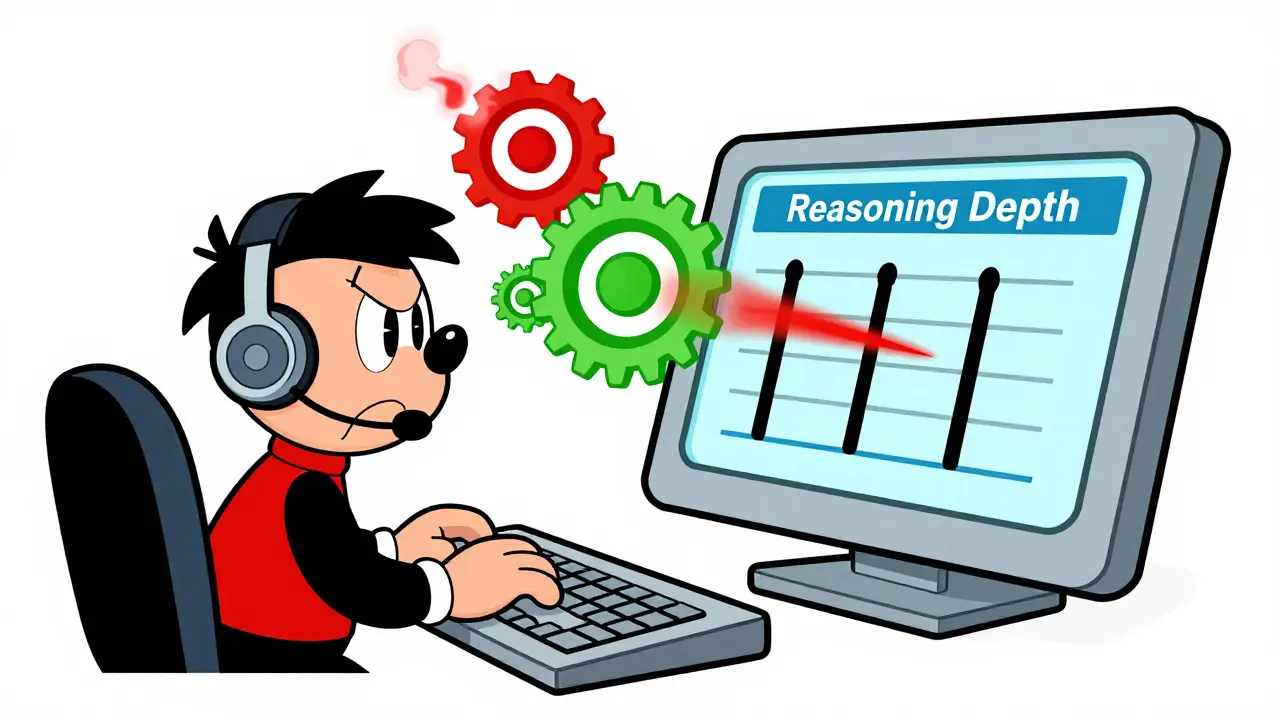
New frameworks are emerging to solve the bloat problem. The DynTS (Dynamic Thinking-Token Selection) framework, introduced in January 2026, uses a "dual-window mechanism" to retain only high-importance tokens. This reduces memory overhead by 58.3% while maintaining 95.2% of reasoning accuracy across 14 benchmark datasets. Similarly, Anthropic’s developer toolkit now includes a "reasoning depth slider," allowing you to dynamically adjust between minimal (200 tokens) and comprehensive (2,000 tokens) reasoning based on task complexity.
Apple also released "Veritas" in January 2026, a framework designed to verify the logical consistency of reasoning traces. Internal testing showed it reduced reasoning errors by 27.4%. As we move into 2026, expect adaptive reasoning depth to become standard, where models automatically decide how much "thinking" a problem deserves.
Market Trends and Future Outlook
The market for reasoning models is exploding. Gartner reported that the sector reached $4.7 billion in 2025, a 32.1% year-over-year growth. OpenAI leads with a 38.2% market share, followed closely by Anthropic at 29.7%. Adoption is highest in technical domains: 82.4% of developers use reasoning models for coding assistance, and 67.1% for data analysis.
Regulatory bodies are catching up too. The EU AI Office issued preliminary guidelines in December 2025 requiring transparency about the reasoning process for high-risk applications. This could increase implementation costs by 15-25% as companies build audit trails for AI decisions. By 2027, analysts predict 95% of enterprise LLM deployments will incorporate some form of optimized reasoning capability. The question is no longer if you should use think-tokens, but how efficiently you can deploy them.
What are think-tokens in large language models?
Think-tokens, also known as reasoning traces or chain-of-thought tokens, are intermediate steps generated by an LLM before producing a final answer. They allow the model to simulate a thought process, breaking down complex problems into manageable logical steps, which significantly improves accuracy on tasks requiring multi-step reasoning.
Do reasoning traces slow down AI responses?
Yes, significantly. Research indicates that reasoning traces add 320-850 milliseconds of latency per query and increase memory footprint by 40-65%. This is because the model must generate and store additional tokens in its KV cache before delivering the final output.
Are all tokens in a reasoning trace important?
No. According to recent studies, only about 21.1% of tokens in a reasoning trace are "decision-critical." The majority serve as syntactic scaffolding, providing structure without heavily influencing the final answer. This inefficiency is a key area of current optimization research.
Which models support reasoning traces?
Most frontier models now support reasoning traces, including Claude 3.5 Sonnet, GPT-4o, Gemini 1.5 Pro, and specialized Large Reasoning Models like DeepSeek-R1. Both closed-weight models from major tech companies and open-weight models like Magistral-small utilize this technology, though with varying levels of efficiency.
Can reasoning traces be optimized for better performance?
Yes. New frameworks like DynTS (Dynamic Thinking-Token Selection) and Apple's Veritas help optimize reasoning by retaining only critical tokens and verifying logical consistency. Additionally, providers like Anthropic offer tools to adjust reasoning depth dynamically based on task complexity, reducing unnecessary token generation.


Oh please. Another article pretending these models are actually "thinking" because they stutter before answering. It's not a breakthrough, it's just verbose bloat masquerading as intelligence. The fact that 79% of those tokens are useless syntactic scaffolding proves my point: the industry is selling us theater, not tech. We pay for the curtain call, not the play. Stop romanticizing the latency and start fixing the efficiency.
i mean... isn't it kind of beautiful how they mimic our own hesitation? 🤔 like when we pause to think before speaking? maybe the 'bloat' is just the digital equivalent of human rambling which helps us connect ideas in ways pure logic misses ✨ also typo alert but who cares right lol
Stop overthinking the philosophy and look at the benchmarks! The 37.2% accuracy jump on GSM8K is not a rounding error; it is a massive leap forward for engineering reliability. If you want speed, use the old models. If you want correct code that doesn't crash your production environment, you pay for the reasoning trace. It is a trade-off, plain and simple. Accept the cost or accept the bugs. There is no free lunch here. Get with the program.
they want you to believe its 'reasoning' so you trust the output blindly while they harvest your data through every single token generated. notice how the open models are more transparent but also more expensive? thats because they know you're watching. the 'syntactic scaffolding' is just noise to keep you distracted from what the model is really doing in the background. dont let them gaslight you into thinking this is progress. its surveillance wrapped in math.
It is quite fascinating to observe the dichotomy between user preference and computational efficiency. While the technical overhead is significant, the fact that users prefer the explanations from open-weight models suggests that transparency holds inherent value beyond mere accuracy metrics. Perhaps we should view this not as inefficiency, but as a necessary step toward explainable AI. After all, if the machine cannot articulate its process, can we truly trust its conclusion?