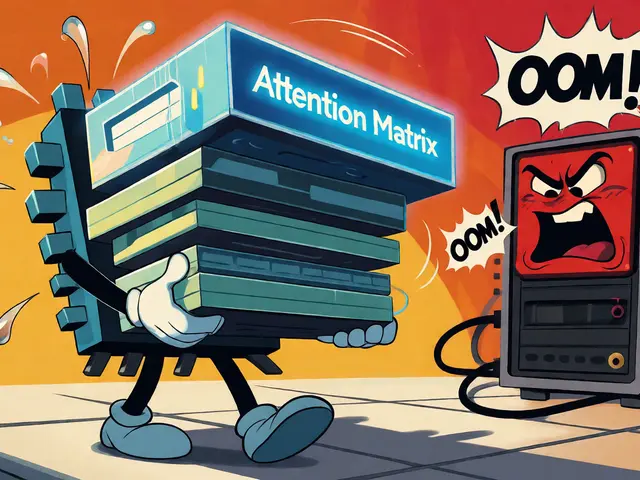
Have you ever wondered why an AI sometimes gives you a perfect answer and other times hallucinates nonsense? It isn't magic, and it isn't quite logic in the way humans use it. At its core, a Large Language Model is essentially a sophisticated guessing machine. It doesn't "know" facts like a database; instead, it calculates the statistical likelihood of what word should come next based on everything that came before it.
This process relies entirely on probabilities. Every time you type a prompt, the model isn't retrieving a pre-written sentence. It is running millions of calculations to assign a probability score to every possible word in its vocabulary. Understanding how this works demystifies why these tools are so good at creative writing but can still stumble on basic math or factual precision.
The Foundation: Tokens and Conditional Probability
To understand how words are chosen, we first need to look at how the model sees text. Humans read sentences; LLMs see numbers. Before any probability calculation happens, your input text undergoes tokenization. This process breaks down words into smaller units called tokens. A single token might be a whole word like "cat," or it might be a fragment like "ing" or even just a space character.
Once the text is converted into a sequence of tokens, the model uses conditional probability to predict the next one. In simple terms, conditional probability asks: "Given all the previous tokens (w1, w2... wn-1), what is the probability that token wm will appear next?"
This concept evolved from older n-gram models, which only looked at the previous three or five words. Modern transformer-based architectures, introduced in the seminal "Attention is All You Need" paper by Vaswani et al. (2017), changed the game. They use self-attention mechanisms to consider the entire context window. If you are using a model with a 128,000-token context window, it can theoretically weigh the importance of a word mentioned thousands of tokens ago when deciding what to say now.
From Logits to Probabilities: The Softmax Function
Inside the neural network, the raw output for each possible next token is called a logit. Think of logits as unnormalized scores. A high logit means the model thinks that token is likely; a low logit means it's unlikely. However, these scores aren't probabilities yet-they don't add up to 100%, and they can be negative.
To turn these scores into usable probabilities, the model applies the softmax function. This mathematical operation converts the logits into a probability distribution where every possible token in the vocabulary gets a value between 0 and 1, and all values sum to exactly 1.
| Token Candidate | Logit Score | Probability (after Softmax) |
|---|---|---|
| "world" | 15.2 | 0.45 (45%) |
| "earth" | 12.1 | 0.30 (30%) |
| "globe" | 10.5 | 0.15 (15%) |
| "mars" | 2.0 | 0.05 (5%) |
| "banana" | -10.0 | ~0.00% (negligible) |
In this example, if the prompt was "Hello ", the model has assigned a 45% chance to "world." But here is the critical part: the model doesn't always pick the highest probability. How it picks determines the style and quality of the output.
Decoding Strategies: How the Choice is Made
Once the probability distribution is ready, the model needs a strategy to select the actual token. This is known as decoding. Different strategies balance creativity against accuracy.
- Greedy Decoding: This method simply picks the token with the highest probability every single time. It is fast and deterministic, but it often leads to repetitive, generic text because it never explores alternative paths. If "the" is always the most likely next word after "I", greedy decoding will keep saying "I the the the..."
- Beam Search: Instead of picking one path, beam search keeps track of the top K sequences (e.g., K=5). It expands each sequence and prunes the worst ones. This is great for structured tasks like translation where accuracy matters more than creativity, but it can feel robotic.
- Top-k Sampling: Here, the model cuts off the bottom of the probability list. If k=40, it ignores all tokens outside the top 40 most likely options and randomly samples from those. This introduces variety while avoiding absurdly unlikely words.
- Top-p (Nucleus) Sampling: This is the industry standard for general-purpose chat. Instead of a fixed number of tokens, it selects the smallest set of tokens whose cumulative probability exceeds a threshold p (usually 0.9). If the model is very confident, it might sample from only 3 tokens. If it's unsure, it might sample from 50. This adapts dynamically to the context.
The Role of Temperature in Shaping Output
You’ve likely seen a "Temperature" setting in AI interfaces. This parameter reshapes the probability distribution before sampling occurs. It acts like a knob for randomness.
A low temperature (e.g., 0.2) sharpens the distribution. It makes the highest-probability tokens much more likely to be chosen and suppresses the lower ones. This is ideal for factual tasks, coding, or customer service bots where consistency and correctness are paramount. According to Anthropic’s technical documentation, a temperature of 0.2 can result in a 95% chance of selecting from the top 3 tokens.
A high temperature (e.g., 1.0 or higher) flattens the distribution. It boosts the probability of less likely tokens, making the output more diverse, creative, and unpredictable. This is useful for brainstorming, fiction writing, or poetry. However, push it too high, and the model starts generating gibberish because it picks tokens that make little sense in context.

Why Probabilities Lead to Hallucinations
If LLMs are just predicting the next word based on statistics, why do they sometimes state falsehoods with such confidence? This is the phenomenon known as hallucination.
Dr. Anna Rogers of the University of Copenhagen notes that LLM probability distributions reflect surface-level patterns in training data rather than deep understanding. If the training data contains a common misconception, the model learns that certain incorrect phrases statistically follow specific prompts. Because the goal is to generate plausible-sounding text, not necessarily true text, the model may output a factually incorrect statement if it has a higher probability than the correct one.
For instance, if asked about a rare medical term, the model might invent a definition that sounds scientifically accurate because it mimics the structure of medical literature, even though the specific facts are wrong. Stanford’s Center for Research on Foundation Models reports that current models still exhibit significant error rates in probability assignments for low-frequency linguistic phenomena, explaining their struggles with specialized jargon.
Practical Implications for Developers and Users
Understanding these mechanics helps you get better results. When using an LLM for a creative project, increase the temperature and use Top-p sampling to encourage novelty. When using it for code generation or data extraction, lower the temperature and consider Beam Search or Greedy Decoding to minimize variance.
Developers integrating these models via libraries like Hugging Face Transformers must tune parameters carefully. A repetition penalty (typically set above 1.0) is often necessary to prevent the model from getting stuck in loops, a problem that occurs in over 20% of long generations according to EleutherAI studies. Additionally, as context length increases, computational complexity grows quadratically, meaning generation speed drops significantly. Benchmarks show a 37% reduction in tokens-per-second when context length jumps from 4,000 to 32,000 tokens on standard hardware.
The future of this technology lies in hybrid approaches. Researchers are working on neuro-symbolic AI systems that combine probabilistic generation with symbolic reasoning engines to validate facts against knowledge graphs. Until then, treating LLM outputs as probable suggestions rather than absolute truths remains the safest approach.
What is the difference between temperature and top-p?
Temperature reshapes the entire probability distribution, making it sharper (lower temp) or flatter (higher temp). Top-p restricts the selection pool to the smallest set of tokens that add up to a certain probability mass (e.g., 90%). Temperature affects the relative likelihood of all tokens, while top-p acts as a cutoff filter before sampling.
Why do LLMs sometimes repeat themselves?
Repetition often occurs when the probability distribution becomes overly peaked around a few tokens, causing the model to select the same word repeatedly. This is common in greedy decoding or when the temperature is too low. Developers mitigate this by using a repetition penalty parameter, which penalizes tokens that have already appeared recently in the sequence.
Does a higher probability mean the word is correct?
Not necessarily. High probability means the word is statistically likely given the training data and context. If the training data contains errors or biases, the model will assign high probability to incorrect statements. Therefore, high confidence does not guarantee factual accuracy.
What is tokenization?
Tokenization is the process of breaking down text into smaller units called tokens. These tokens can be whole words, parts of words, or punctuation marks. The model processes these numerical representations rather than raw text, allowing it to handle a vast vocabulary efficiently.
How does context window size affect probability calculation?
A larger context window allows the model to consider more preceding tokens when calculating probabilities for the next word. This enables better coherence over long documents. However, increasing the context window also increases computational cost and can lead to "context dilution," where the model pays less attention to distant information.