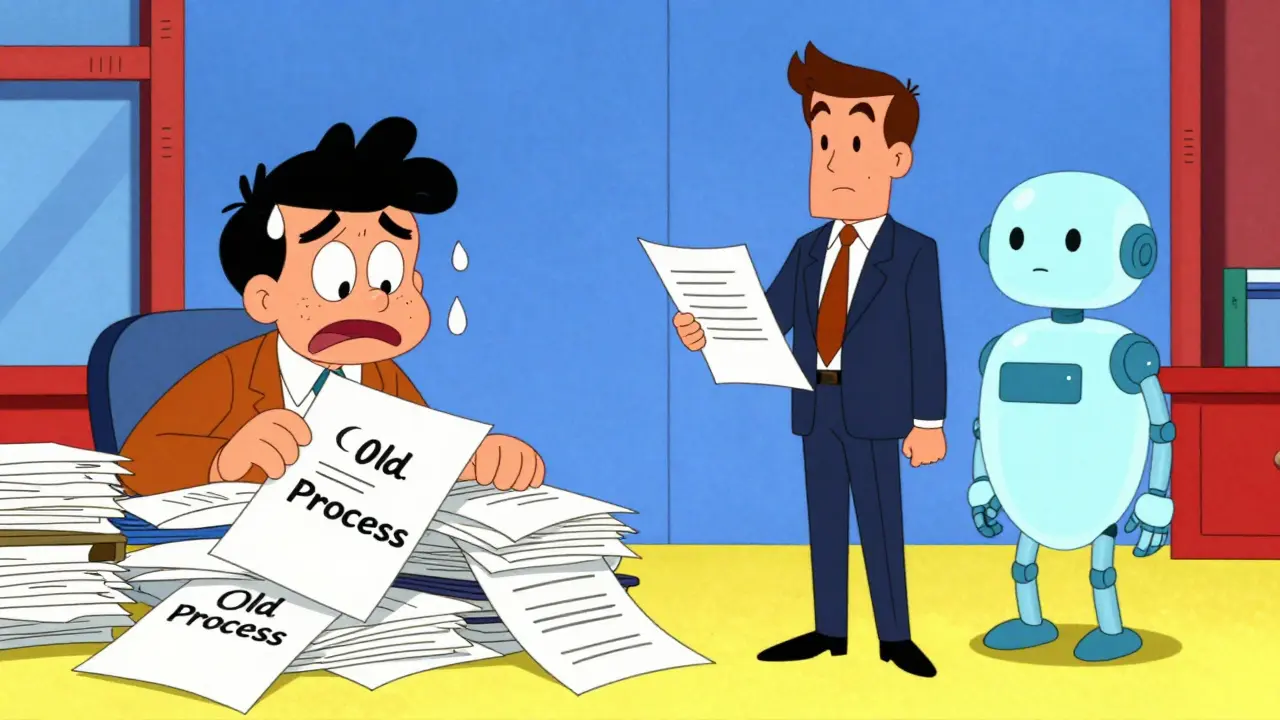
Here is the hard truth about generative AI in 2026: 95% of corporate pilots fail. They start with excitement, burn through budget, and end up as digital dustbins that nobody uses. But the other 5%? They are printing money, saving thousands of hours, and fundamentally changing how work gets done. The difference isn't luck, and it isn't just having a bigger budget. It comes down to one specific behavior: workflow redesign.
Most companies try to slap an AI tool onto their existing processes. They ask, "How can we make this current task slightly faster with AI?" That approach rarely works because it ignores the core problem. High-performing organizations ask a different question: "If we had infinite intelligence at our fingertips, how would we do this job entirely differently?" This shift from automation to transformation is what separates the winners from the rest.
The Myth of Automation vs. The Reality of Redesign
We need to clear up a major misconception right away. Generative AI is not a robot that sits next to you and types faster. If you treat it like a simple efficiency tool, you will likely fall into that 95% failure rate cited by MIT’s recent reports. True value capture happens when you stop thinking about automating steps and start thinking about eliminating entire categories of work.
Consider the example of Colgate-Palmolive. Before adopting generative AI, their marketing teams spent weeks manually reviewing market research reports, third-party data, and consumer surveys. It was slow, tedious, and prone to human error. Instead of just using AI to summarize these reports (automation), they redesigned the workflow. They built a system using Retrieval-Augmented Generation (RAG) integrated with Large Language Models (LLMs). Now, employees don't read reports; they query the entire dataset directly. The AI synthesizes proprietary consumer research and Google search trends instantly. This isn't just speed; it's a new way of accessing knowledge.
This distinction is critical. Automation preserves the old process but makes it quicker. Redesign throws out the old process and builds a new one where AI is the engine, not the accessory. When you redesign, you often find that tasks which used to take days now take minutes, or sometimes, they don't need to happen at all.
Focusing on Specific Pain Points, Not Broad Hype
High performers don't boil the ocean. They pick a single, painful, high-impact problem and solve it completely before moving on. Aditya Challapally, lead author of the MIT report on generative AI success, notes that the most successful implementations-whether in massive corporations or startups led by 19-year-olds-focus intensely on specific pain points.
Look at Klarna. They didn't try to use AI for everything. They focused on customer service, a notoriously expensive and frustrating area for any company. They fed their AI thousands of past customer conversations and support documents. The result was a "tag-team" system. The AI handles routine queries instantly, while humans jump in only for complex issues requiring empathy. This wasn't just about cutting costs; it was about resource allocation. Humans were freed up to do the work machines couldn't do, leading to shorter wait times and better customer experiences.
This focused approach allows companies to prove value quickly. When you see measurable results in one area, it builds the trust and momentum needed to scale. Trying to deploy enterprise-wide solutions without a proven pilot usually leads to confusion and resistance from staff who don't understand why they are being asked to change.
Technical Foundations: RAG and System Integration
You cannot have workflow redesign without solid technical integration. The magic ingredient for most high performers is Retrieval-Augmented Generation (RAG). RAG connects large language models to your private, proprietary data. Without RAG, AI gives generic answers based on public internet data. With RAG, it gives specific, accurate answers based on your internal documents, codebases, and customer records.
Toyota provides a perfect example of this in action. By integrating Google Cloud’s AI infrastructure, they enabled factory workers-not just software engineers-to develop and deploy machine learning models. This democratization of AI tools resulted in over 10,000 man-hours saved annually. The key here was compatibility. The AI didn't replace the workers' jobs; it integrated into their existing operational models, making them more effective at their specific roles.
Similarly, Siemens engineers reduced maintenance costs by 40% and machine downtime by 50% by integrating AI with their Senseye system. The AI didn't just predict failures; it provided actionable insights directly within the workflows the engineers already used. This seamless integration is what prevents the "tool fatigue" that kills many AI initiatives.
| Feature | Failed Pilots (95%) | High Performers (5%) |
|---|---|---|
| Approach | Automate existing tasks | Redesign entire workflows |
| Scope | Broad, unfocused deployment | Specific, high-impact pain points |
| Technology | Generic chatbots | RAG integrated with LLMs |
| Human Role | Supervised by AI or replaced | Augmented for higher-value tasks |
| Outcome | Low adoption, wasted budget | Measurable ROI, scaled growth |
Scaling Beyond the Pilot: From One to Many
Once a high performer proves the concept, they scale. But scaling doesn't mean throwing more money at the same problem. It means replicating the success model across different functions. McKinsey’s 2025 State of AI Global Survey found that companies setting both efficiency and growth objectives are more likely to succeed than those focusing solely on cost reduction.
Consider Gazelle, an AI service for real estate agents in Sweden and Norway. They used Gemini models to extract key information from property documents. The result? Output accuracy jumped from 95% to 99.9%, and content generation time dropped from four hours to 10 seconds. This allowed them to launch four new products in less than a year. They started with document processing, proved it worked, and then scaled that capability to create new revenue streams.
Another example is Sojern, a digital marketing platform. They built an AI-driven audience targeting system that processes billions of real-time traveler intent signals. This reduced audience generation time from two weeks to less than two days. Their clients saw a 20-50% improvement in cost-per-acquisition. By solving a core business metric (customer acquisition), they made the AI indispensable to their operations.
Scaling also involves training. You might think you need a team of PhDs to run these systems, but that’s not true. Most employees in successful implementations needed only 15-20 hours of training to integrate AI into their redesigned workflows. The barrier isn't technical skill; it's mindset. Companies like Rivian use AI to help employees conduct instant research and accelerate learning, allowing staff to get up to speed on complex topics 70% faster.
The Human Element: Motivation and Trust
Let’s talk about the people. HBR research from May 2025 acknowledges a tricky side effect: while generative AI makes people more productive, it can also decrease motivation if not implemented carefully. If employees feel like they are just feeding data into a black box, they disengage.
High performers avoid this by designing for collaboration, not replacement. At MAS, a global experiential marketing agency, directors describe a "harmony" between human input and AI output. They use AI as a creative accelerator and idea generator, engaging in iterative conversations to refine concepts. The AI doesn't replace the creative director; it amplifies their ability to explore ideas rapidly.
Five Sigma, an insurance claims processor, achieved an 80% error reduction and a 25% increase in adjustor productivity. But crucially, they freed human handlers to focus on complex decision-making and empathetic customer service. The AI handled the rote data entry and initial assessment, leaving humans to deal with the nuanced, emotional aspects of claims. This preserved job satisfaction while boosting efficiency.
Practical Steps to Become a High Performer
If you want to move from the failing 95% to the successful 5%, follow these steps:
- Identify a Single Pain Point: Don't try to fix everything. Find one process that is slow, expensive, or error-prone. Is it customer support? Content creation? Code debugging?
- Redesign the Workflow: Map out the current process. Then, imagine how it would look if AI did the heavy lifting. What steps disappear? What new steps appear? Design the new workflow first, then build the tech to support it.
- Implement RAG: Connect your AI to your proprietary data. Generic answers won't cut it. You need specific, accurate insights from your own databases.
- Train for Mindset, Not Just Code: Spend 15-20 hours teaching your team how to interact with AI effectively. Focus on prompt engineering and critical evaluation of AI outputs.
- Measure Real Outcomes: Track metrics that matter to the business. Did you reduce cycle time? Did you increase click-through rates? Did you save man-hours? Bayer, for instance, saw an 85% year-over-year click increase and paid 33% less per click using AI for marketing.
- Scale Gradually: Once you have a win, replicate it. Move from one use case to three or more within 12-18 months.
Capturing value from generative AI isn't about buying the fanciest tool. It's about having the courage to tear up your old playbooks and write new ones. The companies that do this aren't just surviving the AI revolution; they are defining it.
Why do 95% of generative AI pilots fail?
Most pilots fail because companies try to automate existing workflows rather than redesigning them. They add AI as an add-on tool instead of integrating it as a core component of a new operational model. This leads to low adoption, lack of clear ROI, and employee frustration.
What is Retrieval-Augmented Generation (RAG)?
RAG is a technique that connects Large Language Models (LLMs) to private, proprietary data sources. Unlike standard AI that relies on public internet data, RAG allows the AI to retrieve specific information from your internal documents, databases, and research, providing accurate and context-aware responses.
How much training do employees need to use generative AI effectively?
According to case studies from high-performing companies, most employees need only 15-20 hours of training to effectively integrate AI into their redesigned workflows. The focus should be on mindset shifts and prompt engineering rather than advanced coding skills.
Can generative AI decrease employee motivation?
Yes, if implemented poorly. Research suggests that if AI is seen as replacing human judgment or creating a monotonous oversight role, motivation can drop. High performers mitigate this by using AI to handle routine tasks, freeing humans to focus on complex, creative, and empathetic work.
What are some examples of high-performing AI use cases?
Successful use cases include customer service tag-teams (Klarna), automated market research querying (Colgate-Palmolive), predictive maintenance integration (Siemens), and rapid content generation for marketing (Bayer). These examples share a focus on specific pain points and deep workflow integration.

another corporate buzzword salad post. workflow redesign? please. most of these companies just slap a chatbot on their intranet and call it innovation while the middle management layer gets fatter. i've seen three 'pilots' fail in my own org because nobody wanted to actually change how they worked, they just wanted a shiny new toy to justify their budget. stop pretending this is about efficiency when it's really about control.
i think you're missing the nuance here stephanie. it's not about the tool itself but the philosophical shift in how we view labor. if we look at the klarna example, it's interesting how they didn't try to replace the human element entirely but rather created a symbiotic relationship. the ai handles the rote, the human handles the empathy. that's a pretty profound change in organizational structure. it forces us to ask what parts of our jobs are actually valuable versus just busy work. maybe the failure rate isn't due to bad tech but bad leadership who refuse to let go of outdated processes.
OMG! This is exactly what I have been saying!!! You are so right Patrick!! The human element is EVERYTHING! If you don't get the culture right, the tech will just sit there gathering digital dust!!! I saw a company try to implement RAG without training their staff and it was a DISASTER!!! People were terrified!!! They needed that mindset shift first!!! Thank you for pointing this out!!! It is so important to remember that technology serves people not the other way around!!!
the real issue is data quality. garbage in garbage out. no amount of workflow redesign fixes messy legacy databases. most enterprises are sitting on decades of unstructured data that even humans can't make sense of. trying to feed that into an LLM via RAG just amplifies the noise. until companies clean up their data hygiene nothing else matters.
typical american optimism. you guys think throwing money at AI solves everything. in europe we regulate this stuff properly before letting corporations play god with employee workflows. your whole approach is reckless. you want to scale chaos. the fact that you celebrate 'printing money' by cutting costs shows how shallow your economic model is. we prioritize worker protection over your endless growth obsession. keep failing at your pilots.