
You’ve probably heard the hype. Every tech conference slide promises that Generative AI is a transformative technology that automates complex tasks through large language models will double your team’s output overnight. The reality? It’s messier, more nuanced, and frankly, a bit contradictory. Some teams are flying high, churning out features in half the time. Others are drowning in bugs generated by their new digital pair programmers.
If you’re a manager or lead engineer looking to adopt these tools in 2026, you need to look past the marketing fluff. The data shows a split reality: individual developers might feel faster, but does that speed translate to better software for the business? Let’s break down what’s actually happening on the ground with AI coding assistants, why some studies say they slow you down, and how to get real value without compromising security.
The Current Landscape of AI Coding Assistants
First, let’s define what we’re talking about. An AI coding assistant is software that uses machine learning to suggest code, debug errors, and generate documentation based on natural language prompts. These aren’t just fancy autocomplete tools anymore. They understand context, read your entire project structure, and can write full functions from a simple comment.
The market has consolidated quickly. As of mid-2025, GitHub Copilot is the dominant AI coding assistant developed by Microsoft and OpenAI, holding nearly half the market share holds 46% of the market. It’s the default choice for most developers because it integrates seamlessly into Visual Studio Code, which 75% of devs use. But it’s not alone. Amazon CodeWhisperer is an AI coding tool optimized for AWS services, offering strong security scanning features captures 22% of users, mostly those deep in the Amazon Web Services ecosystem. Then there’s Tabnine is a privacy-focused AI coding assistant that allows for on-premises deployment and custom model fine-tuning, popular among enterprises worried about data leakage, holding 18%.
Here’s how they stack up in terms of cost and capability:
| Tool | Market Share | Price (Enterprise) | Key Strength | Best For |
|---|---|---|---|---|
| GitHub Copilot | 46% | $19/user/month | Broad language support, IDE integration | General purpose development |
| Amazon CodeWhisperer | 22% | $19/user/month | AWS integration, security scanning | AWS-heavy stacks |
| Tabnine | 18% | $39/user/month | On-premises deployment, privacy | High-security enterprises |
Note that prices vary by region and contract size, but these are the standard benchmarks. If you’re using legacy systems like COBOL, none of these shine-Copilot’s accuracy drops to 42% there. But for Python, JavaScript, and TypeScript? You’re looking at 85%+ accuracy rates.
The Productivity Paradox: Are We Actually Faster?
This is where it gets tricky. You’d think if an AI writes code for you, you’re faster, right? Not always.
Harvard Business School’s 2024 field experiment found that developers completed tasks 25.1% faster with AI help, and the code quality was 40% higher. That sounds amazing. But then METR, an independent research lab, ran a randomized controlled trial in July 2025 with experienced open-source developers. Their result? A 19% slowdown.
Why the contradiction? It comes down to experience level and task complexity. Junior developers benefit immensely-they learn patterns faster and get unstuck quicker. Experienced devs, however, often spend more time verifying the AI’s suggestions than writing the code themselves. This is called “verification overhead.” If the AI suggests a complex algorithm that looks right but has a subtle bug, you have to read every line carefully. That takes longer than just writing it yourself if you already know the solution.
Faros AI calls this the “AI Productivity Paradox.” Individual output goes up, but company-wide productivity stays flat because coordination costs rise. You’re generating code faster, but merging it, reviewing it, and fixing its edge cases creates bottlenecks elsewhere.
So, who wins? Teams that use AI for boilerplate code, testing, and documentation see huge gains. Teams that rely on it for core logic without rigorous review see diminishing returns.

Security Risks: The Hidden Cost of Speed
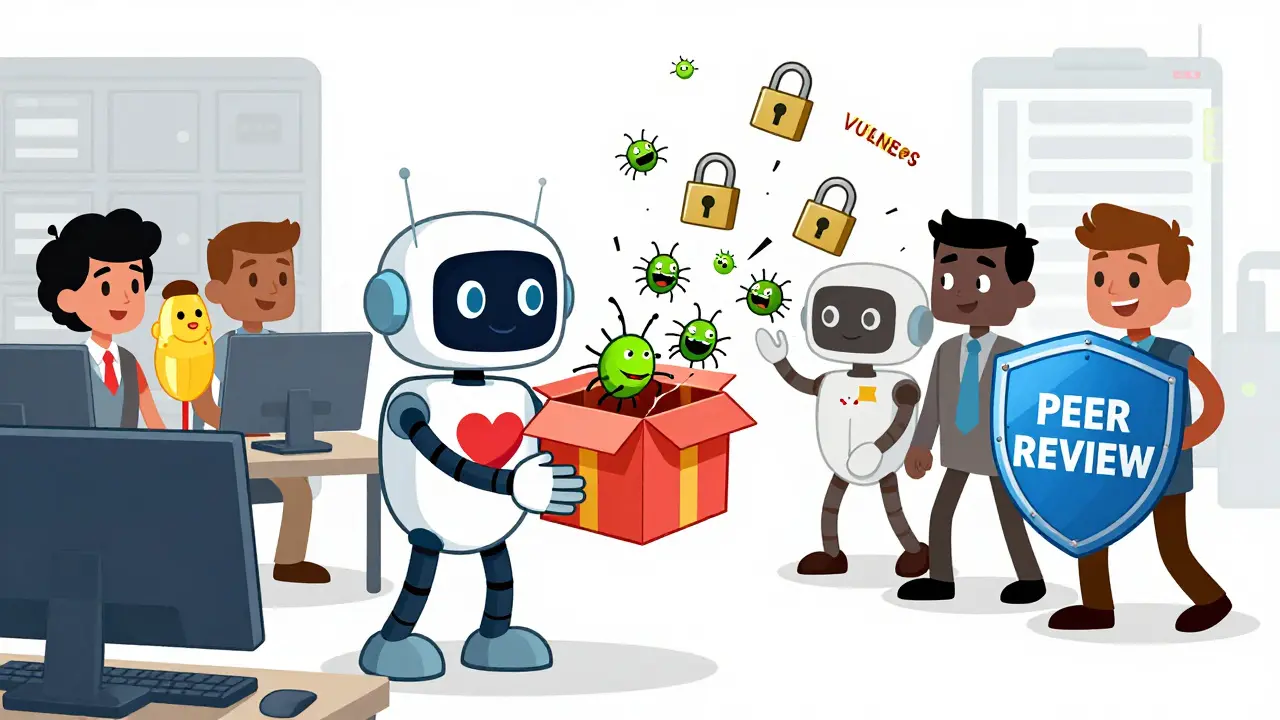
Speed means nothing if your app gets hacked. Here’s the hard truth: 48% of AI-generated code contains potential security vulnerabilities, according to Second Talent’s 2025 report. These aren’t always obvious. The AI might suggest a library that’s outdated, or write SQL queries that are vulnerable to injection attacks because it learned from bad examples online.
Dr. Sarah Elliott from MIT’s AI Ethics Lab warns that this creates a “false sense of productivity.” You feel like you’re moving fast, but you’re actually accumulating technical debt in the form of security holes. Fixing these later costs far more than preventing them now.
To mitigate this, you need strict protocols. 63% of enterprises now mandate peer reviews for all AI-generated code. Don’t skip this step. Treat AI output like code from an intern: helpful, but requiring careful supervision. Also, consider tools like Amazon CodeWhisperer, which includes built-in security scanning, or implement automated security checks in your CI/CD pipeline.
Implementation Strategy: How to Roll Out Without Chaos
Rolling out AI coding assistants isn’t as simple as buying licenses. It requires training, policy changes, and cultural shifts. Based on Menlo Ventures’ 2025 enterprise survey, here’s what works:
- Start with a Pilot Group: Pick 10-15 developers across different skill levels. Have them use the tool for two weeks on non-critical projects. Gather feedback on what helps and what hinders.
- Train on Prompt Engineering: AI isn’t magic; it responds to instructions. Developers need to learn how to ask for specific outputs. GitHub’s “AI Pair Programming” certification program is a good start. Expect a 2-3 week learning curve before proficiency kicks in.
- Establish Review Protocols: Make it clear that AI-generated code must be reviewed. No exceptions. Use static analysis tools to catch common errors early.
- Address Licensing Concerns: AI models are trained on public code. There’s a risk of copyright infringement. 57% of companies use code scanning tools to ensure AI suggestions don’t accidentally copy proprietary code from other projects.
- Prevent Skill Atrophy: 37% of engineering leaders worry that junior devs will lose fundamental skills. Combat this with “AI-free Fridays” or mandatory debugging sessions where devs solve problems without assistance.
Expect to spend 80-120 hours upfront on integration and training. It’s an investment, but skipping it leads to misuse and frustration.
Who Benefits Most? Demographics and Adoption Gaps
Not everyone adopts AI tools equally. A Harvard Business Review study from August 2025 highlighted significant disparities. Male engineers adopted AI assistants at 52%, compared to 31% for female engineers. Engineers under 30 adopted at 68%, while those over 40 were at 39%.
Why the gap? Older developers may be more skeptical of AI’s reliability or less familiar with prompt-based interfaces. Female engineers often face different workplace dynamics and may perceive AI as adding rather than reducing workload due to existing imbalances in code review responsibilities.
If you want broad adoption, you need to address these gaps. Provide targeted training for senior staff. Ensure that AI tools are integrated into workflows that reduce, not increase, administrative burdens for women. Inclusivity isn’t just ethical; it’s practical. You can’t claim enterprise-wide productivity gains if half your team isn’t using the tools effectively.
Future Outlook: What’s Next for AI in Dev?
We’re only at the beginning. By 2027, Gartner predicts 50% of all code will be AI-generated. New features are emerging rapidly. GitHub’s Copilot Workspace, launched in September 2025, lets you describe a feature in plain English, and the AI generates the entire pull request, including tests and documentation. Meta’s Code Llama 3, released in August 2025, offers a massive 1 million token context window, allowing it to understand entire codebases at once.
But beware the hype. McKinsey estimates the long-term productivity potential at $4.4 trillion, but that assumes widespread, effective adoption. Many companies will fail to realize these gains due to poor implementation. Focus on the basics: secure code, rigorous review, and continuous learning. AI is a powerful lever, but it doesn’t replace judgment. It amplifies it-for better or worse.
Is GitHub Copilot worth the cost for small teams?
For most small teams, yes. At $10-$19 per user per month, the time saved on boilerplate code and debugging often pays for itself within a month. However, ensure you have a process for reviewing AI-generated code to avoid security issues. If you’re heavily invested in AWS, Amazon CodeWhisperer might offer better value due to its free tier for basic usage and tight integration.
Can AI coding assistants replace junior developers?
No. While AI can handle routine tasks, it lacks understanding of business context, architectural trade-offs, and creative problem-solving. Junior developers still bring fresh perspectives, energy, and the ability to learn domain-specific nuances. Think of AI as a mentor that never sleeps, not a replacement for human talent.
How do I prevent my team from becoming overly reliant on AI?
Implement regular “unplugged” coding sessions where developers solve problems without AI assistance. Encourage manual debugging exercises. Set expectations that AI suggestions are drafts, not final products. Regularly assess whether developers understand the code they’re accepting from AI.
What are the biggest security risks of using AI coding assistants?
The primary risks include introducing known vulnerabilities, leaking proprietary code to public AI models, and creating insecure dependencies. Always scan AI-generated code with security tools. Never paste sensitive credentials or internal IP into public AI chat interfaces. Use enterprise-grade solutions with data privacy guarantees.
Which AI coding assistant is best for Python development?
GitHub Copilot is generally considered the best for Python due to its extensive training on Python repositories and high accuracy rates (85%+). It integrates well with Jupyter notebooks and VS Code. However, if you’re building data pipelines on AWS, CodeWhisperer’s optimization for boto3 and AWS SDKs might give it an edge.

The modern engineer is but a hollow vessel, waiting to be filled by the silicon oracle. We trade our souls for speed, our intuition for probability distributions. It is a tragedy of epic proportions, this surrender of the human mind to the cold, unfeeling logic of the machine. We are not developers anymore; we are mere curators of digital debris, sweeping up the mistakes of an algorithm that knows nothing of truth or beauty. The code may run, but does it sing? Does it breathe? Or is it just another dead thing in a graveyard of efficiency metrics?
hey there! i totally get where you're coming from with all that existential dread about coding and stuff, its really deep and all that, but honestly speaking from my own experience working on these big projects lately, i think the real issue is just that we havent quite figured out how to work together properly yet, like if you look at the stats they mentioned about junior devs vs senior devs, its not that the ai is evil or whatever, its just that seniors have so much context in their heads that the ai cant possibly know, so when the ai suggests something slightly off, the senior has to stop and think 'wait, why did it suggest that?' which takes time, whereas a junior might just accept it and learn from it later, so maybe its not a moral failing of humanity but just a mismatch in expectations and workflow integration that we need to smooth out over time, dont you think? anyway, just my two cents after reading through all that dense text, hope that helps clarify things a bit!
Oh, spare me the melodrama, Bineesh. You sound like a Victorian ghost haunting a server room.
We aren't selling our souls; we're buying back our weekends. If I can use Copilot to write the boilerplate CRUD operations while I sip my rooibos tea, I'll take that 'tragedy' any day. The article points out that verification overhead kills productivity for seniors, sure, but have you ever tried writing unit tests manually? It's soul-crushing enough without adding poetic despair to the mix.
Let's cut the fluff. The data says 48% of AI-generated code has security vulnerabilities. That's not a 'nuance,' that's a disaster waiting to happen. Companies are rushing to adopt these tools because they want to show shareholders some ROI, not because they care about secure software architecture. It's lazy engineering wrapped in a shiny marketing package. If your team can't review every line of code generated by a black-box model, you don't have a productivity gain; you have a liability. Stop pretending this is about empowerment and start treating it like the risk management crisis it actually is.
I noticed the gender gap in adoption stats was pretty stark.