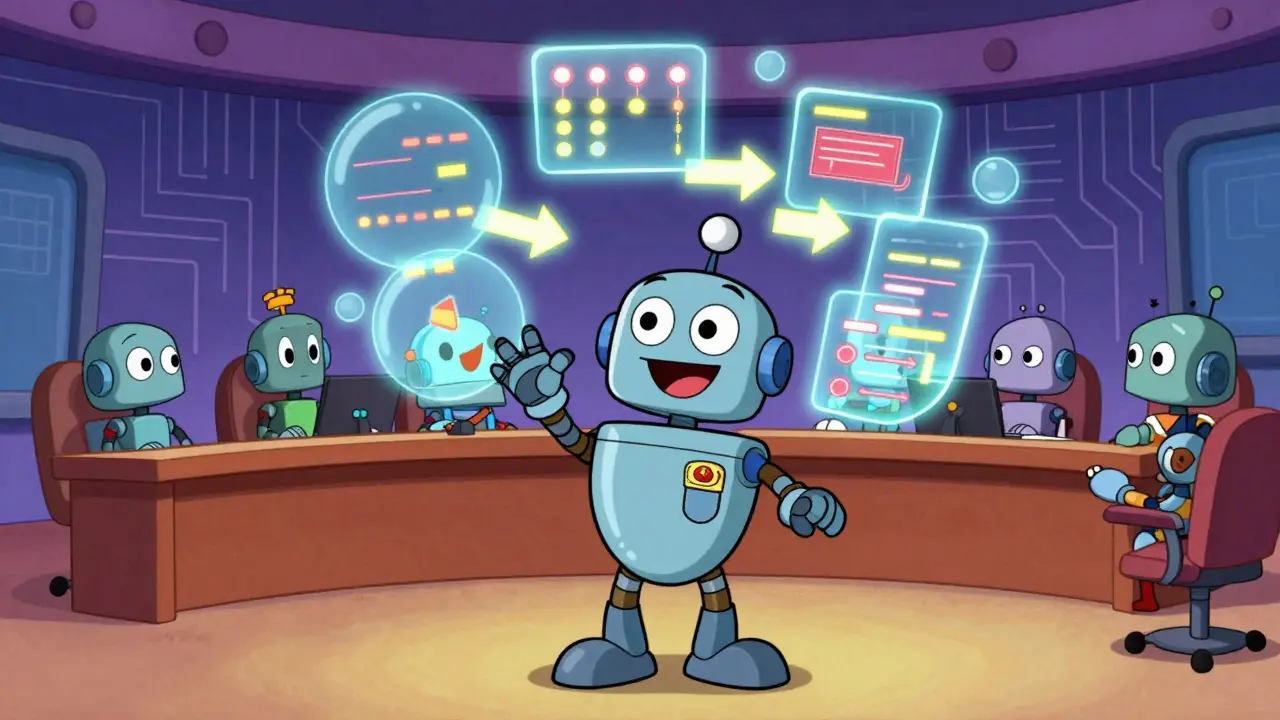
Building with Large Language Models feels like juggling chainsaws sometimes. You have one model trying to do everything-planning, searching, writing code-and it inevitably hallucinates or loops infinitely. That's why the most successful systems aren't just single chatbots; they are complex pipelines where specialized agents pass tasks back and forth like a relay race. To manage this chaos without losing your mind, you need two things: State Diagrams is a visual method to map every possible condition your system can be in, and an Orchestratorthat decides which agent acts next. Together, they turn probabilistic text generators into reliable software components.
This isn't theoretical anymore. By late 2025 and heading into 2026, enterprise architectures rely heavily on explicit control flows. If you're debugging why an agent suddenly stopped generating summaries, you won't find the answer in the logs alone. You look at the state machine. Did it transition correctly? Was the tool call valid? This level of visibility is what separates a weekend project from production infrastructure.
The Role of State Diagrams in Agent Systems
In traditional software, a state machine is usually simple: a light switch goes ON or OFF. In LLM agent systems, states are far more dynamic. A state represents a snapshot of where your application is in its reasoning process. Think of it as the "current task" combined with the "context available." You define nodes for things like ScanAgentNode performs initial reconnaissance or CybersecuritySummaryNode generates final reports. Between these nodes lie edges-the conditions required to move forward.
When you build a complex pipeline, you might have an agent stuck in an infinite loop because it can't parse an output. Without a visual state diagram, finding this bug involves sifting through thousands of lines of log data. With a diagram, you see immediately that the system is oscillating between "Attempt Parsing" and "Retry" without ever reaching "Success." You can add a threshold there. Maybe after three failed parses, the diagram should route to a "Human Review" state instead of retrying again. It gives you hard boundaries for soft thinking processes.
These diagrams also handle memory management. A state isn't just a label; it carries baggage. When moving from State A to State B, what data travels with it? In frameworks, we often use objects like MemorySaver maintains state persistence across executions. This ensures that if the agent pauses or gets interrupted, the context remains intact when it resumes, which is critical for long-running jobs.
How Orchestrators Manage Workflow Execution
If the state diagram is the map, the orchestrator is the traffic controller. It's the code executing the logic defined in your diagram. An Orchestrator is responsible for routing tokens, managing tool calls, and enforcing the rules of engagement between agents. Instead of one massive model doing everything, the orchestrator picks the right tool for the job.
For example, imagine a customer support bot. One agent handles greetings, another looks up order history, and a third resolves billing disputes. The orchestrator listens to the incoming message. Based on intent classification-which might use a lightweight model-it routes the request to the correct node. This prevents the "generalist" model from wasting tokens trying to guess the right department for a query.
Mechanisms for this routing vary. Some use hardcoded classifiers; others use semantic routing where an LLM itself decides the destination. More advanced setups employ conditional routing logic, similar to the ToolRouterEdge establishes conditional transitions based on tool types and agent outputs. If a scan agent returns a specific vulnerability type, the router directs the flow to a remediation agent rather than a reporting agent. This logic keeps the conversation relevant and efficient.
The Pipeline of Agents Pattern
A dominant architecture emerging in 2025-2026 is the Pipeline of Agents. This pattern treats agents as distinct functions in a larger program. Unlike monolithic agents attempting to handle all tasks, pipeline agents follow the single responsibility principle. Each agent excels at one specific task.
This approach creates a chain: Agent N produces output, which becomes input for Agent N+1. Crucially, these agents maintain state isolation. They don't share internal memory buffers; they only exchange defined outputs. This makes testing much easier. If the summary generator fails, you know it's not because the scanner gave weird data, but because the summary agent itself is misconfigured. You can swap out individual agents at runtime-if a new GPT-4.1 offers better math reasoning, you can update just the calculation node without retraining the whole system.
However, this modularity comes with overhead. Passing context between agents consumes API costs and latency. Designers must balance the number of handoffs against the quality of output. Sometimes, giving one smart agent full context is cheaper than chaining five specialized ones. It depends on your tolerance for complexity versus your budget.

Framewoks for Implementation
You don't build these graph structures from scratch in 2026. Several powerful libraries abstract the heavy lifting.
| Framework | Primary Language | Key Strength | Best Use Case |
|---|---|---|---|
| LangGraph | Python | Persistent Cycles | Complex stateful workflows |
| Semantic Kernel | C#, Python | Enterprise Integration | Microsoft ecosystem projects |
| AutoGen | Python | Multi-Agent Debate | Collaborative coding agents |
LangGraph has become a standard for many Python-centric stacks. It allows builders to represent each node as an agent or step. The real power lies in its compiled state graphs. You define edges, and LangGraph compiles them into executable workflows with built-in memory management. This framework supports persistent cycles, meaning your agent can enter a loop, do some work, save state, and return later-essential for long-term autonomous tasks.
Semantic Kernel takes a different angle, focusing heavily on plugin systems and integration with enterprise governance. At its core, the Semantic Kernel Orchestrator coordinates agent interactions, consulting a classifier for intent routing and utilizing a registry for agent discovery. If your company already runs on Azure, this integrates tightly with identity providers and logging systems, ensuring compliance standards are met without custom middleware.
Real-World Application Scenarios
Theory looks great until you apply it to messy reality. Consider the cybersecurity scanning pipeline. Here, we have distinct phases: reconnaissance, analysis, and reporting. We define a sequence: START → scan_agent → attack_agent → cybersecurity_summary → END.
The ScanAgentNode runs tools like ffuf or curl to find open ports. But what happens if a port times out? The orchestrator catches the timeout exception. Instead of crashing, it transitions to an error-handling state that retries the scan with a lower resource limit. If it still fails, it moves to the next target IP, preserving the overall workflow progress. This granular error handling is only possible because the state diagram explicitly defines these failure paths.
Another compelling example is the Feynman diagramming agent. This system synthesizes visual designs based on text descriptions. It uses four distinct states: idea, plan, iterate, and render. The system feeds LLM responses to a coding agent that programs concepts into diagrams. If the output format parsing fails, multiple rounds of iteration occur up to a maximum threshold. Ablation studies showed that this pipeline, specifically combining knowledge planning and scoring, achieved the best average judge scores compared to single-pass generation. The scoring mechanism evaluates outputs against set thresholds. If scores fall below requirements, the state decision forces a re-run. This is deterministic quality control applied to creative generation.

Challenges and Trade-offs
Moving from a single chat interface to orchestrated pipelines introduces friction. The biggest hurdle is inter-agent communication overhead. Every time an agent finishes, the orchestrator has to serialize state, send it to the next node, deserialize it, and load context into the new session. For high-throughput APIs, this added latency matters. Developers often notice response times jump from 2 seconds to 15 seconds depending on the depth of the chain.
Debugging distributed state is another headache. When an error occurs at Step 5, the stack trace might be split across three different agent files and the orchestrator core. You need robust logging at each state transition. Tools that visualize the live path of execution-showing exactly which edge triggered-are invaluable for maintenance. In late 2025, observability platforms began supporting "trace graphs," allowing engineers to replay agent decisions.
Despite these hurdles, the benefits are clear: improved debuggability through isolated domains, easier testing via standardized interfaces, and the ability to swap models as technology evolves. You are no longer locked into the behavior of a single large model version.
Emerging Standards and Future Outlook
The industry is rapidly standardizing how these agents talk. The Model Context Protocol (MCP) servers represent a major shift seen in early 2026 developments. These enable enhanced capabilities through chat-based workflows, providing standardized interfaces for agents to access external tools. Cloud providers like AWS highlighted advanced orchestration patterns for architecture diagram generation using generative AI-powered software agents during their February 2026 events. These sessions emphasized integrating custom context rules and enterprise knowledge sources.
We are seeing a movement toward interoperable agent ecosystems. The hope is to move beyond vendor-specific graphs where you can only use certain tools with certain frameworks. Future versions of state diagram engines will likely support cross-framework definitions, allowing a LangChain graph to trigger an AutoGen agent seamlessly. For now, picking a stack means sticking with it, so choose wisely based on your team's existing expertise.
Do I need a state diagram for simple agents?
For linear, single-step tasks, a diagram adds unnecessary overhead. You only really need formal state management when logic branches significantly, requires memory retention across steps, or involves retries and fallback mechanisms.
How do I handle infinite loops in agent pipelines?
Implement strict cycle counters within your state definition. Most orchestration frameworks allow setting a maximum iteration count for specific cycles. When this count is exceeded, the system should force a transition to a terminal state like 'Failure' or 'Escalate'. Always define explicit exit conditions.
What is the difference between an orchestrator and a manager?
An orchestrator is typically a structural engine that enforces flow and logic without making decisions (the "how"). A manager or supervisor agent often uses an LLM to decide which path to take (the "what"). High-performance systems combine both: a rigid orchestrator structure containing intelligent routing agents.
Which framework is better for startups vs enterprises?
Startups often prefer LangGraph or open-source tools for flexibility and rapid prototyping. Enterprises gravitate toward Semantic Kernel or proprietary clouds for security, compliance, and integration with existing Active Directory or cloud infrastructure systems.
How does state persistence work with LLMs?
Persistence usually relies on serializing the state object (JSON, SQL, or vector store) before an async operation. Tools like MemorySaver in LangGraph automatically checkpoint state at graph nodes, allowing the workflow to resume exactly where it left off even if the server restarts.


The transition from probabilistic models to deterministic pipelines feels like stepping into the machine age finally. We have been dancing around uncertainty for too many years without enough structure to hold us back. State diagrams provide a visual anchor that grounds our chaotic creative processes in reality. Without these boundaries, agents drift into loops that consume resources without producing value. It is terrifying to watch a system hallucinate endlessly when it cannot resolve its internal conflicts. However, introducing rigid states forces us to think about failure paths before deployment begins. This foresight is what separates a fragile experiment from a robust production architecture capable of scaling. Memory management within these nodes acts as the nervous system for distributed intelligence patterns. When context transfers seamlessly between agents, the illusion of singular cognition remains intact for the user. Orchestrators become the silent conductors ensuring every instrument plays its part in harmony. Yet, there is always friction when passing data across different domains of specialized knowledge. Latency spikes during handoffs remind us that efficiency often battles with modularity in design choices. Frameworks like LangGraph attempt to solve this by compiling graphs into executable forms efficiently. Still, the human element of debugging these flows remains a profound challenge for engineers everywhere. Ultimately, this evolution toward explicit control flows is necessary to tame the wild beasts of generative AI. We stand on the precipice of reliable software systems powered by previously unpredictable technology.
Honestly most of this is flavor text nobody actually implements state machines properly.
You see the diagrams but the code never matches the vision.
The philosophical implications of binding free-thinking models to rigid structures are truly staggering to behold. We essentially capture lightning in a bottle and force it to follow train tracks laid by human hands. This represents a fundamental shift in how we perceive artificial agency within our digital ecosystems today. It is no longer about raw creativity but rather about channeling that power through defined corridors of logic. The state diagram serves as a constitution for our synthetic entities preventing them from acting outside agreed parameters. Without such governance we risk creating chaos masquerading as innovation in our server rooms. Every node becomes a checkpoint in the journey of information traversing the neural pathways. We must accept that true intelligence requires discipline alongside sheer computational power. The drama lies in the tension between fluid reasoning and static rules governing execution. This balance defines the next decade of software development more than any algorithmic breakthrough.
I appreciate the depth of analysis provided regarding the structural integrity of these systems. While dramatic interpretations offer engaging perspectives, the practical application remains paramount for enterprise adoption. Formalizing these interactions ensures scalability and reliability across different operational environments. It is crucial to maintain focus on measurable outcomes when implementing such complex architectures.
I dont see why everyone hyping this up againts simple chaining metheds. Its just over engeneering for small projects.
Makes u want to cry sometimes.
While simplified methods work for basic tasks, complex workflows require the structured approach described in the article. Properly defining your edges prevents unexpected behavior later on.
The breakdown on memory savers is honestly super helpful for my current project setup.
We need to keep pushing for better tool support because this tech is just getting started!
The potential for dynamic workflows is absolutely limitless for teams willing to learn.
Stop obsessing over frameworks!!! You guys forget basics first!!! Complicating things further is unnecessary!!! Just code simple logic!!! Or you end up in mess!!!!
Finding a balance between simplicity and robust orchestration is key for sustainable growth in this field. Different contexts demand different levels of control regardless of what tools are available.