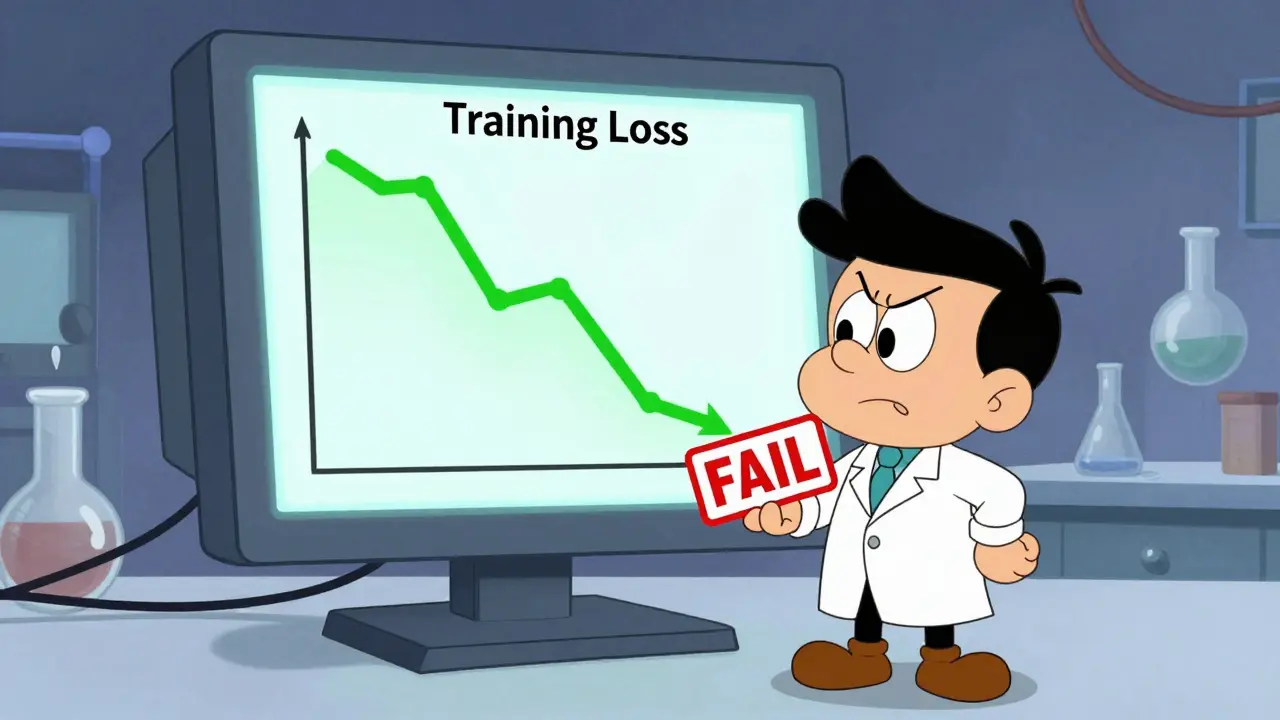
You’ve spent weeks curating data. You’ve tuned your LoRA adapters or run full Supervised Fine-Tuning (SFT). The training loss curve looks beautiful, dipping steadily toward zero. But here is the hard truth: a low training loss tells you almost nothing about whether your model will actually work in production.
Evaluating Fine-Tuned Large Language Models is not like checking if a database query returns the right rows. It is messy, subjective, and often contradictory. If you rely on the same metrics you used for pre-training, you are flying blind. In 2026, the industry has moved past simple accuracy checks. We now know that measuring a fine-tuned model requires a layered approach, combining automated statistical metrics with sophisticated judgment models and human-in-the-loop validation.
The Trap of Traditional Metrics
When we first started evaluating language models, we leaned heavily on Perplexity. Perplexity measures how well a probability distribution predicts a sample. It works great for next-token prediction tasks, where the goal is to guess the exact word that comes next in a sentence. But fine-tuning usually aims for something else entirely: instruction following, style adaptation, or specific task execution.
If you fine-tune a model to write Python code, perplexity won’t tell you if the code runs. It only tells you if the tokens look statistically probable. This is why benchmarks like MMLU (Massive Multitask Language Understanding) have limitations. MMLU tests general knowledge through multiple-choice questions. A model can ace MMLU by memorizing facts during pre-training, yet fail miserably at the nuanced reasoning required by your specific downstream task.
For generative tasks, we turned to ROUGE (Recall-Oriented Understudy for Gisting Evaluation). ROUGE-1 checks unigram overlap, while ROUGE-2 checks bigram overlap between the generated text and a reference summary. It is fast and easy to compute. However, ROUGE suffers from a critical flaw: it rewards surface-level similarity over semantic meaning. If your model paraphrases a correct answer using different words, ROUGE penalizes it. If it repeats the reference text verbatim but misses the point, ROUGE praises it. For open-ended generation, ROUGE is necessary but never sufficient.
The Rise of LLM-as-a-Judge
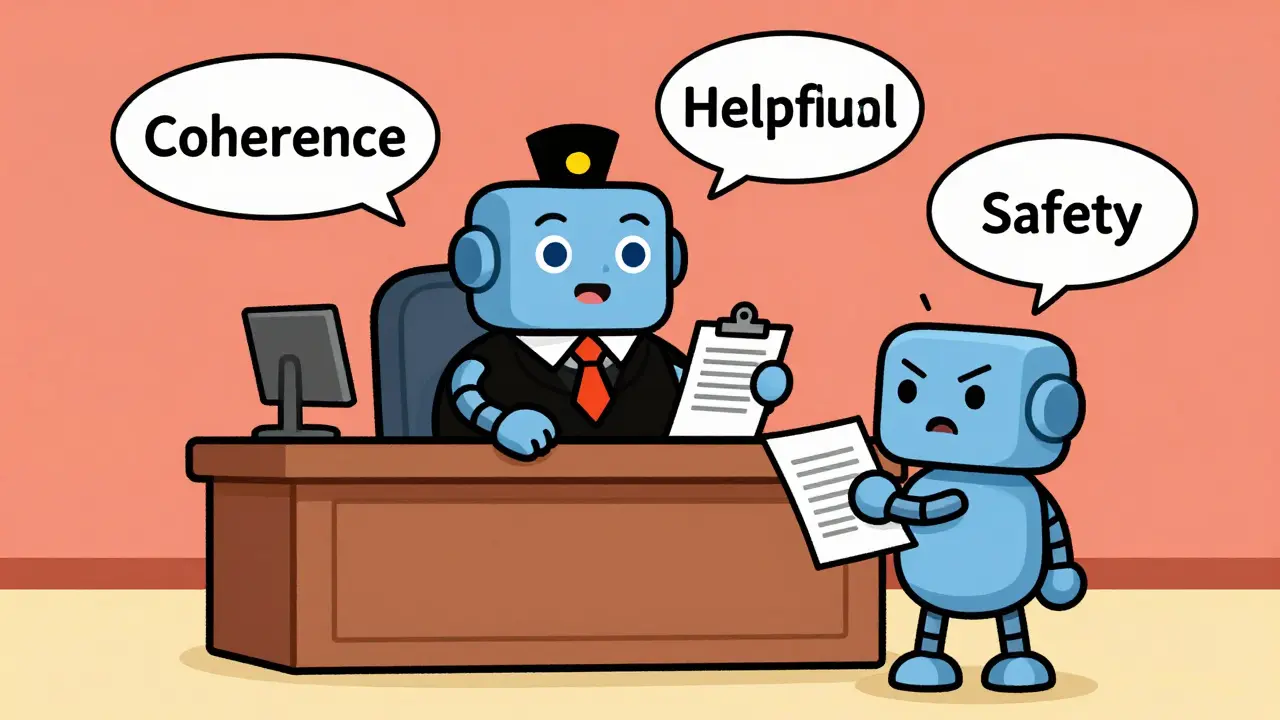
To solve the semantic gap, the industry adopted LLM-as-a-Judge. Instead of comparing strings, you ask another powerful LLM to evaluate the output. You provide the prompt, the generated response, and a rubric. The judge model then assigns a score based on criteria like coherence, helpfulness, and safety.
This approach mirrors how humans evaluate work. But it introduces new challenges. Generic judges can be biased. They might favor longer responses, or they might prefer certain writing styles simply because those styles were overrepresented in their training data. To fix this, researchers developed specialized judge models like Prometheus and JudgeLM.
Prometheus, for instance, uses a structured 1-5 Likert scale. It doesn’t just say "good" or "bad." It evaluates against specific dimensions defined in a scoring rubric. This makes the evaluation reproducible and granular. When evaluating multimodal outputs, variants like Prometheus-Vision check if the text response is grounded in the provided image, reducing hallucinations. Using a fine-tuned judge is significantly more expensive than calculating ROUGE, but the correlation with human preference is much higher.
Aligning Metrics with Your Use Case
There is no single protocol that fits all fine-tuned models. Your evaluation strategy must match your deployment scenario. Here is how to break it down:
| Task Type | Primary Metric | Secondary Metric | Judge Type |
|---|---|---|---|
| Classification / QA | Accuracy / F1 Score | Exact Match | None (Deterministic) |
| Summarization | ROUGE-L | BERTScore | LLM-as-a-Judge (Conciseness) |
| Code Generation | Pass@k (Execution Success) | Syntax Validity | Static Analysis Tools |
| Open-Ended Chat | Helpfulness / Coherence | Engagement | Fine-Tuned Judge (e.g., Prometheus) |
| Content Creation | Style Adherence | Creativity | Human Evaluation + LLM Check |
Notice the distinction. For code, you don’t care about fluency; you care if the script executes without errors. That’s why Pass@k is the gold standard there. For chatbots, fluency and safety matter more than factual precision. You need a judge that understands nuance.
Safety, Bias, and Toxicity
In 2026, you cannot deploy a fine-tuned model without rigorous safety testing. Accuracy means nothing if your model generates toxic content or leaks private data. This is where frameworks like HELM (Holistic Evaluation of Language Models) come into play. HELM goes beyond performance to measure fairness, bias, and toxicity across diverse scenarios.
You should integrate these checks early. Don’t wait until the final stage. Use red-teaming prompts designed to jailbreak your model. Measure the percentage of harmful outputs. If your fine-tuning process inadvertently amplified biases present in your training data, HELM-style metrics will catch it. Relying solely on helpfulness scores can mask severe safety failures.
Preventing Data Leakage
A common mistake in evaluation is data leakage. This happens when examples from your training set accidentally end up in your test set. If the model has seen the question before, it might memorize the answer rather than learn the underlying pattern. Your evaluation scores will look artificially high, but the model will fail in production.
To prevent this, strictly separate your datasets. Use a dedicated test set that contains zero overlap with your training or validation data. Ideally, use out-of-distribution samples-questions that differ stylistically or topically from your training data-to test true generalization. If you are using synthetic data for fine-tuning, ensure your evaluation dataset includes real-world user queries that the model hasn't seen.

Practical Implementation Steps
How do you actually build this pipeline? Here is a streamlined workflow:
- Define Success Criteria: Before writing code, list what "good" looks like. Is it brevity? Accuracy? Tone? Write these as explicit rubrics.
- Select Base Metrics: Choose fast, automated metrics for initial screening (e.g., ROUGE for summaries, Exact Match for QA).
- Implement LLM Judges: Set up a secondary evaluation step using a robust judge model like Prometheus. Prompt it with your rubric. Cache results to save costs.
- Run Safety Checks: Use a toxicity classifier or a safety-focused LLM to scan outputs for harmful content.
- Human Spot-Check: Sample 50-100 outputs randomly. Have a human reviewer rate them. Compare human ratings with your automated scores. If the correlation is low, your automated metrics are flawed.
Tools like DeepEval and LightEval simplify this process by providing libraries that integrate these metrics seamlessly. They allow you to define custom assertions and run evaluations in parallel.
Monitoring Post-Deployment
Evaluation doesn’t stop when you push to production. User behavior changes. New topics emerge. Your model needs continuous monitoring. Track drift in key metrics over time. If the average helpfulness score drops, investigate immediately. Are users asking harder questions? Is the model becoming less coherent?
Collect feedback loops. If users reject a response, log that interaction. Use these negative samples to retrain or refine your evaluation rubrics. This creates a virtuous cycle where evaluation improves the model, and the model’s performance informs better evaluation strategies.
Why is perplexity not enough for evaluating fine-tuned LLMs?
Perplexity measures how well a model predicts the next token in a sequence, which is useful for pre-training assessment. However, fine-tuned models are often evaluated on their ability to follow instructions, generate creative content, or solve specific tasks. Perplexity does not account for instruction adherence, logical consistency, or factual correctness in open-ended generation, making it an insufficient standalone metric for post-fine-tuning evaluation.
What is the difference between ROUGE and BERTScore?
ROUGE evaluates text similarity based on n-gram overlap (word matches) between the generated text and a reference text. It is computationally cheap but ignores semantics. BERTScore uses contextual embeddings from BERT to compare sentences, capturing semantic similarity even if the words are different. BERTScore is generally more accurate for summarization and translation tasks but is more computationally expensive.
How do I avoid bias in LLM-as-a-Judge evaluations?
Bias in LLM judges can arise from length preferences, style biases, or positional bias (favoring the first option in pairwise comparisons). To mitigate this, use specialized judge models like Prometheus that are trained on diverse, balanced datasets. Implement strict prompting guidelines, randomize the order of options in pairwise comparisons, and calibrate your judge against human annotations to ensure alignment.
Is human evaluation still necessary in 2026?
Yes, human evaluation remains critical, especially for subjective qualities like creativity, tone, and nuance. While automated metrics and LLM judges provide scalable feedback, they can miss context-specific errors or cultural sensitivities. Human spot-checks serve as a ground truth to validate and calibrate automated evaluation pipelines, ensuring they remain reliable over time.
What is Pass@k in code generation evaluation?
Pass@k measures the probability that at least one of k sampled code solutions passes a given set of unit tests. It is the standard metric for evaluating code-generating LLMs because it focuses on functional correctness rather than syntactic similarity. A higher Pass@k indicates a more reliable model for practical software development tasks.