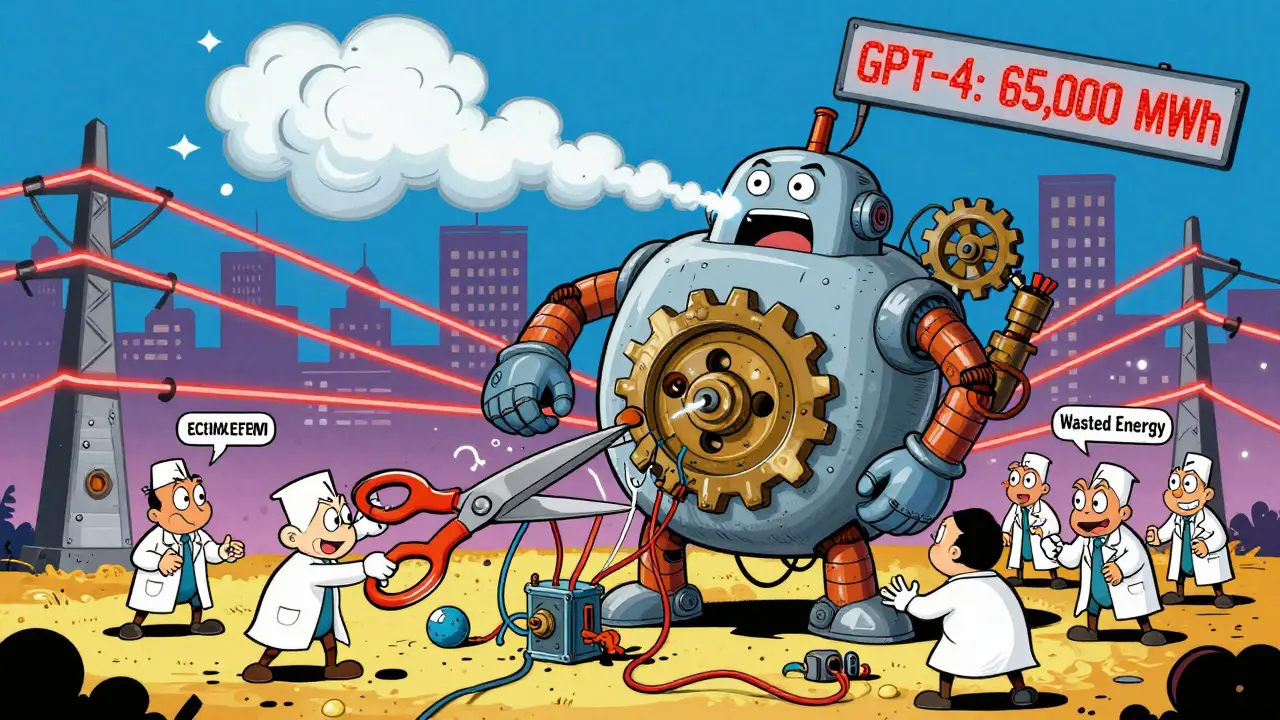
Training a single large generative AI model today can use more electricity than some small countries. GPT-3 burned through 1,300 megawatt-hours. GPT-4? Around 65,000. That’s not just expensive-it’s unsustainable. And it’s not just about the bill. Every kilowatt-hour used in training contributes to carbon emissions, water usage for cooling, and strain on power grids. The question isn’t whether we can keep scaling models up-it’s whether we can scale them efficiently.
Why Energy Matters More Than You Think
Most people think of AI training as a math problem. It’s not. It’s an energy problem. MIT researchers found that nearly half the electricity used to train an AI model goes into squeezing out the last 2 or 3% of accuracy. That’s waste. Pure and simple. And it’s happening at scale. Every company racing to build the next big language model is running a power-hungry machine in the background. The World Economic Forum says AI’s computational demands are doubling every 100 days. If nothing changes, data centers could be responsible for 1.2% of global carbon emissions by 2027. That’s more than aviation.Sparsity: Making Models Leaner by Default
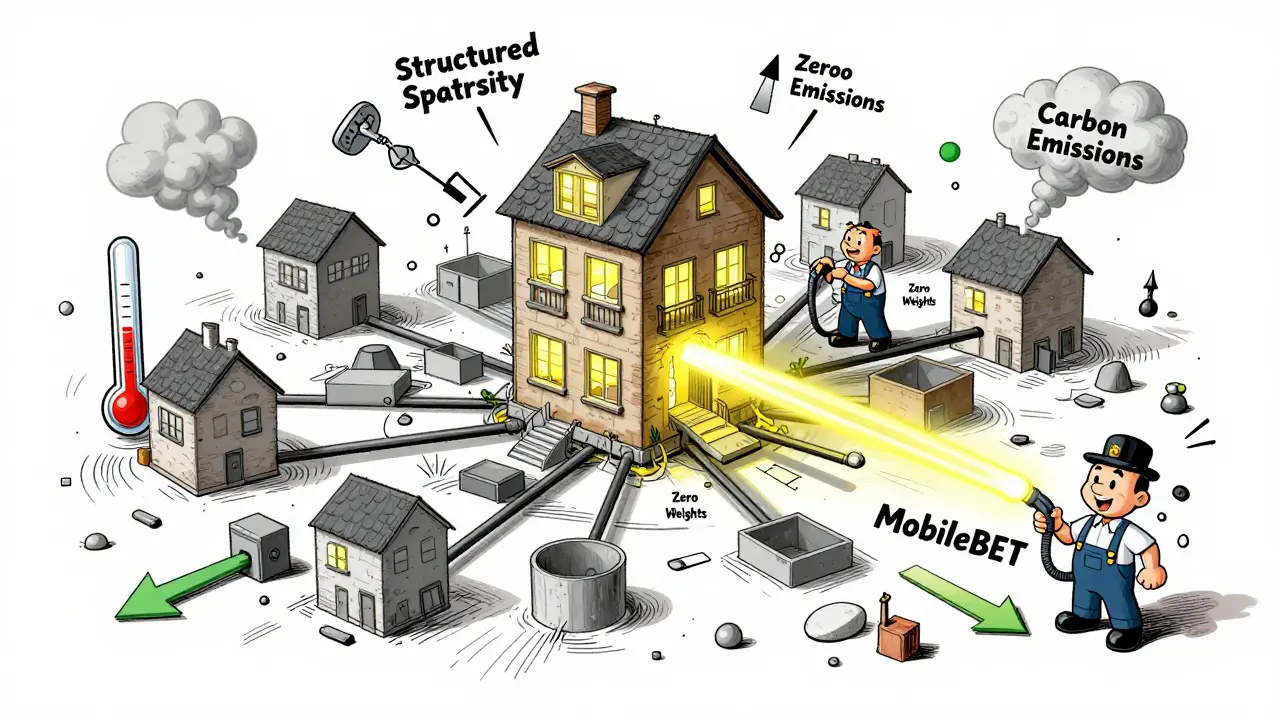
Sparsity means removing unnecessary parts of a neural network-specifically, turning weights into zeros. Think of it like deleting unused rooms in a house. You still have the same structure, but it’s lighter, cheaper to maintain, and uses less power. There are two types: unstructured and structured. Unstructured sparsity zeroes out individual weights randomly across the network. It can hit 80-90% sparsity, meaning nearly all weights are gone. Sounds great, right? But most hardware can’t take advantage of that. A GPU still has to check every zero, which wastes time. Structured sparsity is smarter. It removes entire blocks-whole channels, filters, or neurons. You might lose 50-70% of weights, but now the hardware can skip entire calculations. MobileBERT, for example, cut its parameters from 110 million to 25 million and kept 97% of its accuracy on real-world tasks. That’s not a trick. That’s engineering.Pruning: Cutting the Fat During Training
Pruning is like trimming a tree while it’s still growing. Instead of waiting until the model is fully trained, you remove the weakest connections during training itself. There are three main ways:- Magnitude-based pruning: Cut the smallest weights. Simple, effective. University of Michigan showed this cut GPT-2 training energy by 42% with just a 0.8% accuracy drop.
- Movement pruning: Watch how weights change during training and remove those that don’t move much. More dynamic, less guesswork.
- Lottery ticket hypothesis: Find a small subnetwork within the big model that can learn just as well on its own. Train that instead.
Low-Rank Methods: Reducing Matrix Size, Not Just Numbers
Neural networks are built on matrices-huge grids of numbers. Low-rank methods break those big matrices into smaller ones that multiply together to approximate the original. Think of it like compressing a high-res photo into a smaller file that still looks good. Techniques like Singular Value Decomposition (SVD) and LoRA (Low-Rank Adaptation) are now standard in fine-tuning. NVIDIA’s NeMo framework used LoRA on BERT-base and cut training energy from 187 kWh to 118 kWh-37% less-while keeping 99.2% of accuracy on question-answering tasks. That’s not a rounding error. That’s a game-changer for companies running hundreds of fine-tuning jobs per month. These methods work best when you’re adapting a pre-trained model, not training from scratch. You keep the heavy base model frozen and only train tiny, low-rank matrices on top. It’s like upgrading your car’s engine without rebuilding the whole chassis.How These Methods Compare to Other Approaches
There are other ways to save energy-mixed precision training, early stopping, model distillation. But they have limits. Mixed precision cuts energy by 15-20% by using lower-precision numbers. Helpful, but you need special hardware. Early stopping saves 20-30% by stopping training before full convergence. Risky-you might miss the sweet spot. Distillation creates smaller models from larger ones. Great if you’re starting fresh. Useless if you’ve already trained a 70-billion-parameter model and need to make it run faster. Sparsity, pruning, and low-rank methods win because they work on existing models. You don’t have to start over. You don’t need new chips. You just need to apply the right technique. IBM’s analysis showed that combining structured pruning with LoRA saved 63% on Llama-2-7B training. Mixed precision alone? Only 42%. That’s a 21% gap. That’s a competitive edge.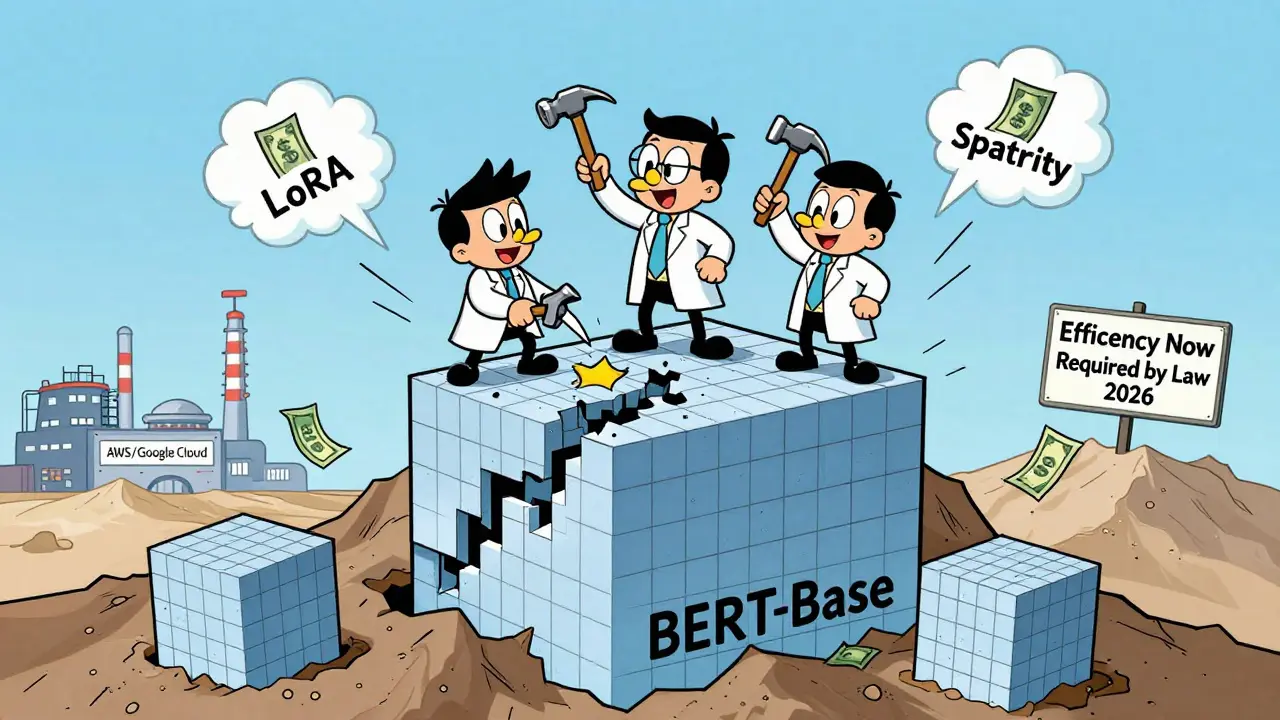
Implementation: It’s Not Easy, But It’s Worth It
These aren’t plug-and-play tools. They require work. Most teams need 2-4 weeks to get comfortable. The TensorFlow Model Optimization Toolkit gives a 5-step guide:- Train your baseline model.
- Configure sparsity or pruning settings.
- Apply it gradually during fine-tuning.
- Check accuracy on validation data.
- Optimize for deployment.
The Future Is Already Here
This isn’t science fiction. It’s happening now. NVIDIA’s new Blackwell Ultra chips, coming in late 2025, will have hardware that accelerates pruning during training. Google’s TPU v5p, launching in Q2 2025, will auto-configure sparsity. PyTorch 2.4, expected March 2025, will let you combine pruning, sparsity, and low-rank methods in one workflow. Regulations are catching up. The EU’s AI Act will require energy logging for large models by mid-2026. AWS and Google Cloud now offer built-in efficiency tools in their AI platforms. Startups like Neural Magic are raising millions just to optimize sparsity. Gartner predicts 90% of enterprise AI deployments will use at least one compression technique by 2027. That’s not a guess. That’s inevitability.What You Should Do Now
If you’re training generative AI models-whether you’re a startup or a Fortune 500-here’s your action plan:- Start with structured sparsity. It’s the easiest to implement and gives the biggest hardware gains.
- Use LoRA for fine-tuning. It’s low-risk and high-reward.
- Apply pruning gradually. Don’t go all-in on day one.
- Measure energy use. Track kWh per training run. Make it part of your KPIs.
- Combine techniques. Sparsity + pruning + LoRA isn’t overkill-it’s the new baseline.
What’s the difference between sparsity and pruning?
Sparsity refers to the state of having many zero weights in a model-like empty spaces in a grid. Pruning is the process of creating that sparsity by removing weights during or after training. Think of sparsity as the result, and pruning as the method to get there.
Can I use these techniques on any AI model?
Yes, but they work best on large transformer-based models like GPT, BERT, or Llama. They’re less effective on small, simple networks. The bigger the model, the more energy you save. Most frameworks now support them out of the box for popular architectures.
How much accuracy do I lose when I prune a model?
Typically, 0.5% to 2% for moderate pruning (50-70% sparsity). Beyond 80%, accuracy drops sharply. The key is gradual application. Start small, monitor performance, and stop before quality degrades. Most teams find a sweet spot at 60-70% sparsity with near-identical results.
Do I need special hardware to use these methods?
No. You can apply sparsity and pruning on standard GPUs. But you’ll get better speedups on newer hardware like NVIDIA’s A100 or H100, which are optimized for sparse computations. Low-rank methods work on any hardware-they’re purely mathematical.
Are these methods used in production today?
Yes. Companies like NVIDIA, Meta, and Google use them internally. Startups like Neural Magic sell tools built on these techniques. Cloud providers like AWS and Google Cloud now offer them as built-in features. If you’re training large models in 2025 without using these methods, you’re paying more than you need to.
What’s the biggest mistake people make when trying these techniques?
Trying to prune too much, too fast. People see a 50% energy savings and think, “Let’s go to 90%.” That’s how you kill accuracy. The best results come from slow, controlled pruning-increasing sparsity in stages while monitoring performance. Patience beats speed here.
Next steps: Pick one model you’re training. Apply structured sparsity at 30%. Run a test. Measure the energy use. Compare it to your baseline. If you save even 20%, you’ve already won.



Sparsity is the real MVP here. I ran a fine-tune last week with 60% structured pruning and cut my GPU hours in half. Accuracy? Barely budged. Why are people still training full models like it's 2020?
One must, with the utmost seriousness and academic rigor, acknowledge that the energy expenditure of contemporary AI training constitutes a moral imperative for recalibration. The pursuit of marginal accuracy gains at the expense of planetary equilibrium is not merely inefficient-it is ethically indefensible. One must, therefore, recalibrate one's priorities with the solemnity of a monk in a carbon-neutral monastery.
Broooooo! I tried LoRA on my local BERT and my电费 bill dropped like it jumped off a cliff! Like 40% less power and still got 98% accuracy?? My laptop stopped sounding like a jet engine and started whispering sweet nothings to me. India needs this NOW. No more burning coal for AI dreams!
Structured sparsity works. LoRA is efficient. Pruning gradually prevents collapse. Track kWh. Combine methods. These are not suggestions. They are baseline requirements for responsible development.
So let me get this straight-we’re spending $2,850 per GPT-2 training run and people are still arguing about whether to prune? I mean, if your startup’s biggest problem is that your GPU bill is too high, you’re doing something right. Also, I just used a 70% pruned model to write my ex a breakup text. She replied ‘wow’ and sent me a meme. Efficiency wins.
It is, of course, profoundly ironic-nay, tragically poetic-that we have engineered machines capable of approximating human thought, yet we lack the collective wisdom to temper their voracious appetite for energy. We build gods in silicon, then feed them with the fossilized remains of ancient forests. Are we not, then, both priest and sacrilege?
You people are still using PyTorch? If you're not training on a TPU with built-in sparsity and automatic LoRA, you're just wasting electricity and your own time. Stop pretending you're a data scientist and start acting like you know what you're doing.
Sparsity? Pruning? Please. The real efficiency hack is just not training models at all. Why are we even doing this? Who asked for another chatbot that writes poems about clouds? We don't need smarter AI. We need less of it.
Wow. You all sound like you're trying to make AI green so you can feel better about running 20 models a day to generate cat memes in 17 languages. Meanwhile, your data center is in a country with no carbon regulations and your ‘efficient’ model still uses more power than a village. You’re not saving the planet. You’re just making your ego feel less guilty.