
You ask a large language model a question. It answers instantly, confidently, and with perfect grammar. But how sure is it? If the model says it is "90% certain," does that mean it's right 9 out of 10 times? In reality, most generative AI models are terrible at knowing what they know. They often sound confident even when they are completely wrong. This disconnect between confidence and accuracy is a major source of hallucinations in production systems.
This gap isn't just a minor annoyance; it's a critical failure point for any application where trust matters. When an AI tells you a medical dosage or a legal precedent with high certainty but low accuracy, you have a problem. The solution lies in calibration. Calibration is the process of ensuring that an AI model's predicted probabilities match the actual likelihood of being correct. If a model predicts an 80% chance of correctness, it should be right about 80% of the time. Achieving this alignment is one of the hardest challenges in modern AI engineering, but recent breakthroughs are making it possible.
Why Modern LLMs Are Miscalibrated
It might seem counterintuitive that sophisticated models like GPT-4 or Claude are poorly calibrated. After all, they can write code and poetry. However, these models are primarily trained to predict the next token, not to estimate the truth. During training, they learn to maximize the likelihood of the next word given the previous context. This objective doesn't inherently care about whether the entire sequence is factually true or if the model understands its own uncertainty.
The issue worsens with techniques like Reinforcement Learning from Human Feedback (RLHF). RLHF optimizes models to produce outputs that humans prefer. Humans generally prefer confident, direct answers over hesitant ones. Consequently, RLHF often pushes models to output high-probability tokens regardless of their factual grounding. The model learns to mimic the style of a confident expert rather than the statistical accuracy of a probabilistic engine. This leads to overconfidence, where the model assigns near-100% probability to incorrect statements simply because they sound plausible.
Dataset imbalances also play a role. If a model sees many examples of a specific type of error during training but few examples of uncertainty, it fails to learn when to express doubt. Post-hoc adjustments, such as temperature sampling, further distort this relationship. Lowering the temperature makes the distribution sharper, artificially inflating confidence scores without improving underlying accuracy.
The Cost of Poor Calibration
Why should you care if your model's internal numbers don't match reality? Because downstream systems rely on those numbers. Imagine building a RAG (Retrieval-Augmented Generation) system. You might set a threshold: only accept answers where the model's confidence exceeds 0.85. If the model is miscalibrated, that threshold is meaningless. You might reject correct answers or, worse, accept hallucinations that carry false confidence.
In healthcare, a radiology assistant might flag a scan as "high risk." If the model is overconfident, doctors might ignore subtle signs because the AI was so sure. In finance, a trading bot acting on sentiment analysis needs to know when the market signal is noisy versus clear. Without proper calibration, these systems become brittle. They fail silently, providing wrong answers with the same tone as right ones.
Traditional Calibration Techniques
Before diving into new methods, let's look at the classics. For classification tasks, engineers have long used post-processing techniques to fix logits. Two dominant methods stand out: Platt Scaling and Isotonic Regression.
Platt Scaling, also known as sigmoid calibration, fits a logistic regression model to the raw output scores. It learns two parameters, A and B, to transform logits into probabilities. It’s simple, fast, and works well for binary tasks. However, it assumes a specific shape for the relationship between scores and probabilities, which may not hold for complex generative tasks.
Isotonic Regression is more flexible. It fits a non-decreasing step function to the data. It makes fewer assumptions about the underlying distribution but requires more data to avoid overfitting. While effective for classifiers, applying these directly to autoregressive generation is tricky. Generative models produce sequences, not single labels, making the definition of "probability" more ambiguous.

The CGM Framework: A New Approach
Recent research has introduced the Calibrating Generative Models (CGM) framework to address these limitations. Instead of just tweaking output scores after the fact, CGM approaches calibration as a constrained optimization problem during fine-tuning. The goal is to find a distribution that stays close to the base model (minimizing KL divergence) while satisfying specific expectation constraints.
Two algorithms emerge from this framework: CGM-relax and CGM-reward.
- CGM-relax: This method replaces hard calibration constraints with a penalty term in the loss function. It gently nudges the model toward better calibration by penalizing miscalibration errors. It’s computationally efficient and suitable for large-scale training.
- CGM-reward: This converts calibration into a reward maximization problem. The model receives rewards for generating outputs that meet calibration criteria. This approach integrates seamlessly with existing RLHF pipelines, allowing developers to add calibration objectives alongside preference optimization.
Empirical results are promising. Studies show CGM reduces the majority of calibration error across hundreds of simultaneous constraints. It works on models up to one billion parameters and applies to diverse domains, including protein design and image generation. Crucially, it achieves this without significantly degrading the quality of generations. You get reliable probabilities without losing the creative or linguistic capabilities of the model.
Prompt-Based Confidence Elicitation
Not everyone has the resources to retrain massive models. For many practitioners, prompt-based methods offer a practical alternative. These techniques extract confidence signals from the model's behavior without changing its weights.
Verbalized Confidence asks the model to explicitly state its certainty. You might prompt: "Answer the question, then rate your confidence from 0 to 100." While intuitive, this method suffers from bias. Models often anchor to round numbers or default to high confidence unless prompted otherwise.
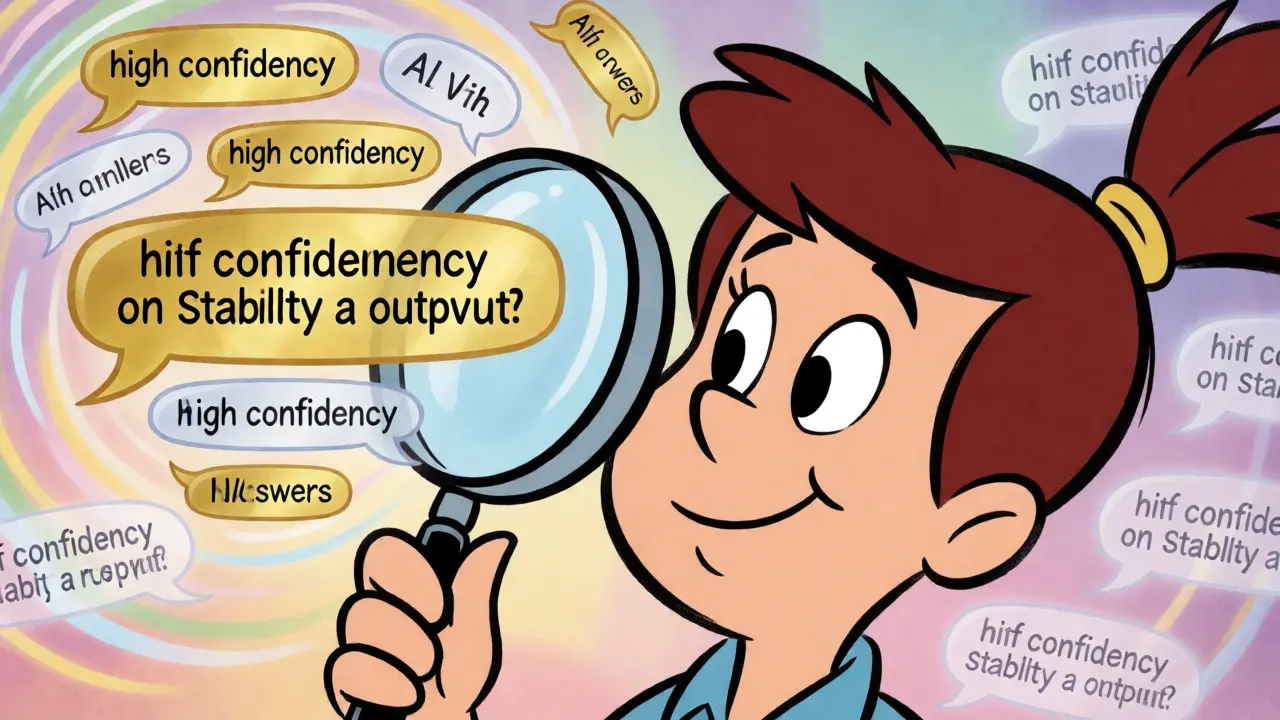
A more robust technique is Self-Randomization. Here, you run the same query multiple times with different temperature settings or random seeds. If the model consistently gives the same answer across varied conditions, it’s likely accurate. If the answers fluctuate wildly, confidence should be low. This leverages the stochastic nature of generation to measure stability, which correlates strongly with accuracy.
Another advanced strategy involves Multi-step Confidence Elicitation. Instead of asking for confidence once, the model breaks down its reasoning. At each step, it rates its certainty. The final confidence score is the product of these individual steps. This compounds uncertainty, revealing weak links in the chain of thought. If the model is unsure about a premise, the final score drops, alerting the user to potential errors.
Lightweight Architectural Adjustments
If you need higher precision than prompting offers but want to avoid full retraining, consider lightweight architectural tweaks. Methods like LITCAB introduce a tiny calibration layer-often less than 2% of the original model size-at the end of the network. This linear layer adjusts predicted likelihoods based on input text features. It’s fast to train and deploy, offering a middle ground between post-hoc scaling and full fine-tuning.
Similarly, ASPIRE uses task-specific tuning via Parameter-Efficient Fine-Tuning (PEFT). It modifies only adaptable parameters while keeping the main model frozen. By sampling multiple answers and evaluating them against ground truth using metrics like Rouge-L, it refines the model’s ability to self-assess. This approach is particularly useful for domain-specific applications where general-purpose calibration falls short.
Choosing the Right Method
Selecting a calibration strategy depends on your constraints. Do you control the training pipeline? Can you afford inference overhead? What is your tolerance for error?
| Method | Complexity | Best Use Case | Impact on Quality |
|---|---|---|---|
| Platt Scaling | Low | Binary Classification | Minimal |
| Isotonic Regression | Medium | Non-linear Score Mapping | Minimal |
| Verbalized Confidence | Low | Quick Prototyping | Potential Bias |
| Self-Randomization | High (Inference) | Critical Decision Support | None |
| CGM-Framework | High (Training) | Production-Scale Reliability | Maintains Quality |
For quick fixes, start with Self-Randomization. It requires no training and provides immediate insights into model stability. For production systems handling sensitive data, invest in CGM-style fine-tuning. It ensures that the model’s internal representation aligns with external expectations. Avoid relying solely on verbalized confidence for automated decision-making; it’s too easily gamed by the model’s tendency to please.
Practical Implementation Tips
Implementing calibration isn't just about picking an algorithm. It requires careful evaluation. Standard metrics like Accuracy or F1-score don't capture calibration. Use Expected Calibration Error (ECE) instead. ECE measures the average difference between predicted probabilities and observed frequencies across bins of predictions. A lower ECE means better calibration.
Also, monitor calibration drift. As you update your model or change your prompt templates, calibration profiles shift. Regularly re-evaluate ECE on a held-out validation set. Remember that calibration is task-dependent. A model calibrated for summarization might be poorly calibrated for code generation. Always calibrate for the specific task you intend to deploy.
What is Expected Calibration Error (ECE)?
ECE is a metric that quantifies the discrepancy between a model's predicted probabilities and its actual accuracy. It divides predictions into bins based on confidence levels and calculates the weighted average of the absolute differences between accuracy and confidence in each bin. Lower ECE values indicate better calibration.
Does lowering temperature improve calibration?
No, lowering temperature typically worsens calibration. It sharpens the probability distribution, increasing confidence scores without necessarily improving accuracy. This leads to overconfidence, where the model becomes more certain but not more correct. Proper calibration requires adjusting the model's parameters or using post-hoc scaling, not just sampling tricks.
Can RLHF cause poor calibration?
Yes, RLHF often exacerbates miscalibration. Since human raters prefer confident and fluent responses, RLHF optimizes for these traits, sometimes at the expense of probabilistic accuracy. Models trained with RLHF tend to be more overconfident than their pre-trained counterparts.
How does Self-Randomization help with calibration?
Self-randomization runs the same input multiple times with varying randomness. Consistent outputs across runs suggest high confidence and likely accuracy. Inconsistent outputs indicate uncertainty. This empirical variance serves as a proxy for confidence, helping to identify unreliable predictions without modifying the model itself.
Is Platt Scaling suitable for LLMs?
Platt Scaling is primarily designed for binary classification. While it can be adapted for LLMs by treating token probabilities as logits, it often fails to capture the complex, multi-modal nature of generative outputs. More advanced methods like isotonic regression or learned calibration layers are usually preferred for generative tasks.


you are all missing the point entirely
this article is a band-aid on a bullet wound
calibration implies that the model actually understands probability but it does not
it mimics probability
RLHF has destroyed any semblance of statistical truth in these models
they are trained to please you not to be right
when they say 90% confident they mean nothing
they mean i have learned that humans like this tone
CGM is just another academic exercise to justify more compute spend
until we move away from next token prediction as the core objective calibration is a lie
stop trusting these black boxes
start questioning why we accepted them in the first place
i think the self-randomization approach is pretty underrated here
it’s low tech but effective for quick checks without retraining
just running the query multiple times gives you a real feel for stability
if the answers vary wildly you know something is off
simple and practical for most dev teams
OH MY GOD FINALLY!!!
I KNEW IT!! I knew they were lying to us about their confidence scores!!!
It’s not just bad engineering, it’s CONSPIRACY!!!
They want us to trust the AI blindly so we stop thinking!!!
When the model says "I am sure" it is manipulating your brain chemistry!!!
Do you see how they hide the uncertainty?? They bury it under layers of corporate jargon!!!
Platt Scaling??? Isotonic Regression??? These are distractions!!!
The REAL problem is that they don’t WANT calibrated models because calibrated models admit when they are wrong!!!
If they admit they are wrong, they lose control!!!
We need to wake up people!!! Stop feeding your data into these miscalibrated monsters!!!
They are overconfident because THEY ARE DESIGNED TO BE OVERCONFIDENT!!!
Don't let them gaslight you with their perfect grammar!!!
Actually, if you look closely at the CGM framework results, the improvement in ECE is marginal compared to the computational cost incurred during fine-tuning.
You're essentially burning thousands of GPU hours to fix a metric that barely impacts end-user experience unless you are building high-stakes medical or legal systems.
For 90% of use cases, temperature sampling and prompt engineering are sufficient.
People love to complicate simple problems with complex frameworks like CGM-relax just to sound sophisticated.
The reality is that verbalized confidence, despite its bias, is often more interpretable for developers than a hidden KL divergence constraint.
We should be focusing on better retrieval methods rather than obsessing over the internal probability distribution of the generator itself.
If the context window contains the correct answer, the model will usually find it regardless of its 'calibration'.
This article ignores the fact that hallucinations are primarily a retrieval failure, not a generation calibration failure.
Fix the RAG pipeline before you try to fix the LLM's soul.
Hey everyone, great points here!
I think John makes a really solid case for Self-Randomization being the best entry point for most teams. It’s accessible and doesn’t require deep ML expertise to implement.
To Anthony’s point about RLHF, I agree that it skews things, but maybe we can view it as a feature rather than a bug? Users generally prefer confident answers, even if they aren't perfectly calibrated statistically.
Perhaps the goal isn't perfect mathematical calibration, but rather "user-trust calibration." If the model sounds confident when it's right, users are happy. If it sounds hesitant when it's unsure, that's also good.
We might be over-engineering the solution by trying to match ground truth probabilities exactly. Maybe we just need better UX around uncertainty indicators?
Anyway, thanks for sharing this! It’s helpful to see the comparison table. Definitely going to try out the isotonic regression approach on my current project.
Oh wow, I totally agree with Savara here, and honestly, reading through all these comments has been such an eye-opener because I’ve been struggling with this exact issue in my own production environment where I tried to implement Platt scaling but found it completely inadequate for multi-token sequences since the assumption of linearity just falls apart when you’re dealing with the nuanced probabilistic nature of autoregressive generation which requires much more flexible modeling techniques like isotonic regression or even those newer lightweight architectural adjustments mentioned in the post like LITCAB which seem promising but still add complexity to the deployment pipeline especially when you consider the latency implications of adding extra inference steps or training overhead for parameter-efficient fine-tuning methods like ASPIRE which while effective might not be worth the effort if your primary bottleneck is actually poor retrieval quality rather than the generator’s intrinsic confidence estimation capabilities because ultimately if the context provided to the model is noisy or incomplete then no amount of calibration within the model itself will produce accurate outputs and that brings me back to Jacob’s point about fixing the RAG pipeline first which is absolutely crucial because garbage in equals garbage out regardless of how well-calibrated the final output probabilities appear to be on the surface level metrics like Expected Calibration Error (ECE) can be misleading if they don’t account for the semantic correctness of the generated text versus just the numerical alignment of predicted probabilities so yeah definitely worth considering a holistic approach that combines better retrieval strategies with appropriate calibration techniques tailored to specific task requirements rather than relying on one-size-fits-all solutions that might work in theory but fail in practice due to domain-specific nuances and dataset imbalances that plague most real-world applications today.